
Most digital ads today are bought and sold by machines, not people. That process is called programmatic advertising, and it has become the backbone of online marketing. According to Statista, global programmatic ad spend reached an estimated $595 billion in 2024, and the market continues to expand. If you run a crypto project, a DeFi protocol, or a Web3 publisher and you are not using programmatic advertising yet, you are likely leaving reach and revenue on the table.
This guide covers the full picture: how the system works, what each component does, how auctions run in milliseconds, and what matters when you are choosing a platform. It is written for advertisers and publishers who want a clear, practical understanding, not a textbook full of jargon.
| What This Guide Covers |
| 1. What Is Programmatic Advertising? |
| 2. Core Components: DSPs, SSPs, and Ad Exchanges |
| 3. How Real-Time Bidding Works |
| 4. Ad Exchanges vs Ad Networks |
| 5. The Role of Ad Servers |
| 6. Programmatic Buying Models |
| 7. Why It Matters for Crypto and Web3 |
| 8. Common Programmatic Ad Formats |
| 9. Data Privacy and Targeting |
| 10. What to Look for in a Platform |
| 11. FAQ |
What Is Programmatic Advertising?
Programmatic advertising is the automated buying and selling of digital ad space. See the benefits of programmatic advertising to understand why this model dominates modern digital marketing. Instead of negotiating directly with a publisher’s sales team, advertisers set targeting rules and budgets inside a software platform. The system then finds the right audience, places the bid, and delivers the ad, all without human involvement in each individual transaction.
Before programmatic existed, buying ads meant lengthy back-and-forth negotiations, fixed pricing, and slow campaign launches. If you want a clearer breakdown of the differences, see programmatic vs direct advertising. Programmatic changed all of that. Deals happen in milliseconds. Budgets can be adjusted in real time. And targeting is based on data signals rather than assumed audience profiles.
Today, programmatic buying accounts for 88% of all digital ad impressions globally, according to Persistence Market Research. Consequently, it has become the default mode for digital advertising, from mainstream brands to niche crypto communities. Therefore, understanding how it works is essential for any team running paid media at scale.
Core Components: DSPs, SSPs, and Ad Exchanges
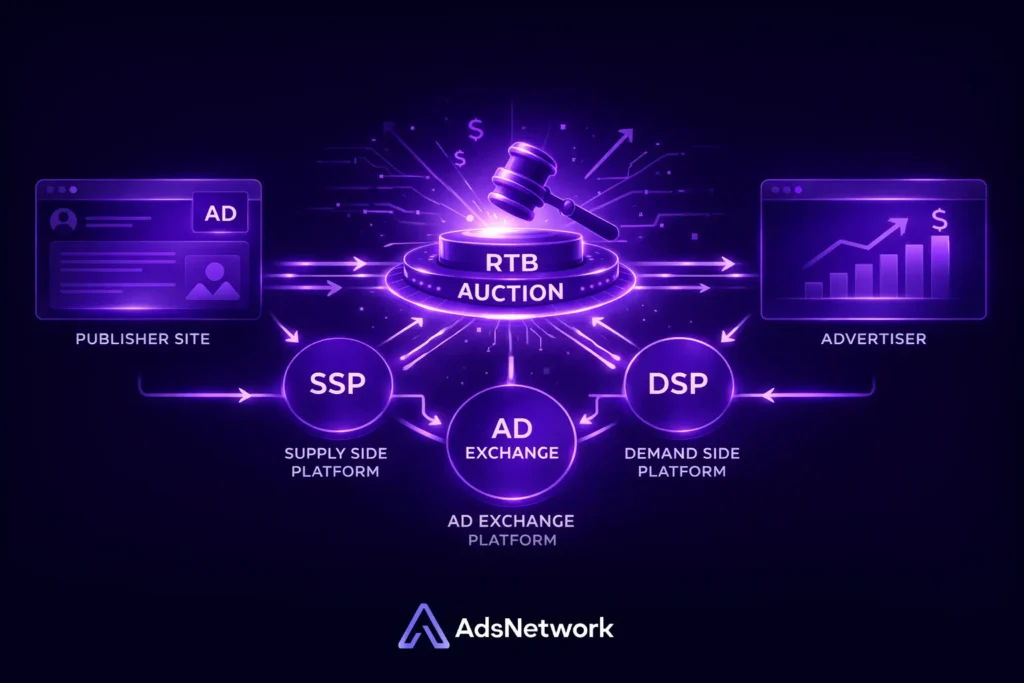
Three main pieces of infrastructure power the programmatic ecosystem. Understanding each one makes the whole system easier to follow. For a detailed comparison of how the buyer and seller sides work together, see our guide to DSP vs SSP.
Demand-Side Platforms (DSPs)
A DSP is the tool advertisers use. It lets you set targeting parameters, define your budget, and bid on ad impressions across thousands of sites and apps from a single interface. The DSP connects to multiple ad exchanges and uses algorithms to decide which impressions are worth bidding on and how much to pay.
For Web3 projects, some DSPs go further. Specifically, they support wallet-based targeting, allowing advertisers to reach users based on on-chain activity such as recent NFT purchases or DeFi protocol interactions. That level of specificity is simply not available on mainstream platforms.
Supply-Side Platforms (SSPs)
An SSP is the publisher’s counterpart. Publishers, such as crypto news sites, Web3 communities, and blockchain-focused apps, connect their ad inventory to an SSP. The SSP then puts that inventory up for auction and helps maximize revenue by exposing it to as many potential buyers as possible.
Modern SSPs increasingly use header bidding instead of the older waterfall model. With header bidding, multiple buyers compete simultaneously for each impression rather than sequentially. As a result, publishers typically earn more revenue per impression, and advertisers gain better access to quality inventory at competitive prices.
Ad Exchanges
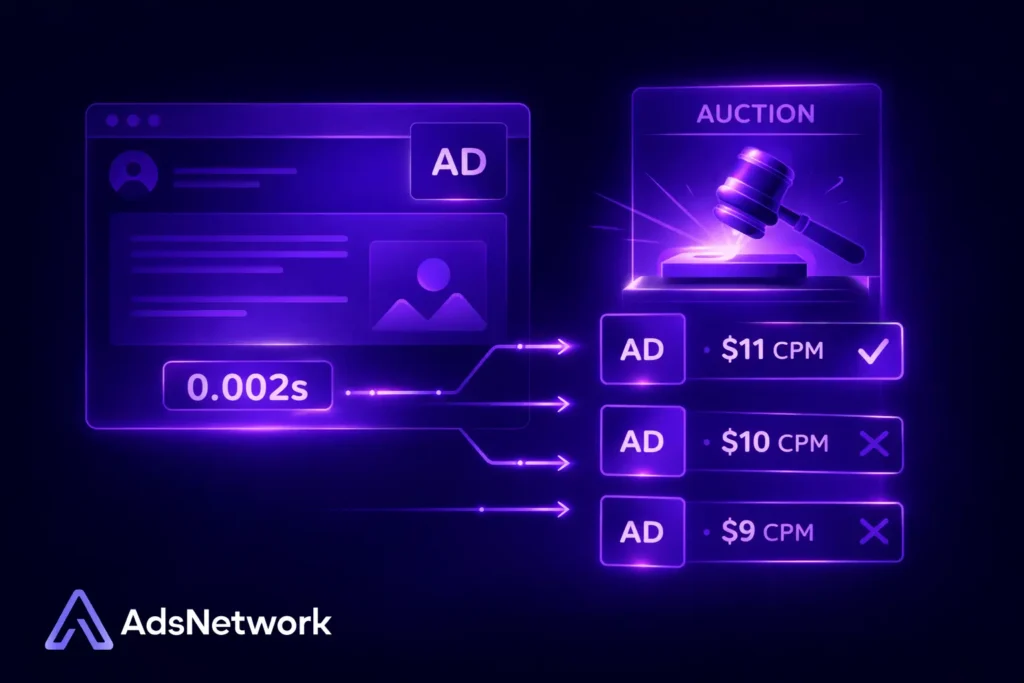
The ad exchange is the marketplace where DSPs and SSPs meet. When a publisher’s SSP signals that an ad slot is available, the exchange runs an auction among competing DSPs in real time. The highest bidder wins, and their ad appears on the page. Understanding the distinction between ad exchanges and ad networks matters for campaign planning. See our full breakdown of the ad exchange vs ad network difference for more detail.
How Real-Time Bidding Works
The most common way to buy programmatic inventory is through real-time bidding (RTB). Here is what happens the moment a user loads a webpage.
- The publisher’s SSP detects an available ad slot and sends a bid request to an ad exchange.
- Connected DSPs receive the request, including data about the user and the placement context.
- Each DSP evaluates the impression against its targeting rules and places a bid if there is a match.
- Whoever bids highest wins the auction, and their ad is served instantly to the user.
Bidding algorithms complete this sequence in under 100 milliseconds, before the page finishes loading. RTB held a 42% market share across programmatic buying models in 2024, according to SNS Insider. For a deep dive into how the auction mechanics work, see our guide to real-time bidding explained, and for the role ad exchanges specifically play in the auction, read our guide on how real-time bidding works in ad exchanges.
To summarize the RTB flow: the SSP sends a bid request, DSPs evaluate and respond, the highest bid wins, and the ad is served. The exchange forwards all bids simultaneously rather than sequentially, which is what makes the entire process so fast.
Ad Exchanges vs Ad Networks
These two terms are often confused, but they serve different functions. An ad network aggregates inventory from multiple publishers and packages it for advertisers, usually at a fixed or negotiated CPM. An ad exchange is a real-time marketplace where inventory is bought and sold through live auctions between DSPs and SSPs.
The practical difference is flexibility and transparency. Specifically, ad exchanges give advertisers more control over which impressions they bid on and what they pay, while ad networks offer simplicity and curation. For a detailed side-by-side comparison, see our guide to the ad exchange vs ad network difference. In practice, most programmatic campaigns combine both, using exchanges for open auction buying and networks for curated inventory access.
The Role of Ad Servers
Ad servers are the infrastructure that actually delivers ads to users once a bidding decision has been made. Specifically, they store creative assets, track impressions and clicks, enforce frequency caps, and provide the reporting data that advertisers and publishers use to measure campaign performance.
Both advertisers and publishers operate their own ad servers. The advertiser’s ad server manages campaign delivery, creative trafficking, and attribution tracking. The publisher’s ad server manages which ads fill which placements and in what order. For a full explanation of how ad servers fit into the programmatic stack, see our guide to the role of ad servers in digital advertising.
Programmatic Buying Models
Beyond open RTB auctions, programmatic advertising supports several buying models. Each suits different campaign goals and inventory types.
Open RTB
The open auction is the default model. Any DSP can compete for any impression that enters the exchange. Open RTB provides the widest inventory access and the most competitive pricing, making it the best starting point for most campaigns. However, brand safety controls are important here because open auction inventory is less curated.
Private Marketplaces (PMPs)
Private marketplaces are invite-only auctions where publishers offer premium inventory to a select group of advertisers before it enters the open auction. PMPs give advertisers access to high-quality, brand-safe placements while maintaining the efficiency of programmatic buying. For crypto campaigns specifically, PMPs on reputable blockchain media sites provide both audience quality and editorial credibility.
Programmatic Guaranteed
Programmatic guaranteed is a direct deal between advertiser and publisher, executed through programmatic technology, with fixed pricing and guaranteed impression volume. It combines the precision of direct buying with the operational efficiency of programmatic execution. This model is useful for high-budget campaigns where predictable delivery is more important than auction efficiency.
Why Programmatic Advertising Matters for Crypto and Web3 Projects
Crypto and Web3 marketing has a targeting problem. Your audience is global, technically sophisticated, and spread across thousands of forums, communities, and niche publications. Traditional media buying cannot reach them efficiently. Programmatic advertising can, and it does so at a scale that manual campaigns cannot match.
Precision Targeting at Scale
Programmatic systems target users based on behavior, geography, device type, and context. For blockchain projects, advanced platforms add wallet-based signals, so you can reach users who have recently interacted with competing protocols or bought assets in your category. That level of precision is simply not available in traditional direct buys.
Real-Time Optimization
Campaign data flows in continuously. Consequently, if one creative is underperforming, you can pause it and shift budget to better-performing variants without renegotiating a deal. This matters especially in crypto, where market conditions can shift within hours and a campaign running on stale targeting wastes significant budget.
A Real-World Example
Consider a mid-size DeFi lending protocol looking to grow its depositor base. The team had tried social media campaigns but struggled to reach high-intent users. By switching to a crypto-focused programmatic setup, they could target users who had recently visited staking platforms, interacted with competing protocols on-chain, or read yield farming content across publisher networks. The DSP optimized bids around cost-per-wallet-connect rather than cost-per-click, tracking actual protocol engagement rather than just traffic. Platforms built for Web3 audiences, including AdsNetwork, give projects access to crypto-native inventory with built-in targeting for blockchain users.
Common Programmatic Ad Formats
Programmatic advertising supports a wide range of formats. The right choice depends on your campaign goal.
- Display banners: standard image ads shown across publisher sites. Good for brand awareness and retargeting.
- Native ads: ads that match the look and feel of surrounding content. Higher engagement and lower friction for audiences unfamiliar with your project.
- Video ads: pre-roll and mid-roll video placements. Strong for storytelling, token launch announcements, and protocol explainers.
- Mobile interstitials: full-screen ads served in mobile apps. Mobile ads now account for over 63% of total programmatic impressions, per Persistence Market Research.
- In-page push: notification-style ads delivered within web pages, no opt-in required.
Programmatic Advertising and Data Privacy
Privacy regulation is reshaping how programmatic works. GDPR in Europe and CCPA in the United States have tightened rules on third-party data use. The industry is actively moving toward first-party data strategies and contextual targeting, where ads are matched to content rather than individual user profiles. For a deeper look at where things are heading, see programmatic advertising trends.
For Web3 advertisers, this shift creates an opportunity. On-chain data and wallet activity are disclosed voluntarily and owned by the user. Platforms that build targeting around these consent-native signals are ahead of the regulatory curve. Furthermore, contextual placements on crypto-specific publishers also sidestep many privacy concerns entirely, since targeting is based on content relevance rather than personal tracking.
For publishers running crypto content, see our guide to the best CPM ad networks for publishers to understand how programmatic inventory connects to publisher monetization.
What to Look for When Choosing a Programmatic Platform
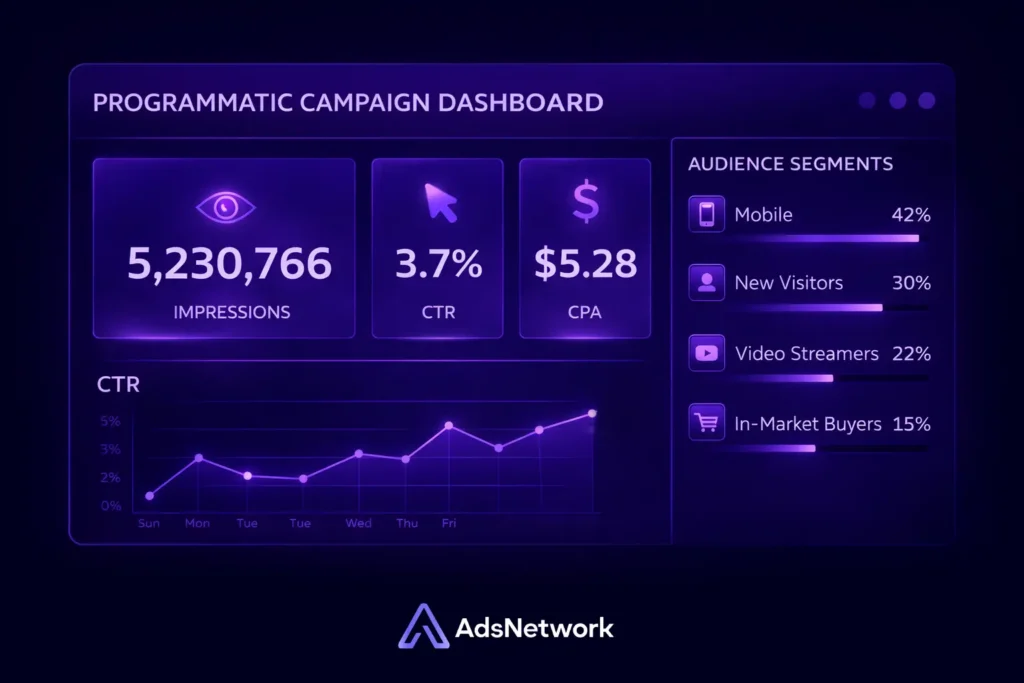
Not all DSPs are built for Web3. When evaluating platforms, prioritize these factors.
- Crypto and blockchain inventory access: can the platform reach users on crypto news sites, DeFi dashboards, and Web3 communities?
- Audience targeting depth: look for behavioral targeting, wallet-based segmentation, and contextual options.
- Transparency: does the platform show where ads ran, what they cost, and how they performed at the impression level?
- Fraud prevention: choose platforms with built-in invalid traffic detection and third-party verification.
- Support for multiple buying models: open RTB is a starting point, but access to PMPs and programmatic guaranteed gives you more control as campaigns mature.
For a broader look at paid media options including programmatic and direct crypto placements, see our comparison of the best crypto ad networks for Web3 advertisers.
Programmatic Advertising: The Default for a Reason
Programmatic advertising is not a niche technical detail. It is the infrastructure behind most digital campaigns running today. For crypto and Web3 projects specifically, it offers something valuable: the ability to reach highly specific, intent-driven audiences at scale, with full reporting and real-time control.
Whether you are launching a token, growing a DeFi protocol, or monetizing a Web3 publisher, understanding how programmatic advertising works puts you in a much stronger position. Specifically, a user loads a page, a millisecond auction happens, and the most relevant ad wins. Everything else is optimization. If you zoom out, the future of programmatic advertising is being shaped by automation, privacy shifts, and data-driven targeting. Ready to run your first programmatic campaign? Visit AdsNetwork to explore crypto-native ad formats built for Web3 audiences.
Event and Seasonal Campaigns
Programmatic advertising shines when timing matters. Major events drive sudden spikes in audience attention, and automated bidding lets brands react in real time instead of locking in placements weeks ahead. You can scale spend up during peak moments and pull back the instant interest fades.
Take advertising during the World Cup as an example. Millions of fans flood streaming platforms, sports sites, and social feeds at once. Programmatic systems target these users by location, device, and behavior, then optimize bids on the fly. The result is sharper reach and better value during the windows that count most.
Featured Posts
Sep 7, 2026
8 min read
Programmatic Advertising vs Display Advertising: What’s the Difference?
Programmatic and display advertising are often used interchangeably, but they describe two different parts of digital advertising. Display…
Read Article
Sep 7, 2026
7 min read
What Is Display Advertising? Types, Examples, Sizes & Benefits
Display advertising is a form of digital advertising that uses visual ads to promote a brand, product, service,…
Read Article
Sep 7, 2026
11 min read
What Is Native Advertising? Definition, Types, Examples & How It Works
Native advertising is one of the most misunderstood formats in digital media. The term gets used for all…
Read ArticleNeed Help?
Our team is ready to help you launch successful campaigns.
Frequently Asked Questions
FAQ
All major IAB standard sizes: 300×250 (Medium Rectangle), 728×90 (Leaderboard), 160×600 (Wide Skyscraper), 320×50 (Mobile Banner), and 970×250 (Billboard). Served dynamically across desktop, tablet, and mobile placements.
There's no fixed minimum. Our platform works for test campaigns and large-scale media buys alike. Tell us your goal and we'll recommend a budget that makes sense - not one that just meets a threshold.
The minimum initial deposit is $5,000. Our platform supports both test campaigns and large-scale media buys. Tell us about your goals, and we'll recommend a budget that aligns with your campaign objectives.
CPM for awareness and reach. CPC for direct response and conversions. If you're not sure, our team will recommend the right model based on your campaign goal - not the one with the highest margin for us.
Ready to buy crypto traffic that actually converts? Three options for tracking: Pixel (a lightweight tag on your conversion page), Server-to-Server (S2S) for cookieless, privacy-compliant tracking, or Google Tag Manager for no-code setup. All three feed real-time data directly into your campaign dashboard.
Most campaigns are live within 24 hours of account approval and creative submission. Onboarding takes about five minutes. After that, it's just a matter of creative review - which we turn around fast.
Geo, device, interest, behaviour, and contextual targeting as standard. For Web3 campaigns, we also offer on-chain audience targeting - reaching users based on wallet activity and blockchain behaviour. No other network goes this deep.
Still have questions?
Get AccessAI-Powered Mobile
Monitor Your Campaigns Anywhere
Stay connected to your live AdsNetwork campaigns with our mobile advertising app. Track impressions, clicks, conversions, campaign spend, and overall performance in real time—anytime, anywhere. Available for iOS and Android.