
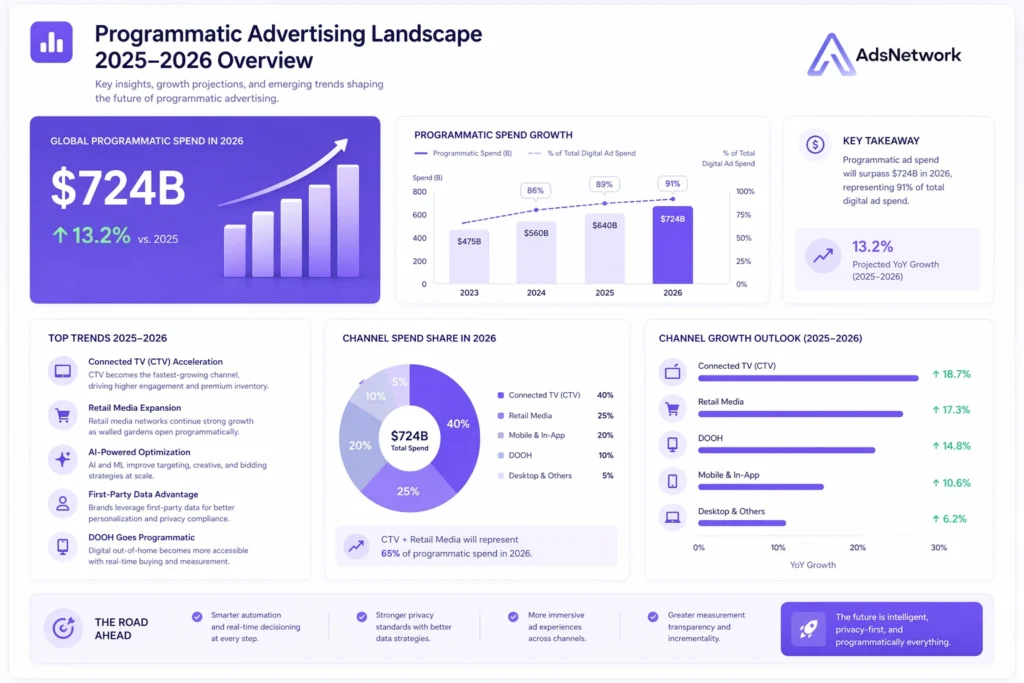
The programmatic advertising landscape does not stand still. Every year, new pressures and technologies reshape how inventory is bought, sold, targeted, and measured. Understanding current programmatic advertising trends is not optional for any team running paid media at scale. Specifically, it is the difference between building campaigns on infrastructure that is improving and spending budget against systems that are already becoming obsolete. According to Basis Technologies, US programmatic display spending surpassed $180.4 billion in 2025, accounting for nearly 92% of all digital display ad spend. Furthermore, that figure is expected to exceed $203 billion in 2026. The growth is real, and the structural changes driving it are worth examining closely.
Trend 1: AI Moves from Optimization to Prediction
Artificial intelligence has been part of programmatic advertising for years, but its role is fundamentally changing. Historically, AI in programmatic operated reactively. It adjusted bids after performance data accumulated and shifted budgets toward what was already working. Today, however, AI-powered systems in the most advanced DSPs operate predictively. Specifically, they evaluate thousands of signals per auction to forecast conversion probability before the bid is placed.
Consequently, the performance difference is measurable. Notably, advertisers using AI optimization report up to 2.7 times the performance lift versus rule-based bidding, according to industry benchmarks via Marketing LTB. According to the same source, AI bidding systems are expected to run more than 90% of programmatic buying by 2027. Indeed, the shift goes beyond bidding. Additionally, dynamic creative optimization now uses AI to assemble and serve individual ad variations in real time. Moreover, budget pacing algorithms distribute spend across channels and dayparts in ways that maximize outcome probability. Specifically, these systems improve continuously as more campaign data accumulates, creating a compounding performance advantage for teams that adopt them early.
Trend 2: Connected TV Becomes a Core Programmatic Channel
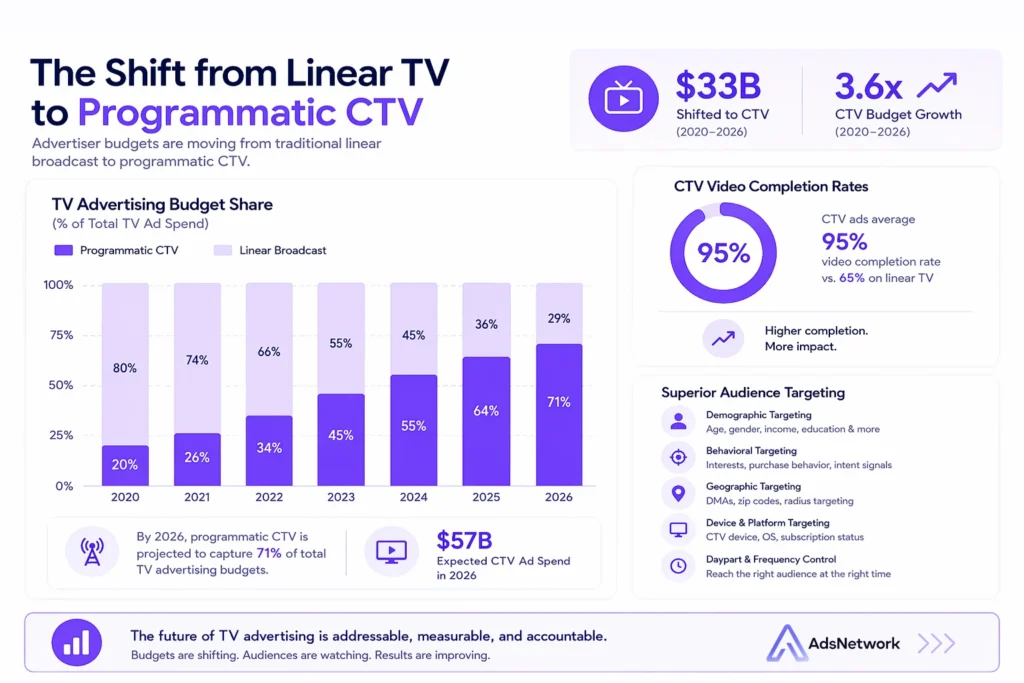
Connected TV has completed its transition from an experimental line item to a primary programmatic channel. According to Blasto.ai, CTV ad spend in the US is projected to hit $32.6 billion in 2025. Video completion rates on CTV average 92 to 97%, according to Marketing LTB, dramatically outperforming display formats on every attention metric. Notably, major streaming platforms including Netflix and Disney+ have entered ad-supported models. This has significantly expanded the available CTV inventory pool.
Specifically, CTV combines the reach and brand impact of television with the targeting and measurement precision of digital. Household-level audience data, frequency capping across devices, and cross-screen attribution are all possible in programmatic CTV environments. CTV is also increasingly accessible to smaller advertisers. Self-serve streaming ad platforms now offer minimum spends starting at $500. Consequently, the large-budget barrier that once kept CTV as an enterprise-only channel has effectively disappeared. Consequently, CTV will claim a larger share of programmatic budgets at every spending tier through 2026 and beyond.
Trend 3: First-Party Data Becomes the Foundation of Targeting
The decline of third-party cookies has been one of the most discussed structural shifts in programmatic advertising over the past several years. However, the operational reality arrived gradually rather than in a single event. Safari and Firefox blocked third-party cookies years ago. Google reversed its initial Chrome deprecation timeline but introduced a user-consent model that materially reduces available third-party signal. In practice, therefore, the era of broad, anonymous third-party audience targeting across the open web is over.
First-party data has become the most reliable targeting foundation available. According to Basis Technologies, 40% of US marketers relied on first-party data as their primary privacy-centric targeting approach in 2025. Furthermore, brands using clean rooms for data collaboration report 25% higher campaign ROI, according to Accio. Specifically, a clean room allows two parties to match and activate audience data without directly sharing underlying personal information. The result is a privacy-compliant path to high-quality targeting at scale.
Additionally, contextual targeting has experienced a significant resurgence as an alternative to behavioral tracking. Modern contextual systems use AI to analyze page content far more precisely than the keyword matching of early programmatic. According to Marketing LTB, contextual targeting adoption rose two to three times between 2022 and 2025. For Web3 advertisers, on-chain behavioral signals and protocol usage patterns function as first-party equivalents, enabling targeting precision that general programmatic channels cannot access.
Trend 4: Retail Media Networks Reshape the Competitive Landscape
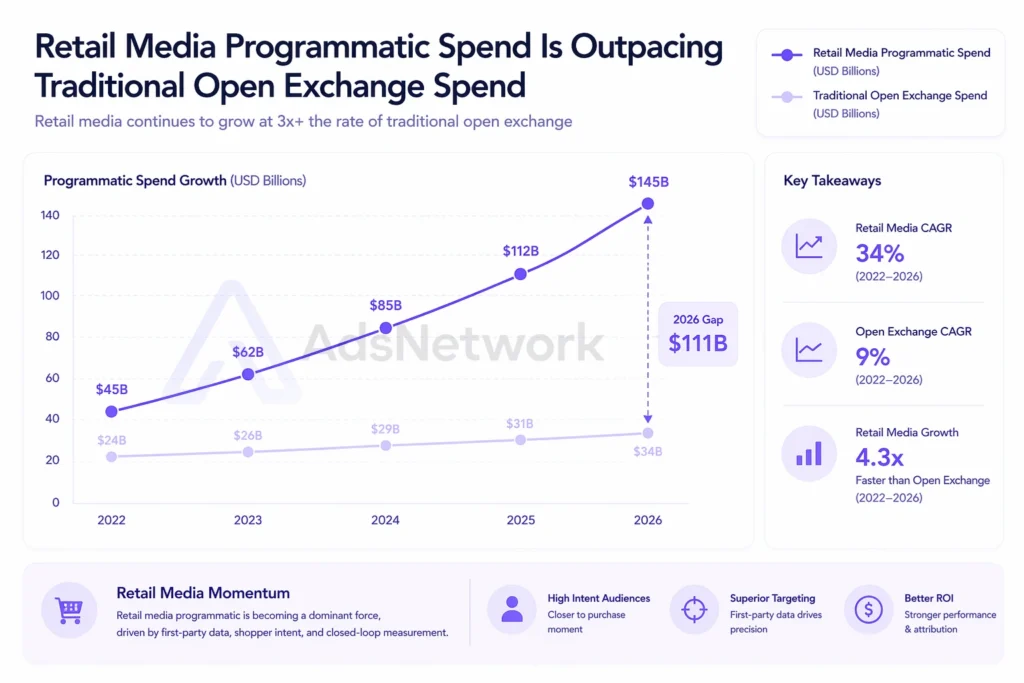
Retail media networks are one of the fastest-growing programmatic advertising trends of this period, and their growth is reshaping how budgets are allocated across the industry. Amazon pioneered the model by making its first-party purchase data available to advertisers through programmatic pipes. Notably, Walmart, Instacart, Kroger, and dozens of other retailers followed. The result is a category that combines high-intent audiences, closed-loop attribution, and privacy-compliant targeting in a single environment.
The scale of this growth is notable. Retail media programmatic display spending grew 41.7% in 2024. It is projected to grow a further 29.3% in 2025, according to Basis Technologies. By 2026, the segment is expected to exceed $30 billion globally. WPP’s end-of-year forecast projected that commerce media as a category would surpass television in total spend by end of 2025. For advertisers, retail media networks offer something uniquely valuable: a clear line between ad exposure and measurable purchase behavior. Consequently, they provide the strongest available attribution between programmatic investment and sales outcome.
Trend 5: Attention Metrics Emerge as the New Performance Standard
Viewability, which measures whether an ad was technically visible on screen, has been the dominant quality metric for years. However, viewability does not measure whether anyone actually engaged with the ad or remembered it. In practice, an ad can be technically viewable while occupying the bottom corner of a page a user never scrolls to. Consequently, attention metrics are emerging as the next performance standard in programmatic advertising.
Specifically, attention measurement platforms track engagement time, scroll depth, audio playback, and active viewing behavior to determine whether an ad actually captured a user’s focus. Specifically, these metrics correlate more strongly with brand recall and conversion than viewability alone. According to Marketing LTB, attention-based media buying is forecast to grow four to seven times by 2026. Accordingly, DSPs are beginning to incorporate attention data into bidding logic, allowing buyers to target high-attention inventory rather than simply viewable inventory. Consequently, this shift will fundamentally change how premium inventory is defined and priced.
Trend 6: DOOH and Audio Expand Programmatic Beyond Screens
Programmatic advertising trends in 2025 and beyond are not limited to digital screens in homes and pockets. Digital out-of-home (DOOH) and programmatic audio are both experiencing rapid adoption. Together, they expand the addressable universe of programmatic inventory. Previously, these environments could not be reached through automated buying.
DOOH programmatic spending has grown more than 400% since 2019, according to Marketing LTB. Digital screens in transit networks, retail locations, and outdoor environments can now be targeted programmatically. Specifically, audiences are informed by location data, time of day, and contextual signals. Programmatic audio operates similarly. Specifically, DSPs now connect to streaming music platforms, podcast networks, and digital radio. This allows advertisers to reach audiences during commutes, workouts, and other screen-free moments with personalized messaging. The evolution of programmatic ads has consistently moved toward more channels, and DOOH and audio represent the latest frontier in that expansion.
Trend 7: Supply Path Optimization and Transparency Continue Maturing
Supply chain transparency remains one of the most active areas of operational improvement in 2025 and 2026. Notably, SPO has moved from a specialized large-agency discipline to a standard practice across advertisers at every spending level. Specifically, SPO involves identifying the most direct, verifiable path between a DSP and a specific publisher, eliminating intermediaries that add fees without adding value.
The financial impact of poor supply path hygiene is significant. According to Basis Technologies, inefficiencies and waste in programmatic spend were estimated at approximately $26 billion in 2025. Furthermore, demand path optimization is emerging as the publisher-side counterpart to SPO. It allows sell-side participants to manage which buyers access their inventory and at what terms. Together, these practices improve supply chain efficiency and transparency. Consequently, a greater share of advertiser budget reaches genuine working media.
What These Programmatic Advertising Trends Mean for Web3
Importantly, the programmatic advertising trends shaping the broader industry have direct implications for Web3 and crypto advertisers. In particular, the shift toward first-party data advantages projects with direct audience relationships. These include DeFi protocols, blockchain gaming platforms, and crypto media properties with registered reader communities. These first-party relationships can be activated programmatically in the same way that retail media networks activate purchase data.
The growth of AI-powered bidding and contextual targeting also creates specific opportunities for crypto campaigns. On-chain behavioral signals, wallet activity patterns, and DeFi protocol usage represent a form of first-party behavioral data that general programmatic platforms do not carry. Purpose-built Web3 advertising infrastructure, such as AdsNetwork, can activate these signals in real time within RTB auction environments, giving crypto advertisers the targeting precision that the industry’s first-party data shift is moving toward.
However, the mainstream programmatic infrastructure that carries these trends, including the largest DSPs and ad exchanges, continues to restrict crypto advertising categories. Accordingly, the trends improving programmatic efficiency, including AI optimization and CTV access, remain largely inaccessible to DeFi protocols and token launch teams on general exchanges. The same benefits of programmatic advertising that general-market advertisers access through these improvements are available to Web3 projects through purpose-built platforms that operate without blanket crypto restrictions. Visit 51.254.143.217/ to explore programmatic advertising infrastructure built for the Web3 ecosystem.
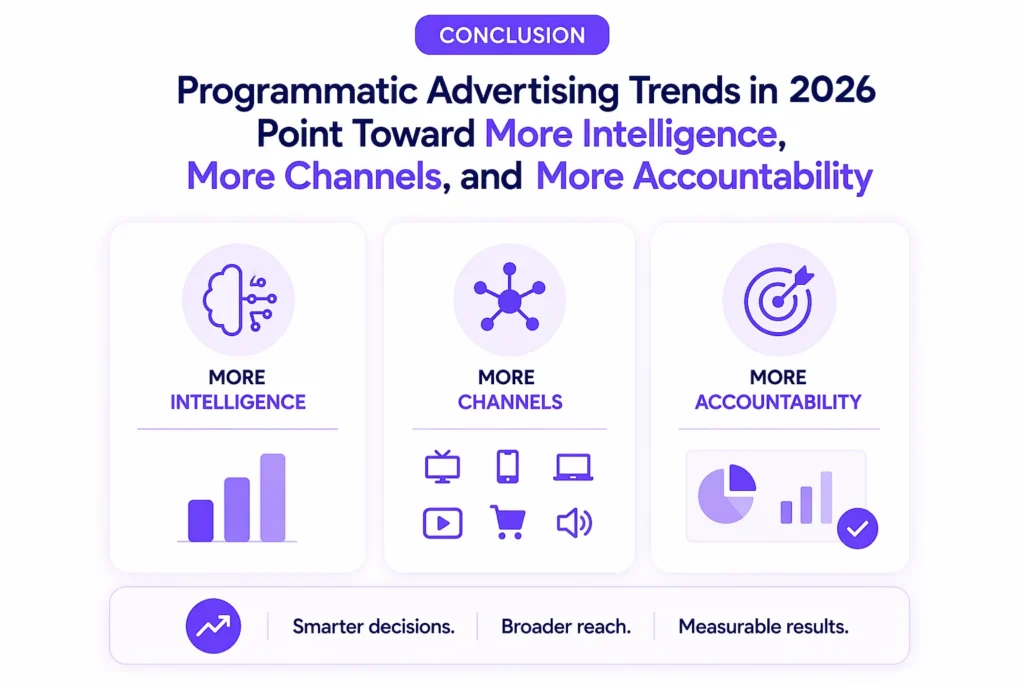
Conclusion: Programmatic Advertising Trends in 2025 Point Toward More Intelligence, More Channels, and More Accountability
The programmatic advertising trends defining 2025 and the years ahead share a common direction. AI is making bidding smarter and more predictive. CTV is absorbing linear television’s budget share. First-party data is replacing third-party cookies as the targeting foundation. Retail media networks are redefining attribution. Attention metrics are replacing viewability as the quality standard. DOOH and audio are extending programmatic reach beyond the screen. SPO is removing waste from the supply chain.
Notably, each of these programmatic advertising trends creates both opportunity and pressure. Specifically, teams that adapt their infrastructure, data strategies, and measurement frameworks will capture the efficiency gains these trends offer. Consequently, teams that do not will find themselves running campaigns on systems that the industry is progressively leaving behind.
Featured Posts

Oct 23, 2026
10 min read
What Is CPM in Advertising? Meaning, Formula and 2026 Rates
CPM is the cost an advertiser pays for 1,000 ad impressions, making it one of the most common…
Read Article
Sep 23, 2026
6 min read
What Is Advertising Technology (AdTech) and How Does It Work?
Advertising technology, commonly known as AdTech, refers to the software, platforms, tools, and systems used to plan, buy,…
Read Article
Sep 16, 2026
8 min read
Media Buying: A Complete Guide for Advertisers
Media buying is the process of purchasing advertising space to reach a target audience. It includes choosing where…
Read ArticleNeed Help?
Our team is ready to help you launch successful campaigns.
AI-Powered Mobile
Monitor Your Campaigns Anywhere
Stay connected to your live AdsNetwork campaigns with our mobile advertising app. Track impressions, clicks, conversions, campaign spend, and overall performance in real time—anytime, anywhere. Available for iOS and Android.