
Every digital ad that reaches a user today is the product of a thirty-year technological evolution. From a single banner ad on a tech magazine’s website in 1994 to a global automated marketplace processing billions of auctions every day, the evolution of programmatic ads tracks one of the most consequential transformations in the history of media. According to Novatiq, ads bought programmatically accounted for 84% of global digital advertising spending in 2022. That share is forecast to reach 87% by 2026. Understanding how the industry arrived at this infrastructure provides essential context for anyone operating in programmatic advertising today. Specifically, each development solved problems the previous one created.
Stage 1: The First Digital Ads and the Ad Network Era (1994-2004)
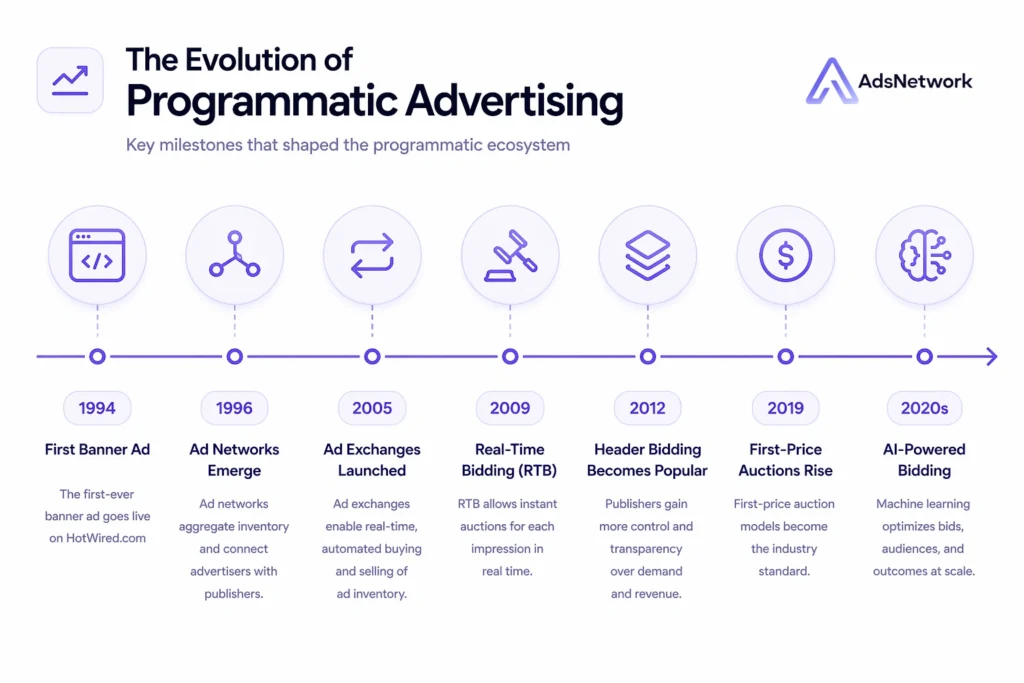
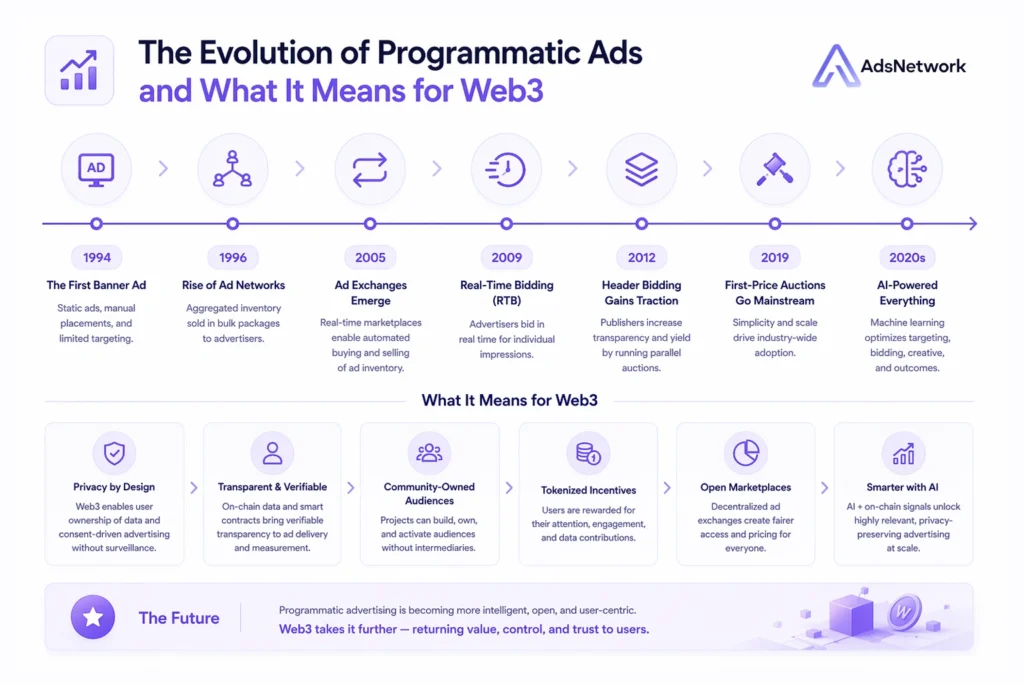
The evolution of programmatic ads begins with a single experiment. On October 27, 1994, HotWired magazine published the first banner ad on its website. AT&T purchased the placement. The ad received a 44% click-through rate, a figure unimaginable by today’s benchmarks. It marked the first proof that web publishers could monetize their audiences through advertising.
However, this early model was entirely manual. Publishers sold placements directly to advertisers through telephone calls and signed contracts. Pricing was negotiated case by case. Consequently, scale was impossible for most publishers. As a result, as the web grew through the late 1990s, this manual approach became impractical. Specifically, thousands of new websites appeared, each needing to find advertisers. Meanwhile, advertisers wanted to reach audiences across many sites without negotiating hundreds of individual deals.
Consequently, ad networks emerged to solve this problem. Companies like DoubleClick, 24/7 Media, and Advertising.com aggregated unsold inventory from thousands of publishers and sold it to advertisers in bulk. This was, as Blasto.ai describes it, the “boom and bust era” of ad tech, with many networks thriving until the dotcom crash reduced digital ad spend sharply in 2001. Despite the crash, the infrastructure these networks built, including DoubleClick’s 1996 ad server, laid the technical foundation for everything that followed.
Google’s acquisition of DoubleClick in 2007 for $3.1 billion signaled how seriously the industry’s largest player viewed ad serving infrastructure. By then, however, the manual model was already under considerable pressure. Specifically, publishers had more inventory than they could sell through direct relationships. Advertisers had budgets they could not deploy efficiently through manual negotiation. Something more automated was needed.
Stage 2: Ad Exchanges and the Birth of Automated Buying (2005-2008)
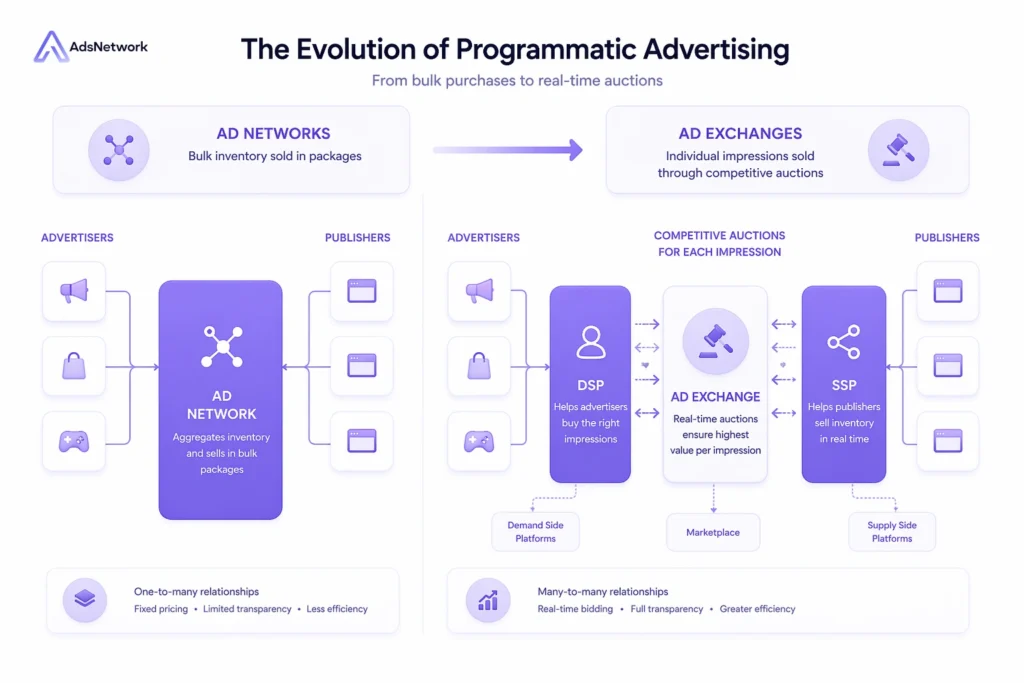
The second phase in the evolution of programmatic ads centered on the ad exchange. Ad networks had aggregated inventory into packages sold at fixed prices. Ad exchanges, in contrast, created open marketplaces where inventory was bought and sold dynamically based on demand signals. Specifically, exchanges introduced competitive bidding for individual placements rather than bulk sales at negotiated rates.
The Right Media Exchange, launched in 2005 and later acquired by Yahoo, is widely credited as the first true ad exchange. Notably, this marketplace-based model fundamentally changed how inventory was priced. Subsequently, Google followed with AdX. Microsoft and AOL built their own exchange infrastructure. For the first time, publishers could expose their available inventory to multiple buyers simultaneously. Prices consequently reflected real competition rather than negotiated averages. The shift from fixed-price networks to auction-based exchanges was consequently the structural precursor to real-time bidding.
Concurrently, demand-side platforms (DSPs) and supply-side platforms (SSPs) began to emerge. Specifically, DSPs gave advertisers automated access to multiple exchanges through a single interface. Similarly, SSPs gave publishers the tools to manage their inventory across multiple demand sources. Together, these platforms created the buy-side and sell-side infrastructure that real-time bidding would later unify.
Stage 3: Real-Time Bidding Changes Everything (2009-2012)
The most transformative event in the evolution of programmatic ads was the introduction of real-time bidding in 2009. As Novatiq notes, RTB enabled advertisers to bid on individual impressions in real time. Specifically, bids were based on actual user data available at the moment of each page load. For the first time, the value of each impression could be assessed independently rather than estimated in aggregate.
The mechanics of RTB were built on the OpenRTB protocol. Specifically, this industry-standard specification allowed DSPs and SSPs from different vendors to communicate reliably at millisecond speed. When a user loaded a page, a bid request containing user and context data was broadcast to connected DSPs. Each DSP had milliseconds to evaluate the impression, calculate a bid, and respond. The highest bid won. The ad appeared. Understanding how RTB auctions work at this level remains essential knowledge for any programmatic practitioner today.
Importantly, RTB solved a problem that ad networks and exchanges had only partially addressed. Previously, even competitive exchanges sold inventory in batches or with delayed pricing. In particular, RTB made every impression its own marketplace event. Publishers now received the true market value for each user visit rather than an averaged bulk price. Advertisers could bid more for high-value users and less for low-value ones. The efficiency gains were immediate and significant.
Stage 4: The Waterfall Problem and the Rise of Header Bidding (2012-2016)
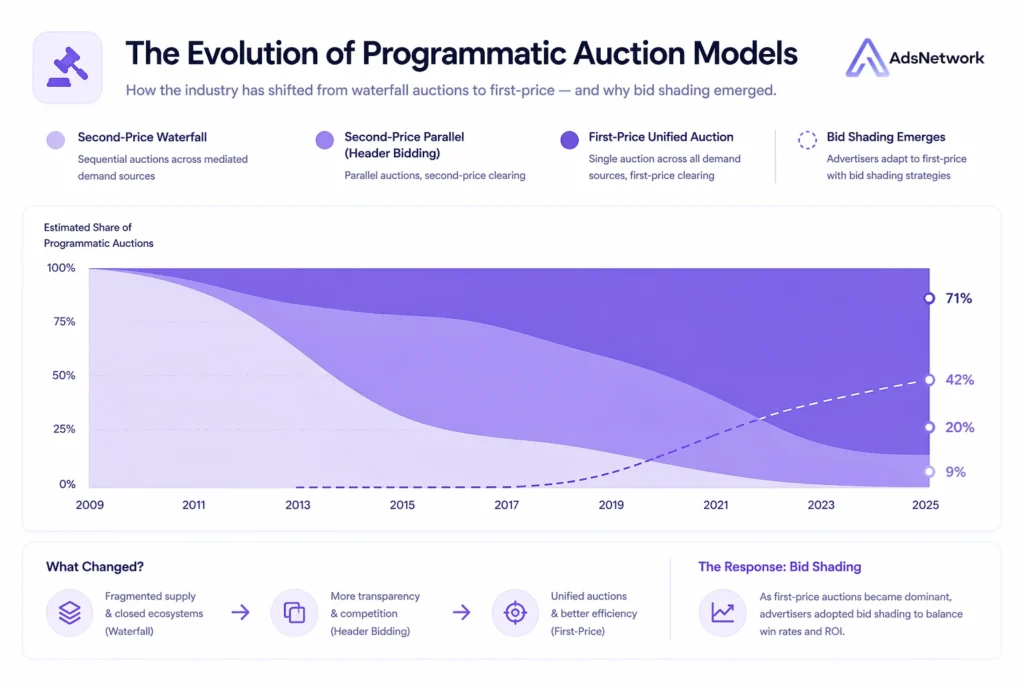
As RTB matured, a structural inefficiency emerged on the publisher side. The waterfall model governed how publishers offered inventory to multiple demand sources. It created a sequential auction where inventory was offered to buyers one at a time in priority order. If the first buyer passed, the impression moved to the second, then the third. Consequently, a buyer willing to pay a premium who sat lower in the priority order never saw the impression at the optimal moment.
Header bidding emerged around 2012 to solve this problem. By inserting a piece of JavaScript into a publisher’s page header, the technology allowed publishers to send bid requests to multiple exchanges simultaneously before the ad server made its final decision. All buyers competed at the same time on equal terms. According to Basis Technologies, header bidding has achieved near-industry-standard status because it fundamentally corrects the inequitable structure of waterfall auctions. Publishers gained higher yields. Advertisers gained equal access to premium inventory regardless of their position in a publisher’s priority stack.
Accordingly, header bidding adoption accelerated rapidly through 2015 and 2016 as publishers recognized the revenue impact. By giving all buyers simultaneous access, it created genuine price discovery for every impression. Accordingly, the average CPM increase publishers experienced from header bidding adoption made it one of the most consequential supply-side innovations in programmatic history.
Stage 5: First-Price Auctions and Transparency (2017-2020)
By the late 2010s, the programmatic supply chain had become extraordinarily complex. Multiple SSPs, each running their own second-price auctions, were feeding into ad servers that ran further auctions. The result was an opaque system where the rules governing who paid what were inconsistent and often invisible to buyers. Advertisers frequently found that the second-price auction model was being manipulated by hidden floor price mechanisms. Consequently, auctions functionally operated closer to first-price anyway.
In 2019, however, Google made a decisive move. It completed the transition of its exchange to a first-price auction model for display and video inventory sold through Google Ad Manager. Notably, most major exchanges followed within months. The migration to first-price auctions standardized how clearing prices were determined across the industry, reducing the opacity that had eroded advertiser trust. However, the trade-off was significant. In a first-price environment, the winner pays exactly what they bid, so advertisers could no longer safely overshoot their true value.
Furthermore, bid shading technology emerged in direct response. Specifically, AI-powered algorithms analyzed historical auction data to estimate the minimum bid likely to win each impression. DSPs could then submit competitive bids without overpaying. This development further embedded machine learning into the core bidding infrastructure of programmatic advertising. Meanwhile, supply path optimization emerged as a formal discipline. Advertisers sought the most direct, cost-efficient routes between their DSP and specific publishers.
Stage 6: CTV, Audio, and the Omnichannel Expansion (2019-2024)
The sixth stage in the evolution of programmatic ads is the expansion beyond display into every digital channel where audiences consume content. The most significant of these is connected TV. As streaming platforms displaced broadcast viewing, CTV inventory became a critical target for programmatic buyers. By 2022, CTV ad spend in the US surpassed $21.2 billion, according to Blasto.ai, with forecasts projecting continued double-digit growth into 2025 and beyond.
Specifically, CTV offered advertisers something previously unavailable: the immersive, brand-safe environment of television combined with the targeting and measurement precision of digital. Households watching streaming content could be reached with the same audience-signal targeting available on a mobile app. Frequency caps, first-party data layering, and conversion measurement all applied. This combination made programmatic CTV one of the most valuable inventory types in the modern ad tech stack.
Simultaneously, programmatic infrastructure expanded into digital audio, digital out-of-home, and in-game advertising. Each new channel followed the same pattern. Specifically, manual buying gave way to SSP-DSP exchange infrastructure, and targeting improved as each channel matured. According to AI Digital, over 90% of global digital display spend in 2026 will occur through programmatic channels, This reflects how thoroughly automated buying has absorbed every major digital advertising format.
Stage 7: AI-Powered Programmatic and the Current Era (2020-Present)
The current stage in the evolution of programmatic ads is defined by the deep integration of artificial intelligence throughout the buying and optimization process. According to StackAdapt, at the center of this evolution is AI. It analyzes millions of data points in real time, turning programmatic bidding from a reactive process into a predictive one. Machine learning models now evaluate thousands of signals per auction to determine optimal bids, moving far beyond the rule-based systems that characterized early RTB.
Additionally, dynamic creative optimization uses AI to assemble and serve ad variations in real time. Rather than selecting a single creative to show a given audience, platforms test and rotate elements based on performance signals. Moreover, predictive audience modeling identifies users likely to convert before they exhibit explicit purchase intent. Budget pacing algorithms distribute spend across dayparts and geographies in ways that human traders cannot replicate at scale or speed.
In addition, the industry’s response to cookie deprecation has accelerated innovation in identity resolution and contextual targeting. As third-party cookies became less reliable, advertisers invested in first-party data strategies. Additionally, privacy-preserving targeting methods and contextual systems gained adoption, matching ad content to page content rather than tracking individual users. Each of these adaptations reflects how the evolution of programmatic ads responds to structural challenges by building more sophisticated solutions.
The Evolution of Programmatic Ads and What It Means for Web3
The evolution of programmatic ads has always been driven by the same underlying pressure. In short, it is about connecting the right advertiser with the right audience at the right price, as efficiently as technology allows. Each stage solved a problem the previous one created. Ad networks solved scale but sacrificed transparency. Exchanges restored competition but created fragmentation. RTB unified the auction but enabled fraud. Header bidding corrected publisher yield but added latency. First-price auctions improved clarity but required new bidding intelligence.
For Web3 and crypto projects, this history has a direct implication. The programmatic infrastructure that exists today was built for general web advertising. Mainstream DSPs, SSPs, and exchanges evolved to serve retail, finance, travel, and consumer goods advertisers. Crypto-related campaigns, including DeFi protocols, token launches, and blockchain gaming projects, were not part of that evolution. Consequently, they face policy restrictions at the exchange and DSP level that block access to the efficiency gains the industry has spent thirty years building.
AdsNetwork addresses this by applying the same evolutionary logic that drove programmatic advertising forward in the general market. Specifically, it brings RTB auction mechanics, first-party audience data activation, supply path optimization, and AI-powered bidding to crypto-native publisher inventory. The benefits of programmatic advertising that general-market advertisers enjoy are fully accessible to Web3 projects through platforms built for the specific context of crypto advertising. That, too, is part of the evolution.
Conclusion: Thirty Years of Evolution, Still Moving
The evolution of programmatic ads is not a completed story. It is a continuous process of solving the problems that each innovation creates. From the first banner ad in 1994 to AI-powered bidding in 2025, the trajectory has always pointed toward greater automation, more precise targeting, and more transparent pricing. The infrastructure that Web3 advertisers need today is the latest chapter in that same trajectory.
To explore programmatic advertising infrastructure built for the next stage of that evolution, visit 51.254.143.217/.
Featured Posts
Sep 23, 2026
6 min read
What Is Advertising Technology (AdTech) and How Does It Work?
Advertising technology, commonly known as AdTech, refers to the software, platforms, tools, and systems used to plan, buy,…
Read Article
Sep 16, 2026
8 min read
Media Buying: A Complete Guide for Advertisers
Media buying is the process of purchasing advertising space to reach a target audience. It includes choosing where…
Read Article
Sep 7, 2026
8 min read
Programmatic Advertising vs Display Advertising: What’s the Difference?
Programmatic and display advertising are often used interchangeably, but they describe two different parts of digital advertising. Display…
Read ArticleNeed Help?
Our team is ready to help you launch successful campaigns.
AI-Powered Mobile
Monitor Your Campaigns Anywhere
Stay connected to your live AdsNetwork campaigns with our mobile advertising app. Track impressions, clicks, conversions, campaign spend, and overall performance in real time—anytime, anywhere. Available for iOS and Android.