
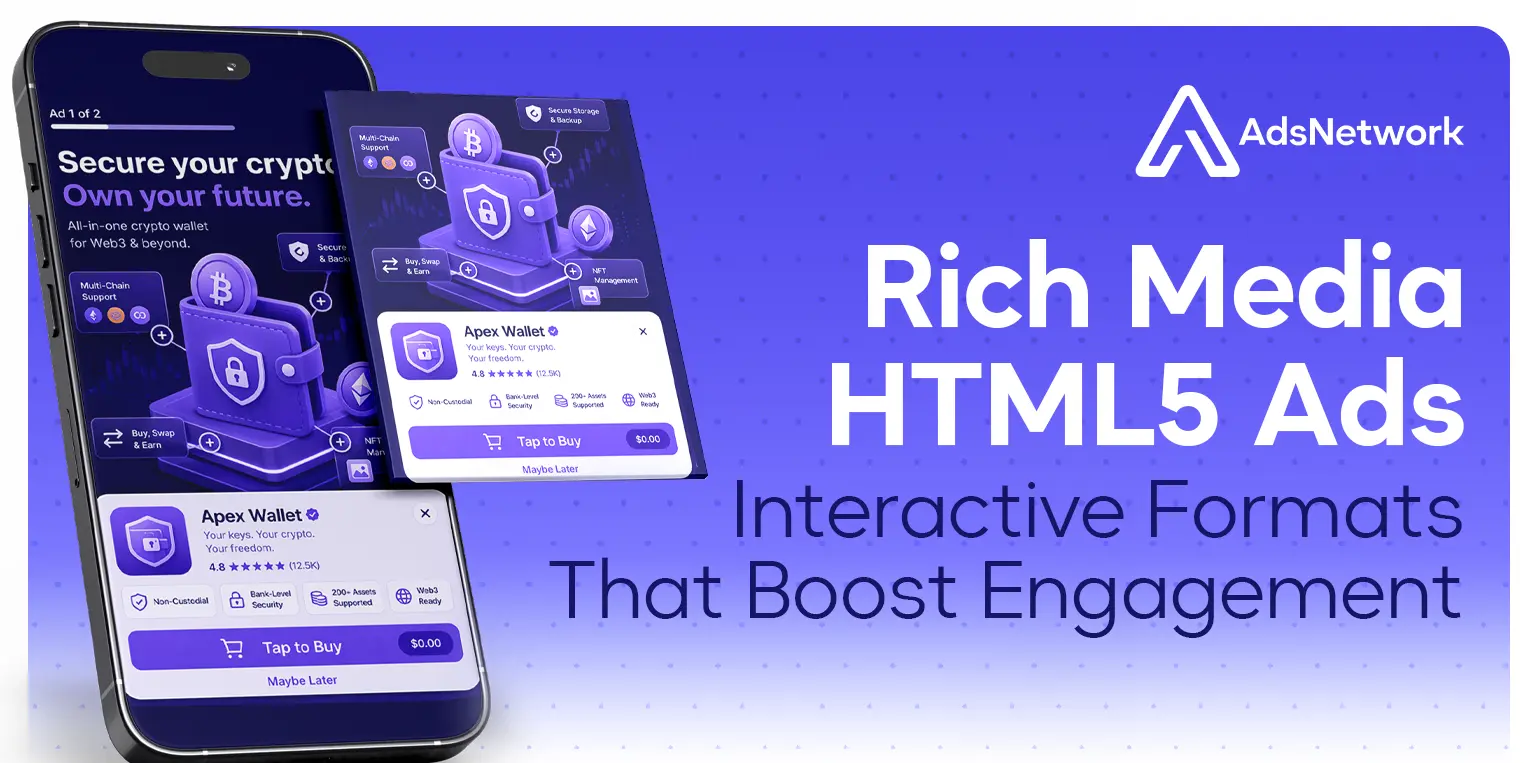
Rich media HTML5 ads are rewriting the rules of digital advertising. A static banner sits on the page, gets ignored, and delivers a 0.12% click-through rate. An interactive HTML5 ad on the same page invites users to swipe, expand, or watch a video, and delivers a 0.44% CTR. That is a 267% improvement from a single format upgrade. The difference is not subtle. It is the gap between being ignored and being engaged with.
Interactive display formats generate approximately three times the engagement of standard banners. In fact, dynamic ads achieve an engagement rate of 16.85% compared to just 2.14% for static creatives. This guide explains how rich media HTML5 ads work, why they outperform static alternatives, and how to build campaigns that turn viewers into participants.
What Are Rich Media HTML5 Ads?
Rich media HTML5 ads are digital advertisements built with HTML5, CSS3, and JavaScript that include interactive elements like video, audio, animations, expandable panels, and clickable hotspots. According to Business of Apps, these ads go beyond traditional banners by offering a more immersive experience that actively encourages users to engage. The IAB defines rich media as any ad format that users can interact with, as opposed to ads that are simply animated.
HTML5 replaced outdated Flash technology and is now the universal standard for interactive advertising. It ensures that these ads render consistently across all browsers, apps, and operating systems. Moreover, HTML5 supports responsive layouts that automatically adapt to different screen sizes, making these ads effective on both desktop and mobile devices.
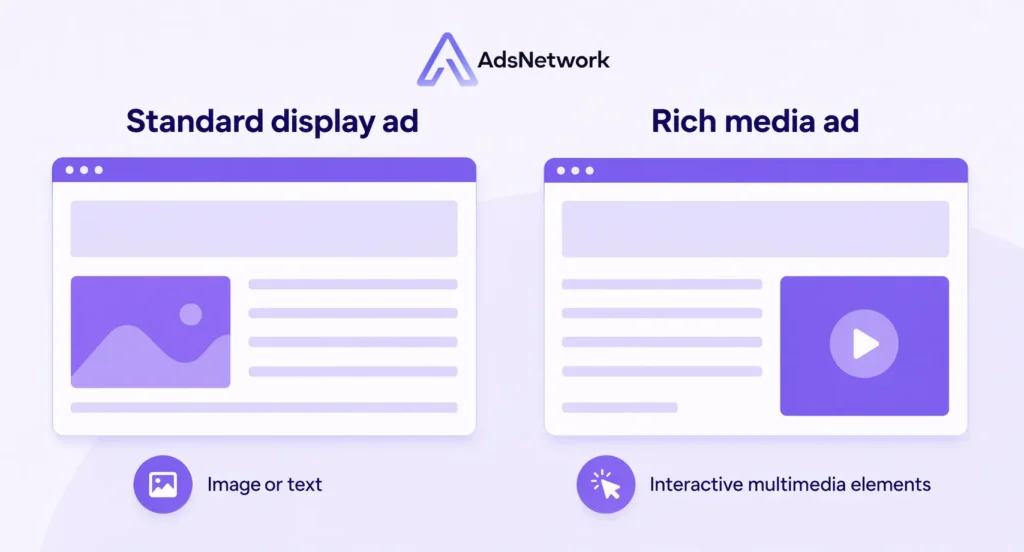
The core difference from standard display is straightforward. If users can only look at it, it is display. If they can do something with it, it is rich media. This distinction, as noted by AI Digital, is what drives the performance gap between the two formats.
Types of Rich Media HTML5 Ads
Not all rich media formats serve the same purpose. Consequently, understanding the available variations helps you match the right format to your campaign goals. Below are the primary types advertisers should consider.
Expandable and Floating Ads
Expandable ads start as a standard banner but grow to a larger format when a user clicks or hovers. This lets advertisers pack detailed product information, video content, or interactive galleries into a compact initial unit. According to AI Digital, users who actively expand an ad show high intent, and they typically spend several seconds engaging with the expanded panel. Floating ads, meanwhile, move across the screen or anchor to a fixed position as the user scrolls, maintaining visibility without disrupting the content flow.
In-Banner Video and Shoppable Rich Media HTML5 Ads
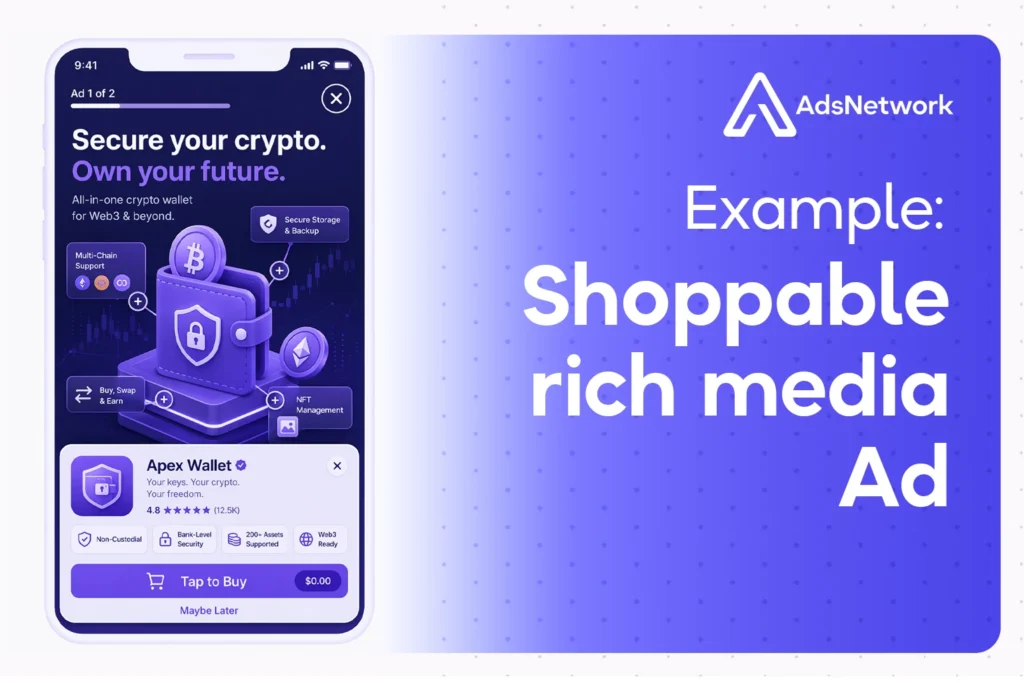
In-banner video embeds a video player directly within a standard ad unit. This combines the storytelling power of video with the scalability of display placement. Shoppable formats take this further by adding clickable product tags, tap-to-buy overlays, and embedded checkout elements. According to AI Digital, interactive videos including shoppable formats can increase conversion rates by up to 70%. These formats also yield three to four times higher engagement than non-interactive video.
Playable and Gamified Ads
Playable ads let users interact with a mini-game or product demo before taking action. According to AI Digital, playable formats have shown three times higher conversion rates than traditional video ads in some non-gaming campaigns. Similarly, gamified elements like quizzes, spin-to-win mechanics, and scratch-to-reveal features create memorable experiences that drive both engagement and brand recall.
Why Rich Media HTML5 Ads Outperform Static Banners
The performance gap between rich media and static banners is well documented and consistent across studies. According to a study by Adform cited by Publift, rich media ads achieve a 0.44% CTR while static banners average just 0.12%. Furthermore, Publift reports that ads using rich media formats increase purchase intent by 27%.
The engagement data is equally compelling. According to Eskimi, parallax ad formats delivered CTRs over five times higher than standard static banners in direct comparison tests. Additionally, the MGID platform reports an average rich media CTR of 0.4%, while static creatives on the same platform barely exceed 0.04%, as noted by MGID.
The reason these formats work is rooted in user behavior. Banner blindness has conditioned audiences to ignore small, static placements. Because rich media invites active participation, it breaks through that autopilot response. Users who interact with an ad are, as a result, far more likely to remember the brand and convert.
Rich Media HTML5 Ads Performance Benchmarks
Understanding benchmarks helps you evaluate campaign performance against industry standards. Therefore, here are the key metrics to track when running interactive campaigns.
CTR and Engagement Rate Benchmarks
According to AI Digital, rich media and interactive ads achieve CTRs of 0.15% to 0.30% or higher, making them the top-performing display format. Standard static banners, in comparison, average approximately 0.06% CTR globally. Interactive CTV formats push this even further. According to AI Digital, they generate up to 10 times the engagement rate of standard video. These formats also add approximately 92 seconds of extra engagement time on top of pre-roll.
Measuring Beyond Clicks
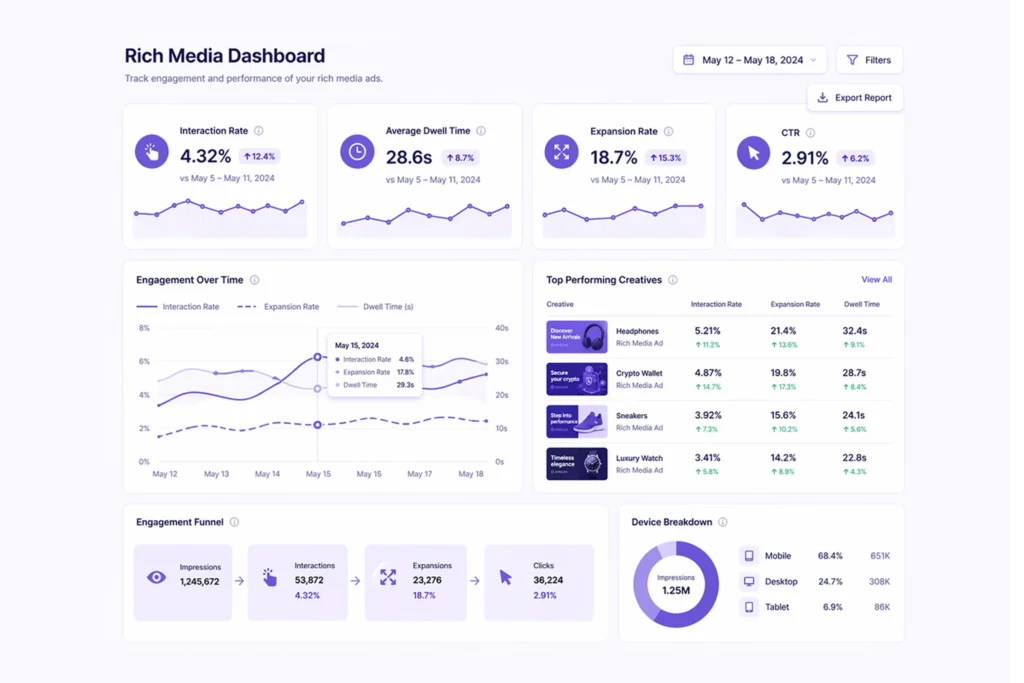
CTR alone does not capture the full value of rich media HTML5 ads. In fact, engagement rate, dwell time, expansion rate, and interaction depth are often more meaningful metrics for this format. Engagement rate measures the percentage of users who actively interacted with the ad through swipes, clicks, video plays, or other actions. Dwell time tracks how long users spent inside the ad unit. Because rich media captures behavioral signals that static banners cannot, it gives advertisers a more complete picture of user intent and attention quality.
Creative Best Practices for Rich Media HTML5 Ads
Building effective rich media requires balancing creativity with performance. After all, interactive elements only work if they enhance the user experience rather than frustrate it. Here is what the data shows about best practices.
Design with a mobile-first approach. Because mobile devices account for over 70% of all display impressions, every interactive element must work seamlessly on touchscreens. Specifically, swipe gestures, tap interactions, and vertical layouts should take priority over desktop hover effects.
Keep file sizes optimized. Rich media ads tend to be larger than standard banners, often exceeding 200KB according to Business of Apps. However, slow load times kill engagement before users ever interact. Therefore, compress assets aggressively, use lazy loading for heavy elements, and test load performance across network conditions.
A/B test interactive elements systematically. Not every interactive feature improves results. Test which interactions drive the most engagement: expandable panels versus in-banner video, swipeable carousels versus static product showcases. Additionally, monitor downstream metrics like conversion rate and cost per acquisition, not just interaction rate, to ensure engagement translates into business outcomes.
Rich Media HTML5 Ads for Crypto and Web3 Projects
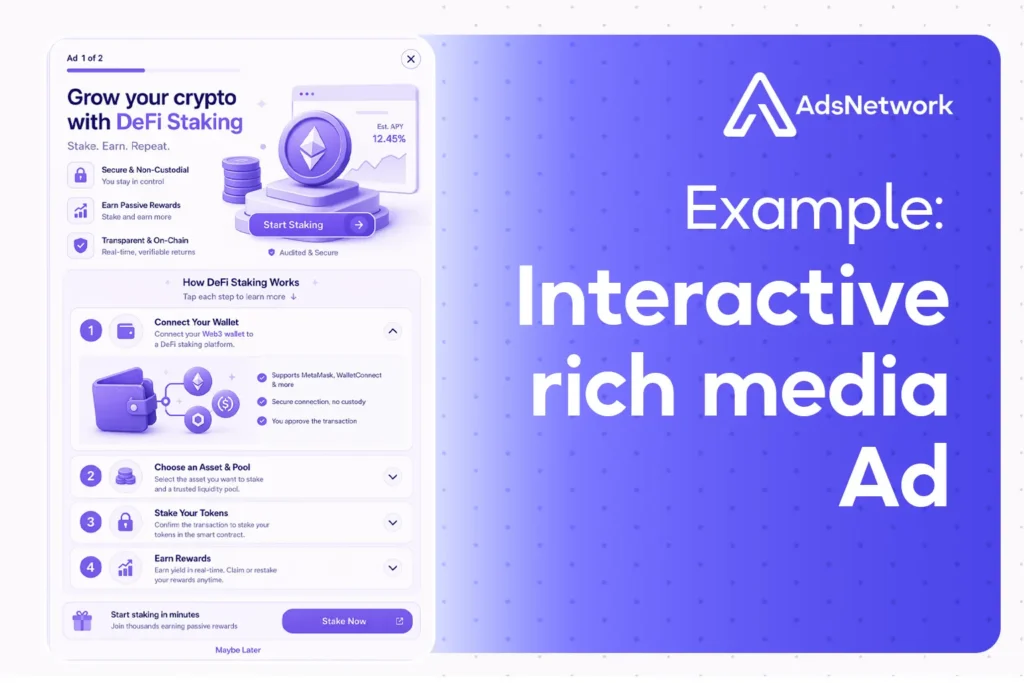
Crypto and Web3 projects have complex products that require explanation. Specifically, DeFi protocols, token mechanics, staking processes, and wallet functionality are difficult to communicate in a static banner. Rich media HTML5 ads solve this by giving advertisers the interactive space to educate users within the ad itself.
An expandable ad can walk a user through a three-step staking process. A shoppable overlay can let users explore token details and link directly to a decentralized exchange. Because these formats encourage voluntary engagement, they build trust with an audience that is inherently skeptical of promotional advertising in the blockchain space.
AdsNetwork supports rich media HTML5 ad formats designed specifically for crypto and Web3 audiences. It connects your interactive campaigns with verified blockchain publishers, offering placements across DeFi dashboards, token trackers, and crypto news platforms. Visit 51.254.143.217/ to explore rich media options and launch your first campaign.
Boosting Engagement with Rich Media HTML5 Ads
Rich media HTML5 ads represent the next evolution in display advertising. The data is clear: 267% higher CTR than static banners, engagement rates eight times greater, and measurable lifts in purchase intent and brand recall. Specifically, advertisers who move beyond passive banner placements and invest in interactive formats are seeing dramatically better results.
For crypto and Web3 projects, moreover, rich media provides the interactive space needed to explain complex products and build trust with a skeptical audience. Whether you are promoting a DeFi protocol, launching a token, or driving wallet adoption, these formats deliver the engagement that static banners cannot match.
Start building interactive campaigns today. Explore rich media HTML5 ad formats, launch campaigns, and track results at 51.254.143.217/.
Featured Posts
Jul 16, 2026
15 min read
Media Buying: The Complete Guide for Digital Advertisers
Media buying used to mean phone calls, faxed insertion orders, and a lunch with a sales rep. Today,…
Read Article
Jul 14, 2026
11 min read
Crypto Banner Ads: Best Practices & Examples
Most crypto banner ads are bad. They are cluttered, hype-heavy, and easy to ignore. Crowd a banner with…
Read Article
Jul 14, 2026
13 min read
Push Ads: The Complete Guide for Advertisers
Push ads are among the highest-ROI formats in performance advertising, yet plenty of media buyers still get them…
Read ArticleNeed Help?
Our team is ready to help you launch successful campaigns.
Frequently Asked Questions
FAQ
All major IAB standard sizes: 300×250 (Medium Rectangle), 728×90 (Leaderboard), 160×600 (Wide Skyscraper), 320×50 (Mobile Banner), and 970×250 (Billboard). Served dynamically across desktop, tablet, and mobile placements.
There's no fixed minimum. Our platform works for test campaigns and large-scale media buys alike. Tell us your goal and we'll recommend a budget that makes sense - not one that just meets a threshold.
The minimum initial deposit is $5,000. Our platform supports both test campaigns and large-scale media buys. Tell us about your goals, and we'll recommend a budget that aligns with your campaign objectives.
CPM for awareness and reach. CPC for direct response and conversions. If you're not sure, our team will recommend the right model based on your campaign goal - not the one with the highest margin for us.
Ready to buy crypto traffic that actually converts? Three options for tracking: Pixel (a lightweight tag on your conversion page), Server-to-Server (S2S) for cookieless, privacy-compliant tracking, or Google Tag Manager for no-code setup. All three feed real-time data directly into your campaign dashboard.
Most campaigns are live within 24 hours of account approval and creative submission. Onboarding takes about five minutes. After that, it's just a matter of creative review - which we turn around fast.
Geo, device, interest, behaviour, and contextual targeting as standard. For Web3 campaigns, we also offer on-chain audience targeting - reaching users based on wallet activity and blockchain behaviour. No other network goes this deep.
Still have questions?
Get AccessAI-Powered Mobile
Mobile App Coming Soon
Our mobile app is currently in development. Soon, you’ll be able to manage and monitor campaigns on the move.