
Push ads are among the highest-ROI formats in performance advertising, yet plenty of media buyers still get them wrong. Part of the problem is the name.
Two different formats share the push label, and they do very different jobs. One reaches people who opted in on their device. The other reaches everyone on a page, with no subscription needed. Mix them up, and you waste budget on the wrong audience.
This guide clears up the confusion. You will learn what push ads are, how each type works, which verticals convert, and how to run push profitably. Engagement is a big reason the format holds up: push click-through rates run about 7x higher than email and SMS, according to MoEngage data.
Push has quietly become a core performance channel. It is cheap to test, fast to launch, and it works in the exact verticals that Google and Meta restrict. That combination is why crypto, iGaming, and finance advertisers keep coming back to it.
What Are Push Ads?
Push ads are ad messages delivered in a notification-style format. They look like the small alerts you get from apps and websites: a title, a short line of text, an icon, and sometimes an image. That familiar shape is the point. People read notifications before they read banners.
The format works because it demands almost no effort. A banner asks the reader to stop and interpret a layout. A push ad delivers one clear message in one glance. That low reading cost is a big reason small formats like push post some of the highest click-through rates in display.
The confusion between the two push types is not just academic. It changes who you reach and what you pay. Buy classic push when you meant in-page, and you hit a smaller, aging audience at a premium. Knowing which is which is the first step to spending well.
Demand for the format is steady, not spiking. Global web push ad spend is projected to grow from about $3.22 billion in 2026 to $3.61 billion by 2030, Search Engine Journal reports. The market is maturing rather than booming, which means quality and targeting now matter more than raw volume. There are two types of push ads, and the difference matters.
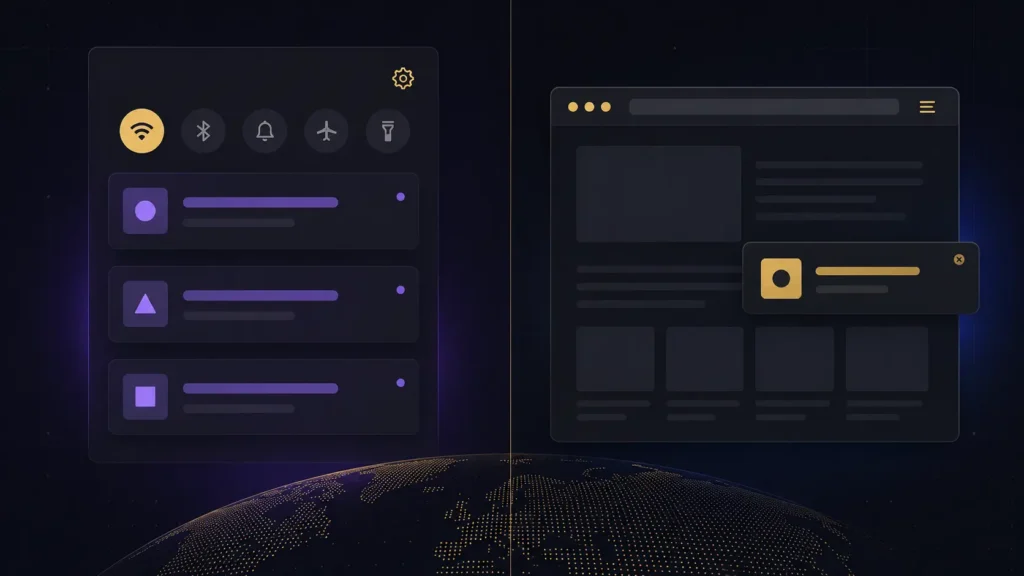
Push notification ads
Push notification ads are sent to devices that opted in through a website or app. The user agreed to receive alerts. The message lands in the notification tray, even when the browser is closed. This is the classic push format.
Because delivery happens outside the browser, classic push feels closer to a direct message than an ad. That is its strength and its risk. Handled well, it re-engages users who already know your brand. Handled badly, it annoys them into unsubscribing.
In-page push ads
In-page push ads are notification-styled units served inside a webpage. No subscription is required. The ad appears while someone browses a publisher site. Because there is no opt-in step, in-page push reaches every visitor, including the iOS users that classic push often misses.
Technically, in-page push behaves more like a banner than a true notification. It renders through a snippet on the page, so it does not depend on browser subscription rules. That makes it immune to the update cycles and opt-in changes that shrink classic push lists.
Keep this line clear: classic push needs a subscriber, and in-page push does not. The rest of this guide builds on that split.
How Do Push Ads Work?
If you have wondered how do push ads work under the hood, the mechanics are simpler than most formats. Each type follows a clear path from publisher to user, and each gives you a different set of levers to pull.
Classic push notification mechanics
A publisher adds a script to their site. Visitors see a prompt asking to allow notifications. Those who accept join a subscriber list. Advertisers then buy access to that list through an ad network.
From there, delivery is about timing and frequency. Messages land in the device tray, so an alert sent during active hours gets more clicks than one sent overnight. Send too often and users tune out or unsubscribe. Send too rarely and the list goes cold. Good campaigns cap frequency and match send times to each geo and time zone.
Subscriber age is the other variable. Fresh subscribers click more than older ones, so many advertisers target new sign-ups separately. Opt-in rates are also under pressure. On Android, they fell from 85% to 67% in a single year after a policy change, Batch reports. Smaller lists make targeting and creative quality more important than ever.
In-page push mechanics
In-page push skips the subscriber step. A publisher runs a snippet that displays notification-styled ads on the page. Every visitor can see them on the first visit. There is no list to build and no browser-update risk, which is why the format scales well and reaches iOS. For a deeper look at the non-intrusive side, our in-page push ads guide covers placement and iOS reach in detail.
The trade-off is intent. In-page viewers did not ask for your message, so they arrive colder than an opted-in subscriber. You make up for that with volume and precise targeting. Because the format shows to everyone, you can layer geo, device, and behavioral filters to reach the right slice of a large audience.
Bidding, pricing, and creative
Both types run on an auction. You set a bid, usually on a CPC basis, and compete for delivery. Higher bids win more impressions, so pricing follows demand for each geo and vertical. Tier-one traffic costs more than tier-three, and competitive verticals like iGaming push CPCs up.
A push creative has four parts: an icon, a title, a description, and an image. Each one does a job. The icon earns the first glance, the title carries the hook, the description adds context, and the image drives the click. Targeting then narrows delivery by geo, device, operating system, browser, and, for classic push, subscription age. The more precisely you target, the less budget you waste on users who will never convert.
One more note on pricing. Push CPCs stay low compared with search or paid social, which is what makes the format so cheap to test. You can validate an offer on a small budget before committing real spend. That low entry cost is a big part of why affiliates favor push.
Push Notification Ads vs In-Page Push: Which to Use
Both formats deliver strong CTRs. Pushwoosh puts the range at roughly 0.5% to 7.4%, depending on industry and platform. The right choice within that range depends on your goal.
Classic push carries higher intent. Subscribers chose to receive alerts, so they are a warmer audience. That makes classic push strong for re-engagement: bringing lapsed users back to an exchange, app, or casino. The catch is decay. Subscriber lists age, and older subscribers click less over time, so you are always topping the list up.
In-page push wins on reach. There is no subscription to build, so you get fresh audiences and scale from day one. It reaches iOS, where classic push falls short. For new-user acquisition, in-page push is usually the better starting point. The table below sums up the trade-offs.
| Factor | Push notification ads | In-page push | Takeaway |
|---|---|---|---|
| Audience | Opted-in subscribers | All page visitors | In-page reaches more people |
| Intent | Higher, they chose in | Broad, first-touch | Classic push runs warmer |
| iOS reach | Limited | Full | In-page covers iOS |
| List decay | Yes, lists age | No list to age | In-page stays fresh |
| Best use | Re-engagement | Acquisition and scale | Match format to goal |
Most experienced buyers run both, and split them by funnel stage. In-page push feeds the top of the funnel with new users, then classic push re-engages the ones who converted. If you want to test the acquisition side first, our in-page push inventory is the fastest way to reach every visitor on a page.
Best Verticals for Push Ads
Push is not a fit for every offer. It shines where speed, re-engagement, and high-intent audiences matter. If your offer is time-sensitive or your users churn fast, push earns its place in the mix. These are the verticals where push ads consistently perform.
- Crypto and Web3. Token launches, listing alerts, and exchange re-engagement suit push perfectly. A price move or a new listing is time-sensitive, and a notification-style ad matches that urgency. The offer usually looks like a short, direct alert: a listing announcement, a bonus, or a wallet reactivation prompt. Push works well for waking up dormant holders and traders.
- iGaming. Match-day alerts, welcome offers, and casino reactivation all convert on push. The format mirrors the alerts players already expect from betting apps, so it does not feel like an interruption. Lapsed-player reactivation is a classic push use case, and deposit bonuses are the offer that pulls it off.
- Finance and fintech. Trading apps, brokerages, and neobanks use push for sign-ups and app re-engagement. Short, direct messaging fits financial offers, where a single clear benefit beats a busy banner. Rate alerts, sign-up bonuses, and feature announcements all work.
- Gaming. Install and re-engagement campaigns run well, especially for reactivating players who stopped opening the app. Push notifications can lift 90-day retention by as much as 190%, Airship data shows. Level-up prompts, event alerts, and reward reminders are the offers that bring players back.
- Sweepstakes and nutra. High-volume, curiosity-led offers pair naturally with the punchy push format. These verticals live on scale, and in-page push delivers the reach they need.
These are also the verticals where AdsNetwork focuses, which is why push sits alongside display and native on the platform rather than as an afterthought.

How to Create High-Performing Push Ad Creative
Creative decides whether push works. The format gives you little space, so every element has to earn its place. Small changes to a title or icon can double a click-through rate, which makes testing the highest-leverage work you do.
- Write punchy titles. Lead with curiosity or a clear benefit. Keep it short enough to read at a glance, and put the hook in the first few words. A title that tries to say everything says nothing.
- Pick the right visuals. The icon and image both drive attention. Notifications with images earn CTRs almost 50% higher than text-only versions, per Business of Apps. Larger icons outperform small ones, so do not waste the space.
- Personalize by geo and language. A message in the user language and currency converts better than a generic blast. Context helps even more: Batch found that triggered, contextual campaigns hit a 14.4% open rate versus 4.19% for generic sends.
- Use emojis with care. Data from CleverTap shows emojis can raise CTR to 9.6%, compared with 3% without. Placement matters, though, so test them in the body before you scale.
Testing and rotating push ads
Fatigue kills push ads fast. The same creative shown too many times stops earning clicks. Rotate creatives often, run A/B tests on titles and images, and pause anything that dips below your target CPA.
A real example makes the point. Mobile studio Beach Bum Games added dice and trophy emojis to its backgammon alerts. The campaign reached an 8% to 12% push CTR, well above typical benchmarks. Pairing the emojis with a custom sound pushed engagement higher still.
Match the creative to the landing page. The message that earns the click has to be the message that greets the user next. When the promise in the push lines up with the page, conversion rates hold. When it does not, you pay for clicks that bounce. Consistency across the whole path is what turns a high CTR into real revenue.
Stay compliant while you optimize. No misleading claims. Never design a creative to look like a real system notification, because that erodes trust and gets campaigns pulled. The formats that last are the ones users do not feel tricked by.
How to Launch a Push Ad Campaign with AdsNetwork
Running your first campaign takes a handful of steps. None of them are complicated, but the order matters.
- Pick your push type. Choose classic push for re-engagement or in-page push for reach and iOS coverage. If you are acquiring new users, start with in-page.
- Set targeting. Narrow by geo, device, OS, and browser to match your offer. Start broad enough to gather data, then tighten once you see what converts.
- Set your CPC bid. Start conservative, then adjust once data comes in. Bidding too low starves delivery, so give the campaign room to compete.
- Build the creative. Icon, title, description, image. Prepare three to five variants so you have something to test from day one.
- Launch and optimize. Watch CTR and conversion rate together. A high CTR with weak conversions usually means a creative-to-landing-page mismatch. Cut weak placements and scale winners.
Measurement is where profit is found. Track CTR, conversion rate, and cost per acquisition side by side, not in isolation. Once a segment beats your CPA target, raise the bid and expand the geo. Once it slips, pull back. Push rewards this kind of steady, data-led tuning more than most formats.
As a push ad network built for crypto, iGaming, and finance, AdsNetwork runs both classic and in-page push from one dashboard. On-chain and behavioral targeting reach audiences that mainstream platforms restrict, so campaigns Google and Meta turn away can still run at scale.
| Ready to launch high-ROI push campaigns across crypto and iGaming? Get Access → |
Push Ads FAQ
How do push notification ads work?
How do push notification ads work? A user opts in to notifications on a website or app and joins a subscriber list. Advertisers buy access to that list and send notification-style messages to the device tray. The ads appear even when the browser is closed, which drives strong engagement.
What is in-page push advertising?
What is in-page push advertising? It is a notification-styled ad served inside a webpage, with no subscription required. Every visitor can see it on the first visit, including iOS users. Because there is no opt-in step, in-page push reaches wider audiences than classic push and scales quickly.
Are push ads effective?
Are push ads effective? Yes, push ranks among the highest-CTR formats in performance advertising. Airship found an average reaction rate of 7.8% across billions of notifications, and some verticals run higher. Effectiveness depends on targeting, creative, and frequency, so testing is essential.
What verticals work best for push ads?
What verticals work best for push ads? Crypto, iGaming, finance, gaming, and sweepstakes lead the list. These verticals rely on time-sensitive offers and re-engagement, which suit the notification format. Crypto listing alerts and casino reactivation are two of the strongest push use cases.
Push Ads: The Bottom Line
Push ads are cheap to test, high in intent, and effective across the verticals that matter most in performance marketing. The key is matching the format to the goal. Use classic push notification ads for re-engagement. Use in-page push for reach and iOS coverage. Get that choice right, test your creative hard, and push becomes one of the most efficient channels in your mix.
| Put push ads to work for your next campaign. Get Access → |
Featured Posts
Oct 23, 2026
10 min read
What Is CPM in Advertising? Meaning, Formula and 2026 Rates
CPM is the cost an advertiser pays for 1,000 ad impressions, making it one of the most common…
Read Article
Sep 23, 2026
6 min read
What Is Advertising Technology (AdTech) and How Does It Work?
Advertising technology, commonly known as AdTech, refers to the software, platforms, tools, and systems used to plan, buy,…
Read Article
Sep 16, 2026
8 min read
Media Buying: A Complete Guide for Advertisers
Media buying is the process of purchasing advertising space to reach a target audience. It includes choosing where…
Read ArticleNeed Help?
Our team is ready to help you launch successful campaigns.
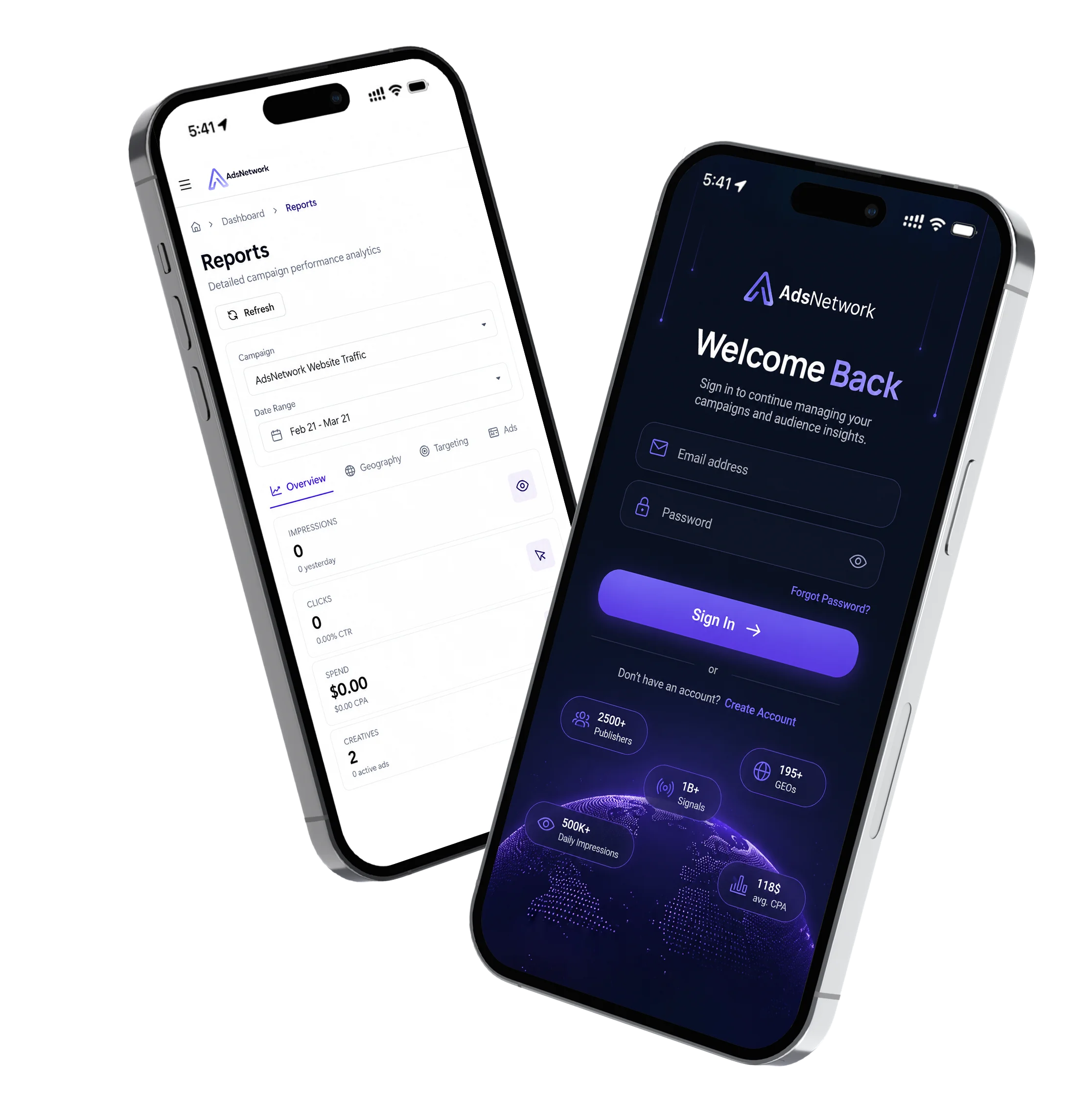
AI-Powered Mobile
Monitor Your Campaigns Anywhere
Stay connected to your live AdsNetwork campaigns with our mobile advertising app. Track impressions, clicks, conversions, campaign spend, and overall performance in real time—anytime, anywhere. Available for iOS and Android.