

Casino and sportsbook get filed under one word: iGaming. That single word hides a costly habit. Online casino advertising and sports betting advertising are not the same job. They reach different players, follow different calendars, and reward different creative. Operators who run both on one template quietly waste budget, month after month.
Here is the split that matters. Casino is evergreen. Players show up every day, so the real work is retention. Sports betting is event-driven. Demand spikes around fixtures, then falls flat between them. Treat those two rhythms the same, and one product ends up carrying the other’s dead weight.
This guide separates them. You get a product-specific playbook for each, covering the audiences, the seasonality, the formats, and the compliance lines that shift by product. In short, good iGaming advertising starts by admitting casino and betting are two businesses wearing one label.

Casino and sports betting share a platform, not a playbook. Each product needs its own audience, timing, and creative.
Online Casino Advertising vs Sports Betting: Why Advertising Differs
From the outside, the two products look like twins. Both take deposits, both live on mobile, and both chase first-time deposits, or FTDs. Under the hood, though, the advertising logic pulls apart fast.
Start with scale, because it sets the wrong expectation. The online gambling market was worth about 88.0 billion dollars in 2025, and sports betting held roughly half of it, according to Grand View Research. Revenue tells a different story, however. In the United States, casino slots and table games pulled in around three times the revenue of sports betting in 2025, per Statista. Casino is the quiet giant. Betting is the loud, spiky challenger. So the money follows one pattern, while the headlines follow another.
Two Different Audiences
Casino draws entertainment players. They come for slots, live dealer tables, and the next jackpot, and they treat it like a game. Sports betting draws sports fans. They come for the match, the odds, and the argument with their mates about who wins. Because those mindsets differ, the creative, the copy, and even the ad placement have to differ with them.
This is why a blended message underperforms. A slots visual means nothing to a bettor scanning the weekend fixtures. A boosted-odds banner means nothing to a slots player looking for a bonus. When the audience splits this cleanly, the advertising should split with it.
Intent differs, too. A casino player is often browsing for entertainment, open to a new game or a fresh bonus. A bettor usually arrives with a decision already forming: which team, which market, which line. Meet each one where their intent sits, and conversion follows.
Two Different Calendars
Casino demand is steady all year. Betting demand tracks the sports calendar instead. The gap is stark. United States sports betting handle peaks near 16 billion dollars in January, then falls to roughly half that by July, according to the University of Kansas School of Business. Casino barely notices the season at all.
For planning, that difference is everything. A casino budget can run flat and compound through retention. A sportsbook budget has to breathe: scale hard into fixtures, then pull back into quiet weeks. Run a sportsbook on a flat casino budget, and you overspend in the off-season while underspending when it counts.
There is a second-order effect as well. Casino can plan a year ahead on steady numbers. A sportsbook plan has to stay flexible, since one deep tournament run can double weekly volume overnight. Build that flexibility into the media plan, or the spike simply passes you by.
| Dimension | Online casino | Sports betting |
|---|---|---|
| Core audience | Entertainment and slots players | Sports fans following fixtures |
| Demand pattern | Steady and evergreen | Event-driven, sharp peaks |
| Peak timing | Largely season-agnostic | Tournaments, playoffs, big matches |
| Core creative | Games, jackpots, live dealer | Odds, boosts, live events |
| Key metric | FTD, retention, ARPU | FTD around events, bet frequency |
How to Advertise Online Casino Products
Online casino advertising is a retention game wearing an acquisition costume. Yes, you still acquire new players. The profit, though, sits in keeping them and in waking up the ones who drifted away. So build every casino campaign to reward the repeat visit, not just the first click.
Online Casino Advertising Channels and Formats
The first thing to settle about how to advertise online casino products is format fit. Casino rewards formats that surface again and again in front of the same player. In practice, that means a few reliable channels:
- Native ads: placements that sit inside gaming and entertainment content, so the game showcase reads as editorial rather than a hard sell.
- In-page push: short, repeatable nudges that bring lapsed players back for a new slot release, a tournament, or a reload offer.
- Pop-under: high-volume placements that drive registration numbers when you need reach at a manageable cost.
- Display: steady banner coverage across gaming publishers for always-on brand presence.
A casino advertising network built for gaming inventory beats a generic platform here, because it already sits on the publishers where slots and table players spend time. Reach without relevance just burns money.
Casino Creative That Converts
Casino creative sells the game itself. Lead with what players want to see: jackpots, new slot themes, live dealer tables, and welcome offers that stay inside the rules. Recognizable content does a lot of the heavy lifting, too. As an example, Evolution’s tie-up with Hasbro to build branded live titles around Monopoly and Clue shows the pattern, as reported by Polaris Market Research. Familiar names pull players in and keep them playing.
Keep the promise clean, though. No guaranteed-win language, no chasing-losses framing. Show the entertainment, state the terms plainly, and let responsible-play messaging sit where players can see it.
Freshness matters here, too. Slot libraries update constantly, so rotate creative around new releases and seasonal themes. Stale banners train players to scroll past. A steady drip of fresh game art keeps the same audience engaged month after month, which is exactly what a retention product needs.
Casino Targeting and Metrics
Target entertainment and gaming audiences first, then layer in reactivation of lapsed players as your second engine. Measure the right things as well. FTD gets a player in the door, but retention and average revenue per user (ARPU) decide whether that player was worth acquiring. Above all, judge casino spend on lifetime value, not on the cost of the first click.
Segmentation sharpens all of this. Separate new players from returning ones, and split slots fans from table players. Each group responds to different offers and different creative. A reload bonus wins back a lapsed slots player, while a live-dealer promo speaks to someone who never touched the reels. When the segments are clean, every dollar works harder.
How to Advertise Sports Betting Products
Sports betting advertising lives or dies by timing. You can use many of the same channels as casino, yet the sports calendar, not the media plan, runs the campaign. Get the timing right, and the same budget delivers far more. Get it wrong, and you pour spend into weeks when nobody is betting.
Event-Timed Channels and Bidding
The channels look familiar, but you deploy them on the clock. Event-timed bidding is the core discipline: raise budgets and bids into a fixture window, then ease off once it closes. Push and mobile formats do heavy lifting before big matches, driving app installs and re-engagement while interest peaks. Because attention is fleeting, speed matters more here than in any casino campaign.
Preparation is the real edge. Set your calendar before the season starts, mark the fixtures that matter for your markets, then pre-load creative and budgets for each window. When the whistle blows, you want campaigns live, not stuck in review. That readiness separates a sportsbook that captures the spike from one that watches it pass.
Sports Betting Advertising Creative and Timing
Betting creative sells the event, not the platform. Show live odds, boosted markets, marquee fixtures, and the moments fans already care about. Timing then mirrors the sports calendar. The clearest recent example is the 2026 World Cup. Analysts projected about 2.9 billion dollars wagered at United States sportsbooks, more than double the 2022 tournament, according to ESPN. Major operators answered by running full slates across all 104 matches. That is sports betting advertising at full tilt.
Daypart logic tightens it further. When group games land in prime time, traffic climbs, so smart operators buy hard into those windows and trim spend when the schedule goes quiet. The same idea scales to any tournament, playoff run, or derby weekend.
Sports Betting Metrics
Judge a sportsbook campaign on FTDs around events and on bet frequency, not on a flat monthly average. Track reactivation for the next fixture, since a bettor who returns each weekend is worth many one-off sign-ups. Off-season, the goal flips to protecting margin. Do not overspend into dead air just to keep the numbers moving.
One more habit pays off: read results per event, not per month. A quiet April can hide a strong Champions League week, and a monthly average blurs both. Break performance down by fixture instead, and the next campaign gets sharper every time.
Ad Formats Compared: Casino vs Sports Betting
The same format library serves both products, yet the budget split changes by goal. Casino leans on formats that repeat in front of the same player. Sports betting leans on formats that spike fast and travel well on mobile. The table below maps where each format earns its keep.
| Format | Best for casino | Best for sports betting |
|---|---|---|
| Native | Strong: game showcases in gaming content | Useful: odds and previews in sports content |
| Display | Steady: always-on brand presence | Strong: banners around live scores |
| In-page push | Strong: retention and reactivation | Strong: pre-match and live re-engagement |
| Pop-under | Strong: registration volume | Situational: reach ahead of a big event |
| Mobile interstitial | Useful: full-screen slot promos | Strong: app installs before major fixtures |
Budget ratios follow the same logic. For a casino-only operator, most spend sits in native and push for repeat exposure. For a sportsbook, the bulk shifts to event push and interstitial in the days around a fixture. Multi-product operators keep the two pools separate and run them on their own calendars, so neither product drains the other.
Practically, casino money flows toward native, push, and pop for repeat exposure and reactivation. Sports betting money flows toward event push, mobile interstitial, and display around live action. For the broader operator view across both products, our iGaming advertising guide walks through channel strategy end to end.
Compliance for Casino and Sports Betting Ads
Compliance is where the two products separate most sharply, and where guessing gets expensive. Some markets license casino but not betting, or the reverse. So the first rule is simple: geo-lock every campaign to markets where you already hold a licence for that specific product. That responsibility sits with the operator, not the network.
Rules also vary by regulator. In Great Britain, an operator must hold a Gambling Commission licence to advertise to British consumers, and every ad has to follow the advertising codes administered by the ASA, as set out by the UK Gambling Commission. Ads must not appeal to children, and they must never suggest that gambling fixes money problems.
Malta takes a similar line with different detail. Under its rules, adverts must display the licensee’s name, licence number, the minimum age to participate, and responsible-gaming information, according to the Malta Gaming Authority. Those requirements extend to social media and to affiliates acting on your behalf.
Rules also move over time. Advertising limits, stake caps, and bonus restrictions change from year to year across major markets. What passed review last season can breach a new code this one. So treat each regulator’s current guidance as the source of truth, and refresh your creative checklist before every big push.
Rules That Differ by Product
Beyond the shared basics, each product carries its own sensitivities. Sports betting sits close to sporting integrity, so anything hinting at fixed outcomes or insider certainty is a hard line. Casino attracts more scrutiny on affordability and responsible play, given how repeat sessions work. Online casino advertising and sportsbook ads therefore share one baseline, then add product-specific care on top. None of this is legal advice, so confirm the current rules in every market with your compliance team before launch.
Documentation helps as well. Keep a simple record of which markets you target, which product each campaign promotes, and which licence covers it. Networks and regulators both ask, and a clear paper trail speeds approvals. In practice, the best operators treat compliance as part of the media plan, not a box ticked at the end.
Running Casino & Sports Betting Campaigns with AdsNetwork
Since casino and betting need different rhythms, the practical question is how to run both without building two separate operations. When you weigh a distribution partner, a few criteria matter more than the sales deck:
- Compliance-first iGaming inventory, so casino and betting ads land on publishers that already accept regulated gambling.
- Event-timed bidding, so a sportsbook campaign can scale into a fixture and ease off afterward without manual firefighting.
- Retention and reactivation formats, so casino spend keeps working on lapsed players, not just new ones.
- Granular geo-targeting, so every campaign stays inside the markets where you hold the right licence.
AdsNetwork was built around those exact needs for crypto and iGaming operators. It runs native, display, push, pop, and interstitial formats from one dashboard, which keeps casino and betting campaigns comparable side by side. For sportsbooks, AdsNetwork supports event-timed bidding into peak windows. For casinos, it leans on push and native for retention. To go deeper on the acquisition funnel, our iGaming performance marketing breakdown covers registrations, FTDs, and lifetime value in detail.
Launching either product follows the same short path. Define the product and its licensed markets, choose formats that match the goal, set the calendar (flat for casino, event-timed for betting), then measure on the metric that fits: retention and ARPU for casino, event FTDs and bet frequency for betting.
| Ready to run casino and sportsbook campaigns on inventory built for regulated gambling? Start with a compliance-first plan for each product.Get Access → |
Frequently Asked Questions
How do you advertise iGaming products?
How do you advertise iGaming products effectively? You split the work by product. Casino runs evergreen, retention-led campaigns built on native, push, and pop formats. Sports betting runs event-timed campaigns that scale into fixtures. Both chase FTDs, yet each needs its own audience, calendar, and creative to avoid wasted spend.
How do you advertise a sportsbook?
Knowing how to advertise a sportsbook comes down to timing. Map your spend to the sports calendar, then scale hard into major fixtures with odds-led creative and event-timed bidding. Push and mobile formats drive installs before big matches. Between events, pull budgets back and focus on reactivating bettors for the next fixture.
Is online casino advertising allowed?
Is online casino advertising allowed? Yes, in markets where you hold a valid licence for the product and where you follow the local advertising codes. Rules differ by regulator, and some markets license casino but not betting. Geo-lock every campaign to licensed markets, and keep responsible-gambling messaging clear and visible.
What ad formats work for sports betting?
What ad formats work for sports betting best? Event push, mobile interstitial, and display around live scores lead the way, because they spike quickly and travel well on mobile. Native works for previews and odds inside sports content. The winning mix depends on the fixture and the market, so test formats per event.
Online Casino Advertising and Sports Betting: One Platform, Two Playbooks
Casino and betting share a platform, not a playbook. Casino rewards patience: acquire, retain, reactivate, and compound value over time. Betting rewards timing: scale into the fixture, capture the spike, then protect margin in the quiet weeks. Run each to its own audience and rhythm, and the same budget stretches further across both.
So stop treating iGaming as one thing. Online casino advertising and sports betting advertising deserve separate plans, separate creative, and separate calendars. Split them cleanly, and you stop paying for one product’s dead weight while the other does the work.
| Build a product-specific plan for casino and sportsbook campaigns, with compliance and targeting handled from day one. Get Access → |
Featured Posts
Oct 23, 2026
10 min read
What Is CPM in Advertising? Meaning, Formula and 2026 Rates
CPM is the cost an advertiser pays for 1,000 ad impressions, making it one of the most common…
Read Article
Sep 23, 2026
6 min read
What Is Advertising Technology (AdTech) and How Does It Work?
Advertising technology, commonly known as AdTech, refers to the software, platforms, tools, and systems used to plan, buy,…
Read Article
Sep 16, 2026
8 min read
Media Buying: A Complete Guide for Advertisers
Media buying is the process of purchasing advertising space to reach a target audience. It includes choosing where…
Read ArticleNeed Help?
Our team is ready to help you launch successful campaigns.
AI-Powered Mobile
Monitor Your Campaigns Anywhere
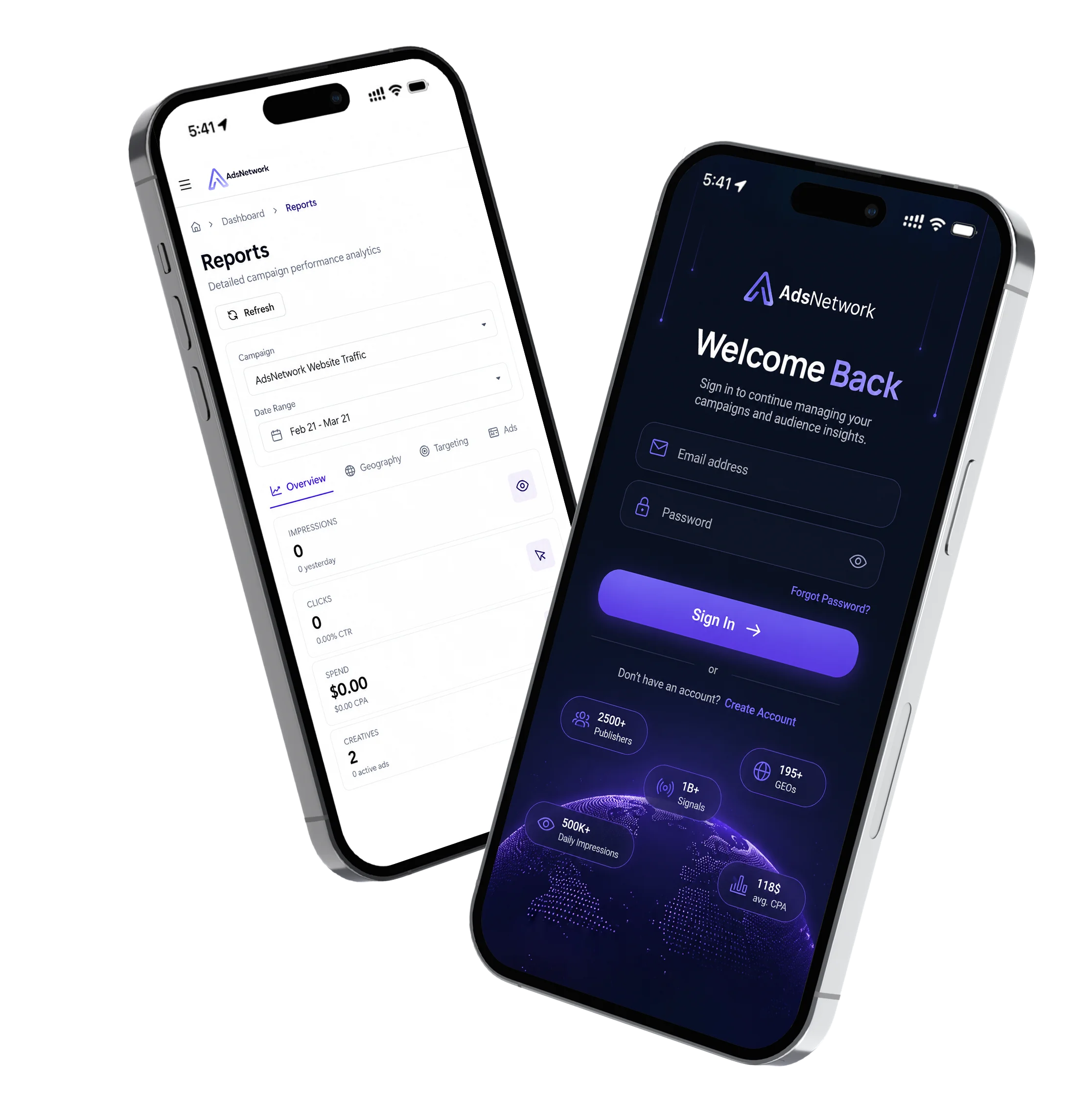
Stay connected to your live AdsNetwork campaigns with our mobile advertising app. Track impressions, clicks, conversions, campaign spend, and overall performance in real time—anytime, anywhere. Available for iOS and Android.