
The iGaming market crossed $130 billion in 2026, according to Business Research Company market data. With that scale comes fierce competition. Every casino, sportsbook, and poker platform is fighting for the same players across the same channels. For operators, iGaming advertising has become the central battleground where growth is won or lost.
Traditional advertising platforms create significant barriers for the industry. Google requires written certification before showing gambling ads. Meta runs a multi-tiered approval process that varies by jurisdiction and can take weeks. Many programmatic networks simply exclude gambling inventory. As a result, iGaming operators must navigate a tighter, more specialized advertising ecosystem than almost any other vertical.
This guide covers the iGaming advertising landscape in full: how it differs from other verticals, which ad formats drive player acquisition, how programmatic strategies work for casinos and sportsbooks, what compliance and geo-restriction rules apply, and how to measure campaign performance accurately. Whether you are launching a new brand or scaling an established operator, this is the framework you need.
The iGaming Advertising Landscape in 2026
iGaming advertising differs from other digital marketing verticals in several fundamental ways. Understanding these differences is the foundation of any effective strategy.
First, the audience. iGaming players are not passive consumers. They are active, often daily users who respond to specific triggers: welcome bonuses, odds promotions, free spins, and deposit matches. Consequently, performance-based advertising dominates the industry. Operators pay for measurable outcomes, not impressions. As an industry benchmark, on average 25 to 30% of iGaming revenue is reinvested into marketing, one of the highest ratios of any industry.
Second, the competition is extreme. The market is consolidating rapidly. Large platforms are absorbing niche operators, and the cost to acquire a depositing player in a Tier 1 market ranges from $200 to $600 CPA. In contrast, emerging markets in Latin America, Southeast Asia, and Africa offer lower acquisition costs but require different compliance and localization approaches.
Third, mobile dominates. Mobile and tablet platforms captured 53.65% of online gambling revenue in 2025. Furthermore, 70% of online betting is now conducted via mobile devices. This fundamentally shapes which ad formats perform, which placements convert, and how funnels must be designed.
Ad Formats That Work for iGaming Operators
Not every ad format performs equally for gambling brands. The highest-converting iGaming ad formats share one quality: they reach users with intent at the moment they are actively browsing gambling-adjacent content.
Display Banner Ads
Display banners remain the most widely used iGaming ad format. They appear across sports media, casino review sites, fantasy sports platforms, and financial news publishers. Standard IAB sizes, particularly the 728×90 leaderboard and the 300×250 rectangle, are workhorses for brand awareness and retargeting. For iGaming, rich media HTML5 banners that animate bonuses or free spin offers consistently outperform static creatives.
Native Ads
Native ads match the editorial tone of the publisher, making them less intrusive and more persuasive for educated gambling audiences. A native placement on a sports betting news site, framed as editorial content, reaches readers in a high-intent context. Furthermore, native ads typically avoid the banner blindness that affects display placements on high-traffic sites.
In-Page Push Ads
In-page push notifications deliver browser-style alerts directly within web pages. They do not require subscription opt-in, making them easier to deploy than classic push notifications. For iGaming, in-page push works especially well for time-sensitive promotions such as live sports bonuses, limited-time deposit offers, and jackpot alerts. The immediacy of the format creates urgency that drives click-through rates above display benchmarks.
Pop-Under Ads
Pop-under ads open behind the active browser tab and are seen once the user finishes their current session. They provide high volume at low CPM, making them suitable for top-of-funnel awareness in markets where brand recognition is the primary goal. However, traffic quality requires careful vetting. Work only with networks that provide brand safety controls and fraud filtering.
Video Pre-Roll Ads
Video pre-roll placements on sports streaming and casino entertainment platforms deliver strong brand impact for iGaming operators. A 15-second pre-roll on a live sports stream reaches viewers in a directly relevant context. Specifically, the audience is already engaged with competitive activity, which makes conversion to a sportsbook or live casino product more natural.
Programmatic Strategies for Acquiring iGaming Players
Programmatic advertising has become the dominant player acquisition channel for scaling iGaming operators. Instead of negotiating individual placements, programmatic technology connects campaigns to thousands of publisher sites simultaneously through automated real-time auctions. This provides speed, scale, and targeting precision that direct buys cannot match.
How Real-Time Bidding Works in iGaming
When an iGaming player visits a publisher site, the ad server sends a bid request to multiple DSPs (Demand-Side Platforms) in milliseconds. Each DSP evaluates the impression against the advertiser’s targeting criteria and bids accordingly. The highest bidder wins the placement, and the ad appears before the page fully loads. For iGaming operators, this process allows targeting based on geography, device, browser, time of day, and behavioral data simultaneously.
Audience Segmentation for iGaming Campaigns
Effective iGaming advertising relies on precise audience segmentation. Generic targeting wastes budget quickly in a vertical where CPAs are high. Instead, successful operators segment by several key dimensions.
- Geo tier: Tier 1 markets (UK, Germany, Canada) command premium CPMs but deliver higher LTV players. Tier 2 and 3 markets offer lower acquisition costs but require adjusted bonus structures.
- Device type: Mobile-first creatives are mandatory in most markets. Desktop audiences typically show higher average deposit values.
- Behavioral intent: Users browsing sports betting forums, casino review sites, or financial news have measurably higher conversion rates than broad interest-based segments.
- Engagement recency: Retargeting visitors who browsed but did not register within the previous 7 to 14 days is one of the most cost-efficient acquisition tactics in iGaming.
The CPM-to-CPA Funnel Strategy
The most effective iGaming programmatic campaigns run in two phases. Phase one uses CPM (Cost Per Mille) buying to build brand awareness and populate retargeting pools. Phase two shifts to CPA or CPC optimization once the data identifies which audience segments convert at acceptable rates. This hybrid approach is also proven in adjacent verticals. For broader context on these programmatic mechanics, the iGaming advertising playbook covers campaign execution in detail.
Specifically, the hybrid model prevents the common mistake of launching CPA campaigns before gathering sufficient conversion data. Bidding algorithms cannot optimize toward conversions they have not observed, so the CPM awareness phase builds the dataset that powers the CPA phase.
Compliance and Geo-Restrictions in iGaming Advertising
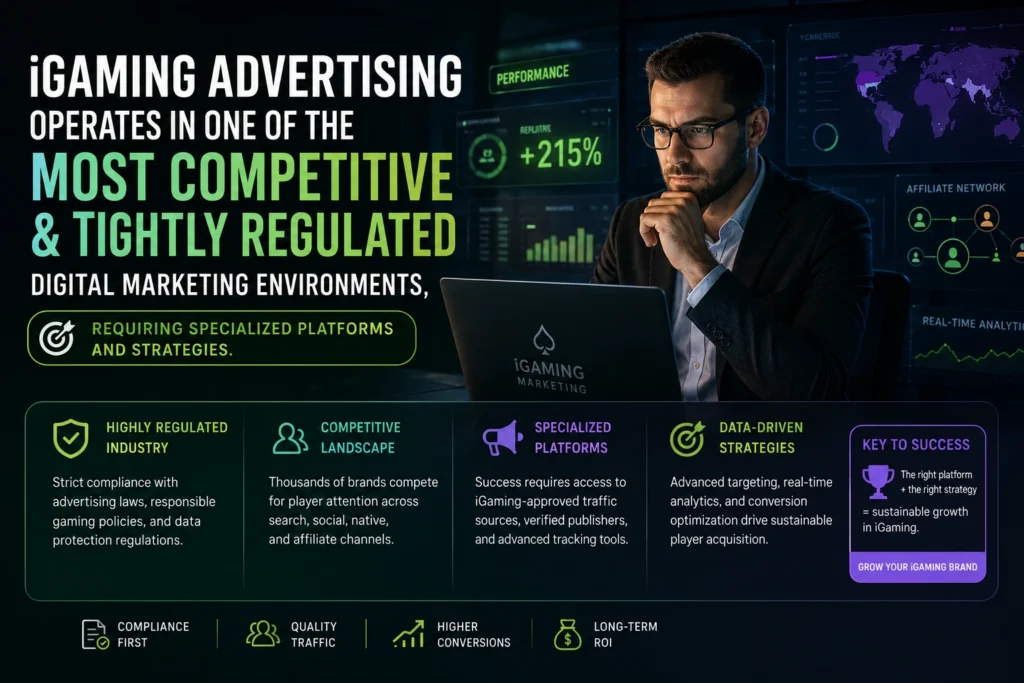
Compliance is not a checkbox in iGaming advertising. It is a design constraint that determines where campaigns can run, what creatives can say, and which audiences can be targeted. Operators who treat compliance as an afterthought face account bans, regulatory fines, and reputational damage.
Key Geographic Restrictions
Europe leads global iGaming revenue with a 56.9% market share. However, each European jurisdiction operates under different rules. The UK requires operators to hold a Gambling Commission license before running any advertising. Germany restricts advertising to licensed operators under the State Treaty on Gambling, limiting campaign times and messaging. Italy, France, and Spain each have their own licensing requirements and advertising restrictions.
In the United States, iGaming advertising is legal in states that have authorized online casino or sports betting, but remains illegal in others. As of 2026, over 25 states have legalized online sports betting. Consequently, campaigns must apply strict geo-fencing to avoid serving ads in prohibited states, because violations can result in loss of operating licenses.
Asia-Pacific presents high volume but complex compliance. Several major markets, including China and Japan, prohibit most online gambling advertising. In contrast, regulated markets like the Philippines and several Australian states permit licensed operations with clear advertising guidelines. As a result, campaigns targeting this region require market-by-market legal review before launch.
Platform-Level Compliance Rules
Google requires operators to complete a certification process for gambling ads, which includes providing evidence of regulatory licenses for each target country. Meta operates a similar multi-tiered approval system requiring written permission before campaigns can go live. Both platforms enforce age-targeting restrictions that prohibit serving ads to users below the legal gambling age in each jurisdiction.
Specialized iGaming ad networks manage much of this complexity natively. According to Traffic Nomads’ 2026 iGaming campaign guide, advertisers should prioritize networks that understand compliance requirements, geo-restrictions, and user behavior unique to betting audiences rather than generic multi-vertical platforms.
Responsible Gambling Requirements
Most regulated markets require iGaming ads to include responsible gambling messaging. Ads must link to resources like GambleAware in the UK. Additionally, campaigns must exclude vulnerable populations and implement frequency caps to avoid targeting problem gamblers with excessive promotional messages. These requirements apply at the ad network, DSP, and publisher levels simultaneously, so operators must verify compliance at each layer of their stack.
How to Measure Performance in iGaming Campaigns
iGaming advertising performance is measured differently from standard e-commerce or lead generation campaigns. The metrics that matter most tie directly to player revenue rather than surface-level engagement.
First-Time Deposit (FTD) and Cost Per Acquisition (CPA)
The First-Time Deposit is the primary conversion event in iGaming. A user becomes a real customer only when they deposit and wager. Accordingly, cost per FTD is the central KPI for acquisition campaigns. In Tier 1 markets like the UK and Germany, CPA rates for a depositing player typically range from $200 to $600. In Tier 2 markets such as Poland, Romania, and Canada outside Ontario, CPAs run between $80 and $200. Campaign optimization should target a CPA well below the expected player LTV to ensure profitability.
Player Lifetime Value (LTV)
LTV is the total revenue a player generates across their relationship with the operator. Since acquiring a player costs significantly more than retaining one, LTV optimization is as important as acquisition. A healthy iGaming marketing program targets an LTV to CPA ratio of at least 3:1. This means each $100 spent on acquisition should generate $300 or more in player revenue over 12 months. Tracking LTV requires integrating campaign data with your player management system.
Return on Ad Spend (ROAS)
ROAS measures revenue generated for every dollar of advertising spend. For iGaming, ROAS above 3x is generally considered a healthy benchmark at the campaign level. However, ROAS varies significantly by market, bonus structure, and player segment. A well-optimized campaign targeting high-intent users in a competitive market might deliver 4 to 6x ROAS, while broad awareness campaigns in emerging markets may run at 1.5x during the brand-building phase.
Retention Rate and Reactivation
Player churn is a significant cost in iGaming. Tracking 30-day, 60-day, and 90-day retention rates reveals whether acquired players have genuine long-term value or are simply bonus hunters. Additionally, reactivation campaigns targeting lapsed players through email, retargeting, and SMS typically deliver CPAs at 20 to 40% of new player acquisition costs, making retention marketing one of the most efficient channels in the iGaming stack.
Core Traffic Channels in iGaming Performance Marketing
Successful iGaming operators rarely rely on a single traffic source. A diversified multi-channel strategy reduces dependency, improves resilience against platform policy changes, and provides more data points for optimization.
Affiliate Marketing
Affiliate marketing drives between 40% and 70% of total traffic for most online casinos. Affiliates promote operators through casino review sites, SEO content, comparison platforms, and paid traffic campaigns. Compensation models include CPA (fixed payment per depositing player), revenue share (percentage of player GGR), and hybrid deals combining both. For operators, affiliates provide performance-based traffic with zero upfront cost, which makes them essential infrastructure for any acquisition strategy.
Programmatic Display and Native Advertising
Programmatic advertising provides the scale that direct affiliate relationships cannot. By connecting to thousands of publishers simultaneously, operators can reach large audiences across sports media, entertainment sites, and gambling-adjacent content. AdsNetwork connects iGaming advertisers with premium publishers worldwide, providing compliant campaign infrastructure, flexible ad formats, and real-time optimization tools built specifically for operators in regulated verticals.
SEO and Content Marketing
Search engine optimization generates high-intent organic traffic at low marginal cost. Users searching for terms like “best online casino,” “sports betting bonus,” or “live blackjack” are in active purchase mode. Consequently, SEO-driven content, including casino reviews, bonus guides, game tutorials, and betting strategies, captures these users at the lowest possible cost per conversion. The tradeoff is time: SEO takes six to twelve months to build meaningful traffic.
Email and SMS Retention Marketing
Email and SMS are the highest-ROI channels for retention and reactivation. Welcome sequences guide new players through their first deposit. Weekly promotions keep active players engaged. Re-engagement campaigns target dormant users with personalized bonus offers. According to SOFTSWISS 2025 data, influencer and direct communication channels have been identified as the most important promotional channels in 2026. Segmentation is critical here. A new depositor and a lapsed player who was once high-value require entirely different messaging and incentives.
Building a High-Converting iGaming Acquisition Funnel
Traffic alone does not guarantee profitability. The real performance of any iGaming advertising campaign is determined by what happens after the click. Each stage of the acquisition funnel requires specific optimization.
Landing Page Optimization
Landing pages should minimize friction and maximize the perceived value of registration. Specifically, effective iGaming landing pages load in under two seconds, lead with the welcome offer, display trust signals such as licensing badges prominently, and use a single focused call to action. Mobile-first design is mandatory, as more than half of traffic arrives on mobile devices.
Registration and KYC Optimization
Registration drop-off is one of the most common sources of wasted iGaming advertising spend. Specifically, each additional form field reduces completion rates. Operators who implement streamlined registration flows, pre-filled social login options, and single-step email verification consistently see 20 to 40% higher registration conversion rates. KYC verification, required in most regulated markets, should be positioned as a trust benefit rather than a bureaucratic hurdle.
First Deposit Strategy
The First-Time Deposit is where iGaming advertising investment either pays off or doesn’t. Welcome bonuses, deposit match promotions, and free spins are the standard tools. However, the bonus structure must align with the player segment the campaign is targeting. High-value sports bettors respond to free bet offers. Casino slots players respond to free spins. Table game players often value cash bonuses over matched deposits. In other words, segmented bonus strategy converts better than generic welcome offers across all player types.
How AdsNetwork Supports iGaming Operators
iGaming advertisers need platforms that understand their compliance requirements, accept their campaigns without policy friction, and provide the targeting capabilities to reach genuine players. AdsNetwork is built for exactly this. The platform connects iGaming advertisers with premium publishers across sports media, casino review networks, and gambling-adjacent content publishers worldwide.
Campaign targeting extends to geo, device, browser, time of day, and behavioral signals. Multiple ad formats are supported including display banners, native, video, in-page push, and pop-under, giving operators the creative flexibility to test what works. Real-time reporting dashboards provide the conversion tracking and attribution data needed to optimize toward FTD cost rather than surface-level click metrics.
For operators developing their full marketing strategy, see our iGaming advertising playbook for a step-by-step campaign execution guide. Ready to launch? Explore AdsNetwork’s iGaming advertising solutions to reach verified, high-intent iGaming audiences.
Timing Spend to Tournament Demand
Performance marketing in iGaming lives and dies by timing. Betting demand is not steady, it clusters around major tournaments when casual players enter the market and active bettors increase their volume. Programmatic strategies let you read these signals and shift budget toward high-intent moments instead of burning spend on flat periods.
Reaching World Cup bettors takes more than raising bids. Segment audiences by betting behavior, retarget users who browsed but did not deposit, and adjust frequency as match days approach. Tie your KPIs to deposits and first bets, not just clicks, so your spend tracks the outcomes that actually drive revenue.
iGaming Advertising: The Path to Profitable Player Acquisition
iGaming advertising in 2026 operates at the intersection of performance marketing, regulatory compliance, and advanced programmatic technology. The operators who grow profitably are those who combine a multi-channel acquisition strategy with rigorous funnel optimization, geo-specific compliance infrastructure, and LTV-focused measurement frameworks.
The market is $130 billion and growing. Player acquisition costs are high, but so is player lifetime value when campaigns are built correctly. Furthermore, the competitive advantage in iGaming advertising does not come from spending more. Instead, it comes from targeting better, optimizing faster, and building compliance into every layer of the campaign before launch. Start with the channels that fit your market and player profile, then scale what the data proves.
Featured Posts
Sep 23, 2026
6 min read
What Is Advertising Technology (AdTech) and How Does It Work?
Advertising technology, commonly known as AdTech, refers to the software, platforms, tools, and systems used to plan, buy,…
Read Article
Sep 16, 2026
8 min read
Media Buying: A Complete Guide for Advertisers
Media buying is the process of purchasing advertising space to reach a target audience. It includes choosing where…
Read Article
Sep 7, 2026
8 min read
Programmatic Advertising vs Display Advertising: What’s the Difference?
Programmatic and display advertising are often used interchangeably, but they describe two different parts of digital advertising. Display…
Read ArticleNeed Help?
Our team is ready to help you launch successful campaigns.
AI-Powered Mobile
Monitor Your Campaigns Anywhere
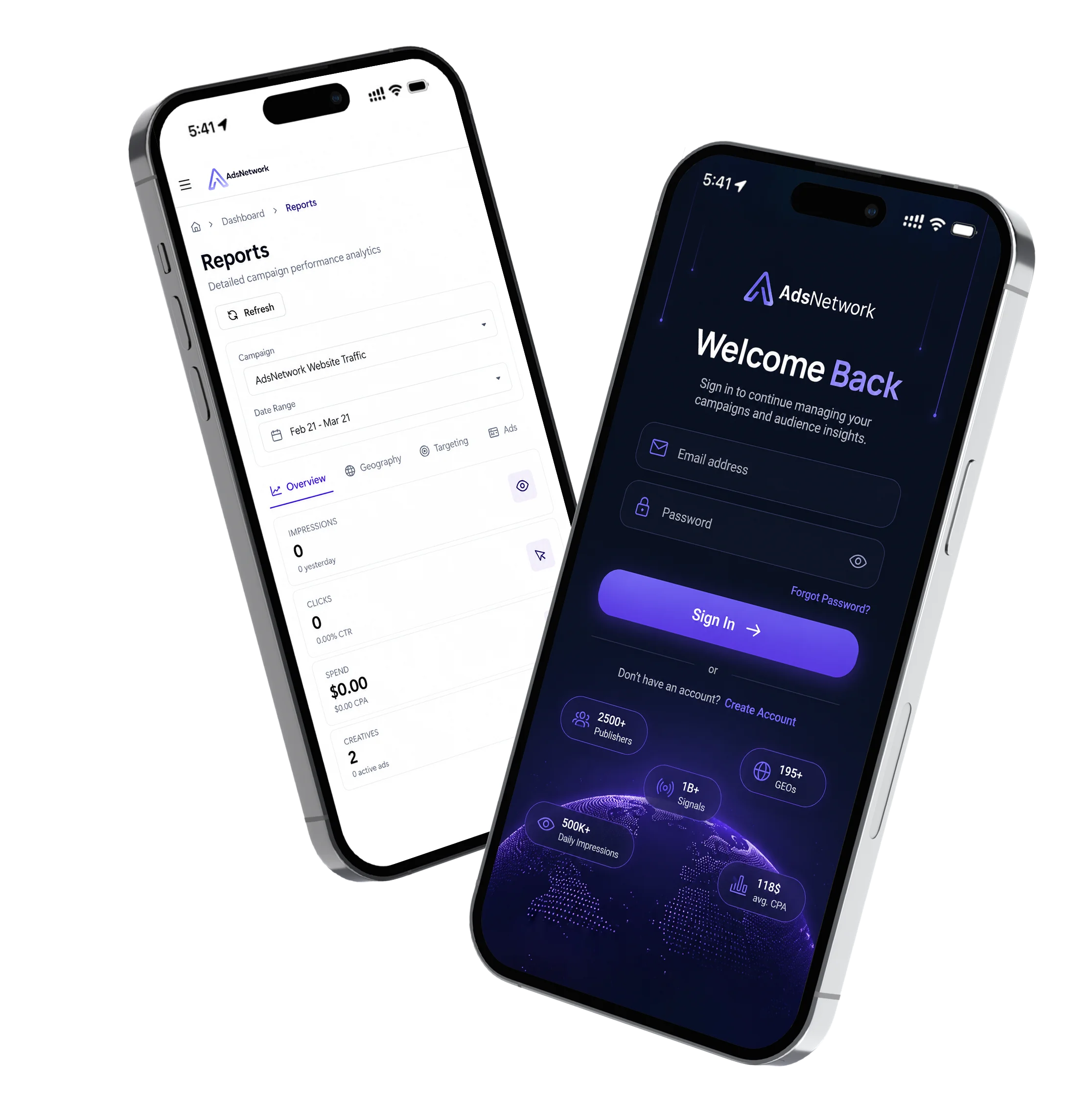
Stay connected to your live AdsNetwork campaigns with our mobile advertising app. Track impressions, clicks, conversions, campaign spend, and overall performance in real time—anytime, anywhere. Available for iOS and Android.