
iGaming advertising is entering a new era of scale, regulation, and performance-driven strategy. The online gambling market crossed $130 billion in 2026, and global iGaming ad spend continues to grow at double digits. The opportunity for operators and affiliates has never been larger. However, neither have the challenges: tighter compliance rules, rising acquisition costs, and more sophisticated players demanding better experiences.
This playbook provides a step-by-step iGaming advertising strategy framework for 2026. Each phase covers what to do, in what order, and why. Whether you are launching a new brand or optimizing an established campaign stack, this guide gives you the structure to execute with precision and confidence. For a broader overview of the full advertising landscape, see our iGaming performance marketing guide first.
The iGaming advertising playbook for 2026: five structured phases from market setup through to player retention.
The iGaming Market in 2026: What Advertisers Need to Know
Understanding the market is the prerequisite to every other step in this playbook. The numbers set the context for every budget and targeting decision you make.
The global online gambling market is growing at a CAGR of 17.8%, heading toward $249 billion by 2030. Europe still leads with a 56.9% revenue share, and the UK remains the global benchmark for regulated online gambling. The US is growing aggressively, with the market valued at $6.89 billion in 2026 and growing at 16.51% annually as state-by-state legalization accelerates.
Mobile is the dominant platform. Mobile and tablet devices captured 53.65% of iGaming revenue, and 70% of online betting is now conducted via mobile. Furthermore, over 75% of iGaming companies spend more than half of their marketing budgets on digital advertising, which means competition for every impression and click is intense. Consequently, the advertisers who win are those with a structured, data-driven approach.
Phase 1: Define Your Markets and Compliance Framework
No other phase determines your campaign’s long-term sustainability more than this one. Starting with compliance prevents account bans, regulatory fines, and wasted creative investment. Define your target markets and compliance requirements before spending a single dollar on traffic.
Step 1.1: Select Target Geographies
iGaming advertising rules vary dramatically by country and sometimes by region within a country. Your first task is mapping which markets you can legally advertise in, what licenses are required, and what advertising restrictions apply.
- United Kingdom: requires a valid Gambling Commission license. Bonus promotions must use clear language, and all ads must direct users to responsible gambling resources.
- Germany and Netherlands: licensed operators can advertise, but restrictions apply to bonus promotion language, targeting parameters, and approved ad channels.
- Belgium and Italy: broad restrictions on gambling promotion apply. Both affiliates and influencer-led campaigns are limited or prohibited.
- United States: legal in licensed states only. Each state has different rules around promotion language, bonus terms disclosure, and channel restrictions.
- Brazil: the National Consumer Secretariat banned betting bonuses and restricted gambling ads targeting minors, with daily fines for violations.
- Latin America, Southeast Asia, Africa: emerging markets with lower acquisition costs but variable regulatory environments. Research local rules carefully before launching.
Step 1.2: Verify Platform Permissions
Once you have selected your target markets, verify that your chosen ad platforms will accept your campaigns. Google requires written certification for gambling ads and licensing documentation for each target country. Meta operates a multi-tiered approval system requiring pre-written permission before campaigns go live. Both platforms enforce strict age-targeting restrictions.
Specialized iGaming ad networks, by contrast, are built for this vertical. They manage compliance natively, understand geo-restriction requirements, and accept campaign types that mainstream platforms reject. Accordingly, most iGaming campaigns rely on specialist networks as their primary paid channel rather than as a fallback.
Phase 2: Build Your Channel Mix
Successful iGaming advertisers never rely on a single channel. Each channel serves a different point in the player acquisition funnel. The best mix depends on your budget, your target markets, and whether your goal is brand awareness, first-time deposits, or player retention.
Push Notification Ads: The iGaming High-Performer
PPush notification advertising has emerged as one of the highest-performing channels for iGaming campaigns specifically. Unlike display ads competing for attention in crowded feeds, push notifications land directly on user devices via an opt-in model that ensures genuine engagement.
The performance data is compelling. Push notifications deliver an average open rate of 20% across industries. Rich push formats containing images or media achieve a 56% higher open rate. The average click-through rate reaches 28%, and conversion rates average 4.4%. For iGaming specifically, campaigns that leverage geotargeting nearly double open rates (from 4.2% to 7.9%) and more than double conversion rates (from 1.5% to 3.8%).
Personalization amplifies these results further. Personalized messages increase reaction rates by 4 times. Messages of 10 words or fewer achieve nearly double the click rate compared to longer notifications. Furthermore, push notifications are a retention powerhouse: users receiving notifications in their first 90 days show nearly 3 times higher retention. Weekly notifications produce 440% higher retention versus zero notifications (Source: Industry benchmark data compiled by AdsNetwork.).
Cost efficiency is another advantage. Push traffic CPC rates on major networks start as low as $0.001, making it accessible for both large operators and smaller affiliates. For iGaming advertisers operating on CPA models, this combination of performance and affordability makes push the go-to channel for reactivation and time-sensitive promotions. In particular, limited-time deposit offers and live sports bonus alerts perform exceptionally well in this format.
Native and Display Advertising
Native ads match the editorial tone of publisher content, making them less intrusive and more persuasive for educated gambling audiences. A native placement on a sports betting news site, framed as editorial content, reaches readers in a high-intent context. In addition, display banners on sports media, casino review sites, and fantasy sports platforms provide broad awareness reach that push campaigns alone cannot deliver.
Rich media HTML5 banners that animate bonus offers and free spin promotions consistently outperform static creatives. Similarly, programmatic display allows rapid scaling across thousands of publishers simultaneously, without the manual effort of direct placements. For a full breakdown of programmatic iGaming strategies, see AdsNetwork’s iGaming advertising solutions.
Affiliate Marketing
Affiliate marketing drives 40 to 70% of total traffic for most online casinos. It is performance-based by design, meaning operators pay only when affiliates deliver verified players. Compensation models include CPA (fixed payment per depositing player), revenue share (percentage of ongoing player GGR), and hybrid deals. For operators, affiliates provide a scalable, zero-upfront-cost acquisition channel. However, it suits established brands with strong landing page conversion rates better than early-stage operators who have not yet validated their funnel.
Social Media Advertising
Social media advertising for iGaming requires navigating strict platform policies. Meta allows gambling ads only in approved regions with verified licenses. X (formerly Twitter), Reddit, and Telegram offer more flexibility for betting promotions. The key is matching your audience to the right platform: sports bettors respond to real-time X updates during live events, casino players engage through rich visual content on Instagram, and poker communities thrive in Telegram groups with exclusive tournament announcements.
Phase 3: Build Compliant Creatives
Creative compliance is where many iGaming campaigns fail. In 2024 alone, operators paid £67 million in penalties globally for non-compliant advertising. Building compliant creatives from the start protects your account, your license, and your brand.
Mandatory Elements by Region
Most regulated markets require specific elements in every iGaming ad. The UK Gambling Commission requires all promotions to include responsible gambling messaging and direct links to resources like GambleAware. Aspire Global received a £1.4 million fine in 2026 for anti-money laundering and social responsibility breaches. The standard is genuinely strict.
For bonus promotions specifically, terms and conditions must be clearly presented, not hidden in footnotes. Specifically, the language around wager requirements and minimum odds must be accurate and readable. Misleading bonus language is one of the most common grounds for regulatory action, and it is also one of the most avoidable.
Age-Gating and Audience Exclusions
Every iGaming ad must be configured to exclude audiences below the legal gambling age in each target jurisdiction. In most markets this is 18, but in some it is 21 or 25. Specifically, your ad network or DSP must apply these age restrictions at the campaign level, and you should maintain documentation of these settings in case of a regulator audit.
The Affiliate Liability Shift
Perhaps the most significant compliance trend in 2026 is the shift in liability. Regulators are increasingly holding affiliates directly responsible for what they publish, not just the operators. Consequently, every advertiser in the chain must ensure creatives include mandatory disclosures and responsible gambling messaging. Compliance monitoring tools like GiG Comply and Rightlander scan millions of pages monthly to catch violations before regulators do. Investing in these tools is far cheaper than paying the fines.
Phase 4: Launch, Target, and Optimize
With markets defined, channels selected, and creatives built to spec, you are ready to launch. However, launching is just the start. The difference between a profitable campaign and a break-even one is systematic optimization from day one. Specifically, the three pillars of Phase 4 are audience segmentation, funnel strategy, and AI-driven bidding.
Segment Your Audience Precisely
Generic targeting wastes budget fast in a vertical where CPAs range from $200 to $600 in Tier 1 markets. Instead, build campaign segments from the beginning around four dimensions.
- Geo tier: Tier 1 markets (UK, Germany, Canada) command premium CPMs and deliver higher LTV players. Tier 2 and 3 markets offer lower acquisition costs but require adjusted bonus structures.
- Device type: Mobile-first creatives are mandatory. Desktop audiences typically show higher average deposit values, so build separate ad sets per device.
- Behavioral intent: Users browsing sports betting forums, casino review sites, or financial news convert at measurably higher rates than broad interest-based segments.
- Engagement recency: Retargeting visitors who browsed but did not register within the previous 7 to 14 days is one of the most cost-efficient iGaming tactics available.
Use a CPM-to-CPA Funnel Approach
The most effective iGaming programmatic campaigns run in two phases. Phase one uses CPM buying to build brand awareness and populate retargeting pools. Phase two shifts to CPA or CPC optimization once data identifies which audience segments convert at acceptable rates. Specifically, bidding algorithms cannot optimize toward conversions they have not observed. Therefore, the CPM awareness phase is not optional. It builds the dataset that makes the CPA phase work.
Leverage AI-Driven Optimization
AI has moved from buzzword to backbone in iGaming advertising. Agentic AI systems can independently adjust bids, reallocate budgets, and swap creative assets based on real-time performance data. This frees media buyers to focus on strategy rather than micro-management. In 2026, AI-driven campaign optimization is not optional for operators running campaigns across multiple geos and formats simultaneously. The volume of decisions required exceeds manual capacity.
Creative Testing Framework
Run at least two creatives per ad set at launch. Test one variable at a time: headline, image, CTA, or offer framing. Give each test sufficient impressions before drawing conclusions. For push notifications specifically, test message length (10 words or fewer typically outperform longer copy), emoji inclusion, and whether a time-sensitive urgency angle improves conversion over a benefit-led angle.
Phase 5: Measure on LTV, Scale on ROAS, Retain with Push
The iGaming affiliate model is undergoing a fundamental transformation. Traditional volume-based CPA models are giving way to hybrid structures that emphasize player quality over quantity. Last-click attribution is crumbling. Operators relying on flat CPA risk overpaying for volatile traffic while under-rewarding campaigns that generate genuine long-term player value.
Measure What Actually Matters
The primary conversion event in iGaming is the First-Time Deposit (FTD). However, FTD alone is not sufficient as your north-star metric. Layer in the following measurement framework.
- Cost per FTD (CPA): your acquisition efficiency benchmark. In Tier 1 markets, targets should be set well below $200 to maintain a positive LTV ratio.
- Player Lifetime Value (LTV): total revenue generated across the player relationship. Target a minimum LTV-to-CPA ratio of 3:1.
- 30/60/90-day retention rate: reveals whether acquired players have genuine long-term value or are bonus hunters.
- Return on Ad Spend (ROAS): overall campaign revenue efficiency. Target 3x or above at the campaign level, with higher expectations for premium geo and high-intent segments.
Scale Affiliate Performance with Quality Tiers
Tier your affiliate commissions based on 30-day and 60-day player value, not just first-deposit volume. Implement KYC-gated attribution and publish partner scorecards to build transparency and attract quality affiliates. This approach rewards affiliates who deliver genuinely valuable players while automatically reducing payout for those delivering low-value deposits.
Use Retention Marketing to Protect Acquisition Investment
Reactivation campaigns targeting lapsed players through push notifications, email, and SMS typically deliver CPAs at 20 to 40% of new player acquisition costs. Therefore, every iGaming advertiser should allocate a meaningful portion of their budget to retention, not just acquisition. Weekly push notifications produce 440% higher retention rates versus no push. Daily notifications produce 820% higher retention. For iGaming operators where player LTV determines profitability, this retention impact is transformative.
Invest in mid-tier creator partnerships for ongoing retention amplification. Mid-tier creators with 10,000 to 100,000 engaged followers outperform mega-influencers on lifetime value because they feel authentic and local. In iGaming, where trust drives deposits, a streamer with 50,000 engaged followers often delivers better ROI than a celebrity endorsement. Similarly, micro-influencer partnerships tend to attract players with genuine gaming interest rather than opportunistic bonus hunters.
What Comes Next: iGaming Advertising Trends for 2026 and Beyond
The iGaming advertising landscape continues to evolve toward attention-based metrics and first-party data. New CPM models recognize that a 5-second active interaction outweighs passive impressions. Generative AI is enabling dynamic ad personalization at unprecedented scale, while privacy regulations make consent-based audience data increasingly valuable. Publishers with properly consented audience data see CPMs 30 to 50% higher than open auction competitors.
For operators ready to embrace these shifts, the iGaming vertical offers exceptional growth potential. Specifically, the competitive advantage belongs to those who build compliance into every campaign layer, measure on player lifetime value rather than vanity metrics, and use AI to optimize at the speed the market demands.
Riding Major Sporting Events
For iGaming brands, major tournaments are peak season. Betting traffic surges around marquee fixtures, and the operators who prepare early capture players that competitors miss. The window is short and crowded, so your creative, landing pages, and bidding need to be ready before the first whistle blows.
Advertising your brand during the World Cup is the clearest example of this dynamic. Search interest, deposits, and live-betting activity all spike together across key markets. Line up your offers, tighten your geo and device targeting, and scale spend into the moments when intent peaks. Preparation, not reaction, is what wins these windows.
Your iGaming Advertising Strategy for 2026: Final Checklist
A strong iGaming advertising strategy is not a single campaign. It is a system. Use this final checklist to verify your setup before launch.
- Markets defined: licensing requirements confirmed, geo-fencing configured, age-targeting exclusions set.
- Platform approvals: Google and Meta certifications complete where applicable, specialized iGaming ad network selected.
- Channel mix built: push notifications for performance and retention, native/display for awareness, affiliates for scale.
- Creatives compliant: responsible gambling messaging included, bonus terms clear, region-specific disclosures verified.
- Audience segments defined: geo tier, device type, behavioral intent, and retargeting pools all configured before launch.
- CPM-to-CPA funnel staged: awareness phase budgeted, CPA optimization phase planned once conversion data is available.
- Measurement framework in place: FTD cost, LTV, ROAS, and 30/60/90-day retention all tracked from day one.
Ready to launch? Explore AdsNetwork’s iGaming advertising solutions to reach premium, high-intent iGaming audiences with compliant campaign infrastructure built for the regulated gambling market.
Featured Posts
Oct 23, 2026
10 min read
What Is CPM in Advertising? Meaning, Formula and 2026 Rates
CPM is the cost an advertiser pays for 1,000 ad impressions, making it one of the most common…
Read Article
Sep 23, 2026
6 min read
What Is Advertising Technology (AdTech) and How Does It Work?
Advertising technology, commonly known as AdTech, refers to the software, platforms, tools, and systems used to plan, buy,…
Read Article
Sep 16, 2026
8 min read
Media Buying: A Complete Guide for Advertisers
Media buying is the process of purchasing advertising space to reach a target audience. It includes choosing where…
Read ArticleNeed Help?
Our team is ready to help you launch successful campaigns.
AI-Powered Mobile
Monitor Your Campaigns Anywhere
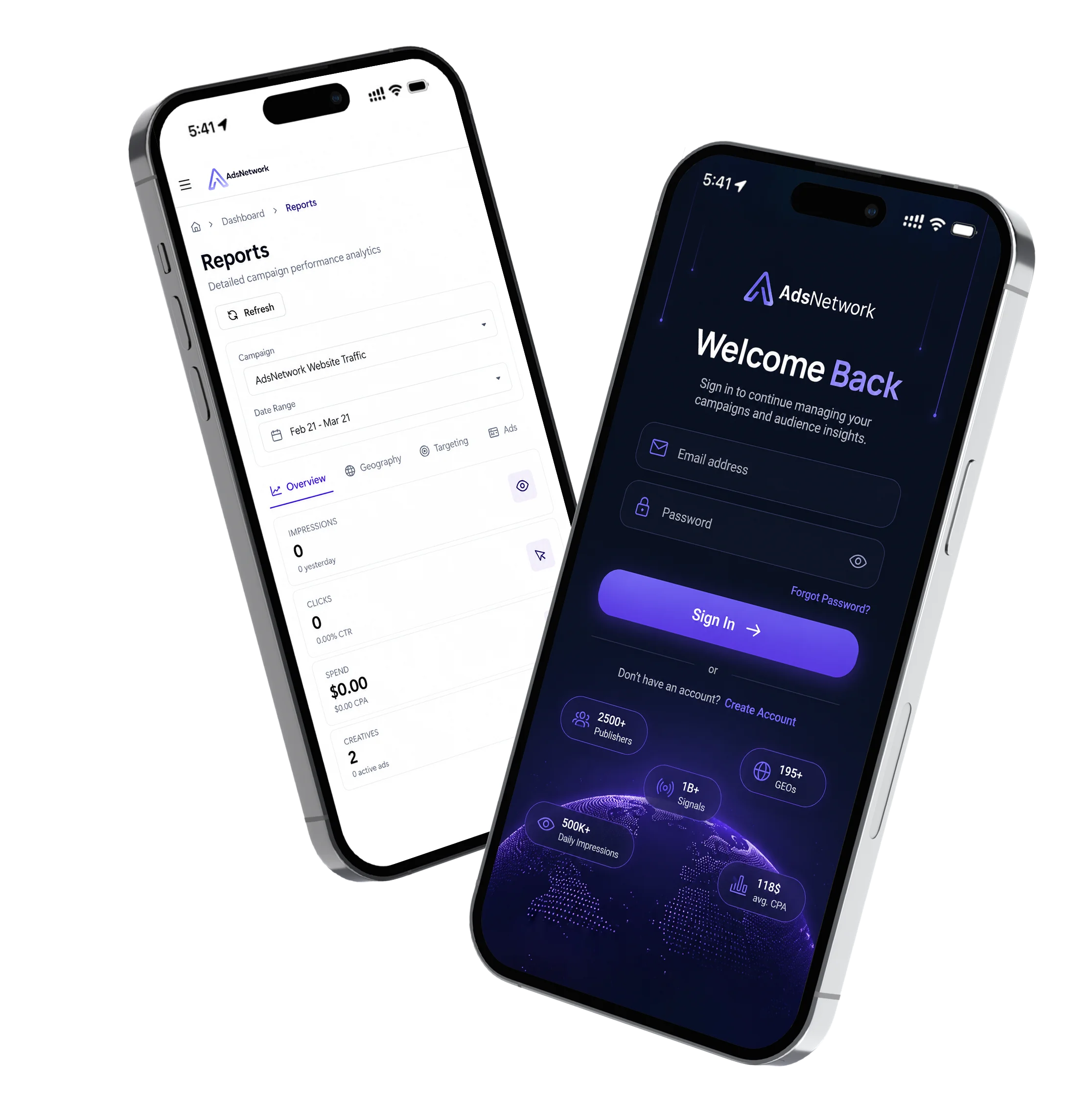
Stay connected to your live AdsNetwork campaigns with our mobile advertising app. Track impressions, clicks, conversions, campaign spend, and overall performance in real time—anytime, anywhere. Available for iOS and Android.