

Most DeFi teams grow the expensive way. They print tokens, offer double-digit yields, and watch total value locked climb. Then the emissions taper, and the capital leaves as fast as it arrived. This is the core problem DeFi advertising is meant to solve. Incentives rent liquidity. Advertising, done right, brings users who actually stay.
The catch is that mainstream platforms make it hard. Google restricts most crypto categories and blocks DeFi outright. Meta rejects ads for liquidity pools, yield farming, and automated market makers no matter how you word them. So most protocols never learn how to promote a DeFi project through paid channels at all. They default to incentives because that is the only lever they know.
This guide covers the compliant path. Where you can actually run DeFi advertising, which formats convert for a protocol, how to target sticky users instead of mercenary capital, and how to measure the on-chain outcomes that mainstream ad metrics miss. If you want the broader picture first, our Web3 advertising guide sets the wider context; this piece goes deep on DeFi.

Why DeFi Projects Struggle to Advertise
The stakes here are real. DeFi is a large, competitive market. DefiLlama tracked total value locked at roughly $85 billion in mid-2026, down about 50 percent from its $171 billion peak. Capital is tighter than it was, and thousands of protocols compete for a shrinking pool of active users. In that environment, how you acquire users decides who survives.
The advertising gap in DeFi is not an accident. Three structural problems push protocols toward incentives and away from paid acquisition.
Mainstream Platforms Ban DeFi Outright
This is the biggest one. Google permits ads only from certified exchanges, wallets, and coin trusts in approved markets. DeFi protocols remain excluded, alongside DEX promotion and yield products. Meta went further in 2026. Under its updated policy, ads promoting liquidity pools, yield farming, or automated market makers are rejected regardless of how the product is described. That single rule takes the two largest ad platforms in the world off the table for most protocols.
Pseudonymous Audiences Break Identity Targeting
Web2 advertising runs on identity. Email lists, phone numbers, logged-in profiles, lookalike audiences. DeFi users are wallets, not names. They browse through privacy tools, switch addresses, and rarely hand over personal data. The targeting infrastructure that mainstream platforms sell simply does not map onto a pseudonymous user base. Web3 advertising has to work from different signals: on-chain behavior and the content people read, not who they are.
Regulatory Grey Zones Make DeFi Advertising Feel Risky
Yield is a compliance minefield. Promise a return and you risk framing your token as a security. Even ad networks that accept crypto get cautious around APY claims. The result is a chilling effect. Teams that could run DeFi advertising compliantly assume they cannot, so they fall back on emissions instead.
Put those three together and you get the default DeFi growth model: incentive-led, short-lived, and expensive. Advertising stays underused, not because it fails, but because most teams never realize it is an option.

Where You Can Advertise a DeFi Project
The compliant channels exist. They are just different from the ones a Web2 marketer would reach for. The shift is from identity-based buying to context-based buying. Instead of chasing a user across the web based on who they are, you place your protocol where DeFi users already gather and let the content do the qualifying. Here is where DeFi advertising actually runs.
- Crypto and Web3 ad networks: A crypto ad network is built for exactly this problem. These platforms accept DeFi advertisers, connect you to crypto-native publishers, and let you target by on-chain and contextual signals rather than personal identity.
- Native placements on DeFi media: Analytics dashboards, DeFi news outlets, and research publications reach users mid-research. This is where protocol comparisons happen and where a well-placed ad earns trust instead of interrupting.
- Programmatic via crypto-friendly DSPs: Demand-side platforms with crypto inventory let you bid on impressions across DeFi content in real time, with the targeting controls generic DSPs cannot offer for this audience.
- Push and pop for retargeting: Visitors who connected a wallet but did not deposit are your warmest audience. Retargeting formats bring them back, and they work for TVL milestone or new-pool announcements too.
What stays off-limits is mainstream search and social without heavy restriction and, for most DeFi products, outright rejection. The core play is contextual: put your protocol in front of people already reading about DeFi. For a fuller breakdown of the platforms, see our guide to crypto ad networks and Web3 advertising networks.
Ad Formats That Work for DeFi
Format choice is not cosmetic. Each one maps to a different stage of the protocol funnel, and each carries a different compliant creative angle. The rule that runs through all of them: lead with utility, never with a yield promise.
That rule is not just about compliance, though it is that too. DeFi audiences are the most skeptical in crypto. They have seen the rug pulls and the inflated APYs. An ad that screams a guaranteed return reads as a red flag, not an offer. Creative that explains the mechanism, the security model, and the actual problem the protocol solves converts better precisely because it respects how these users think.
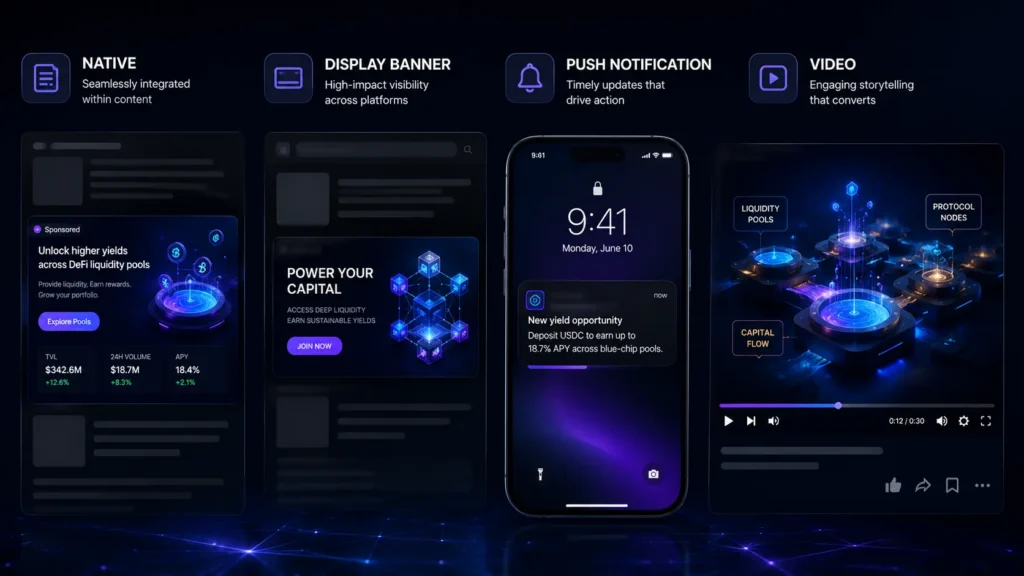
Native Ads for Trust
Native ads sit inside editorial content on DeFi media, matching the look of the page around them. That context builds trust, which matters more in DeFi than anywhere else in crypto. The compliant angle is educational: explain what your protocol does and the problem it solves, not what it pays.
Display Banners for Presence
Display banner ads keep your protocol visible on the analytics and dashboard sites where DeFi users spend their time. Think of these as brand presence, not direct response. A banner on a portfolio tracker reaches someone actively managing on-chain positions, which is precisely your audience.
Push Notifications for Retargeting
Push notification ads are built for re-engagement. Someone visited, connected a wallet, then left without depositing. Push brings them back. The format also works for time-sensitive updates: a new pool, a TVL milestone, a governance vote. Keep the copy factual and skip the urgency-driven hype that skeptical DeFi users tune out.
Programmatic Video for Awareness
Complex protocols are hard to explain in a banner. A short explainer video does the work that static creative cannot, walking a viewer through the mechanism before they ever reach your app. Use it for top-of-funnel awareness, not for pushing deposits.
Targeting the Right DeFi Users, Not Mercenary Capital
This is the section that separates DeFi advertising from generic crypto ads. Incentives are indiscriminate. They attract anyone chasing yield, and the data on how fast that money leaves is brutal.
Mechanism Capital’s analysis of liquidity mining found that of the farmers who entered at launch, almost half left within 24 hours and 70 percent left within three days. That is the reality behind most launch-week TVL charts. The number looks like traction. It is mostly capital passing through.
Berachain made the pattern impossible to ignore. Its TVL peaked above $3.3 billion in early 2025, then collapsed more than 90 percent by year-end once emissions revealed how little of the activity was organic. The lesson is not that incentives are useless. It is that incentives alone build nothing durable. They are a bridge, not a growth engine, and a protocol that treats them as the whole strategy pays twice: once for the rewards, and again when the capital leaves.
Good DeFi marketing does the opposite. It targets people likely to use the protocol and stay. A few signals make that possible.
- Contextual targeting on DeFi content: Someone reading a lending protocol comparison is closer to depositing than a random yield chaser. The content they consume is the intent signal.
- Analytics and dashboard visitors: Users on portfolio trackers and DeFi dashboards are already active on-chain. They manage positions, which means they convert differently from newcomers drawn only by rewards.
- Wallet-behavior signals where available: Some platforms can reach users based on the protocols they have interacted with on-chain. Reaching wallets that already use a competing lending market is far more efficient than broad crypto reach.
- GEO for compliant markets: Restrict delivery to jurisdictions where your protocol can operate cleanly. Compliance and targeting efficiency point the same direction here.
The contrast is the whole point. Incentive farming buys a TVL number that evaporates. Quality user acquisition buys people who deposit because the product fits, then stay. For the mechanics of building these segments, our guide to audience targeting in programmatic ads goes deeper.
Measuring DeFi Campaign Performance On-Chain
Standard ad metrics fall apart in DeFi. Impressions, clicks, and click-through rate tell you nothing about whether a wallet deposited and stayed. A campaign can look great on paper and contribute zero durable TVL. The metrics that matter live on-chain.
This is not a minor reporting preference. It changes which campaigns you keep funding. A campaign with a high click-through rate and no deposits is a failure dressed as a success. A campaign with a modest click rate that drives sticky deposits is the one to scale. If you measure only the top of the funnel, you will optimize toward the wrong outcome and never know it.
What to actually measure:
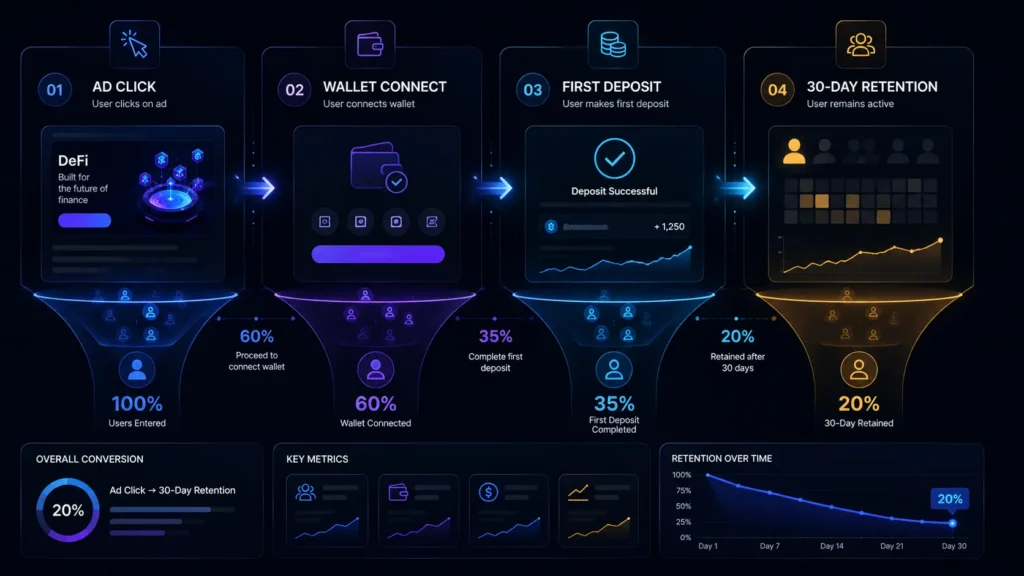
- Wallet connects: the first real signal of intent, well past a click.
- First deposit: the conversion that counts, the moment a visitor becomes a user.
- TVL contributed: how much real capital the campaign brought into the protocol.
- Retention at 30 days: are those wallets still in the pool, or did they farm and flee?
- Returning users: wallets that come back and deposit again signal genuine product fit.
The hard part is attribution. An ad click happens off-chain; the deposit happens on-chain, often days later and from a wallet with no obvious link to the click. Bridging the two is the central measurement challenge in DeFi advertising.
Practical workarounds exist. Campaign-specific landing pages with wallet-connect tracking, on-chain tagging where your stack supports it, and cohort analysis that compares wallets arriving during a campaign against baseline behavior. None is perfect, but together they turn ad spend into an on-chain outcome you can defend. For the wider optimization framework, see our guide on how to optimize ad campaigns for maximum ROI.
How to Launch a DeFi Advertising Campaign
Pulling it together, a compliant DeFi advertising campaign follows a clear sequence. Skip the guesswork and run it in order.
- Define the on-chain goal. TVL, active users, or governance participation. The goal dictates every choice that follows, so pick one primary metric and commit to it.
- Pick contextual DeFi inventory. Choose placements on the analytics sites, dashboards, and DeFi media where your target users already spend time.
- Choose the format. Native for trust, display for presence, push for retargeting, video for explaining a complex mechanism. Match the format to the funnel stage.
- Write utility-led creative. Explain the product and the problem it solves. No guaranteed-return or APY-promise language, and reference risk disclosures where relevant. This is not legal advice, but it keeps you inside compliant norms.
- Set up on-chain measurement before launch, not after. Wire wallet-connect tracking and define how you will attribute deposits, so you are not reconstructing it later.
- Launch through a crypto ad network that accepts DeFi and reaches crypto-native audiences.
One more discipline separates campaigns that work from campaigns that burn budget: start small. Run a contained test against a single on-chain goal, confirm the deposits are real and sticky, then scale the placements that deliver. DeFi rewards patience here. A protocol that proves its acquisition math on a small budget can pour spend into what works, instead of guessing at scale and hoping.
This last step is where execution platform matters. AdsNetwork runs across crypto and Web3 inventory with the formats, contextual targeting, and on-chain measurement DeFi campaigns need, operating as a crypto advertising network built for exactly these verticals. If you want the broader strategy context, our crypto advertising guide covers campaign structure before you pick a network.
FAQ
How to advertise a DeFi project?
To advertise a DeFi project, use crypto-native ad networks rather than Google or Meta, which restrict or ban DeFi. Run native ads, display banners, and push retargeting on DeFi media and analytics sites. Lead with utility, not yield promises, and measure on-chain outcomes like wallet connects and deposits.
Where can you advertise DeFi projects?
You can advertise DeFi projects on crypto and Web3 ad networks, native placements on DeFi news and analytics sites, crypto-friendly programmatic DSPs, and push or pop retargeting. Mainstream search and social are largely off-limits, so contextual targeting on DeFi content is the core channel.
How do you get users for a DeFi protocol?
How do you get users for a DeFi protocol without renting mercenary capital? Combine compliant advertising with targeting that reaches active on-chain users. Contextual placement on DeFi content, dashboard-visitor targeting, and wallet-behavior signals bring in people who deposit because the product fits, then measure retention to confirm they stay.
Is DeFi advertising allowed?
DeFi advertising is allowed on crypto-native ad networks and DeFi media, but not on most mainstream platforms. Google excludes DeFi, and Meta rejects ads for liquidity pools, yield farming, and AMMs. Compliant creative that avoids guaranteed-return language runs cleanly on crypto-friendly channels.
Conclusion: DeFi Advertising Builds What Incentives Cannot
Incentives rent liquidity. Advertising builds a user base. That difference decides which protocols survive the next cycle.
The teams still leaning only on emissions are paying for a TVL number that leaves the moment yields drop. The teams learning DeFi advertising now are acquiring users who deposit because the product works, and who stay because they chose it rather than got paid to show up. Mainstream platforms make the compliant path harder to find, but it is there, and the protocols that walk it are building something the incentive-farmers cannot: real, durable demand.
Start with one on-chain goal, target the users who fit it, and measure past the click. That is how DeFi advertising turns ad spend into liquidity that lasts.
Featured Posts

Sep 23, 2026
6 min read
What Is Advertising Technology (AdTech) and How Does It Work?
Advertising technology, commonly known as AdTech, refers to the software, platforms, tools, and systems used to plan, buy,…
Read Article
Sep 16, 2026
8 min read
Media Buying: A Complete Guide for Advertisers
Media buying is the process of purchasing advertising space to reach a target audience. It includes choosing where…
Read Article
Sep 7, 2026
8 min read
Programmatic Advertising vs Display Advertising: What’s the Difference?
Programmatic and display advertising are often used interchangeably, but they describe two different parts of digital advertising. Display…
Read ArticleNeed Help?
Our team is ready to help you launch successful campaigns.
AI-Powered Mobile
Monitor Your Campaigns Anywhere
Stay connected to your live AdsNetwork campaigns with our mobile advertising app. Track impressions, clicks, conversions, campaign spend, and overall performance in real time—anytime, anywhere. Available for iOS and Android.