
Your project has a working product, a growing community, and real on-chain traction. However, scaling that momentum requires paid visibility. The problem is that traditional ad platforms make crypto advertising unnecessarily difficult. Google restricts DeFi campaigns. Meta blocks token promotions. Twitter/X frequently suspends crypto accounts without warning.
Meanwhile, the crypto advertising market crossed $1.2 billion in 2025, and 2026 spending is on pace to exceed that significantly. The blockchain technology market itself is projected to grow from $41.14 billion in 2025 to over $2.3 trillion by 2035. That growth creates enormous demand for advertising infrastructure built specifically for Web3.
This guide covers everything Web3 brands need to know about crypto advertising. You will learn how it works, which ad formats deliver results, what compliance rules apply, and how to choose the right platform for your project. By the end, you will have a clear framework for building campaigns that reach real blockchain users.
What Is Crypto Advertising?
Crypto advertising is paid promotion designed specifically for blockchain projects, cryptocurrency platforms, and Web3 products. It differs from traditional digital advertising in several important ways.
In contrast, traditional ad platforms rely on cookies, browsing behavior, and third-party data to target users. Crypto advertising platforms instead use blockchain-related signals. Specifically, these include wallet activity, token ownership, DeFi interactions, and on-chain behavior patterns.
This distinction matters because it changes who sees the ads. For example, a traditional campaign targeting the keyword “best crypto exchange” reaches anyone searching that term. In contrast, a crypto advertising campaign can target someone who already holds ETH and actively uses DeFi protocols. As a result, audience quality improves dramatically.
Additionally, crypto advertising platforms accept campaigns that mainstream networks reject. Many blockchain projects promote token launches, DeFi yield strategies, NFT collections, and decentralized applications. These product categories face strict restrictions on Google Ads and Meta. Specialized crypto ad networks were built to solve this problem.
Why Traditional Ad Platforms Restrict Crypto Campaigns
Google, Meta, and other major platforms began restricting crypto advertising in 2018. The restrictions have evolved since then, but significant barriers remain in 2026.
According to Google’s official cryptocurrency advertising policy, advertisers can promote certain crypto products only after completing a certification process. Exchanges, wallets, and coin trusts require approved applications before ads can run. Meanwhile, ICOs, DeFi trading protocols, and token presales remain completely banned.
Moreover, the certification process is not simple. Compliance reviews for cryptocurrency advertisers take an average of 45 to 60 days as of late 2025. In addition, advertisers must provide regulatory documentation for each country they target. In the United States, this means FinCEN registration plus state money transmitter licenses. Similarly, in the United Kingdom, FCA registration is mandatory.
Furthermore, only 8% of cryptocurrency ad policies became less restrictive between 2024 and early 2026. The trend toward openness is slow. For most Web3 projects, especially those in DeFi, GameFi, and NFTs, traditional platforms are simply not viable primary channels.
This regulatory gap created the market for best crypto ad networks that specialize in blockchain audiences. These platforms accept the campaigns that Google and Meta reject, while still providing the targeting, analytics, and scale that modern advertisers expect.
How Crypto Advertising Works
Crypto advertising follows a process similar to traditional programmatic advertising, with several blockchain-specific additions.
Campaign Setup and Targeting
Advertisers begin by creating a campaign on a crypto ad network. They define their budget, select ad formats, and configure targeting parameters. In addition to standard options like geography and device type, crypto platforms offer blockchain-specific targeting. Specifically, this includes filtering by wallet activity, token holdings, DeFi protocol usage, and NFT ownership.
Publisher Matching and Ad Delivery
Subsequently, the ad network matches the campaign with its publisher inventory. Crypto ad networks maintain relationships with blockchain media sites, DeFi dashboards, NFT marketplaces, blockchain explorers, and Web3 gaming platforms. Consequently, ads appear across these properties in formats like display banners, native placements, video pre-rolls, and in-app units.
Crypto Advertising Performance Tracking
Performance tracking in crypto advertising goes beyond clicks and impressions. Advanced platforms measure wallet connections, token purchases, smart contract interactions, and onchain conversions. Cost per wallet (CPW) has emerged as the defining metric for Web3 advertising in 2026. Unlike cost per click, CPW measures the cost to acquire a verified wallet visitor, providing a meaningful signal of user quality.
Market cycles also affect crypto advertising performance significantly. During bull markets, expect 20 to 40% higher CPMs but also 30 to 50% higher conversion rates. Net CPA often improves despite higher costs because user intent increases during periods of market optimism.

Crypto ad networks connect advertisers with blockchain publishers across DeFi dashboards, NFT marketplaces, and Web3 gaming platforms.
Types of Crypto Ad Formats That Drive Results
Choosing the right ad format is critical for crypto advertising success. In particular, each format serves a different campaign objective and audience context.
Display Banner Ads
Banner ads remain the most widely used format across crypto ad networks. Standard sizes include 728×90, 300×250, and 320×50. They work well for brand awareness and retargeting across crypto news sites and blockchain explorers. Display banners are cost-efficient and easy to produce at scale.
Native Ads
Native ads blend into the surrounding content on publisher sites. As a result, they typically generate higher engagement rates than display banners because they match the look and feel of editorial content. For crypto projects, native ads work particularly well on research platforms and analytics dashboards where users spend time reading.
Video Pre-Roll Ads
Video ads are effective for explaining complex products like DeFi protocols, Layer 2 solutions, and blockchain infrastructure. They capture attention quickly and allow brands to demonstrate product functionality. Video pre-roll placements on crypto YouTube channels and media sites deliver strong engagement metrics.
In-Page Push Notifications
In-page push ads deliver notification-style messages directly within the browser. Moreover, they do not require user opt-in, making them easier to deploy than traditional push notifications. For token launches and time-sensitive promotions, in-page push formats create urgency and drive immediate clicks.
Pop-Under Ads
Pop-under ads open in a background tab behind the main browser window. They are nonintrusive because users see them only after finishing their current activity. This format works well for high-volume awareness campaigns and is often the most affordable option on a CPM basis.
Compliance Considerations for Crypto Advertising
Regulatory compliance is one of the biggest challenges in crypto advertising. Specifically, rules vary by platform, country, and product type. Therefore, understanding the landscape protects your project from account bans, fines, and wasted spend.
Google and Meta Restrictions
As noted earlier, Google requires certification for exchanges, wallets, and coin trusts.
Additionally, it completely prohibits ICOs, DeFi trading protocols, and token sale promotions. Meta follows a similar pattern. Furthermore, both platforms enforce these restrictions aggressively, and account suspensions can happen without meaningful warning.
Europe’s MiCA Framework
The European Union’s Markets in Crypto-Assets Regulation (MiCA) introduced strict truth-inmarketing rules for crypto. All promotional materials must provide accurate, non-misleading information, especially regarding capital loss risks. The MiCA transitional period ends July 1, 2026, meaning all crypto service providers operating in the EU must be fully authorized by that deadline.
According to reporting from CoinLaw, over 65% of EU-based crypto businesses achieved MiCA compliance by early 2025. Moreover, the European Central Bank reported a 60% decline in crypto fraud cases following MiCA implementation. Consequently, these results demonstrate that regulatory frameworks can actually benefit legitimate advertisers by reducing competition from fraudulent operators.
Why Specialized Crypto Ad Networks Simplify Compliance
Dedicated crypto advertising platforms are built with these regulations in mind. They understand which ad categories are permitted in each jurisdiction. They pre-screen campaigns for compliance issues before launch. For Web3 brands, working with a crypto-native ad network significantly reduces the risk of policy violations compared to navigating Google or Meta restrictions independently.

Compliance frameworks like MiCA are reshaping how crypto brands approach advertising across European markets.
How to Choose a Crypto Advertising Network
Not all crypto ad networks deliver the same results. Therefore, evaluating platforms carefully before committing budget prevents wasted spend and poor campaign performance.
Audience Quality and Publisher Network
The most important factor is audience quality. A strong crypto ad network maintains partnerships with reputable publishers across blockchain media, DeFi platforms, and Web3 applications. Ask whether the network delivers verified crypto users or generic web traffic. Platforms that offer wallet-based targeting typically deliver higher-quality audiences.
Targeting Capabilities
Look for networks that offer crypto-specific targeting beyond standard demographics. Ideally, the best platforms allow filtering by on-chain activity, token holdings, protocol usage, and chain preference. In turn, granular targeting reduces wasted impressions and improves cost per acquisition.
Analytics and Optimization Tools
Effective crypto advertising requires continuous optimization. Accordingly, choose a platform that provides real-time dashboards, conversion tracking, and performance analytics. In addition, advanced networks also offer automated bidding and AI-driven optimization to improve campaign results over time.
Supported Ad Formats
Different campaigns require different formats. Ensure the network supports the formats you need, whether that is display banners, native ads, video pre-roll, in-page push, or pop-under. Platforms with diverse format options give advertisers more flexibility to test and scale.
Pricing Models and Transparency
Crypto ad networks typically offer CPM, CPC, and CPA pricing models. Benchmark costs vary by format and targeting. According to HypeLab’s 2026 crypto advertising benchmarks, CPM rates on most Web3 networks sit between $2 and $15. Wallet-targeted campaigns on premium inventory can reach $20 to $40 per thousand impressions. Make sure the network provides transparent reporting so you can verify where your budget is going.
Crypto Advertising Strategies That Work in 2026
Successful Web3 brands combine paid crypto advertising with organic growth channels. Here are the strategies producing the strongest results this year.
Combine Paid Ads with KOL Marketing
Crypto influencer marketing delivers 3 to 5 times higher engagementthan traditional banner advertising. The most effective strategy combines paid ad network campaigns with Key Opinion Leader (KOL) partnerships. Paid ads build broad awareness. KOL endorsements build trust and credibility. Together, they accelerate user acquisition faster than either channel alone. Learn more about how KOL marketing in crypto drives Web3 growth.
Invest in Content-Driven Campaigns
Content marketing amplifies the impact of paid advertising. For instance, research-backed articles, Twitter/X threads, and YouTube explainers create organic touchpoints that support your paid campaigns. When users see your ad and then find helpful content from your brand in search results, conversion rates increase. Similarly, a solid crypto content marketing strategy builds compounding returns over time.
Build Community Before Scaling Ads
A Messari Research study analyzing 540 token launches between January 2024 and February 2026 found that projects with active communities of over 50,000 members achieved 91% higher 180-day token price retention compared to projects relying primarily on paid advertising. Community-generated content accounted for an average of 64% of total organic search traffic in the first 30 days following launch. Build the community first. Then use crypto advertising to accelerate growth.
Test Multiple Formats and Optimize Continuously
No single ad format works for every crypto project. Exchanges benefit from display banners on trading platforms. DeFi protocols perform better with native ads on research sites. NFT collections convert well through video formats. Start with small test budgets across multiple formats. Analyze the results and concentrate spend on what converts.
Leverage Retargeting for Higher Conversions
Most crypto users do not convert on their first visit. Instead, retargeting campaigns re-engage users who previously visited your site, connected a wallet, or interacted with your content. In particular, this approach is effective for DeFi protocols and exchanges, where users often research multiple options before committing. Retargeting through crypto ad networks keeps your brand visible during that consideration phase.
Align Campaign Timing with Market Sentiment
Crypto advertising performance correlates strongly with market sentiment. Specifically, bull markets bring higher competition for ad inventory, but they also increase user activity and conversion rates. Conversely, bear markets offer lower CPMs and less competition. Therefore, smart advertisers maintain consistent presence during downturns to capture market share. When the next bull cycle arrives, they benefit from established brand recognition and optimized campaign infrastructure.
Key Metrics for Crypto Advertising Performance
Measuring crypto advertising success requires different metrics than traditional digital campaigns. Certainly, standard indicators like CTR and CPC still apply. However, blockchainspecific metrics provide deeper insight into campaign quality.
Cost per wallet (CPW) measures the cost to acquire a user who connects a verified wallet. This metric filters out casual browsers and identifies users genuinely engaged with Web3.
Additionally, cost per on-chain action tracks how much it costs to generate a specific blockchain interaction, such as a token swap, liquidity deposit, or NFT purchase.
Furthermore, wallet quality score evaluates the activity history and asset holdings of acquired wallets. For example, a campaign generating connections from active DeFi wallets with significant holdings delivers more value than one attracting empty or dormant wallets. Accordingly, the most advanced crypto ad networks provide this level of granularity in their reporting dashboards.
Finally, monitor return on ad spend (ROAS) relative to market conditions. Compare campaign performance against the broader market trend. A campaign that maintains positive ROAS during a market downturn is performing exceptionally well, even if absolute numbers are lower than during a bull cycle.
Real-World Crypto Advertising Success
The data confirms that crypto advertising delivers measurable results when executed properly.
Crypto wallets benefit from relatively simple conversion actions. A wallet download and creation requires less user commitment than depositing funds or executing trades. This makes wallet campaigns ideal for top-of-funnel crypto advertising. According to HypeLab’s benchmark data, wallets consistently achieve some of the lowest CPAs across Web3 ad categories.
The gaming NFT market provides another compelling example. Valued at $4.8 billion in 2024with a projected 24.8% CAGR through 2034, gaming NFTs are attracting significant advertising investment. Web3 game studios use crypto ad networks to reach players already active in blockchain gaming ecosystems, resulting in higher install rates and better lifetime value metrics than campaigns run through mainstream platforms.
Platforms like AdsNetwork enable crypto projects to access these high-quality blockchain audiences. By connecting advertisers with verified crypto publishers across DeFi, NFT, and gaming verticals, AdsNetwork provides the targeted reach that mainstream ad platforms cannot deliver for Web3 brands.
The Future of Crypto Advertising
Crypto advertising infrastructure is evolving rapidly. Several trends are shaping the next phase of growth.
On-chain targeting will become more sophisticated. As more user activity moves on-chain, ad networks will leverage wallet analytics, protocol usage patterns, and cross-chain behavior data to deliver increasingly precise audience segments.
Similarly, AI-driven optimization will transform campaign management. Machine learning algorithms will automate bidding, creative rotation, and budget allocation in real time. Consequently, this reduces the manual effort required to run effective campaigns.
In addition, regulatory clarity will accelerate industry growth. Frameworks like MiCA are establishing rules that legitimate advertisers can follow with confidence. As more jurisdictions implement clear crypto advertising regulations, the market will become more accessible and competitive.
Finally, cross-chain audience segmentation will enable advertisers to reach users across multiple blockchain ecosystems simultaneously. Instead of running separate campaigns for Ethereum, Solana, and Base users, advertisers will target unified audience profiles that span chains.
How you plan and execute your approach to marketing a crypto project successfully will depend on staying ahead of these trends. The brands that adopt crypto-native advertising infrastructure now will have a significant advantage as the market matures.
Reaching Mainstream Sports Audiences
Web3 brands often struggle to break past crypto-native circles. Major sporting events solve that problem by gathering huge mainstream audiences in one place, giving blockchain projects a rare chance to reach everyday users who have never opened a wallet. The trick is meeting these fans on the platforms they already trust.
Putting crypto brands in front of World Cup fans shows how this works at scale. Web3 ad networks place your message across sports sites, streaming feeds, and social channels where attention concentrates. Pair clear, jargon-free creative with precise targeting, and you turn a global event into a mainstream onboarding moment.
Crypto Advertising: Your Path to Web3 Growth
Crypto advertising has become an essential growth channel for Web3 brands. Traditional platforms restrict too many blockchain product categories. Specialized crypto ad networks fill that gap by providing access to verified blockchain audiences, compliant campaign infrastructure, and advanced targeting based on on-chain behavior.
The fundamentals are clear. Define your target audience. Select the right ad formats for your product. Choose a crypto ad network with strong publisher relationships and transparent reporting. Combine paid campaigns with community building and content marketing for the strongest results.
Whether you are launching a token, growing a DeFi protocol, or scaling a Web3 game, crypto advertising provides the infrastructure to reach the right users at the right time. Explore AdsNetwork’s blockchain and crypto advertising solutions to get started.
Featured Posts

Sep 23, 2026
6 min read
What Is Advertising Technology (AdTech) and How Does It Work?
Advertising technology, commonly known as AdTech, refers to the software, platforms, tools, and systems used to plan, buy,…
Read Article
Sep 16, 2026
8 min read
Media Buying: A Complete Guide for Advertisers
Media buying is the process of purchasing advertising space to reach a target audience. It includes choosing where…
Read Article
Sep 7, 2026
8 min read
Programmatic Advertising vs Display Advertising: What’s the Difference?
Programmatic and display advertising are often used interchangeably, but they describe two different parts of digital advertising. Display…
Read ArticleNeed Help?
Our team is ready to help you launch successful campaigns.
AI-Powered Mobile
Monitor Your Campaigns Anywhere
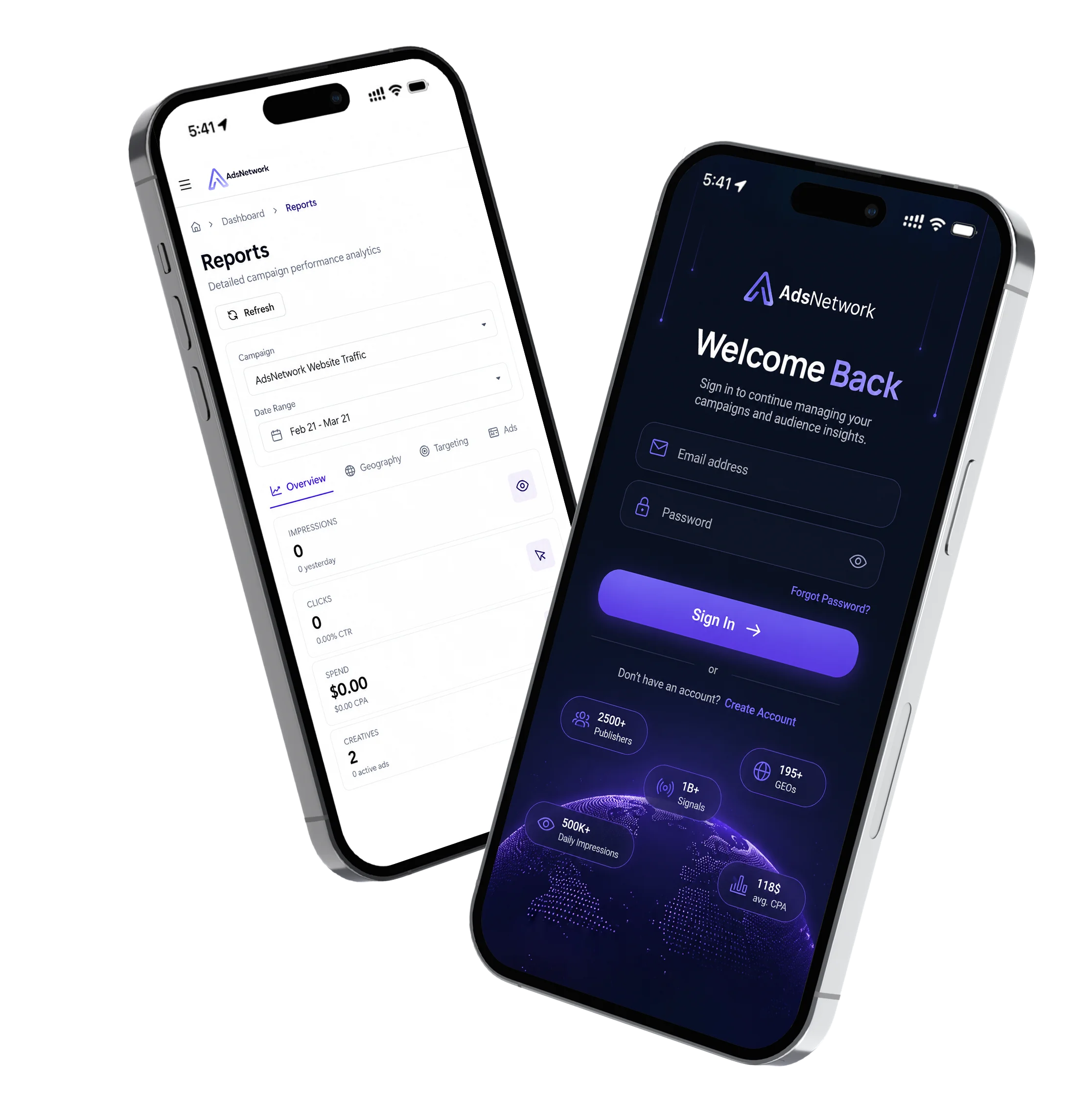
Stay connected to your live AdsNetwork campaigns with our mobile advertising app. Track impressions, clicks, conversions, campaign spend, and overall performance in real time—anytime, anywhere. Available for iOS and Android.