
KOL in crypto stands for Key Opinion Leader. A KOL is an individual with deep expertise and credibility in the blockchain space whose opinions influence how communities think, invest, and engage with projects. In short, KOLs are the trusted voices that crypto audiences rely on for guidance.
However, the role of a KOL in crypto goes far beyond posting on social media. According to a theKOLLAB’s 2026 crypto influencer analysis, crypto influencer campaigns return an average of $6.50 for every $1 spent, with engagement rates running at 5.2%. Additionally, Disence’s 2026 Web3 KOL data shows that 84% of crypto users concentrate their time on just three platforms: X, Telegram, and YouTube. Those numbers reveal why crypto KOL marketing has become the dominant growth strategy for Web3 projects.
For founders and marketing teams, understanding what KOL in crypto means is not optional. Instead, it is essential for planning effective campaigns, allocating budgets wisely, and avoiding costly partnerships that deliver vanity metrics instead of real growth. Accordingly, this guide explains everything you need to know about key opinion leaders in the blockchain ecosystem.

Key opinion leaders in crypto shape market sentiment and drive community growth for Web3 projects.
KOL in Crypto: Definition and Role
A KOL in crypto is someone whose opinions carry measurable weight within the blockchain ecosystem. Specifically, this person has built authority through consistent expertise, transparent analysis, or hands-on involvement in building Web3 projects. Their credibility comes from demonstrated knowledge rather than popularity alone.
Unlike traditional brand ambassadors, crypto KOLs focus on substance. Their content typically covers market analysis, token reviews, protocol comparisons, ecosystem updates, and educational breakdowns. As a result, their audiences follow them for guidance rather than entertainment.
The influence of a KOL in crypto can be significant. When a respected key opinion leader shares a positive assessment of a token or protocol, it can trigger immediate traffic spikes, rapid Telegram and Discord growth, increased trading volume, and higher social engagement. Conversely, a negative review can slow momentum and erode community confidence. This is why projects invest heavily in crypto KOL marketing as a core growth channel.
How KOLs Differ from Traditional Influencers in Web3
The terms KOL and influencer are often used interchangeably. However, they serve different functions in crypto. Therefore, understanding this distinction is critical for building effective marketing strategies.
Traditional influencers build audiences through personality, lifestyle content, and entertainment. Their value lies in reach and visibility. In contrast, a KOL in crypto builds authority through demonstrated knowledge and technical credibility. Their value lies in trust and influence over decision-making.
In practice, this difference affects campaign outcomes directly. KOLs drive wallet connections and protocol usage, while influencers primarily drive impressions and awareness. For Web3 projects, wallet connections and on-chain actions matter far more than vanity metrics like follower counts or likes.
Additionally, crypto KOLs often have skin in the game. Many hold tokens, participate in governance, or advise projects directly. This alignment of incentives creates a different dynamic than traditional influencer marketing, where the creator typically has no ongoing stake in the product they promote. For a broader perspective on how paid promotion fits alongside KOL efforts, explore how crypto advertising works across Web3 ad networks.
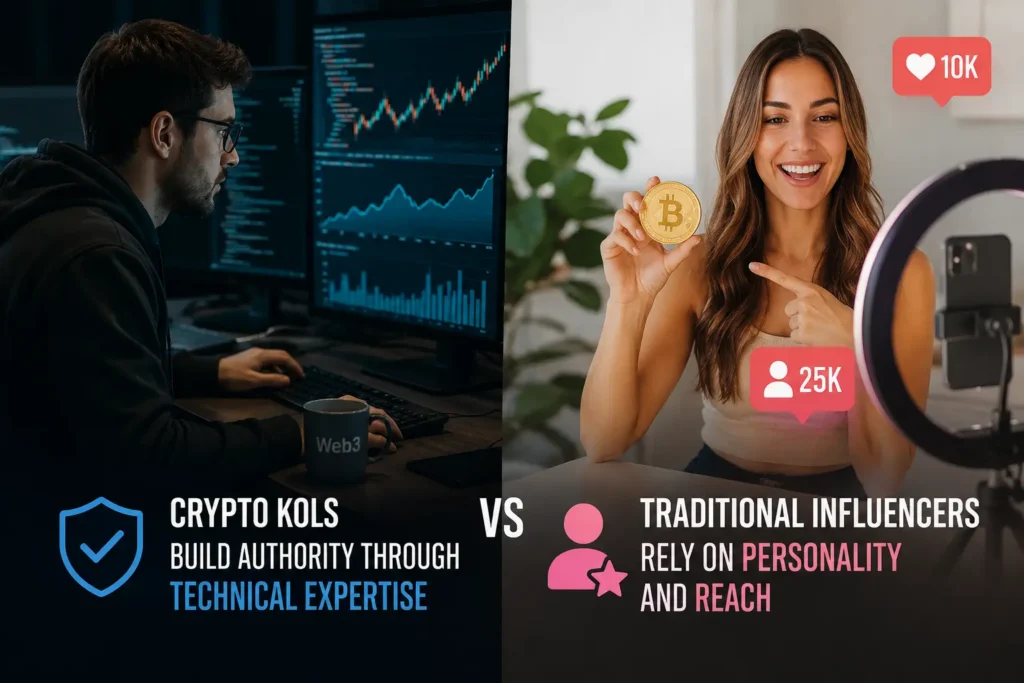
Crypto KOLs build authority through technical expertise, while traditional influencers rely on personality and reach.
Where Crypto KOLs Build Their Influence
KOL activity in crypto is platform-dependent. In particular, each social channel serves a different purpose within the Web3 ecosystem.
On X (formerly Twitter), KOLs share rapid market commentary, analytical threads, and token opinions. This platform is the primary hub for real-time crypto discourse. Consequently, most KOL campaigns include an X component as the foundation of their promotion strategy.
On YouTube, key opinion leaders publish deep-dive reviews, protocol walkthroughs, and educational series. YouTube content has a longer shelf life than tweets. Therefore, it works well for projects that need sustained visibility over weeks or months.
Telegram and Discord communities allow KOLs to build more exclusive environments. Engagement rates in these channels tend to be higher because members actively chose to join. Furthermore, AMAs (Ask Me Anything sessions) hosted on Telegram give KOLs direct interaction with project teams, which builds credibility for both sides.
Similarly, short-form platforms like TikTok simplify crypto education for newer audiences. While TikTok KOLs may have less influence on serious investors, they still play an important role in onboarding retail users who are new to blockchain.
KOL in Crypto: How to Build a Strategy That Works
How to Find the Right KOLs
Finding the right KOL in crypto starts with defining your campaign goals. For example, are you launching a token? Growing a DeFi protocol’s user base? Building awareness for an NFT collection? Each goal requires a different type of KOL.
Start by researching KOLs who already cover your niche. Specifically, look for creators who discuss your specific blockchain, protocol category, or target audience segment. A KOL who covers Solana DeFi will deliver better results for a Solana-based protocol than a generalist crypto commentator.
Use tools like LunarCrush, Kaito, and social listening platforms to identify KOLs with genuine engagement in your category. Moreover, review their content history to confirm that their audience aligns with your target users.
How to Vet KOLs Before Partnering
Vetting is where most projects make costly mistakes. According to Disence’s 2026 Web3 KOL marketing guide, KOL accounts with 50,000 to 250,000 followers yield 30% higher ROI compared to accounts with over one million followers. Bigger is not always better.
When evaluating a potential KOL partner, check engagement rate consistency first. Healthy engagement rates typically range from 1% to 5% for larger accounts. Smaller KOLs should demonstrate rates between 5% and 20%. In addition, look at comment quality. Genuine engagement produces thoughtful replies and community discussion. Bot-driven engagement produces generic comments and emoji spam.
Transparency history matters significantly. On-chain investigator ZachXBT revealed in 2025 that over 100 crypto influencers accepted promotional deals without disclosing them as paid advertisements. Fewer than five disclosed their posts as ads. Partnering with KOLs who have a track record of transparent disclosures protects your project from reputational damage.
How to Structure a KOL Deal
KOL compensation in crypto follows several common models. According to Disence’s 2026 budget guide, the hybrid model combining a base cash payment with vested token allocation has become the 2026 standard for mid-tier and macro KOLs.
Nano-KOLs with 5,000 to 25,000 followers typically charge $200 to $1,500 per deliverable. Meanwhile, micro-KOLs with 25,000 to 100,000 followers range from $500 to $5,000 per campaign. Mid-tier KOLs with 100,000 to 500,000 followers command $5,000 to $25,000 per campaign. In addition, these figures vary by platform, with YouTube integrations generally costing more due to production time.
For token launches specifically, KOL rounds offer an alternative structure. In this model, the KOL receives a discounted token allocation in exchange for promotional commitments. Vesting schedules of one to two years with performance milestones help ensure the KOL remains invested in long-term project success rather than dumping tokens after launch.
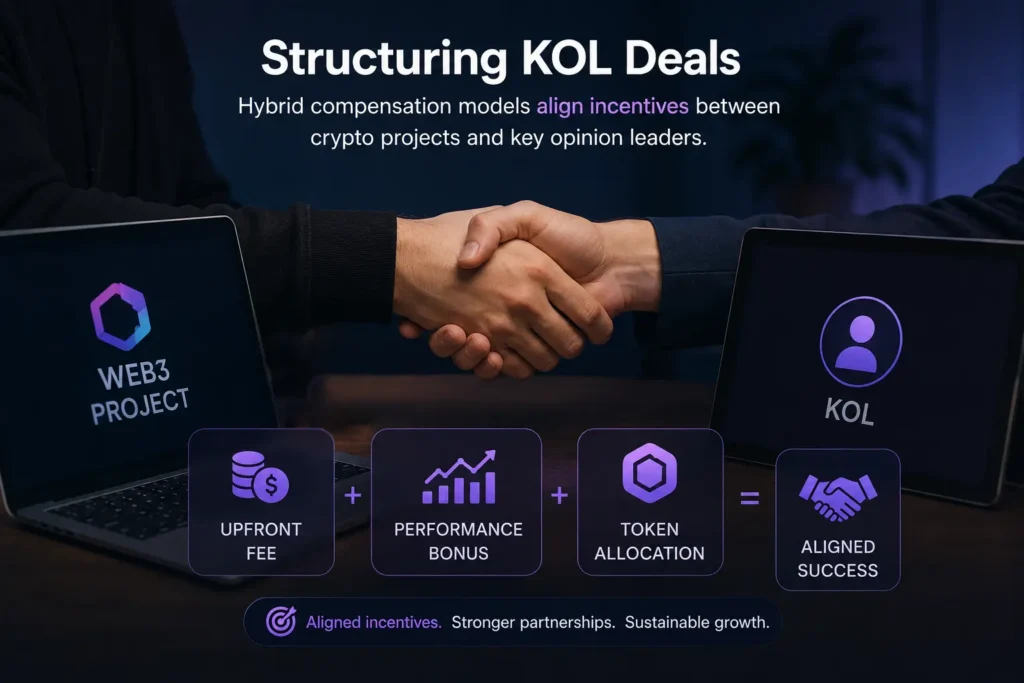
Structuring KOL deals with hybrid compensation models aligns incentives between crypto projects and key opinion leaders.
Risks and Red Flags in Crypto KOL Marketing
Not every KOL in crypto delivers genuine value. Consequently, understanding the risks is just as important as understanding the opportunity.
Artificial follower inflation remains a persistent problem. Some KOLs purchase followers to appear more influential than they are. Similarly, low engagement relative to follower count is a warning sign. An account with 500,000 followers but only 50 genuine replies per post likely has a hollow audience.
Undisclosed paid promotions represent a serious risk for both the KOL and the project. Regulators are increasingly active in this area. The SEC charged Kim Kardashian $1.26 million in penalties for failing to disclose a paid crypto promotion. The EU’s MiCA regulation includes provisions around crypto marketing disclosures. Consequently, projects should require clear disclosure language in all KOL contracts.
Finally, beware of KOLs who promote tokens aggressively and then sell immediately after the price rises. This pattern damages retail investor trust and can expose your project to legal and reputational consequences. Vetting KOLs thoroughly and structuring deals with vesting protections mitigates this risk. For broader strategies on promoting blockchain projects responsibly, review this guide on how to market a crypto project successfully.
How to Measure KOL in Crypto Campaign Performance
Measuring crypto KOL marketing success requires looking beyond social media metrics. Certainly, impressions and likes provide surface-level data. However, on-chain metrics reveal whether the campaign actually drove meaningful results.
Track wallet connections generated during the campaign period. Additionally, monitor token swaps, protocol interactions, and staking activity linked to KOL referral codes or UTM parameters. These on-chain signals indicate whether the KOL’s audience took real action, not just scrolled past a post.
Community growth quality matters more than raw numbers. Specifically, track retention rates in Discord and Telegram after the KOL campaign ends. A surge of 5,000 Telegram joins means little if 4,500 leave within a week. Sustained engagement indicates genuine interest.
When you combine KOL marketing with paid crypto advertising through platforms like AdsNetwork, you create multiple touchpoints that reinforce each other. KOL endorsements build trust. Paid ads provide consistent visibility. Together, they produce stronger results than either channel alone.
KOL in Crypto: Building Partnerships That Drive Real Growth
KOL in crypto is more than a marketing buzzword. Key opinion leaders are a fundamental growth lever for Web3 projects. They provide the trust, credibility, and targeted reach that blockchain audiences demand before engaging with new protocols and tokens.
The most successful projects approach crypto KOL marketing strategically. They define clear goals before outreach. Additionally, they vet KOLs based on engagement quality rather than follower count. Deal structures align incentives through hybrid compensation and vesting schedules. Finally, performance measurement relies on on-chain data rather than vanity metrics.
Combine KOL partnerships with a strong crypto content marketing strategy and paid advertising to build a complete growth engine. Explore AdsNetwork’s blockchain and crypto advertising solutions to amplify your KOL campaigns with targeted paid reach across Web3 audiences.
Featured Posts
Oct 23, 2026
10 min read
What Is CPM in Advertising? Meaning, Formula and 2026 Rates
CPM is the cost an advertiser pays for 1,000 ad impressions, making it one of the most common…
Read Article
Sep 23, 2026
6 min read
What Is Advertising Technology (AdTech) and How Does It Work?
Advertising technology, commonly known as AdTech, refers to the software, platforms, tools, and systems used to plan, buy,…
Read Article
Sep 16, 2026
8 min read
Media Buying: A Complete Guide for Advertisers
Media buying is the process of purchasing advertising space to reach a target audience. It includes choosing where…
Read ArticleNeed Help?
Our team is ready to help you launch successful campaigns.
AI-Powered Mobile
Monitor Your Campaigns Anywhere
Stay connected to your live AdsNetwork campaigns with our mobile advertising app. Track impressions, clicks, conversions, campaign spend, and overall performance in real time—anytime, anywhere. Available for iOS and Android.