

Last updated June 2026
Google and Meta still block most crypto ads outright. Exchanges and certified wallets get a narrow path through. Meanwhile, DeFi protocols, token launches, and NFT projects are mostly locked out. That leaves crypto marketers searching for the best crypto ad networks instead. The choice matters more than it should. Some networks deliver real crypto-native audiences. Others, however, recycle the same low-quality traffic across a dozen sites that have nothing to do with blockchain.
This guide compares the platforms that actually matter for Web3 advertisers in 2026. We look at ad formats, targeting depth, minimum spend, crypto-native inventory, and compliance support. Those are the dimensions that decide whether a budget turns into real users or disappears into bot traffic. Most roundups of crypto advertising platforms, in fact, are written by affiliates with a financial stake in the outcome. This one, instead, lays out what each platform actually offers. That way, you can match the network to your goal instead of guessing.
The mainstream alternative is not much easier to navigate. Even for the categories Google does allow, certification takes 45 to 60 days on average and carries roughly a 40 percent approval rate, according to Google’s own advertising policy documentation. In practice, most crypto teams cannot wait two months to find out whether a campaign will run. That delay is exactly why dedicated crypto-native networks exist.

What to Look For in a Crypto Ad Network
Before comparing platforms, it helps to agree on what actually matters. Picking the best blockchain ad network for your project comes down to six factors. Most advertisers only think about the first one.
- Ad formats offered: display, native, video, mobile interstitial, pop-under, and in-page push all perform differently. The right pick depends on whether you want reach, trust, or conversions.
- Audience targeting: contextual placement, behavioral signals, geo-targeting, and increasingly wallet-based or on-chain targeting for Web3 campaigns.
- Crypto-native inventory: are you reaching dedicated crypto and finance publishers, or generic sites that simply accept crypto ad spend?
- Compliance support: which jurisdictions are supported, and what restrictions apply to gambling, DeFi protocols, or unregulated tokens?
- Minimum spend and pricing model: CPM, CPC, or fixed placement, and how much capital you need to properly test the network.
- Reporting and optimization: real-time dashboards, conversion tracking, and how quickly you can react to underperforming placements.
Quick Checklist for Choosing the Best Crypto Ad Networks
Run a small test budget across no more than two networks at a time. Track cost per registration or cost per wallet connect, not just clicks. Otherwise, a network that delivers cheap traffic with no downstream conversions is not actually cheap. It is just slower to reveal the problem.
Compliance support, in particular, deserves more attention than most advertisers give it. Meta’s advertising ecosystem spans Facebook, Instagram, and WhatsApp. It applies detailed authorization requirements to crypto advertising that mirror Google’s approach. Exchanges in compliant markets can sometimes access the platform. Even so, DeFi protocols, NFT platforms, and most token projects still face the same friction they always have: unpredictable approvals and sudden account suspensions. That history is exactly why crypto-native networks built their own vetting systems instead of trying to satisfy rules written for a different kind of advertiser.
Best Crypto Ad Networks in 2026: Comparison Table
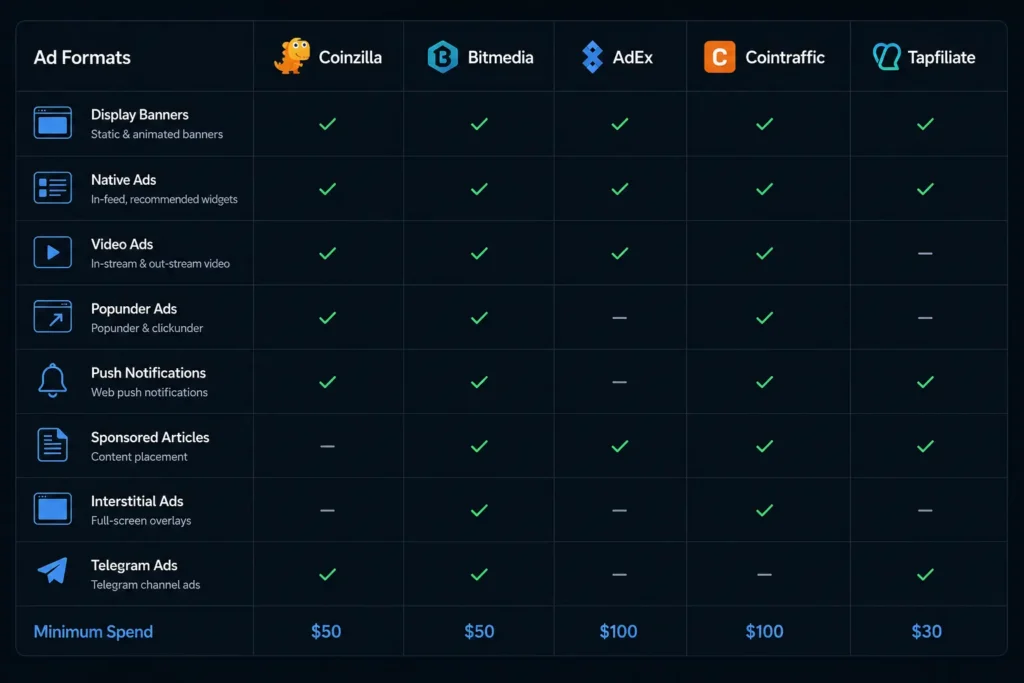
This Web3 ad network comparison focuses on the platforms that consistently come up when crypto marketers ask where to put their budget. Specs below reflect each platform’s own public pricing and policy pages as of June 2026. Minimums in particular change often, so confirm current terms before committing spend.
| Platform | Best For | Ad Formats | Minimum Spend | Targeting | Crypto-Native | Compliance Support |
|---|---|---|---|---|---|---|
| AdsNetwork | Multi-vertical crypto and iGaming campaigns | Display, native, video pre-roll, mobile interstitial, rich media HTML5, pop-under, in-page push | No fixed minimum | Geo, device, interest, behavioral, on-chain wallet | Yes | 195+ GEOs, crypto and iGaming compliance built in |
| Coinzilla | Brand awareness on premium crypto media | Classic banners, native, pop-under, header and sticky banners | EUR 100 deposit, EUR 50 per day | Geo, device, publisher-level | Yes | Vets advertisers, excludes gambling and unregulated products |
| Bitmedia | Mid-size campaigns needing flexible targeting | Image, HTML5, responsive, text, Telegram ads | $100 to $300 by payment method | Geo, device, wallet activity segments | Yes | AI fraud filtering, GDPR-aligned |
| Cointraffic | Token launches and exchange brand campaigns | Display banners, native ads, pop-unders, press releases, video | Around $500 for a first display campaign | Geo, language, device, publisher category | Yes | Manual campaign review, EU-based |
| Adshares | Metaverse and in-game crypto placements | Banner, native, video, metaverse and AR/VR placements | No fixed minimum, paid in ADS token | Zone-level, publisher-level | Yes, decentralized network | Decentralized, no central compliance layer |
| A-Ads | Low-budget testing, privacy-conscious campaigns | Banner, text, pop-under | No minimum | Basic geo and category | Yes, since 2011 | Minimal vetting, anonymous by design |
A few patterns stand out. AdsNetwork and Adshares are the only two with no fixed minimum spend, which matters for early-stage teams. Coinzilla and Cointraffic lean toward premium, manually reviewed inventory. That inventory costs more but reduces brand-safety risk. Bitmedia sits in the middle on price while offering some of the deepest format variety, including Telegram-native placements most competitors do not have.
Pricing also varies more than the table alone suggests. Standard CPM placements across crypto-native networks generally run $2 to $15. Wallet-targeted campaigns on premium inventory can reach $20 to $40 per thousand impressions. That is still cheaper than crypto-related keywords on Google Ads, where cost per click for terms like crypto exchange routinely runs $15 to $25. The premium reflects how thin the certified, brand-safe inventory actually is once gambling-adjacent and unregulated token sites get filtered out.
AdsNetwork: Profile
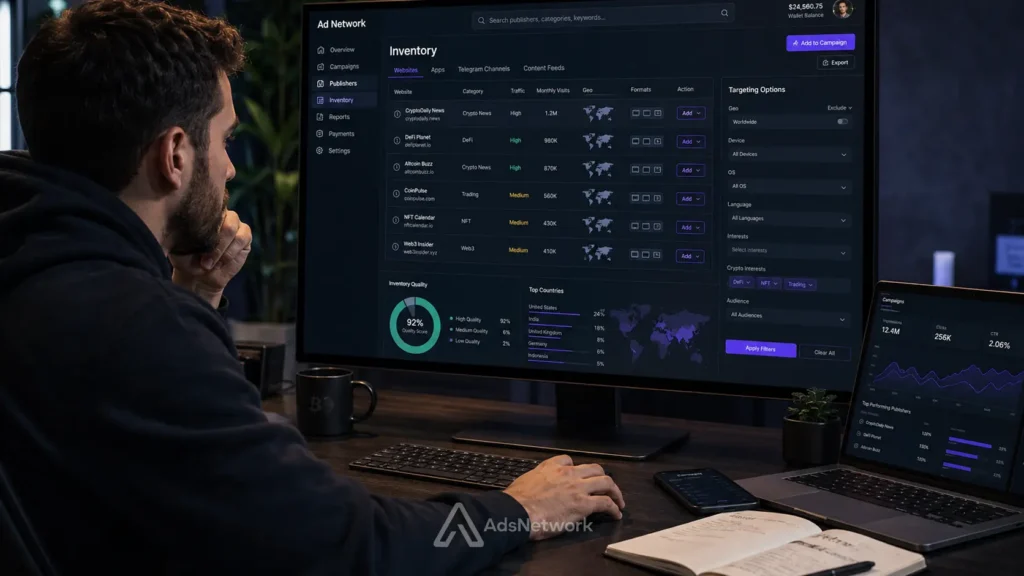
AdsNetwork runs programmatic campaigns across seven ad formats: display banner, native, video pre-roll, mobile interstitial, rich media HTML5, pop-under, and in-page push. All seven run from a single dashboard with unified tracking. The network spans more than 2,500 publishers and delivers roughly 500,000 daily impressions across 195-plus countries. Targeting includes geo, device, interest, and behavioral signals, alongside on-chain wallet activity for Web3 campaigns.
There is no fixed minimum spend. That makes the platform accessible for early-stage projects testing a first campaign, as well as for established exchanges scaling existing spend. Pricing runs on CPM or CPC, and campaigns typically go live within 24 hours of approval. AdsNetwork, in addition, covers crypto and Web3, iGaming, and finance and fintech verticals at once. That matters for projects that straddle more than one category, like a crypto casino or a trading platform with gambling-adjacent products.
Results vary by vertical, but one published case study gives a sense of scale. A crypto project running AdsNetwork campaigns to drive verified wallet connections reported a cost per registration of $18 and a 38 percent wallet connection rate. Specifically, the campaign delivered more than 450 monthly verified wallets at a cost roughly 80 percent lower than the project’s previous affiliate channel. That kind of result depends heavily on creative and targeting setup, so treat it as a benchmark rather than a guarantee.
On the tracking side, AdsNetwork supports pixel, server-to-server, and Google Tag Manager integrations. Teams can choose the setup that matches their existing stack instead of rebuilding analytics around the ad network. Reporting, in turn, breaks performance down by device, GEO, time, and publisher, with real-time fraud filtering to catch bot traffic before it skews the numbers. For a crypto marketer who has been burned by a network that reports clicks but not conversions, that granularity is the difference between optimizing a campaign and guessing at it.
For founders building a broader campaign playbook, our guide on crypto advertising covers how to structure a campaign before picking a network. The breakdown of Web3 ad networks looks at how wallet-based targeting compares across platforms.
Coinzilla: Profile
Coinzilla has operated since 2016 and remains one of the most established names in crypto advertising, with over 1 billion monthly impressions across roughly 650 publisher websites. Reported clients include eToro and KuCoin. The platform’s content marketplace lets advertisers pair display campaigns with sponsored articles and press release distribution, useful during a token launch sequence.
Getting started requires a deposit of at least EUR 100, with a EUR 50 daily minimum per campaign, according to Coinzilla’s own pricing terms. Targeting covers geo, device, and publisher-level placement, and the network runs both CPM and CPC pricing. Coinzilla vets advertisers strictly and excludes gambling and unregulated financial products. That keeps the publisher network brand-safe, but it also means iGaming-adjacent crypto brands may not qualify. Independent reviews note CPC rates on the higher end compared to other crypto networks. That makes Coinzilla a stronger fit for funded projects running brand-awareness campaigns than for tightly budgeted performance tests. Payment runs through bank wire or cryptocurrency deposit, with crypto transactions typically clearing within 24 hours.
Bitmedia: Profile
Bitmedia has served the crypto and bitcoin advertising market since 2014, connecting advertisers with a publisher network reported at more than 6,000 sites and tens of millions of monthly visitors. Clients cited on the platform’s own site include OKX, Bybit, KuCoin, and BitStarz.
Ad formats include image, HTML5, responsive, and text ads, plus Telegram-specific placements, a format few competitors offer. Minimum deposits run from $100 for crypto funding up to $300 for card payments, depending on the method. The platform supports both CPC and CPM bidding, with AI-powered fraud filtering to limit bot traffic. Targeting extends to wallet activity segments alongside standard geo and device options. That puts Bitmedia closer to wallet-aware targeting than most mid-market networks. For Bitcoin-specific brand exposure, where the goal is visibility across a dense network of crypto-focused sites rather than precision wallet targeting, Bitmedia is consistently one of the more accessible entry points. Ad approval generally takes under 24 hours, and the platform accepts BTC, ETH, BNB, and USDT alongside card payments.
Other Crypto Ad Networks Worth Knowing
Coinzilla and Bitmedia cover most general-purpose campaigns. A few other platforms fill specific gaps worth knowing about, particularly for niche placements or absolute lowest-cost testing.
Cointraffic has operated since 2014 from Estonia and built its reputation on premium publisher relationships, claiming over 700 million monthly impressions across roughly 600 to 700 publishers. Display campaigns typically require around $500 to start. Personal account management is included on every campaign, useful for teams without an in-house media buyer.
Adshares takes a different approach entirely. It is a decentralized advertising protocol that connects advertisers and publishers directly over its own blockchain, with no fixed minimum spend and payment in its native ADS token. The real differentiator is inventory. Adshares supports placements inside metaverse environments, blockchain games, and AR/VR spaces. That makes it close to the only practical option for projects that need advertising inside a virtual world rather than on a crypto news site.
A-Ads, also known as Anonymous Ads, has operated since 2011 and is the longest-running bitcoin advertising network still active. It requires no account and no minimum spend, and it pays out in Bitcoin. That makes it attractive for fast, low-friction testing. The tradeoff is traffic quality. Several independent reviews have flagged inconsistencies between A-Ads impressions and verified site analytics. It works best as a creative testing ground rather than a primary acquisition channel.
How to Choose the Right Crypto Ad Network for Your Project
The comparison table above answers what each platform offers. This section answers which one fits your specific goal.
Budget stage matters as much as vertical. A pre-launch project testing creative for the first time should pick a network with no minimum spend. Treat the first two weeks as a learning exercise, not a growth campaign. AdsNetwork and Adshares both fit that stage well. A funded project past product-market fit can afford the higher entry cost of Coinzilla or Cointraffic in exchange for more tightly vetted, brand-safe inventory. Skipping straight to premium placements before you know your numbers usually wastes more budget than it saves.
An NFT project launching a mint benefits most from volume. In-page push and pop-under formats, accordingly, deliver impressions cheaply. Bitmedia or A-Ads can generate the broad initial reach a mint launch needs before community channels take over.
A DeFi protocol trying to build TVL needs a different approach. Contextual targeting on DeFi-focused media outperforms broad crypto reach, since the audience reading about yield farming and liquidity pools is already further down the funnel. Cointraffic’s premium publisher network and AdsNetwork’s behavioral and on-chain targeting both work well here, depending on whether brand credibility or precision matters more for the campaign.
A crypto exchange operating in regulated markets should prioritize compliance support above everything else. Geo-locked display campaigns that respect each jurisdiction’s rules protect the exchange from the kind of account suspensions that plague unprepared advertisers on Google. Coinzilla’s advertiser vetting and Cointraffic’s manual review process both add a layer of protection here.
An iGaming brand with crypto payment rails sits in an unusual position. Most crypto-only networks exclude gambling outright, which narrows the field fast. This is where AdsNetwork’s dual coverage of crypto and iGaming verticals becomes a practical advantage rather than a marketing line. The same campaign infrastructure handles both, without needing two separate vendor relationships. For a deeper breakdown of channel mix beyond paid ad networks, our guide on crypto marketing strategies covers how KOL partnerships and content fit around a paid media plan.
Red Flags to Watch For Once a Campaign Is Live
A suspiciously high click-through rate paired with zero downstream signups usually means bot traffic, not a winning creative. Watch for sudden spikes in clicks from a single geography that does not match your usual audience. Ask every network for placement-level reporting, so you can exclude underperforming sources rather than pausing the whole campaign. Industry estimates suggest 15 to 25 percent of crypto ad clicks across the category are invalid or bot-generated. That is exactly why cost per registration matters more than cost per click when comparing networks.
FAQ
What are the best crypto ad networks in 2026?
The best crypto ad networks in 2026 depend on your goal. AdsNetwork, Coinzilla, Bitmedia, and Cointraffic consistently rank among the top choices. Each suits a different campaign type: broad reach, premium publisher placement, accessible entry pricing, or dual crypto and iGaming coverage. There is no single winner across every use case. Matching the network to the goal matters more than chasing whichever name shows up first in search results.
How do crypto ad networks work?
How crypto ad networks work is straightforward. Advertisers fund a campaign, choose targeting and ad formats, then pay per impression (CPM) or per click (CPC) as ads run across the network’s publisher sites. Most platforms review creatives before launch and provide real-time dashboards to track performance.
What is the best crypto ad network for Web3 brands?
The best crypto ad network for Web3 brands is usually one offering on-chain or wallet-based targeting alongside standard geo and device options. AdsNetwork and Bitmedia both support wallet activity segments. That helps Web3 brands reach users based on actual blockchain behavior rather than guesswork.
What are the best crypto advertising platforms for DeFi projects?
The best crypto advertising platforms for DeFi projects prioritize contextual targeting on finance and DeFi-focused media over broad reach. Cointraffic’s premium publisher network and AdsNetwork’s behavioral targeting both work well, since DeFi audiences respond better to context than to raw impression volume.
Conclusion: Choosing the Best Crypto Ad Networks for Your Campaign
There is no single best crypto ad network for every project. The right platform depends on your vertical, your budget, and what you are trying to achieve this quarter. A token launch needs volume, while a DeFi protocol needs context instead. A regulated exchange, meanwhile, needs compliance support above everything else.
What does change the calculation is breadth. AdsNetwork covers the widest range of crypto, Web3, and performance ad formats from a single platform. That matters if a project touches more than one vertical, or if you would rather manage one vendor relationship instead of three. Whichever network you start with, test small, measure past the click, and let the data decide where the rest of the budget goes.
Featured Posts

Sep 23, 2026
6 min read
What Is Advertising Technology (AdTech) and How Does It Work?
Advertising technology, commonly known as AdTech, refers to the software, platforms, tools, and systems used to plan, buy,…
Read Article
Sep 16, 2026
8 min read
Media Buying: A Complete Guide for Advertisers
Media buying is the process of purchasing advertising space to reach a target audience. It includes choosing where…
Read Article
Sep 7, 2026
8 min read
Programmatic Advertising vs Display Advertising: What’s the Difference?
Programmatic and display advertising are often used interchangeably, but they describe two different parts of digital advertising. Display…
Read ArticleNeed Help?
Our team is ready to help you launch successful campaigns.
AI-Powered Mobile
Monitor Your Campaigns Anywhere
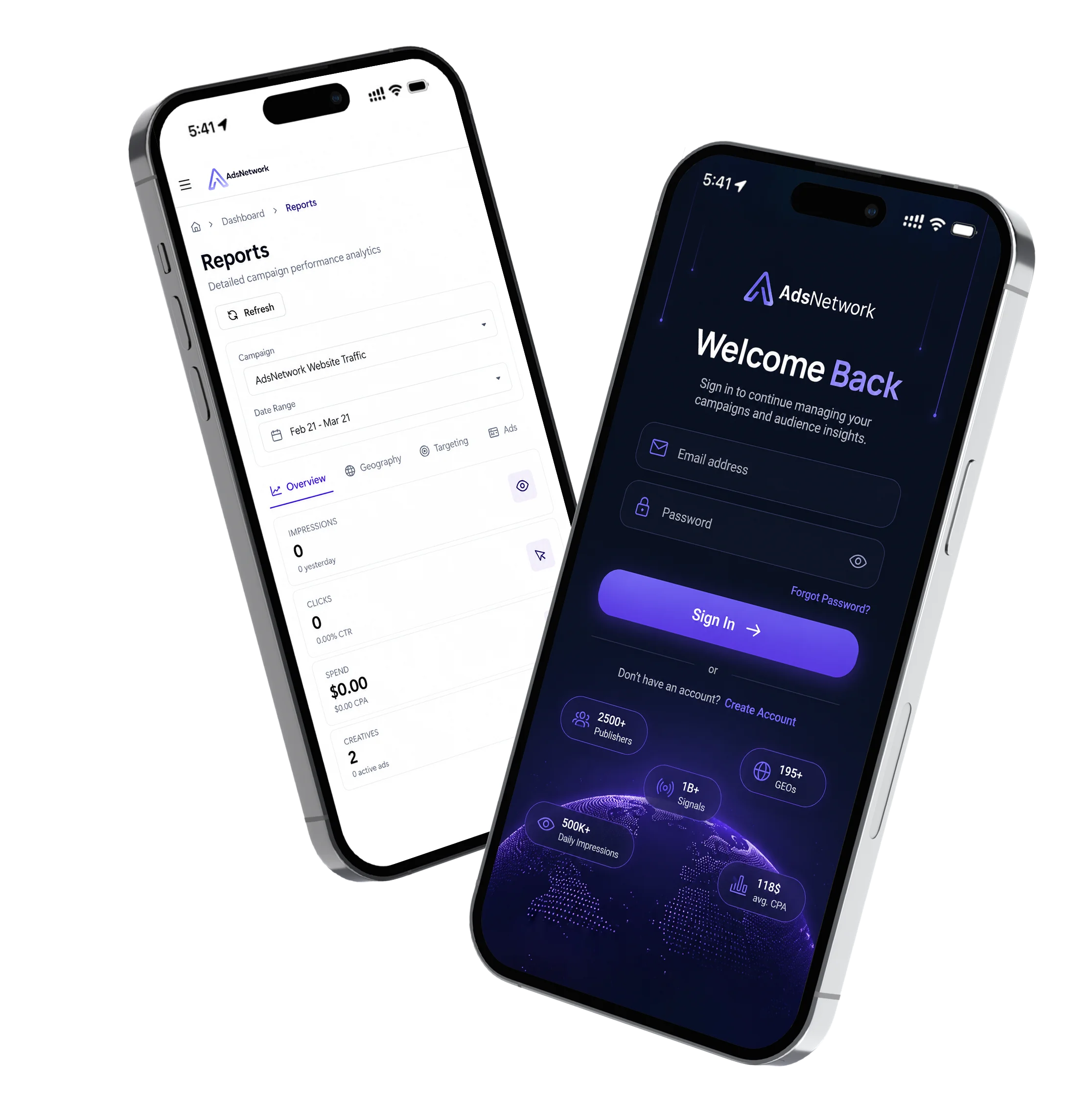
Stay connected to your live AdsNetwork campaigns with our mobile advertising app. Track impressions, clicks, conversions, campaign spend, and overall performance in real time—anytime, anywhere. Available for iOS and Android.