

Web3 advertising is no longer an experimental budget line. The global Web3 market was valued at USD 3.47 billion in 2025 and is projected to reach USD 29.97 billion by 2031, growing at a compound annual rate above 43%. That is serious money, and the projects building paid acquisition channels now are the ones who will own the next market cycle.
The problem is that mainstream advertising infrastructure was built for a different internet. Google requires country-specific certification just to run exchange ads. Meta demands pre-approval. Twitter/X allows some crypto content but limits categories arbitrarily. Most Web3 brands know the organic side of distribution well: Discord, Telegram, Twitter threads, KOL partnerships. What fewer have cracked is paid advertising that actually reaches crypto-native audiences at scale.
This guide covers the landscape as it actually stands. Where Web3 brands can advertise, what formats work for each brand type, and how to build a strategy that converts.

What Makes Web3 Advertising Different
The fundamentals of paid advertising apply here: reach the right audience, with the right message, at the right cost. But Web3 introduces constraints that make the standard playbook break down fast.
Your audience is pseudonymous
Cookie-based identity targeting does not translate to Web3 users. Wallet addresses are pseudonymous. Most high-value crypto users have VPNs on, ad blockers running, and resist data collection by design. Identity-based retargeting, the backbone of Facebook and Google performance campaigns, is largely unavailable for this audience.
Platform restrictions limit your reach
Even with a budget, mainstream channels gate access. Google requires certification per country for crypto exchanges and software wallets. In the EU, from April 2025, advertisers must also hold a valid CASP license under MiCA regulation to run exchange or wallet ads. ICOs, DeFi protocols, and token presales remain off-limits on Google entirely. These restrictions push serious Web3 marketing budgets toward channels that actually work.
Token economics create unique acquisition incentives
Web3 brands can reward engagement with tokens, airdrop eligibility, whitelist spots, and staking access. No Web2 brand has an equivalent. Your advertising creative and conversion funnels can tap incentives that simply do not exist in traditional digital marketing.
Community is both audience and distribution
A funded Web3 community does not just convert, it refers. Effective advertising in Web3 is about seeding community growth, not just chasing clicks. The metric you are optimizing for is often a wallet connection, a Discord join, or a TVL deposit, not a purchase on a checkout page.

Where Web3 Brands Can Actually Advertise
This is where most founders waste time. They try channels built for Web2 products, hit policy walls, and conclude that paid advertising does not work for Web3. The real issue is channel selection.
Crypto-native ad networks
Specialist crypto ad networks serve inventory across blockchain media publishers, DeFi dashboards, wallet interfaces, and crypto news sites. They offer contextual targeting by content category, which is the closest equivalent to identity targeting available in this space. A Web3 advertising guide that ignores this channel is incomplete: this is where the addressable crypto audience actually spends time. AdsNetwork and similar platforms in this category serve Web3-specific inventory that mainstream DSPs do not reach.
For a full comparison of channels and platforms, see our guide to Web3 advertising networks.
Programmatic via compliant DSPs
Some programmatic DSPs support crypto-adjacent inventory and contextual targeting aligned with blockchain content. The advantage is scale and automated optimization. The constraint is that not all DSPs carry crypto-relevant publishers, so inventory quality varies significantly.
Crypto editorial and native placements
Direct buys on CoinDesk, Decrypt, The Block, CoinTelegraph, and similar editorial properties offer high-trust placement for blockchain advertising. Native formats in particular perform well here because the audience is reading to learn, not to transact, and editorial-adjacent advertising converts on that information-seeking intent.
KOL and influencer channels
Twitter/X, YouTube, and Telegram are where crypto KOLs operate. Paid KOL campaigns require careful vetting, but they remain one of the highest-trust acquisition channels in Web3 because community members trust familiar voices over display ads. These are technically owned-media distributions, but they function as paid reach.
Restricted channels: what to know
Google allows exchange and wallet ads in approved markets for certified advertisers. Meta permits crypto advertising with pre-approval. Twitter/X allows some crypto categories. None of these are set-and-forget channels for Web3 brands. Compliance overhead is high, category coverage is limited, and enforcement is inconsistent.
Web3 Advertising by Brand Type
The right channel and format depends entirely on what kind of Web3 brand you are building. Here is the breakdown by project type.
NFT projects
NFT advertising sits at the intersection of awareness and urgency. Before a mint, you need eyeballs. During a mint, you need conversion. Post-mint, you need secondary market liquidity and community retention.
According to DappRadar’s Q3 2025 State of the Dapp Industry report, NFT sales count reached its highest level since 2022, with 18.1 million NFTs sold in Q3 alone. The sports NFT sector surged 337% quarter-over-quarter. Volume is returning, and projects with distribution infrastructure in place are capturing it.
- Primary goal: Awareness ahead of mint, conversion during mint window
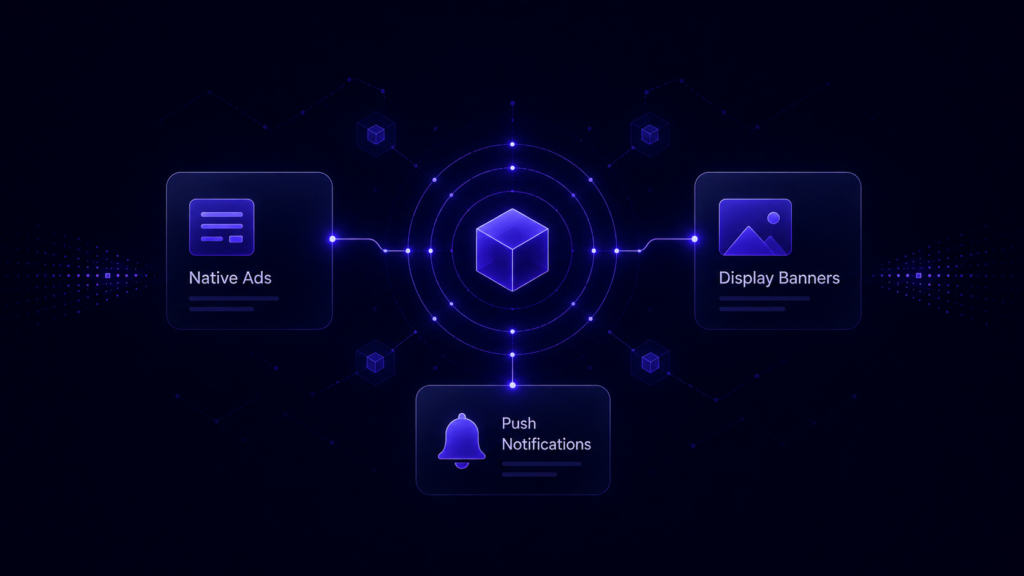
- Best formats: Display banners on crypto media, push notification ads for mint-day reminders, native editorial placements
- Key metric: Wallet connections, mints per campaign dollar
DeFi protocols
DeFi advertising is about TVL acquisition. You are targeting users who already hold crypto assets and are looking for yield, liquidity, or lending products. Total value locked across all chains exceeded $150 billion in 2025 according to DeFiLlama, and the competition for that capital is intense. Wallet-holder targeting via contextual blockchain media is the most effective route.
- Primary goal: TVL deposits, protocol wallet connections
- Best formats: Native ads on DeFi dashboards and crypto editorial, display banners on crypto portfolio tools
- Key metric: Cost per wallet connect, TVL contributed per campaign
Web3 games
GameFi user acquisition requires reaching active players who understand on-chain mechanics. Gaming accounted for 25% of daily unique active wallets in Q3 2025, making it the most active sector across all dapp categories, according to DappRadar. These players respond to utility-led creative: show the gameplay loop and the token economy, not generic gaming visuals.
For deeper strategy on reaching this audience, see Web3 game marketing.
- Primary goal: Player acquisition, wallet registration, NFT item adoption
- Best formats: Native ads, video pre-roll on crypto content channels, push notifications for in-game events
- Key metric: Day-1 wallet registration rate, cost per active player
Crypto exchanges
Exchanges face the most constrained advertising environment of any Web3 brand type. Google and Meta allow exchange ads in approved markets, but only with certification and regulatory registration in each territory. In the EU, MiCA CASP licensing has been required for Google Ads since April 2025. The practical path for most exchanges is crypto-native inventory and programmatic channels rather than fighting for access on restricted mainstream platforms.
- Primary goal: New trader acquisition, deposit activation
- Best formats: Display and native on crypto editorial, programmatic contextual targeting
- Key metric: Cost per funded account, first deposit rate
Ad Formats for Web3 Brands: What Works and Why
Native ads
Native advertising performs consistently well with crypto audiences because it matches the editorial context the reader is already in. A DeFi protocol ad appearing inside a DeFi strategy article reaches someone who is actively thinking about that category. There is no disconnect between the ad and the surrounding content. Trust transfers from the publisher to the advertiser, which matters enormously in a space where audiences are skeptical of anything promotional.
Push notification ads
Push notifications are the highest-intent re-engagement format in crypto. They work because the user has already expressed interest by visiting a crypto media property or connecting a wallet. Mint-day alerts, protocol launch reminders, and price-action-triggered messages all perform well. The key is timing: push works best when there is a concrete event to anchor the message.
Display banner ads
Display banners on high-traffic crypto publishers drive brand awareness at scale. They are less suited to direct response but essential for category presence during a token launch or protocol upgrade cycle. Creative must be direct and utility-led: state what the product does in the first line, not what it promises.
Programmatic video
Pre-roll and outstream video formats are emerging as a viable awareness channel for protocol brands. They work best for explaining complex mechanics, such as how a restaking protocol generates yield or how a GameFi economy functions. Video gives you 15 to 30 seconds to demonstrate something that static creative cannot.
Building a Web3 Advertising Strategy: Key Principles
The web3 advertising guide that actually helps performance marketers is not a list of tactics. It is a set of operating principles that hold across project types and market cycles.
Target by content context, not identity
Because cookie-based identity targeting is largely unavailable, contextual targeting is your primary lever. Place ads alongside content your target audience is reading. DeFi dashboards for DeFi audiences. Crypto gaming coverage for GameFi players. NFT marketplace content for collectors. Crypto ad networks that index their publisher inventory by category make this practical.
Align conversion goals with on-chain actions
Web3 conversion funnels do not end at a form submission. They end at a wallet connection, a transaction, a governance vote, or a TVL deposit. Build your campaign attribution around on-chain events, not last-click web analytics. If your goal is TVL growth, track the deposit event, not the landing page visit.
Lead creative with utility, not promise
Web3 audiences are uniquely skeptical of marketing language. APY promises, token price charts, and hype-driven copy convert worse than utility-led messaging that answers a specific question: what does this protocol do for someone who deposits funds into it? What does this game give a player on day one? Lead with the answer, not the aspiration.
Test networks against each other
Performance varies significantly between crypto ad networks, depending on your vertical, target region, and format. Run split tests across networks before committing budget to one channel. A DeFi protocol may find that native placements on DeFi-focused publishers outperform run-of-site display by a factor of three. You will not know without testing.
Retarget on-chain activity signals where possible
Some crypto ad platforms support audience segments built from on-chain behavioral signals, such as wallet holders who have interacted with a competing protocol or users who have minted NFTs in your category. These segments are coarse compared to Web2 behavioral data, but they are far more relevant than demographic proxies.
Respect the compliance layer
Whatever your channel mix, document your compliance position before launching. Claiming a certification you do not have, targeting markets where your product is not approved, or running creative that implies financial returns will get accounts suspended. The compliance overhead is real, but it is the cost of operating in a regulated advertising environment.
For a broader view of how to build a marketing plan from the ground up, see our article on how to market a crypto project.
Getting Started with Web3 Advertising on AdsNetwork
AdsNetwork is a programmatic platform built specifically for Web3, crypto, and iGaming brands. Its publisher network spans crypto media, DeFi dashboards, blockchain news sites, and related properties, giving advertisers direct access to a crypto-native audience without navigating mainstream platform certification or restricted inventory.
The platform supports the ad formats that perform best in this space: native ads, display banners, push notifications, and pop-under units. Targeting is built around contextual categories and audience segments relevant to crypto verticals, so you are not buying generic digital traffic and hoping it converts.
For Web3 brands that are ready to move beyond organic growth, paid distribution through a crypto advertising network with a relevant inventory is the shortest path to scalable audience growth.
FAQ: Web3 Advertising
How do you advertise a Web3 project?
Advertising a Web3 project starts with selecting channels that allow crypto content. Mainstream platforms like Google and Meta restrict most crypto categories and require certification for exchanges and wallets. Crypto-native ad networks offer the most direct route to blockchain audiences. From there, choose formats aligned to your conversion goal: native ads for DeFi TVL acquisition, push notifications for NFT mint-day urgency, and display banners for protocol brand awareness. Align creative with utility and make sure your conversion tracking captures on-chain events, not just web visits.
What is Web3 advertising?
Web3 advertising refers to paid distribution strategies designed for blockchain-based products and their audiences. It encompasses ads for NFT projects, DeFi protocols, crypto exchanges, Web3 games, DAOs, and token launches. Because Web3 audiences are pseudonymous and resistant to cookie-based tracking, Web3 advertising relies on contextual targeting via crypto-native publisher networks rather than identity-based audience segments. The conversion actions it measures are on-chain: wallet connections, protocol deposits, NFT mints, and token purchases.
How does Web3 advertising differ from traditional advertising?
Traditional advertising runs on identity data: behavioral cookies, demographic profiles, and third-party audience segments. Web3 advertising cannot rely on these because most crypto users operate pseudonymously and actively resist data collection. Web3 advertisers use contextual publisher targeting, on-chain audience signals, and crypto-native inventory instead. Conversion goals are also fundamentally different. Web3 tracks wallet connects and on-chain transactions rather than form fills or page-checkout events. Platform access is more restricted, compliance requirements vary by country, and creative that performs relies on utility messaging rather than the aspirational copy that works in consumer categories.
How do Web3 ad networks work?
Web3 ad networks aggregate inventory from crypto-focused publishers: blockchain news sites, DeFi dashboards, NFT marketplace pages, crypto portfolio tools, and related properties. Advertisers place bids to reach audiences on this inventory, targeting by content category, geography, and device type. Crypto ad networks handle the publisher relationships, traffic quality verification, and creative delivery, so advertisers do not have to negotiate individual site deals. Some platforms also support audience segments built from on-chain behavioral data, allowing advertisers to reach users who have interacted with similar protocols or products.
The Brands Building Now Will Own the Next Cycle
Web3 advertising is not waiting for mainstream platforms to catch up. Brands running crypto-native paid campaigns today are building audience equity, testing what converts, and training attribution models while most competitors still rely entirely on organic reach.
According to Research and Markets, the Web3 marketing sector is projected to reach USD 7.65 billion by 2030, growing at over 23% annually. That window to build paid distribution infrastructure before the market matures is open now, not later.
Run your tests. Choose channels that reach your actual audience. Align creative with utility. Measure on-chain conversions, iterate on what works. That is Web3 advertising done right.
Featured Posts
Sep 23, 2026
6 min read
What Is Advertising Technology (AdTech) and How Does It Work?
Advertising technology, commonly known as AdTech, refers to the software, platforms, tools, and systems used to plan, buy,…
Read Article
Sep 16, 2026
8 min read
Media Buying: A Complete Guide for Advertisers
Media buying is the process of purchasing advertising space to reach a target audience. It includes choosing where…
Read Article
Sep 7, 2026
8 min read
Programmatic Advertising vs Display Advertising: What’s the Difference?
Programmatic and display advertising are often used interchangeably, but they describe two different parts of digital advertising. Display…
Read ArticleNeed Help?
Our team is ready to help you launch successful campaigns.
AI-Powered Mobile
Monitor Your Campaigns Anywhere
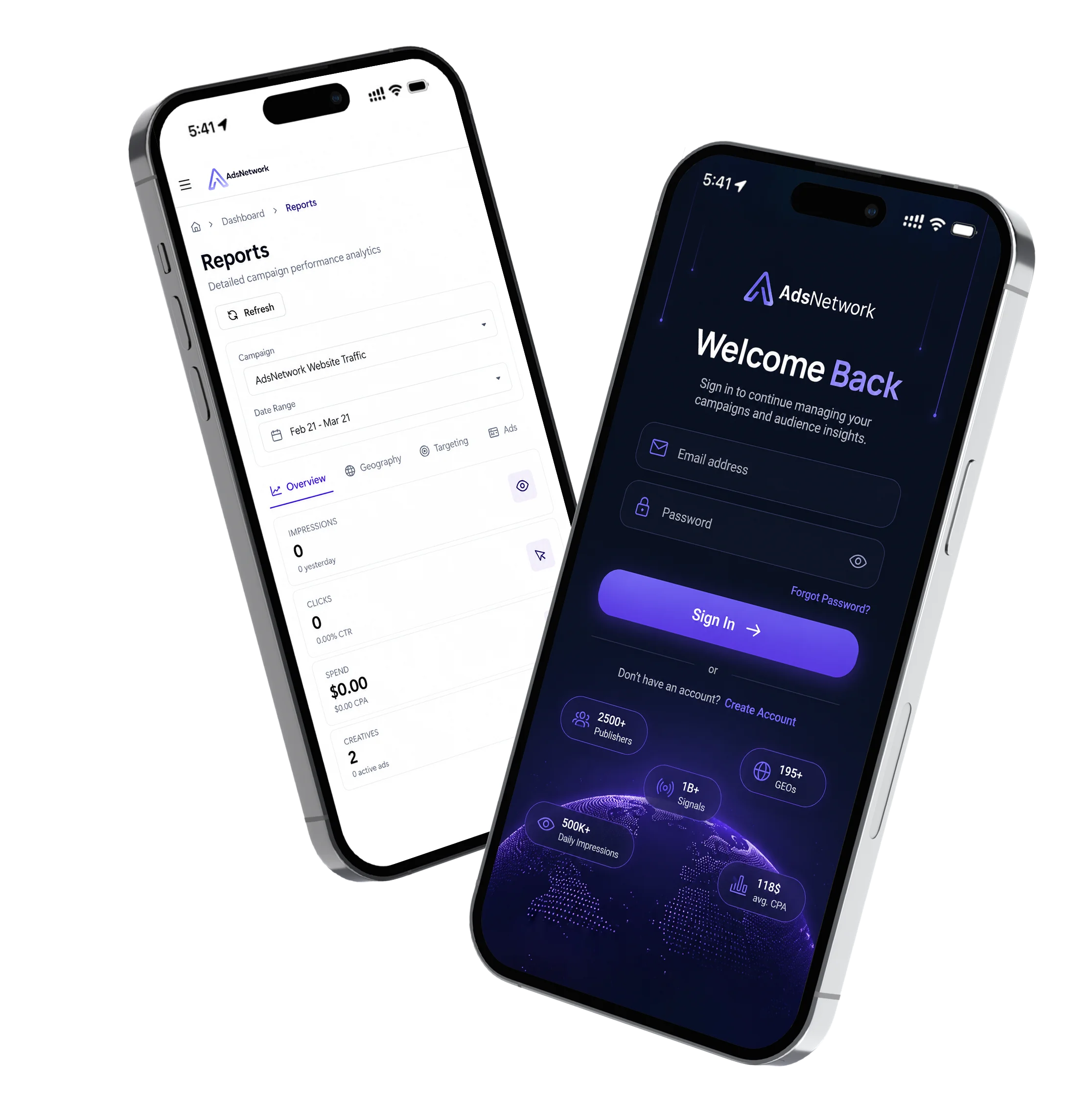
Stay connected to your live AdsNetwork campaigns with our mobile advertising app. Track impressions, clicks, conversions, campaign spend, and overall performance in real time—anytime, anywhere. Available for iOS and Android.