
iGaming advertising is one of the most lucrative and most punishing channels in digital marketing. Traffic is expensive. Compliance rules shift by border. Rivals spend hard and guard every placement. Win, and you build a deposit machine that runs around the clock. Get it wrong, and you torch budget on clicks that never fund an account. You already know the vertical, so this guide skips the primer. It focuses on what actually moves first-time deposits: the channels, the formats, the geo-targeting, and the numbers that protect your margin.
The prize is large and still growing. The global online gambling market reached $88 billion in 2025 and is on track for $97.7 billion in 2026, according to Grand View Research. In Great Britain alone, online gambling produced £7.8 billion in gross gambling yield in the year to March 2025, per the UK Gambling Commission. The wider gambling market is projected to pass $1 trillion in gross gaming revenue by 2030, according to H2 Gambling Capital. Demand is not the problem. Reaching it compliantly, at a cost that holds margin, is the whole game.
Why iGaming Advertising Requires a Specialist Approach
Generic ad networks were never built for this vertical. iGaming advertising carries a compliance and targeting load that breaks standard tools. Plug a gambling brand into a mainstream platform and you fight the system at every step. Plug it into a specialist network and the system works with you. Two problems stand out above the rest.
The iGaming advertising compliance maze
Google and Meta restrict gambling ads heavily. Both demand certification, licensing proof, and market-by-market approval, and both reject creative that hints at guaranteed wins. Many operators never clear the bar. Even when they do, a single policy flag can freeze the account in the middle of a campaign. A specialist casino advertising network removes that bottleneck, because gambling is its core business, not a restricted edge case it merely tolerates. Reviews now cover the landing page as well as the ad, so a clean creative pointed at a non-compliant page still fails. For an operator, a frozen account does more than pause spend. It stalls acquisition across every market at once.
Traffic that is geo-locked, device-split, and event-driven
iGaming traffic does not behave like ecommerce traffic. Licensing locks your audience to specific countries, so a misfired geo wastes spend and invites trouble. Device habits split by market: mobile and tablet made up around 61% of online gambling revenue in 2025, per Market Research Future, yet desktop still leads high-value casino play in some regions. Timing matters too. Sports betting demand spikes around fixtures, finals, and live events, then drops away. A generic network cannot price or pace against that rhythm. A specialist one can.
Bot traffic and bonus abuse: the hidden tax
iGaming attracts fraud like few other verticals. Bot clicks inflate costs, and bonus hunters drain promotions without ever becoming real players. Generic networks rarely screen for this. A specialist network checks traffic quality, blocks known bad sources, and protects your cost per deposit. That filtering alone can decide whether a campaign clears its CPA target. Ask any network how it verifies traffic and what share it rejects, since a clear answer marks a partner worth trusting.

iGaming traffic is geo-locked by licensing, splits across devices by market, and spikes around live sporting events.
iGaming Advertising Channels That Perform in 2026
Channel choice sets your floor. The right mix depends on your product, your licensed markets, and your acquisition goal. Five channels carry most iGaming campaigns today. Run the right two or three together and you cover awareness, acquisition, and re-engagement at once.
Comparing the channels
| Channel | Compliance readiness | Targeting depth | Cost profile | Best use case |
| Specialist iGaming ad networks | High | High | Mid | FTD-focused acquisition |
| Programmatic DSPs with iGaming inventory | High | Very high | Mid to high | Scaled, data-driven campaigns |
| Push notifications | High | Medium | Low | Re-engagement, match-day alerts |
| Native ads on sports/gambling media | High | High | Mid | Trust and awareness |
| Pop-under | Medium | Medium | Low | Registration funnel volume |
A few things to read from that. A dedicated iGaming ad network and programmatic iGaming ads tend to do the heavy lifting, because they pair compliant inventory with the targeting depth operators need. Push and pop formats add cheap volume and re-engagement. Native earns trust on the media your players already read. If your roadmap includes blockchain titles or crypto casinos, Web3 gaming advertising opens an audience that mainstream networks rarely reach well.
Where each channel fits
Programmatic DSPs reward operators who want control. They let you buy iGaming inventory in real time, apply geo and device rules at the impression level, and scale spend the moment a creative proves out. For data-driven teams, that precision is hard to match anywhere else.
Affiliate and native media carry the trust layer. Players study odds and bonuses before they register, so a credible placement on a sports or casino site does real persuading. Push and pop formats sit at the volume end, cheap and fast, and best used to feed the top of the funnel rather than to close a deposit.
Affiliate partners stay a backbone of iGaming acquisition. They get paid on CPA, revenue share, or a hybrid of both, and they pull hardest when paid media warms the audience first. No single channel wins alone. The strongest operators run a stack: programmatic for scale, native for trust, push for re-engagement, and affiliates for reach, all measured against cost per deposit.
Best Ad Formats for iGaming Campaigns
Channel gets you in front of the right audience. Format decides whether they register and deposit. Five formats earn their place in iGaming.
Native advertising
Native advertising blends into sports and casino editorial, so it reads as a tip rather than a pitch. Use it for brand building and bonus explainers. Match the creative to the host site’s tone. On sports media, time native around fixtures for a lift. The watch-out: keep claims factual, with no win guarantees.
Push notification ads
Push notification ads reach opted-in users, which makes them strong for re-engagement and match-day alerts. Fire them before a big fixture or a new bonus window. Keep the copy short. Avoid spammy frequency, or players mute you fast.
Pop-under ads
Pop-under ads deliver registration-funnel volume at a low CPM. They suit Tier 2 and Tier 3 markets, where deposit conversion is harder and cheap reach pays off. Run them as a volume layer beneath your core campaigns, not as the main event. Expect lower intent, then price your bids for it.
Display banners
Display banners hold the awareness layer on iGaming portals and odds-comparison sites. They keep your brand visible while players research. Strong, compliant creative carries the result. Size and placement matter more than motion, so test a few standard units on high-traffic portals first. Skip the flashing animation that screams ad.
Mobile interstitial ads
Mobile interstitial ads own the screen for a moment, which suits app installs and re-engagement. They work well for casino apps and sportsbook downloads. Frequency capping keeps the format from wearing out loyal players. Use a clear call to action and an easy exit, since friction here hurts the brand.
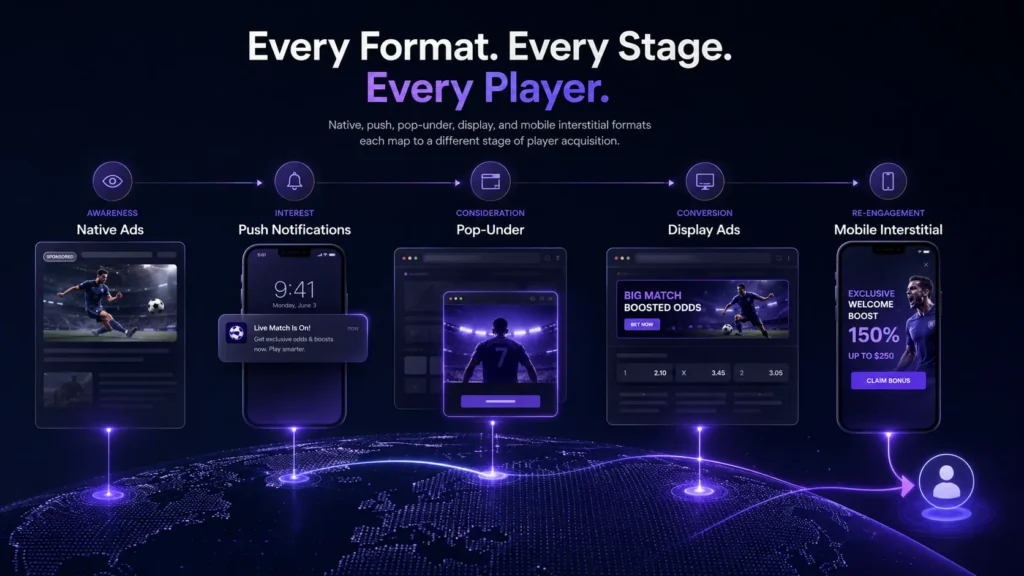
Native, push, pop-under, display, and mobile interstitial formats each map to a different stage of player acquisition.
Geo-Targeting for iGaming: Compliance by Market
Geo-targeting is where iGaming campaigns are won or lost. The rule is easy to state and hard to execute: advertise only where you are licensed.
iGaming advertising is legal and regulated across much of Europe, including the UK, Germany, the Netherlands, and the Nordics, plus parts of Latin America and a growing list of US states. Each market sets its own rules through its own regulator. The UK Gambling Commission, the Malta Gaming Authority, and Curaçao’s gaming regulator each license operators on different terms. Compliance with those terms is your responsibility as the operator, not the network’s, and the details change often.
Three rules for compliant geo-targeting
Three practical points guide good geo-targeting. First, separate licensed from unlicensed markets and exclude the latter cleanly. Second, match language and creative to each market, since a localized ad converts far better than a translated afterthought. Third, bid by time zone around sports events, so budget lands when intent peaks. Localize payment methods and currency too, since a checkout that feels foreign kills conversions even when the ad lands well. Handle this well and compliance stops being a tax. It turns into a moat that keeps sloppier competitors out of your markets.
Responsible gambling and creative compliance
Compliant geo-targeting is only half the job. Most regulated markets also require responsible gambling messaging, clear bonus terms, and strict age controls that keep ads away from minors. Creative that promises certain wins or buries the terms gets pulled fast. Build these rules into the brief, not the review stage, and your approval rate climbs while your account stays healthy. Keep a record of approvals and creative versions by market, so an audit never catches you flat.
iGaming Performance Marketing: How to Measure What Matters
Vanity metrics lie in this vertical. Clicks and registrations look busy, yet they do not pay. iGaming performance marketing lives and dies on what happens after the signup. A campaign can look like a winner on click data and still lose money once the deposits fail to land. So measure the outcome, never the activity. Registrations flatter a report. Deposits pay the bills.
Why FTD cost beats CPM and CPC
The number that matters is the first-time deposit, or FTD. A thousand cheap clicks mean nothing if none fund an account. So the operators who win track cost per FTD, not cost per click. Around that sit the metrics that define real profit: CPA, ARPU, bonus redemption rate, retention, and player lifetime value. LTV measured against acquisition cost tells you how hard you can afford to bid.
Put numbers on it. Affiliate FTD payouts commonly run from roughly €50 to €700 or more, depending on market and product, according to SMSEdge. Your task is to win that same deposit for less than the player returns over their lifetime. Get that ratio right and you can outbid rivals on the placements that matter.
Track FTD, then optimize
Watch retention by cohort, not only day-one signups. A cheap player who never returns costs more than a pricier one who stays and redeposits. Bonus redemption and reactivation rates tell you which sources send real players versus one-and-done traffic.
Set up tracking before you scale. Postback tracking ties each deposit back to its source, creative, and GEO, so you can cut what loses and feed what wins. Clean attribution is the line between scaling profit and scaling waste. For the full framework, our guide to optimize ad campaigns walks through the measurement stack step by step.
iGaming Advertising Costs in 2026: What to Budget
Cost in iGaming swings hard by format, GEO, and competition, so treat any benchmark as a starting point, not a quote. The pattern is steady, though. Cheap volume formats sit low, premium and event-driven inventory runs high, and the only number that truly matters is what you pay for a funded account.
Typical cost benchmarks
Pop-under and push traffic usually carry the lowest CPMs. Pop-under inventory often runs between $0.30 and $2.00 per thousand impressions, depending on GEO and competition, according to Traffic Nomads. Native and display land in the middle. Premium placements on top sports portals, and high-demand windows like a cup final, price at the top of the range. Run small tests across two or three GEOs before you commit real budget to any one.
Three levers move your effective cost:
- GEO tier. Tier 1 markets cost more and convert higher. Tier 2 and Tier 3 trade cheaper traffic for harder deposit conversion.
- Timing. Bids spike around major fixtures, so plan budget around the sporting calendar.
- Creative quality. A fresh, compliant, localized ad lowers cost per deposit more than any bid tweak.
Budget for testing, then do the FTD math
Budget for a learning period as well. Most campaigns need a week or two of data before targeting and creative settle. Treat that early spend as research, not waste. Once the network learns your players, cost per FTD usually falls and holds.
A quick example shows the math. Say a casino player is worth €400 in lifetime value, and you hold to a 3:1 LTV-to-CPA target. That leaves roughly €130 to win each first-time deposit. Track every source against that ceiling, then pause whatever drifts above it.
How to Set Up an iGaming Advertising Campaign with AdsNetwork
Here is a practical sequence for launching a compliant, FTD-focused campaign. None of it is complicated, but the order matters.
- Define the objective. FTD, sports bettor, casino player, or app install each need different formats and creative, so pick one primary goal.
- Pick the format. Match it to the objective: native for trust, push for re-engagement, pop for volume, interstitial for installs.
- Lock geo-targeting to licensed markets. Exclude every region where you lack a license. This single step protects the account and the brand.
- Write compliant creative. Lead with the product and the bonus terms, and drop any guaranteed-win language for good.
- Set the bidding strategy. Start on CPM to gather data, then move to performance bidding once the numbers stabilize.
- Launch, then measure FTD and CPA. Refresh creative every two to three weeks to fight fatigue, and reallocate to the GEOs and formats that deposit.
This is the workflow AdsNetwork was built to run. It pairs compliant iGaming inventory with geo-precise targeting and FTD-level reporting, so iGaming user acquisition stays measurable from first impression to funded account. Operators scale through programmatic delivery without rebuilding their stack. Geo rules, creative checks, and FTD tracking sit in one place, which cuts the busywork that stalls most launches. For the strategy layer behind it, see our iGaming performance marketing playbook.
A real iGaming campaign in action
Real campaigns show the payoff of format discipline. In one published case, an advertiser running on ExoClick set a $15 cap on cost per registration, used mobile fullpage interstitials with short gameplay GIFs, and refreshed creative every two to three weeks to beat fatigue. Starting on CPM bidding to learn the format, the team then switched to automated bidding. Both the CPA and FTD targets were hit inside the first month. The lesson is not the tool. It is the method: test, measure FTD, and let the data pick the winners.
Ready to run compliant iGaming campaigns that move first-time deposits? Get Access →.
Frequently Asked Questions
What is iGaming advertising?
iGaming advertising is the paid promotion of online casino, sportsbook, poker, and betting products to acquire and re-engage players. It spans specialist ad networks, programmatic display, native, push, and pop formats. Because gambling is heavily regulated, campaigns must run only in licensed markets and follow each regulator’s creative rules.
How do you advertise iGaming products?
To advertise iGaming products, operators use channels built for the vertical: specialist iGaming ad networks, programmatic DSPs, native media, push, and pop-under. Mainstream platforms like Google and Meta require certification and licensing. The core steps are define an FTD goal, target only licensed geos, run compliant creative, and optimize on cost per deposit.
What ad formats work for iGaming?
The ad formats that work for iGaming are native ads for trust, push notifications for match-day re-engagement, pop-under for registration volume, display banners for awareness, and mobile interstitials for app installs. The best mix depends on your product and markets. Most operators run two or three formats together and optimize toward first-time deposits.
Is casino advertising allowed programmatically?
Casino advertising is allowed programmatically, but only in licensed markets and through inventory that accepts gambling ads. Specialist DSPs and iGaming ad networks supply compliant programmatic supply with geo controls. Operators stay responsible for advertising only where they hold a license and for meeting each market’s disclosure and creative rules.
iGaming Advertising in 2026: Compliance as Your Competitive Edge
The barriers that frustrate iGaming advertising are also its best feature. Every certification hurdle and geo rule that slows a careless competitor protects the operator who runs clean, compliant, FTD-focused campaigns. Treat compliance as a moat, not a chore. The market is large, demand is constant, and the operators who master measurement keep the margin. Build that discipline now, while many rivals still treat compliance as an afterthought, and the lead compounds.
Ready to reach licensed-market players without the compliance headache? Get Access → at adsnetwork.io.
Featured Posts

Sep 23, 2026
6 min read
What Is Advertising Technology (AdTech) and How Does It Work?
Advertising technology, commonly known as AdTech, refers to the software, platforms, tools, and systems used to plan, buy,…
Read Article
Sep 16, 2026
8 min read
Media Buying: A Complete Guide for Advertisers
Media buying is the process of purchasing advertising space to reach a target audience. It includes choosing where…
Read Article
Sep 7, 2026
8 min read
Programmatic Advertising vs Display Advertising: What’s the Difference?
Programmatic and display advertising are often used interchangeably, but they describe two different parts of digital advertising. Display…
Read ArticleNeed Help?
Our team is ready to help you launch successful campaigns.
AI-Powered Mobile
Monitor Your Campaigns Anywhere
Stay connected to your live AdsNetwork campaigns with our mobile advertising app. Track impressions, clicks, conversions, campaign spend, and overall performance in real time—anytime, anywhere. Available for iOS and Android.