
Most digital advertising budgets are still producing less than they should. Audiences are reached inconsistently, costs are difficult to predict, and campaign performance is measured days after the money is already spent. The benefits of programmatic advertising exist precisely to address these problems. Specifically, by replacing manual buying with automated, data-driven systems, programmatic advertising delivers measurable improvements in cost efficiency, targeting accuracy, and campaign performance. Traditional methods cannot replicate these gains. According to SEO Design Chicago, global programmatic ad spend exceeded $650 billion in 2024 and programmatic now accounts for nearly 90% of all digital display ad spending worldwide. That adoption rate is not coincidence. It reflects a consistent, documented performance advantage across every major metric that matters to advertisers.
Benefit 1: Lower CPMs and More Efficient Budget Allocation
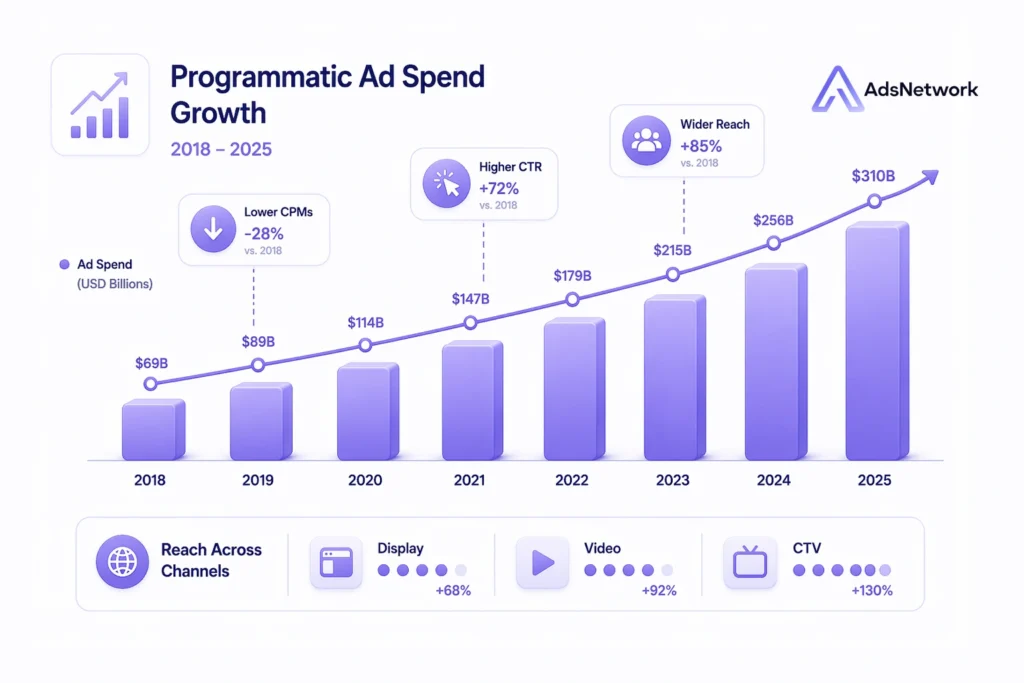
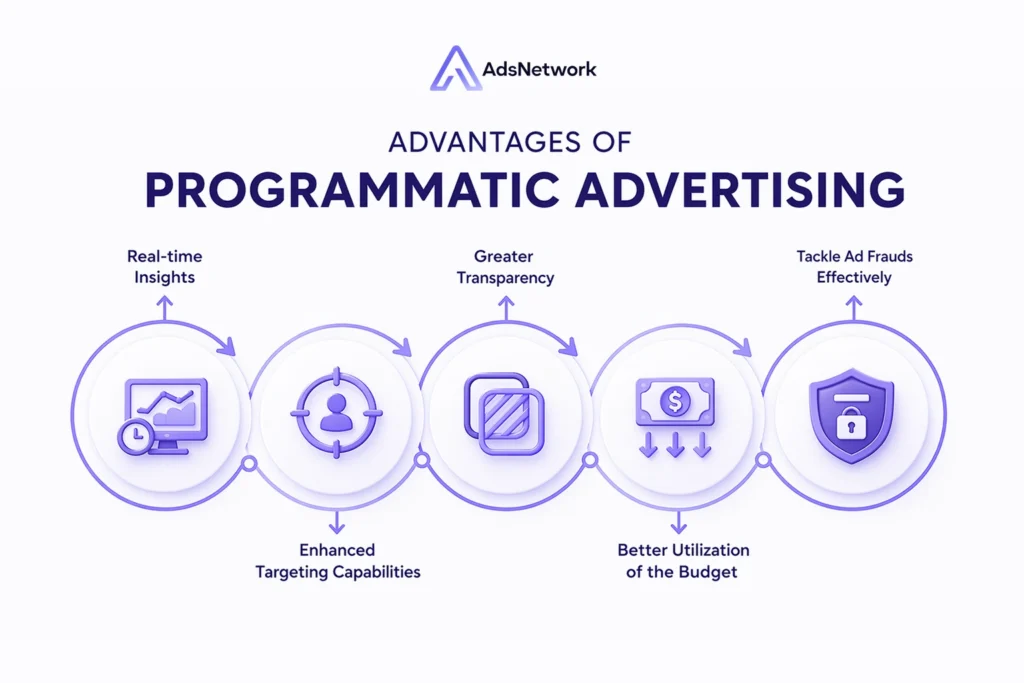
One of the most immediately tangible benefits of programmatic advertising is cost reduction. Programmatic platforms access inventory across thousands of publishers through real-time auctions, creating genuine price competition for every impression. The result is consistently lower clearing prices than direct buys can achieve. Notably, advertisers typically see 25 to 45% lower CPMs with programmatic compared to direct-buy display, according to industry benchmarks via Marketing LTB. That gap reflects the structural advantage of auction-based pricing over negotiated fixed rates.
Furthermore, programmatic platforms allocate budget dynamically. Instead of committing spend to a fixed placement in advance, automated systems evaluate each impression in real time. Budget flows toward placements and audience segments that are converting. It moves away from those that are not. As a result, the same budget delivers more qualified impressions. A static direct buy cannot match this in the same period.
The ANA’s 2024 Programmatic Transparency Benchmark Study confirmed this efficiency improvement in practice. According to SEO Design Chicago, 43.9 cents of every $1,000 entering a DSP now reaches consumers as viewed ad impressions, up from 36 cents in 2023. That eight percentage point improvement represents real incremental working media delivered without any increase in budget.
Benefit 2: Precision Audience Targeting
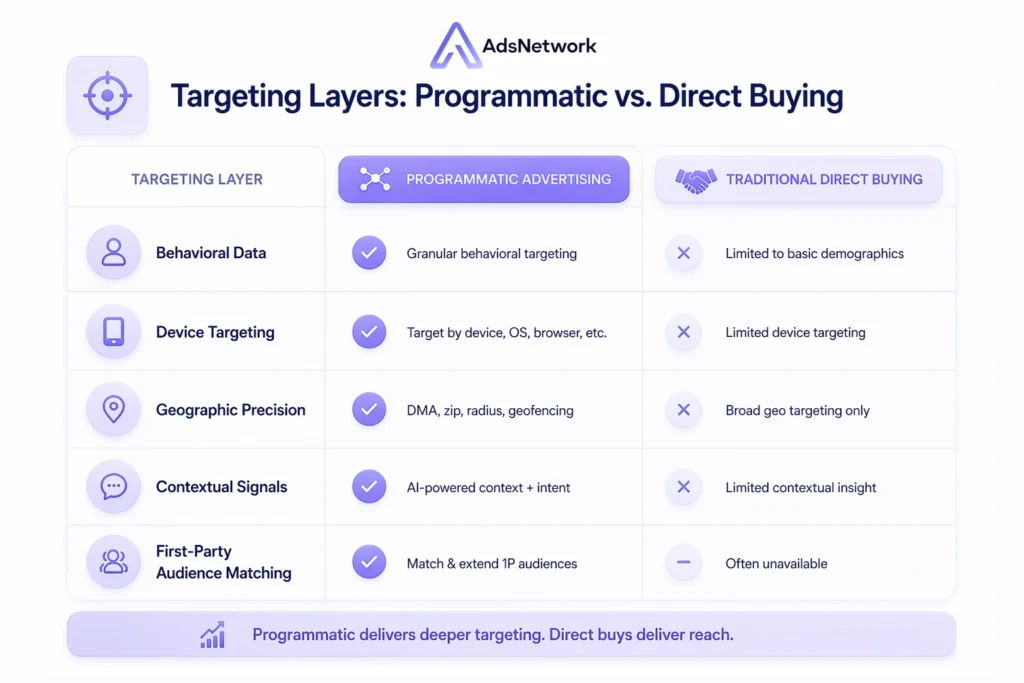
Manual media buying targets audiences at the publisher level. An advertiser buying space on a finance website knows broadly who reads it. However, they cannot filter by purchase intent, device type, geographic precision, or the behavioral signals that differentiate high-value users from casual visitors. Programmatic advertising changes this entirely.
Specifically, programmatic platforms evaluate each impression against a detailed audience profile before bidding. Specifically, they layer behavioral data, demographic segments, contextual signals, first-party CRM data, and device identifiers. The goal is to identify users most likely to convert. The performance difference is significant. Programmatic ads achieve 200% higher click-through rates than non-targeted ads, according to SEO Design Chicago. Additionally, retargeting through programmatic increases ROAS by 2 to 4 times on average, according to Marketing LTB’s performance benchmarks.
For Web3 and crypto advertisers, this targeting depth is particularly valuable. Crypto audiences are highly specific, including DeFi users, NFT collectors, on-chain traders, and blockchain developers. Reaching these groups through broad publisher buys wastes budget on users with no interest in crypto products. Programmatic platforms that support on-chain behavioral signals and crypto-specific audience segments deliver far higher relevance at equivalent spend.
Benefit 3: Real-Time Optimization
Traditional advertising campaigns are evaluated after they run. A direct buy delivers its impressions whether or not early data suggests the placement is working. There is no mechanism to redirect budget once the contract is signed. One of the most structurally important benefits of programmatic advertising is that this constraint disappears entirely.
In programmatic campaigns, every auction generates performance data. The DSP analyzes this data continuously. Specifically, bids increase toward audience segments, times of day, and publishers that are producing conversions. Consequently, spend reduces automatically on placements that are not performing. Additionally, creatives that underperform can be swapped without pausing the campaign. Consequently, programmatic campaigns improve over time in a self-reinforcing cycle that manual buying cannot replicate.
According to Bannerflow, over 83% of senior brand marketers now use AI to target digital ads. This reflects how thoroughly real-time optimization has become standard rather than advanced practice. Dynamic creative optimization (DCO) takes this further. Specifically, individual ad elements, such as headlines and calls to action, are adjusted in real time based on what resonates with each audience segment. As a result, campaigns adapt to user behavior rather than relying on pre-set creative assumptions.
Benefit 4: Multi-Channel Reach at Scale
Reaching a broad, specific audience across multiple channels through manual media buying would require separate relationships with dozens of publishers and formats. In practice, negotiating individually for display, video, mobile, connected TV, and audio placements is operationally impractical for most teams. Programmatic advertising consolidates all of this through a single interface.
Through a DSP, a single campaign serves ads across display, mobile apps, video pre-roll, connected TV, digital audio, and digital out-of-home inventory simultaneously. Cross-channel programmatic campaigns achieve 166% higher engagement and 24% higher conversion rates compared to single-channel approaches, according to SEO Design Chicago. Notably, mobile accounts for 71% of all programmatic ad spend globally. This reflects how thoroughly automated buying now spans the environments where audiences actually spend their time.
For crypto and Web3 advertisers, multi-channel reach matters because blockchain audiences engage across a wide range of digital environments. A DeFi user might encounter a relevant campaign on a crypto news site, a gaming app, and a financial podcast in the same day. Consequently, programmatic infrastructure allows a single campaign to follow that audience across all three touchpoints. No separate manual negotiations are needed for each channel.
Benefit 5: Transparent Measurement and Accountability
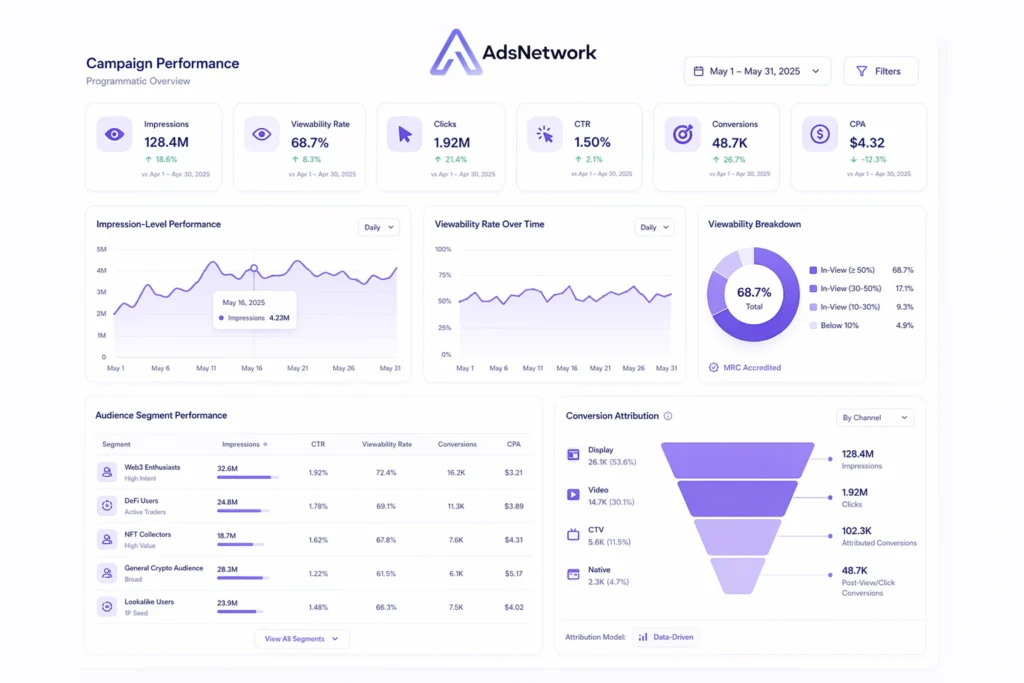
Notably, a persistent frustration with traditional advertising is the difficulty of attributing results. An advertiser running a homepage takeover on a publisher’s site receives an aggregate impression count. Instead, they receive no information about which users saw the ad, whether it was viewable, or whether those users subsequently converted. Programmatic advertising replaces this opacity with impression-level reporting.
Specifically, programmatic platforms log every impression served: the publisher, the placement, the audience signal, the clearing price, and downstream behavior. In turn, this data enables attribution modeling, frequency analysis, and audience segment performance comparisons that are simply not available through manual buying. Moreover, verification platforms integrated into the programmatic stack monitor impressions in real time for viewability and invalid traffic.
The industry has made measurable progress on quality. According to the ANA 2024 Benchmark Study via SEO Design Chicago, ad spending on made-for-advertising sites dropped from 15% in 2023 to 6.2% in 2024 following advertiser and platform interventions. Additionally, TAG-certified channels saw a 92% reduction in fraud losses, saving $10.8 billion in 2023. These improvements are direct consequences of the transparency and verification tooling that programmatic infrastructure makes possible.
Benefit 6: Scalability for Any Budget Size
One of the underappreciated benefits of programmatic advertising is that its advantages do not require a large budget to access. Traditional direct buying often demands minimum spend commitments, long-term contracts, and agency relationships that put premium inventory out of reach for smaller advertisers. Programmatic markets are open to anyone with a DSP account and a campaign goal.
A token launch team with a limited runway can run a test campaign with a small budget, evaluate performance data after days, and scale spend toward audience segments that convert. Conversely, if results do not justify scaling, the campaign can be paused immediately. Importantly, there are no cancellation fees and no minimum delivery commitments. This flexibility is structurally unavailable in traditional direct buying.
Additionally, the self-serve model that many programmatic advertising platforms offer has lowered the operational barrier further. Consequently, teams no longer need a dedicated agency or media buyer to access RTB infrastructure. Campaign setup, targeting configuration, and real-time optimization are all accessible through platform interfaces designed for direct use by marketing teams. This democratization of access is one of the most significant structural changes programmatic advertising has introduced to the industry.
Benefit 7: AI-Powered Bidding and Creative Optimization
Modern programmatic advertising goes well beyond automated buying. AI is now embedded throughout the stack, improving outcomes at every stage of the campaign lifecycle. Bidding algorithms analyze historical win rates and conversion probability signals. They submit bids that balance winning impressions against cost efficiency. Dynamic creative systems test and optimize ad elements continuously without requiring manual creative updates.
According to SEO Design Chicago, over 80% of senior marketers now use AI to enhance ad targeting and campaign optimization. Accordingly, the technology enables real-time bid adjustments and pattern recognition that improves performance across campaigns. For Web3 advertisers, this capability matters because crypto audience behavior is volatile and fast-moving. Automated bidding systems that adapt to real-time signals respond to market conditions far faster than any human-managed campaign could.
The Benefits of Programmatic Advertising for Web3 and Crypto Projects
Importantly, every benefit described above applies to Web3 and crypto advertisers. However, accessing these benefits requires programmatic infrastructure that operates within the crypto ecosystem rather than against it. Mainstream DSPs restrict DeFi protocols, token launches, and NFT projects regardless of their compliance status. This blocks crypto advertisers from the efficiency, targeting, and optimization advantages that programmatic delivers.
AdsNetwork addresses this directly. It provides Web3 projects with RTB-based programmatic buying across crypto-native publisher inventory. Targeting is calibrated for on-chain audience signals and optimization tools are built for crypto campaign patterns. Furthermore, the benefits of programmatic advertising, including lower CPMs, precision targeting, and transparent measurement, are all available through infrastructure that understands what Web3 campaigns need.
For teams comparing approaches, the full picture is in the numbers. Consider the contrast against programmatic vs direct advertising: direct buys offer placement certainty but lack the targeting depth and cost efficiency that programmatic delivers at scale. For performance-oriented Web3 campaigns, the programmatic model consistently produces better outcomes per dollar spent.
Conclusion: The Benefits of Programmatic Advertising Are Measurable and Compounding
The benefits of programmatic advertising are not theoretical. They are documented, replicable, and growing as the technology matures. Lower CPMs reduce acquisition costs. Precision targeting reduces wasted impressions. Real-time optimization compounds performance over each campaign cycle. Multi-channel reach extends audience coverage without operational complexity. Transparent reporting improves decision-making. AI-powered optimization reduces the manual overhead of campaign management.
For Web3 and crypto projects specifically, these benefits are accessible through purpose-built infrastructure that does not impose the policy restrictions of mainstream exchanges. Visit AdsNetwork to explore programmatic advertising built for DeFi protocols, token launches, and blockchain publishers.
Featured Posts
Oct 23, 2026
10 min read
What Is CPM in Advertising? Meaning, Formula and 2026 Rates
CPM is the cost an advertiser pays for 1,000 ad impressions, making it one of the most common…
Read Article
Sep 23, 2026
6 min read
What Is Advertising Technology (AdTech) and How Does It Work?
Advertising technology, commonly known as AdTech, refers to the software, platforms, tools, and systems used to plan, buy,…
Read Article
Sep 16, 2026
8 min read
Media Buying: A Complete Guide for Advertisers
Media buying is the process of purchasing advertising space to reach a target audience. It includes choosing where…
Read ArticleNeed Help?
Our team is ready to help you launch successful campaigns.
AI-Powered Mobile
Monitor Your Campaigns Anywhere
Stay connected to your live AdsNetwork campaigns with our mobile advertising app. Track impressions, clicks, conversions, campaign spend, and overall performance in real time—anytime, anywhere. Available for iOS and Android.