
Every digital ad that reaches a user has traveled through a chain of software before it appears on screen. That chain is the ad tech stack. It is a set of interconnected platforms that handle buying, selling, data, targeting, delivery, and measurement simultaneously. Understanding the ad tech stack is not just useful for engineers or ad operations specialists. For any advertiser or Web3 project running paid media, it is the practical foundation that determines where budget goes and where money gets lost. According to Grand View Research, the global ad tech market was valued at $719.62 billion in 2024. It is projected to reach $1,580.86 billion by 2030, growing at a CAGR of 14.4%. That scale reflects the degree to which digital advertising now depends entirely on this infrastructure layer.
What Is an Ad Tech Stack?
Specifically, an ad tech stack is the collection of software platforms an advertiser, publisher, or agency uses to execute digital advertising campaigns. Specifically, it refers to how individual tools connect and communicate to complete a transaction. No single platform handles every function. Specifically, each component handles one part of the process: buying, selling, audience data, creative delivery, or measurement. Consequently, the stack as a whole is only as strong as its weakest integration.
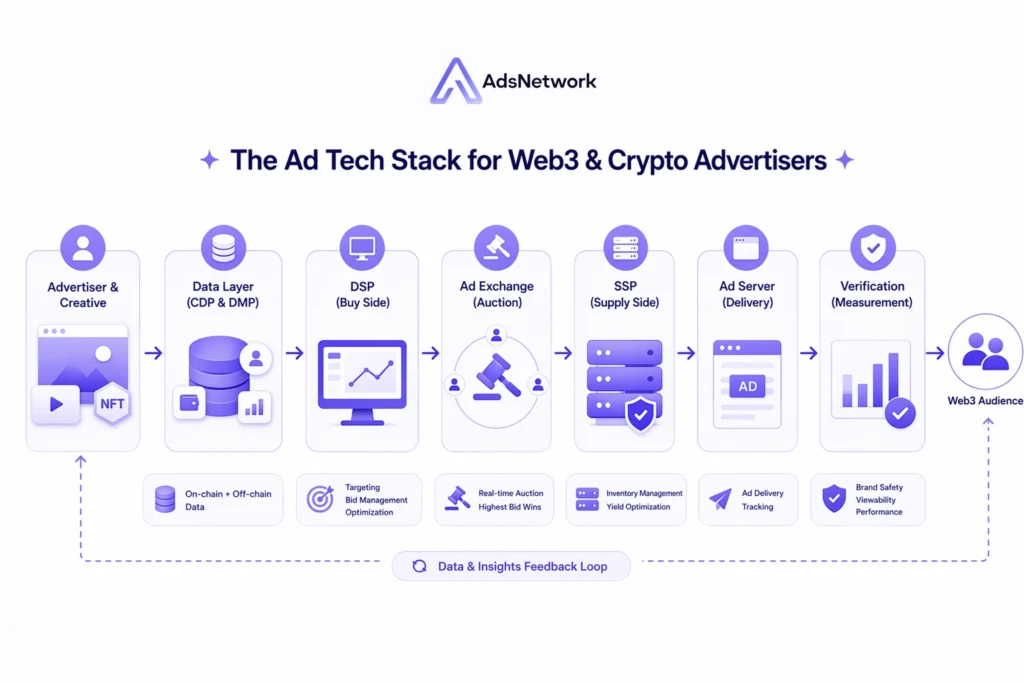
In practice, different participants in the advertising ecosystem have different stacks. An advertiser’s stack centers on demand-side tools: a DSP for buying, a DMP or CDP for audience data, and analytics platforms for measurement. A publisher’s stack centers on supply-side tools: an SSP for yield management, an ad server for delivery, and verification tools for quality control. The ad exchange sits in the middle, connecting both sides. Indeed, understanding all components, and what each one does, is the starting point for diagnosing campaign performance and identifying where budgets underperform.
The Core Components of the Ad Tech Stack
The Ad Server
The ad server is the oldest and most foundational component of the ad tech stack. It is software that stores, manages, and delivers ad creatives to specific placements at the right time. Notably, every publisher runs an ad server to manage the ads that appear on their properties. Advertisers also use ad servers to track delivery, measure viewability, and run frequency caps across campaigns.
In a modern programmatic setup, the publisher’s ad server sits above the SSP in the decision chain. When a user loads a page, the ad server first checks for any direct or guaranteed deals that have priority. If no guaranteed deal applies, it passes the impression to the SSP for auction. Consequently, the ad server acts as the gatekeeper that determines whether an impression enters the open market at all. Consequently, without a properly configured ad server, programmatic revenue leaks to low-value buyers or direct deal delivery suffers.
The Supply-Side Platform (SSP)
The supply-side platform manages a publisher’s available ad inventory and connects it to multiple demand sources simultaneously. Specifically, the SSP packages available impressions into bid requests and sends them to connected ad exchanges. Specifically, it enforces floor prices, applies brand safety rules, and optimizes the auction to return the highest available CPM for each impression. In practice, publishers connect to multiple SSPs in order to maximize demand coverage and fill rates.
For a detailed breakdown of how SSPs operate and differ from DSPs, see our guide to DSP vs SSP explained. In summary, SSPs serve the sell side of every programmatic transaction. They are the primary revenue management tool for publishers participating in open or private marketplace RTB.
The Demand-Side Platform (DSP)
The demand-side platform is the buying engine advertisers use to access inventory across multiple ad exchanges and publishers through a single interface. When a bid request arrives from an exchange, the DSP evaluates it against the advertiser’s targeting criteria, calculates a bid price, and submits a response automatically. According to Grand View Research, DSPs dominated the ad tech market in 2024 with a revenue share of over 33%. This reflects how central automated buying has become to digital advertising operations.
Additionally, DSPs provide campaign management tools including audience targeting, budget pacing, frequency capping, and real-time reporting. Additionally, advanced DSPs use machine learning to optimize bids toward campaign goals. These platforms are the primary interface through which advertisers interact with the programmatic stack on a day-to-day basis. Additionally, the DSP connects to audience data platforms to enrich bid decisions with behavioral and demographic signals.
The Ad Exchange
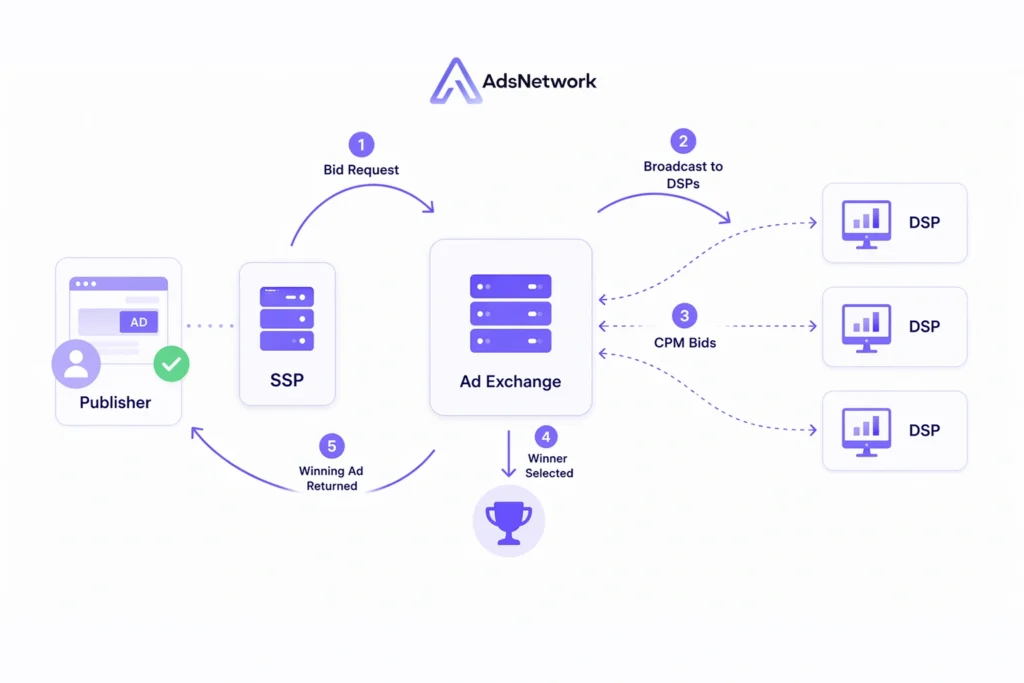
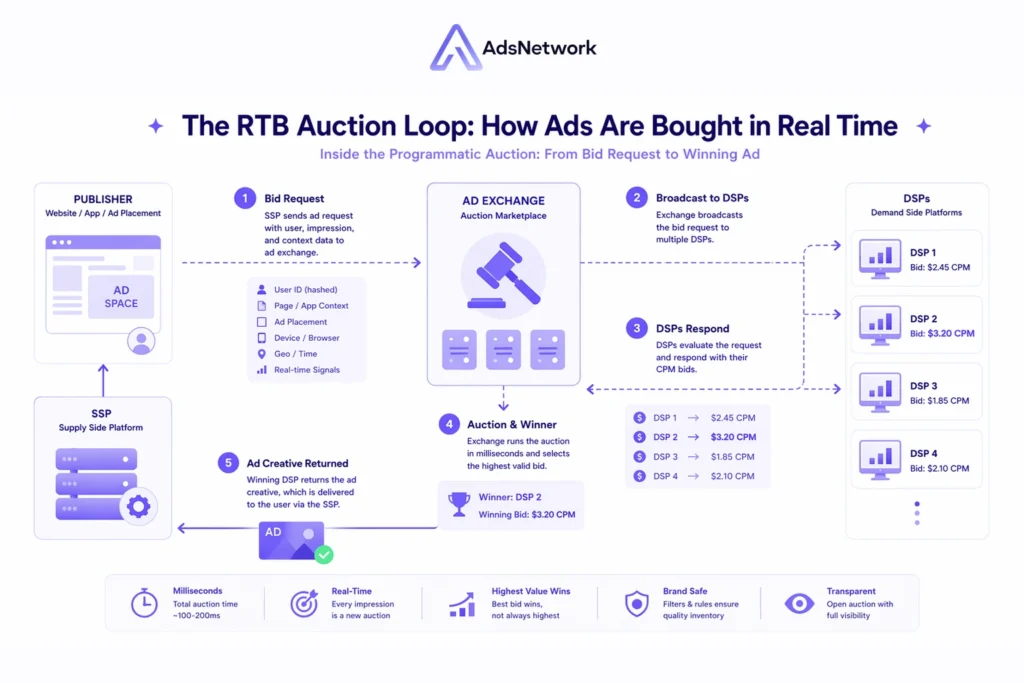
The ad exchange is the marketplace at the center of every programmatic transaction. It receives bid requests from SSPs and broadcasts them to connected DSPs simultaneously. It then collects bid responses and selects the highest valid bid above the floor price. The winning creative is returned to the publisher for delivery. The whole process completes in under 100 milliseconds.
Ad exchanges standardize the communication between buyers and sellers using the OpenRTB protocol. This protocol defines how bid requests and responses are structured. Consequently, DSPs and SSPs built by entirely different vendors can transact together at scale. For a deeper look at how the auction logic works, see our breakdown of how RTB auctions work. Notably, major exchanges include Google’s Display and Video 360, Xandr, Magnite, and PubMatic, among dozens of others operating across different inventory types and geographies.
The Data Management Platform (DMP)
A data management platform collects, organizes, and activates audience data for targeting purposes. Specifically, DMPs aggregate third-party data from cookies, browsing signals, and demographic sources to build anonymous audience segments. These segments are then pushed to a DSP to improve targeting precision. Specifically, a DMP helps advertisers reach users who match high-intent behavioral profiles. These include recent visitors to competitor sites or users who have shown interest in a specific product category.
However, DMPs face a structural challenge in the post-cookie era. Third-party cookies, which DMPs historically depended on, have been significantly restricted across major browsers. Safari and Firefox blocked them years ago. As a result, DMP-based targeting is becoming less reliable for anonymous audience segments. Many advertisers are transitioning toward customer data platforms as their primary data layer, using DMPs only for supplemental third-party enrichment where it remains available.
The Customer Data Platform (CDP)
A customer data platform collects and unifies first-party data from across a brand’s own touchpoints: website visits, CRM records, email interactions, purchase history, and app behavior. Unlike a DMP, which builds anonymous segments from third-party sources, a CDP creates persistent, identified profiles around real customer relationships. Consequently, CDPs operate with higher data accuracy and are far more resilient to cookie deprecation.
In a connected ad tech stack, a CDP feeds first-party audience segments directly into the DSP. Consequently, advertisers can target existing customers, suppress already-converted audiences, and build lookalike segments. According to Geomotiv, CDPs help advertisers target more precisely by unifying first-party customer data into real-time audience profiles. For Web3 advertisers, this matters significantly. On-chain wallet interactions and protocol usage data, properly structured, function as first-party signals that a CDP can activate across programmatic campaigns.
Verification and Measurement Tools
The verification layer is not always discussed as a stack component, but it is essential. Verification platforms like DoubleVerify and Integral Ad Science monitor impressions in real time for invalid traffic, brand safety violations, and viewability. They evaluate whether each impression reaches a real user in a brand-safe context and whether it is actually viewable on screen.
Without active verification, programmatic campaigns are vulnerable to ad fraud and low-quality placements. According to the ANA’s 2024 Programmatic Transparency Benchmark Study via Geomotiv, less than half of every $1,000 spent on programmatic ads reached real users in a recent assessment period. The rest was lost to fees, intermediaries, and inefficiencies. In short, verification tools are not optional for teams managing programmatic budgets at any meaningful scale.
How the Ad Tech Stack Operates in a Single Transaction
Every impression served through programmatic advertising involves all of these stack components operating in sequence. The following is how a typical transaction flows.
A user opens a publisher’s webpage. The ad server detects an available slot and checks for guaranteed deals. Finding none, it consequently passes the impression to the SSP. The SSP packages impression data, including page context, user signals, and floor price. It then sends this bid request to connected ad exchanges. Each exchange broadcasts the request to qualified DSPs.
Specifically, each DSP queries its connected DMP or CDP to enrich the user signal. It then evaluates whether the impression matches active campaigns. If it does, the DSP submits a CPM bid before the timeout expires. The exchange collects all bids, selects the highest valid one, and sends the winning creative back through the SSP to the publisher’s ad server. Subsequently, the ad server renders the creative in the available slot. Finally, the verification layer records the impression and checks for validity. The whole sequence resolves in under 100 milliseconds.
The Ad Tech Stack and Supply Path Efficiency
One of the most important, yet least visible, aspects of the ad tech stack is supply path efficiency. Each intermediary in the chain, every exchange hop, every SSP pass-through, charges a fee or takes a margin. These fees accumulate. Consequently, a dollar entering the stack at the DSP does not fully reach the publisher. Portions are retained at each layer.
Supply path optimization (SPO) has consequently emerged as a formal discipline to address this problem. Specifically, advertisers analyze which supply paths between their DSP and specific publishers produce the cleanest, most direct route and eliminate redundant intermediaries. According to AI Digital, the ANA’s 2025 TrueCPM Index flagged a 37.8% optimization gap, indicating substantial savings are available from cleaner supply paths and tighter fee controls. For advertisers spending at scale, even modest SPO improvements translate to significant incremental working media.
The Ad Tech Stack for Web3 and Crypto Advertisers
For Web3 and crypto projects, the ad tech stack introduces a specific challenge beyond the general complexity that all advertisers face. Mainstream stack components, particularly general-market DSPs and ad exchanges, restrict crypto-related advertising categories. DeFi protocols, token launches, and NFT projects encounter policy rejections at the DSP and exchange level, regardless of compliance status. This effectively blocks crypto advertisers from the majority of the standard programmatic stack.
Purpose-built Web3 advertising infrastructure addresses this by assembling an equivalent stack specifically calibrated for the crypto ecosystem. AdsNetwork provides DSP-side buying access to crypto advertisers, SSP-side monetization for Web3 publishers, and ad exchange infrastructure that does not apply blanket crypto restrictions. Additionally, first-party audience data from on-chain activity can be activated through the platform. This gives DeFi and blockchain gaming projects the same targeting depth that general-market advertisers access through CDPs and DMPs.
Furthermore, the transparency properties of blockchain infrastructure create opportunities to address supply path efficiency at a structural level. Several emerging protocols apply on-chain ledgers to ad transaction records. This enables advertisers to audit exactly where budgets were spent and which impressions were valid. This aligns directly with the verification and fraud prevention concerns that affect all programmatic stacks, while adding auditability that traditional ad tech cannot provide.
Conclusion: The Ad Tech Stack Explained as a System, Not a Tool
The ad tech stack is not a single product. It is a system of interdependent components, each handling one part of a transaction that resolves in milliseconds. Ad servers manage delivery priority. SSPs manage publisher yield. DSPs manage advertiser buying. Ad exchanges connect both sides. DMPs and CDPs supply the audience intelligence. Verification tools protect against waste and fraud. Together, these layers power every digital ad transaction in the programmatic ecosystem.
For Web3 projects, finding the right stack configuration is the practical first step. Specifically, it must be built for crypto audiences and free from blanket policy restrictions. Visit 51.254.143.217/ to explore ad tech stack infrastructure designed for DeFi teams, token launches, and Web3 publishers.
Featured Posts
Sep 23, 2026
6 min read
What Is Advertising Technology (AdTech) and How Does It Work?
Advertising technology, commonly known as AdTech, refers to the software, platforms, tools, and systems used to plan, buy,…
Read Article
Sep 16, 2026
8 min read
Media Buying: A Complete Guide for Advertisers
Media buying is the process of purchasing advertising space to reach a target audience. It includes choosing where…
Read Article
Sep 7, 2026
8 min read
Programmatic Advertising vs Display Advertising: What’s the Difference?
Programmatic and display advertising are often used interchangeably, but they describe two different parts of digital advertising. Display…
Read ArticleNeed Help?
Our team is ready to help you launch successful campaigns.
AI-Powered Mobile
Monitor Your Campaigns Anywhere
Stay connected to your live AdsNetwork campaigns with our mobile advertising app. Track impressions, clicks, conversions, campaign spend, and overall performance in real time—anytime, anywhere. Available for iOS and Android.