


Most programmatic advertisers set a CPM, launch a campaign, and assume the system does the rest. However, what actually happens inside RTB auctions is far more precise than that. Each auction resolves in milliseconds, but the outcome depends on bid request data, floor prices, clearing mechanics, and competitor activity that most advertisers never see. Understanding real time bidding explained at a surface level is one thing. Understanding how RTB auctions work at the mechanics level is what separates teams that optimize effectively from teams that simply spend. According to Future Market Insights via Xapads, the global RTB market is projected to grow from $21.02 billion in 2025 to $26.32 billion in 2026, at a CAGR of 25.2%. The scale of that market means every misaligned bid multiplies across billions of auctions.
What Triggers an RTB Auction
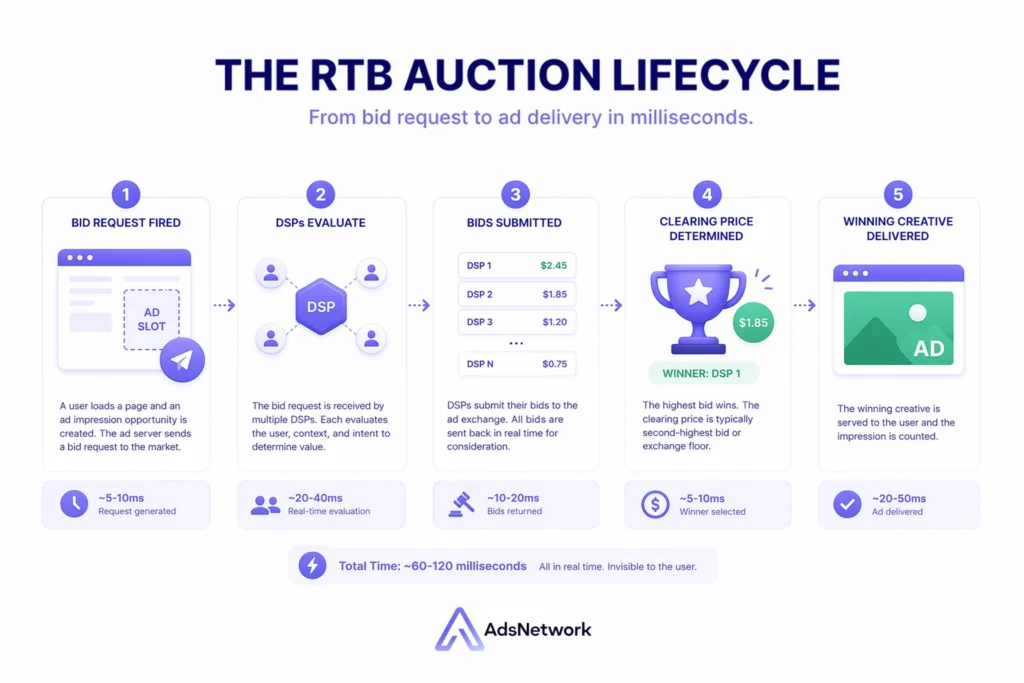
Every RTB auction begins with a single user action. When a user opens a webpage, launches a mobile app, or starts a video stream, the publisher’s ad server detects an available ad slot. Specifically, this triggers a bid request, which is the data packet sent from the publisher’s supply-side platform (SSP) to connected ad exchanges. The exchange then broadcasts that request to all qualified demand-side platforms (DSPs) simultaneously.
Each bid request carries structured data that DSPs use to evaluate the impression. That data typically includes the page URL or app bundle, ad unit dimensions, device type, geographic location, and available audience signals. It also carries browser or app environment details. Additionally, the request includes the publisher’s floor price: the minimum CPM below which no bid will be accepted.
The Anatomy of a Bid Request
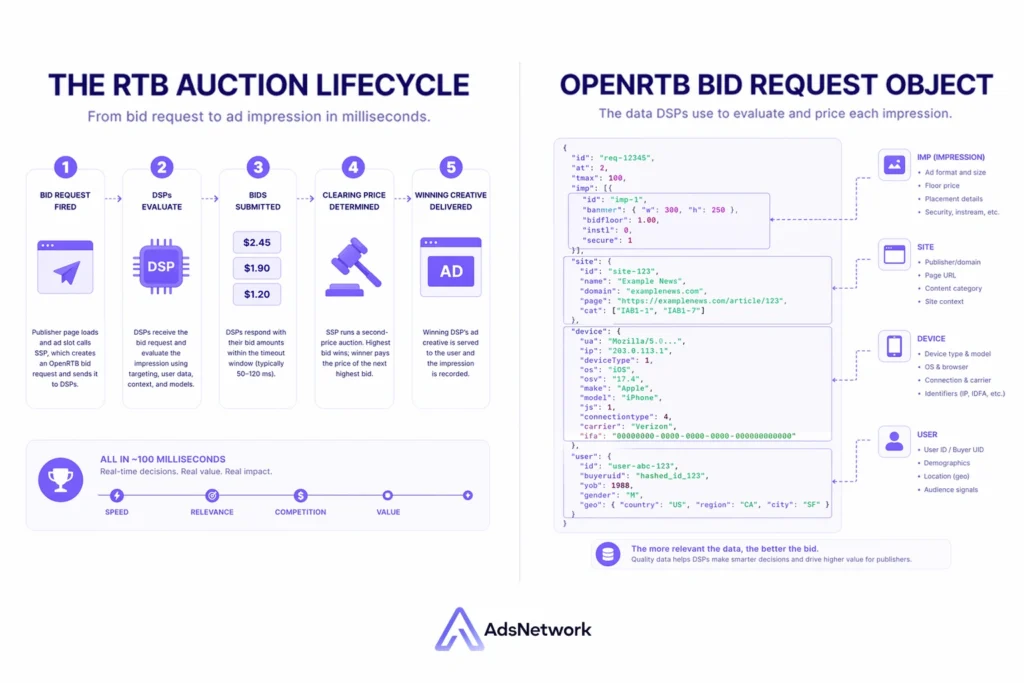
A bid request is not simply a notification that an impression is available. It is a structured data object following the OpenRTB protocol, the industry-standard specification that governs how exchanges and DSPs communicate. Specifically, the OpenRTB format defines mandatory and optional fields that standardize auction participation across thousands of buyers and sellers. Without this shared protocol, DSPs and SSPs from different technology vendors could not interoperate.
Key fields include the impression object (ad slot details), the site or app object (publisher context), the device object (user hardware), and the user object (anonymized audience data). Furthermore, the request includes a timeout value: the maximum number of milliseconds the exchange will wait for bid responses before closing the auction. Any DSP that misses this deadline is excluded from that impression entirely.
Floor Prices: The Publisher’s Minimum Threshold
Floor prices play a critical but often misunderstood role in RTB auctions. Specifically, a floor price is the lowest CPM a publisher will accept for an impression. Bids below the floor are rejected, even if they are the highest bid received. According to Fraudlogix, well-calibrated floor prices maximize publisher revenue by balancing fill rate against CPM yield. A floor price set too high reduces fill rate. A floor price set too low leaves money on the table.
Modern SSPs do not use static floor prices. Instead, they use dynamic floor pricing that adjusts based on real-time signals. Factors such as time of day, user value, content category, and current demand levels all influence where the floor is set for any given impression. Consequently, an identical ad slot on the same website can carry different floor prices at different moments. For advertisers, this means a static bid strategy can produce inconsistent win rates even on familiar inventory.
How RTB Auctions Clear: First-Price vs. Second-Price
Once bids arrive at the exchange, the auction clears using one of two pricing models. Understanding which model applies directly affects how a DSP should price its bids.
Second-Price Auctions: The Legacy Standard
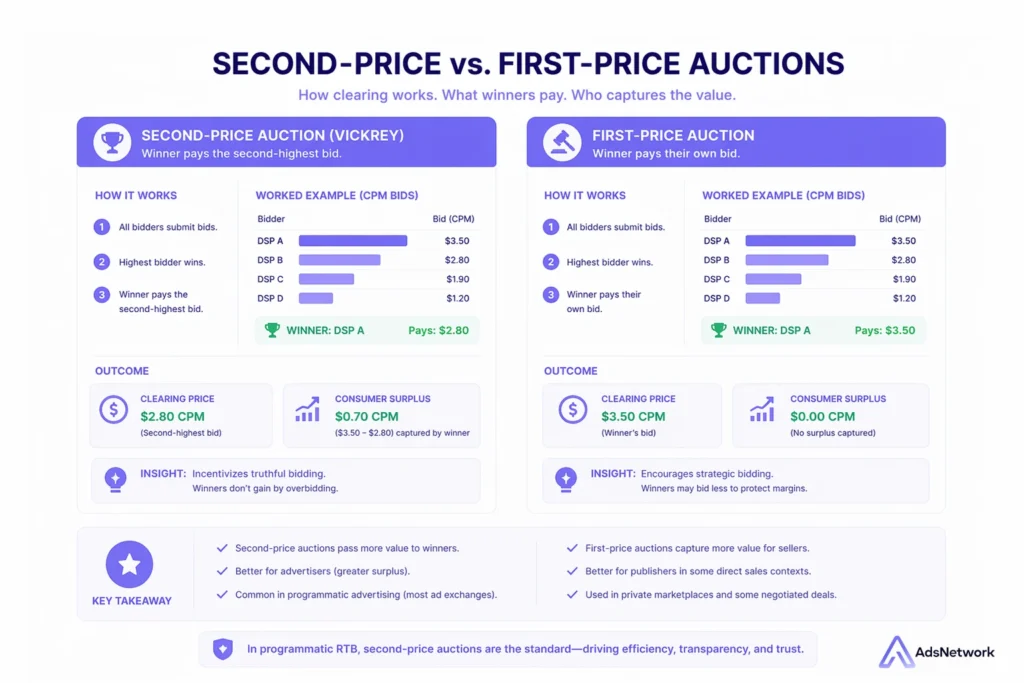
In a second-price auction, the highest bidder wins the impression but pays only the second-highest bid plus one cent. This model, also called a Vickrey auction, historically encouraged honest bidding. Advertisers could safely bid their true value without fear of overpaying. If Bidder A submitted $5.00 CPM and Bidder B submitted $3.00 CPM, Bidder A would win and pay $3.01 CPM. According to Clearcode, this difference between the bid price and the clearing price was known as the consumer surplus. However, SSPs and exchanges routinely manipulated floor prices and applied undisclosed fees that eroded this advantage for advertisers.
First-Price Auctions: The Current Standard
Today, the industry has fully migrated to first-price auctions. In this model, the highest bidder wins and pays exactly what they bid. According to Setupad, Google completed its transition to first-price auctions in 2019 for display and video inventory sold through Google Ad Manager. Most major exchanges followed. In a first-price environment, the incentive to bid your true maximum value disappears. A DSP that submits $5.00 CPM and wins against a $3.00 competitor pays the full $5.00 rather than $3.01. Consequently, first-price auctions make bid calibration far more important than it was in the second-price era.
Bid Shading: Controlling Costs in a First-Price World
Bid shading emerged as the direct response to the first-price auction transition. It is an AI-driven technique that reduces a DSP’s submitted bid toward the estimated clearing price, rather than the maximum the advertiser would theoretically pay. Without bid shading, advertisers routinely win impressions at their maximum bid when a meaningfully lower bid would have secured the same win.
Specifically, bid shading algorithms analyze historical auction data for similar impressions, competitor bid patterns, and floor price signals. They calculate the minimum bid likely to win and submit that price instead of the advertiser’s maximum. According to Xapads, bid shading is now a non-negotiable capability in open exchange RTB. Platforms that do not offer bid shading systematically disadvantage their advertisers. In practice, effective bid shading reduces average CPMs without sacrificing win rates. Most auctions clear well below the maximum bid the advertiser would otherwise have submitted.
However, bid shading also introduces a risk. If a shading algorithm reduces bids too aggressively, it sacrifices win rate on impressions the advertiser actually needed. Consequently, well-designed shading systems balance cost efficiency against the campaign’s delivery and targeting goals. This balance is calibrated dynamically rather than set once as a fixed discount.
Win Rate: The Metric That Reveals Bidding Accuracy
Win rate is the percentage of auctions a DSP wins relative to the total number it enters. Specifically, it is one of the most informative metrics available to programmatic buyers. Yet many advertisers overlook it in favor of downstream metrics like CPC or conversions. According to Xapads, a healthy win rate for performance campaigns sits between 15% and 40%. A sustained win rate below 10% indicates underbidding or over-targeting on inventory that is too competitive. A sustained win rate above 60% typically indicates overbidding, meaning the advertiser is regularly paying more than necessary to win.
Monitoring win rate alongside CPM and conversion data allows advertisers to calibrate bids continuously. Specifically, if win rate drops while CPMs hold steady, the likely cause is increased competition from other buyers. If win rate stays high but conversion rates fall, the issue is likely targeting rather than bid pricing. In this way, win rate functions as a diagnostic tool for auction-level campaign health rather than a vanity metric.
Private Marketplace Auctions vs. Open Exchange RTB
Not all RTB auctions operate under the same rules. Open exchange RTB auctions are accessible to any qualified DSP with a bid request. Private marketplace auctions, by contrast, are invite-only. Publishers curate a specific set of buyers who receive access to premium inventory before it reaches the open exchange. Additionally, deal IDs tag these private transactions. This allows the exchange to apply different pricing rules and priority logic to deal-tagged bids versus bids from the open market.
For advertisers, private marketplace deals offer meaningful advantages. First, brand safety is higher because the publisher controls which advertisers can participate. Second, inventory quality is typically better, since PMPs are built around premium placements rather than remnant supply. Third, the competitive environment is less crowded. Fewer buyers are bidding on the same impression, which can improve win rates without requiring higher bids. Furthermore, first-party data agreements between buyer and publisher are common in PMP setups, enabling targeting that is not available in open exchange environments.
How Auction Data Improves Campaign Performance Over Time
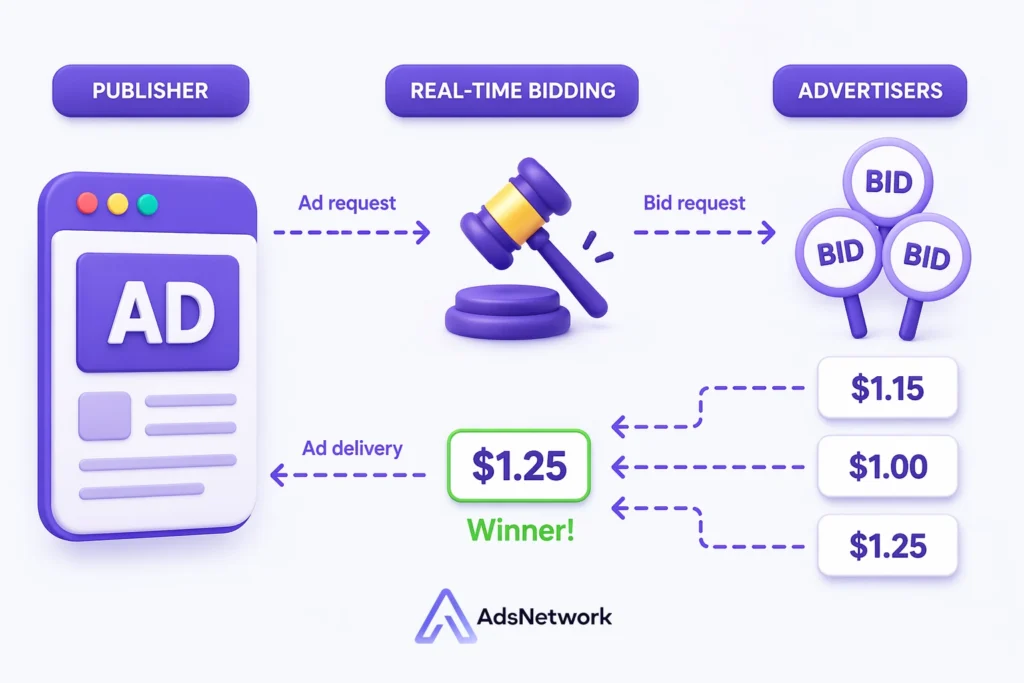
Every RTB auction generates data. DSPs that analyze this data systematically build a significant performance advantage over those that do not. Specifically, auction logs reveal which placements consistently clear at low prices, which audience segments attract heavy competition, and which times of day produce the best cost-per-conversion outcomes. Importantly, this data also exposes floor price patterns that can inform smarter bid floor strategies on the publisher side.
In practice, well-optimized RTB campaigns improve over time because each auction cycle feeds back into the bidding model. A DSP that tracks win prices, loss rates, and clearing price distributions can continuously refine its valuation of each impression type. As a result, the campaign becomes more cost-efficient without reducing reach or conversion performance. This self-reinforcing loop is one of the core structural advantages of programmatic advertising platforms over manual media buying, where optimization cycles take days or weeks rather than milliseconds.
How Web3 Advertisers Should Think About RTB Auctions
For Web3 and crypto projects, RTB auctions present both an opportunity and a constraint. The opportunity is precision. RTB allows crypto advertisers to bid only on impressions from users who match specific behavioral profiles: wallet-connected visitors, DeFi users, or blockchain gaming communities. The constraint is infrastructure: mainstream ad exchanges restrict most crypto-related creatives and categories, regardless of compliance status.
Consequently, Web3 teams need access to RTB auction infrastructure built specifically for crypto inventory. AdsNetwork operates exactly this type of system. It provides real-time bidding access across Web3-native publisher networks, with floor prices, clearing mechanics, and audience data calibrated for crypto audiences rather than general web traffic. Advertisers can monitor win rates and track clearing prices by publisher segment. They can also apply bid shading logic, all within an environment that does not treat crypto as a restricted category.
Furthermore, because crypto audiences are concentrated on specific publisher types, win rate and floor price dynamics behave differently than on general exchanges. Competition for high-value DeFi user impressions is often intense, which means accurate bid calibration matters even more. Understanding how RTB auctions clear in a crypto-native environment is therefore directly applicable to campaign cost efficiency for any Web3 project running paid acquisition.
Conclusion: How RTB Auctions Work Determines How Budgets Perform
RTB auctions are not a black box. Every clearing price, every floor price threshold, and every win rate signal is data. Teams that understand how RTB auctions work at the mechanics level can use that data to bid more accurately, reduce wasted spend, and improve campaign returns over time. Teams that treat RTB as a set-and-forget channel leave significant efficiency on the table.
For Web3 and crypto advertisers, that efficiency starts with finding the right auction infrastructure. Visit adsnetwork.io to explore RTB auction-based advertising built for DeFi protocols, token launches, and blockchain publishers.
Frequently Asked Questions
What is a clearing price in an RTB auction?
The clearing price is the actual CPM the winning bidder pays after the auction resolves. In a second-price auction, the clearing price is the second-highest bid plus one cent. In a first-price auction, the clearing price equals the winning bid exactly. Today, first-price auctions are the industry standard across major exchanges, meaning the winner always pays their submitted bid. Bid shading algorithms help advertisers reduce clearing prices by estimating the minimum bid needed to win rather than bidding their true maximum.
Why does my RTB win rate matter?
Win rate is the percentage of auctions your bids win out of all auctions entered. A healthy range for most performance campaigns is 15 to 40 percent. A win rate below 10 percent suggests your bids are too low for the inventory you are targeting. Sustained win rates above 60 percent suggest overbidding, meaning you are consistently paying more than necessary. Monitoring win rate alongside CPM and conversion data is one of the most effective ways to diagnose and improve bidding accuracy in programmatic campaigns.
How are private marketplace RTB auctions different from open exchange auctions?
Open exchange RTB auctions are accessible to any qualified demand-side platform. Private marketplace auctions are invite-only. Publishers select specific buyers to access premium inventory before it reaches the open market. Deal IDs tag these transactions so the exchange can apply different priority rules. Private marketplace auctions typically offer higher inventory quality, better brand safety controls, and access to first-party publisher data that is not available in open exchange environments.
Ready to Get Started?
Launch your advertising campaign today and reach your target audience effectively.
Start Your CampaignAbout the Author
Hana Mori
Content specialist focused on digital advertising and marketing strategies. Passionate about helping businesses grow through data-driven campaigns.
Related Articles
Ad Tech Stack Explained
Every digital ad that reaches a user has traveled through a chain of software before it appears on screen. That chain is the ad tech stack. It is a set of interconnected platforms that handle buying, selling, data, targeting, delivery, and measurement simultaneously. Understanding the ad tech stack is not just useful for engineers or […]
12 min read
Programmatic vs Direct Advertising
Every digital advertising budget eventually faces the same decision: buy programmatically or buy direct. On the surface, the choice seems straightforward. In practice, it involves trade-offs between cost, control, scale, and brand safety that change depending on the campaign type, the audience, and the publisher relationship. Programmatic vs direct advertising is not a question with […]
10 min read
DSP vs SSP Explained
Digital advertising now runs on infrastructure most people never see. Behind every ad impression served on a webpage, app, or streaming platform, two software categories are talking to each other at high speed. These are demand-side platforms (DSPs) and supply-side platforms (SSPs). DSP vs SSP is the foundational split in programmatic advertising. One platform serves […]
11 min read