

Digital advertising now runs on infrastructure most people never see. Behind every ad impression served on a webpage, app, or streaming platform, two software categories are talking to each other at high speed. These are demand-side platforms (DSPs) and supply-side platforms (SSPs).
DSP vs SSP is the foundational split in programmatic advertising. One platform serves buyers. The other serves sellers. Together, they power a marketplace that, according to Epom, transacted over $180 billion in US programmatic digital display ad spend in 2025 alone. That figure represents approximately 92% of all digital display advertising in the country. Understanding what each platform does, how the two interact, and who uses them is essential knowledge for any advertiser, publisher, or Web3 project running paid media.
What Is a DSP?
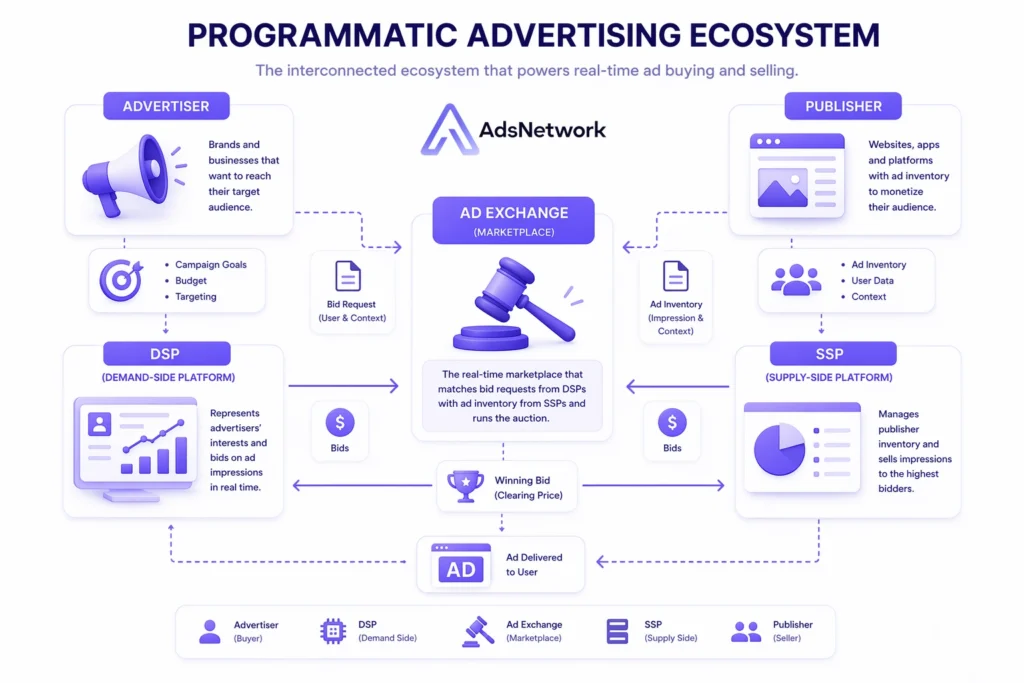
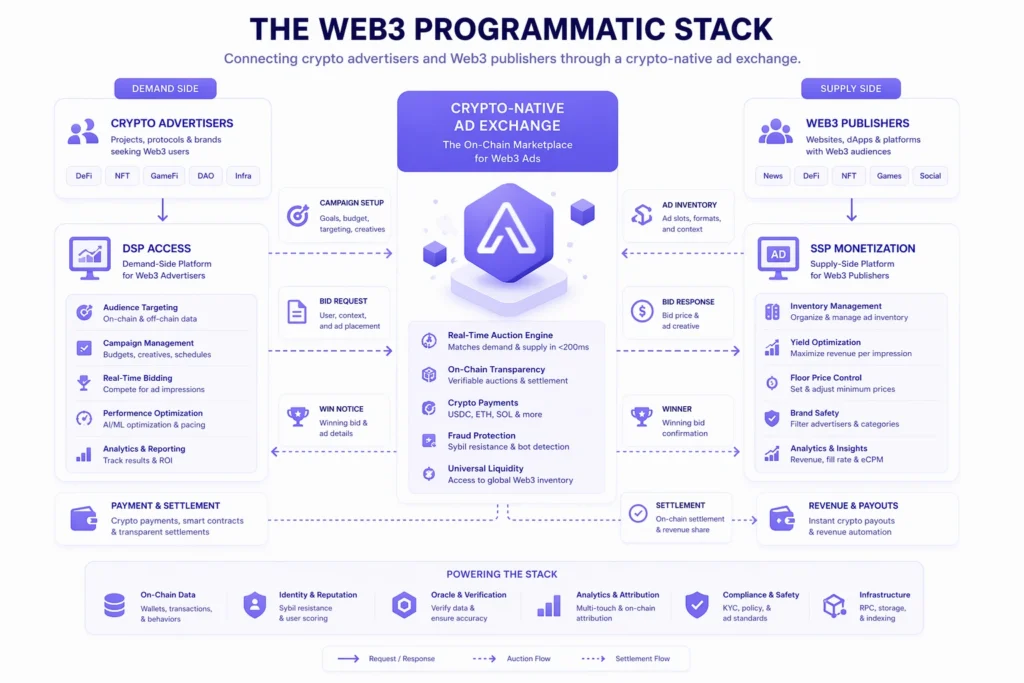
A demand-side platform is software that advertisers use to buy digital ad inventory programmatically. It connects to multiple ad exchanges and supply-side platforms simultaneously, giving advertisers access to inventory across thousands of publishers through a single interface. Instead of negotiating directly with individual websites, an advertiser sets targeting criteria, bid limits, and campaign goals inside the DSP. The platform then evaluates available impressions in real time and submits bids automatically on the advertiser’s behalf.
The DSP market reflects how central this software has become to digital advertising. According to DevriX, the global DSP market was valued at $31.49 billion in 2024 and is projected to reach $148.92 billion by 2032, at a compound annual growth rate of 21.1%. North America led the market in 2024, holding 39.25% of global share. Specifically, this growth reflects increasing reliance on data-driven bidding strategies and automated campaign management across industries.
What a DSP Does for Advertisers
At its core, a DSP solves a scale problem. Reaching a large, specific audience across the open web would be impossible through manual placements. Consequently, the DSP automates the process entirely. It evaluates each incoming bid request and determines whether the impression matches campaign criteria. If it does, the DSP calculates a bid price and submits it before the auction window closes. All of this occurs in under 100 milliseconds.
Beyond bidding, a DSP provides campaign management tools. Advertisers can set daily and total budget caps and define frequency limits. Targeting layers include geographic, demographic, behavioral, contextual, and device-based criteria. Moreover, advanced DSPs use machine learning to optimize bids over time. The platform learns which audience segments, placements, and times of day produce the best results and adjusts accordingly. According to a 2024 Winterberry Group study cited by Appsamurai, advertisers using AI-powered DSPs report 35 to 40% improvements in campaign performance metrics.
What Is an SSP?
A supply-side platform is software that publishers use to manage and sell their ad inventory programmatically. Publishers include website owners, app developers, streaming platforms, and any entity with digital ad space to monetize. The SSP connects the publisher’s available inventory to multiple ad exchanges and demand-side platforms simultaneously. As a result, this creates competition among buyers for each impression, which drives higher prices than a publisher could achieve by dealing with one buyer at a time.
Like the DSP market, the SSP sector is expanding rapidly. According to DevriX, the global SSP market is projected to grow from $65.58 billion in 2025 to $215.49 billion by 2034. That is a compound annual growth rate of 14.13%. In short, this trajectory reflects how thoroughly automated inventory management has replaced manual publisher sales operations across the digital media landscape.
What an SSP Does for Publishers
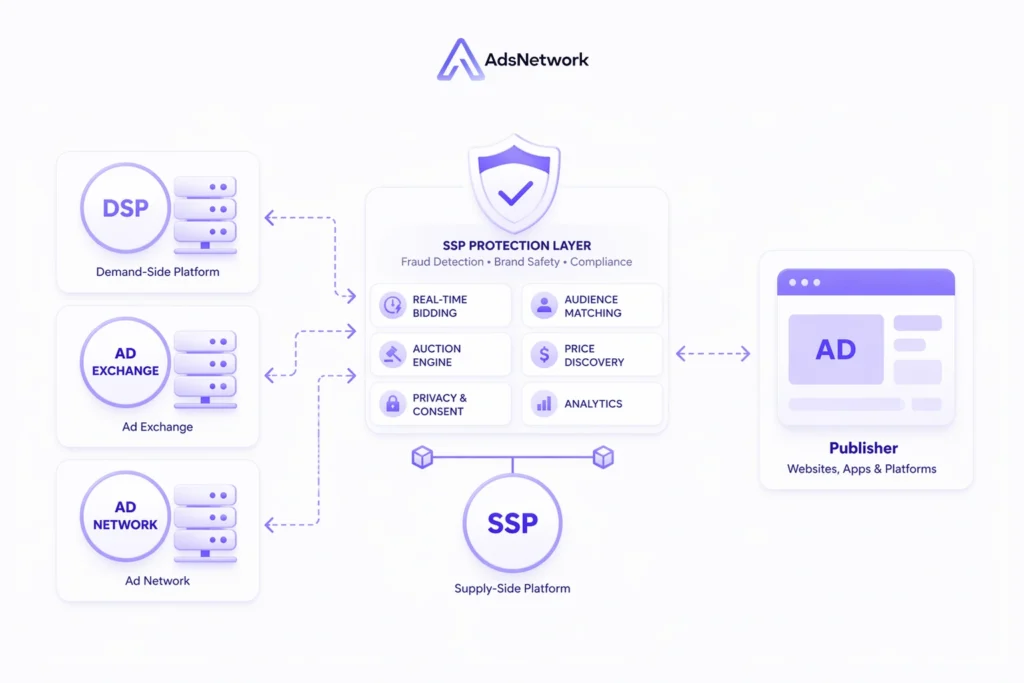
An SSP manages the publisher’s ad inventory from detection through delivery. When a user visits a publisher’s page, the SSP identifies available ad slots. It packages impression data into a bid request and sends it to connected exchanges and DSPs. It also enforces the publisher’s floor price: bids below a minimum threshold are automatically rejected. Furthermore, the SSP applies brand safety filters, creative restrictions, and advertiser category blocks on behalf of the publisher.
Yield optimization is another core SSP function. Rather than selling inventory at a fixed rate, the SSP uses algorithms to surface the highest available bid for each impression. It connects to multiple demand sources. This is precisely why publishers connect to several SSPs rather than one: broader demand coverage means more competition for each slot and, consequently, higher average CPMs. Additionally, the SSP provides reporting that helps publishers understand which audience segments and content categories attract the most advertiser demand.
DSP vs SSP: The Core Difference
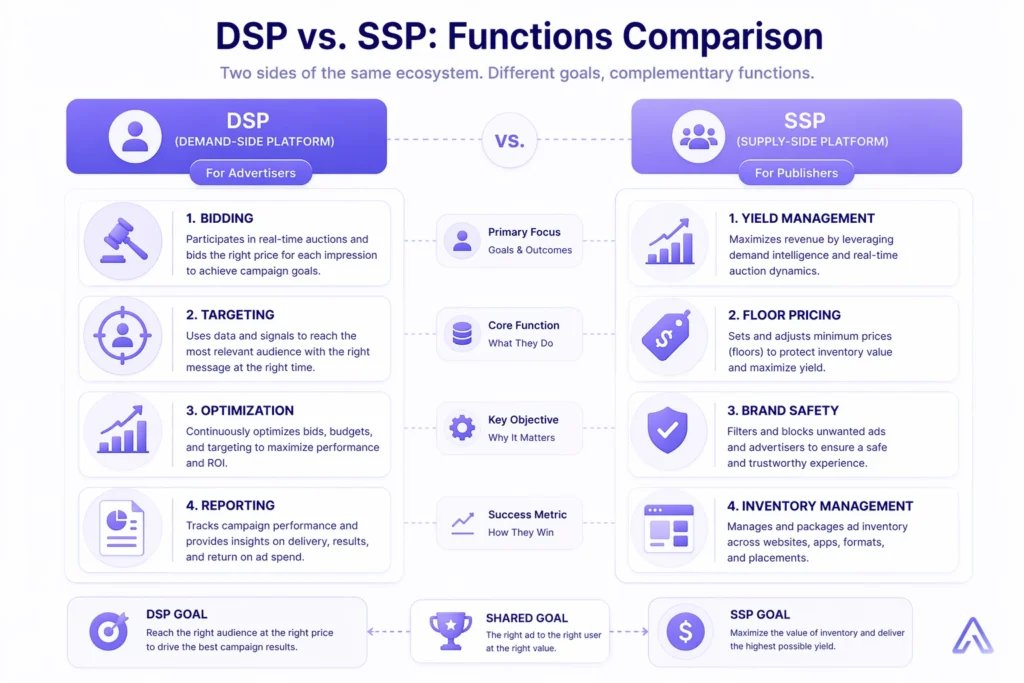
The fundamental distinction between DSP and SSP comes down to who they serve and what problem they solve. A DSP serves advertisers. Its goal is to help them spend budget efficiently by reaching the right audience across the open web. An SSP serves publishers. Its goal is to help them earn the most revenue from their inventory by exposing each impression to as many qualified buyers as possible.
In contrast to each other, these platforms have opposite objectives in every transaction. The DSP wants to win impressions at the lowest price that meets the campaign goal. Meanwhile, the SSP wants to sell those same impressions at the highest available price. The ad exchange sits between them and resolves this tension through a real-time auction. Neither the DSP nor the SSP controls the outcome directly. Instead, both optimize within the rules the exchange sets.
Notably, DSPs and SSPs are not competitors. They are counterparts. Every successful ad transaction requires both. Without a DSP, advertisers cannot access publisher inventory at scale. Without an SSP, publishers cannot monetize their traffic efficiently. Understanding iref(how RTB auctions work in ad exchanges) requires understanding both sides of this relationship. Specifically, the bid request generated by the SSP and the bid response submitted by the DSP are the two halves of every programmatic transaction.
How DSPs and SSPs Interact in a Live Auction
The interaction between a DSP and an SSP happens in a sequence that, from the user’s perspective, is invisible. Here is how the two platforms coordinate in practice. Specifically, the entire process completes in under 100 milliseconds.
A user arrives at a publisher’s website. An ad slot becomes available. The publisher’s SSP immediately packages data about that impression: page context, ad format, user device, location, and available audience signals. It then sends this bid request to connected ad exchanges. The exchange, in turn, broadcasts the request to all qualified DSPs at once.
Each DSP evaluates the bid request independently. Some will pass if the impression does not match active campaigns. Others will calculate a CPM bid and respond within the auction timeout window, typically under 100 milliseconds. The exchange collects all responses and selects the highest valid bid above the SSP’s floor price. Consequently, the winning DSP’s ad creative is returned to the publisher and the SSP delivers it in the available slot.
The two platforms never communicate directly. Instead, they communicate through the shared language of the ad exchange, using the OpenRTB protocol to structure bid requests and responses consistently. This standardization allows a DSP built by one technology company to transact successfully with an SSP built by another. As a result, the programmatic ecosystem can function at global scale across thousands of buyers and sellers.
Key Differences at a Glance
While both platforms automate ad transactions, several specific differences separate DSPs from SSPs in how they are configured, priced, and evaluated. Understanding these distinctions helps teams choose the right platform for their role in the ecosystem.
DSPs charge advertisers based on a percentage of media spend or a platform fee structure. SSPs, by contrast, charge publishers based on a take rate: a percentage of each impression’s revenue that the platform retains. For advertisers, the relevant metric is CPM efficiency and conversion performance. For publishers, the relevant metric is yield, meaning revenue per thousand impressions served.
Furthermore, DSPs are evaluated on inventory access, targeting depth, optimization algorithm transparency, and reporting depth. SSPs are evaluated on demand coverage, fill rate, floor price control, and brand safety tooling. The number and quality of DSPs connected to an SSP directly determines how competitive auctions will be. Consequently, most publishers maintain connections to multiple SSPs to ensure maximum demand exposure.
DSP vs SSP for Web3 Advertisers and Publishers
For Web3 projects, the DSP vs SSP distinction has a direct operational consequence. Teams running paid acquisition campaigns need DSP access. Crypto protocols and token launch teams are, by definition, on the demand side. Specifically, they need a DSP to reach specific audiences, manage bids, control spend, and optimize toward performance outcomes.
However, mainstream DSPs impose strict category restrictions on crypto advertising. DeFi protocols, token launches, and NFT projects face automatic rejections on most general-market DSPs, regardless of compliance status. According to the ANA’s 2024 Programmatic Transparency Benchmark Study via Epom, 43.9 cents of every $1,000 entering a DSP now reaches consumers, up 7.9 percentage points year over year. However, that figure means nothing if the campaign is rejected before it can run.
Similarly, Web3 publishers, including crypto media sites, DeFi dashboards, and blockchain gaming platforms, need SSP infrastructure built for their content category. Most mainstream SSPs do not serve crypto publishers or carry the demand from crypto advertisers that would generate competitive bids for their inventory. Consequently, purpose-built Web3 programmatic infrastructure addresses both sides of this gap simultaneously. AdsNetwork provides DSP-side access for crypto advertisers and SSP-side monetization for Web3 publishers, connecting both within a single crypto-native programmatic ecosystem. For teams building iref(programmatic advertising) campaigns for Web3 projects, that means access to both sides of the transaction without the policy friction that general-market platforms create.
DSP vs SSP Explained: What to Look for in Each
Whether a team is buying or selling programmatic inventory, evaluating the right platform requires different criteria on each side. The key factors differ significantly depending on which side of the transaction you sit on.
For advertisers evaluating DSPs, the key factors are inventory breadth and quality, targeting granularity, optimization algorithm transparency, reporting depth, and fee structure. Specifically, how the platform handles bid shading, how it reports clearing prices, and whether it provides impression-level data are all signals of transparency. A DSP that delivers strong reach but obscures its fee structure creates cost uncertainty that compounds over time.
For publishers evaluating SSPs, the key factors are demand coverage, fill rate, floor price control, and brand safety tooling. The number and quality of DSPs connected to the SSP directly determines how competitive auctions will be for each impression. An SSP with limited demand access will consistently undersell publisher inventory regardless of how strong its optimization algorithms are. Consequently, most publishers maintain connections to multiple SSPs to ensure maximum demand exposure.
Conclusion: DSP vs SSP in One Sentence Each
The DSP vs SSP distinction comes down to this: a DSP is the buying engine that advertisers use to reach audiences across the open web. An SSP is the selling engine publishers use to monetize their traffic competitively. Both are essential. Neither can function without the other. Together, therefore, they power the automated marketplace that drives the majority of global digital ad transactions.
For Web3 teams on either side of that transaction, finding the right infrastructure is the starting point. Visit 51.254.143.217/ to explore DSP and SSP capabilities built specifically for crypto advertisers and Web3 publishers.
Frequently Asked Questions
What is the difference between a DSP and an SSP?
A DSP (demand-side platform) is used by advertisers to buy digital ad inventory programmatically across multiple publishers and exchanges through a single interface. An SSP (supply-side platform), by contrast, is used by publishers to sell their available ad inventory to multiple buyers simultaneously, maximizing revenue through competitive bidding. DSPs serve the buy side. SSPs serve the sell side. Both connect at ad exchanges where real-time auctions match buyers with available inventory.
How does a demand-side platform work?
A demand-side platform works by connecting an advertiser’s campaign settings to multiple ad exchanges and supply-side platforms simultaneously. When a publisher’s SSP sends a bid request to an exchange, the exchange forwards it to all connected DSPs. The DSP then evaluates the impression against the advertiser’s targeting criteria, such as geography, device type, behavioral segment, and bid price limits. If the impression matches, the DSP calculates a bid and submits it within the auction timeout window, typically under 100 milliseconds. Consequently, if the DSP’s bid wins, the advertiser’s ad is served to the user. The DSP records the outcome and uses it to refine future bidding decisions, improving campaign performance over time through machine learning optimization.
Can a company use both a DSP and an SSP?
Yes, though the use cases are distinct. A media company that runs its own ad campaigns and monetizes its own content properties would use a DSP for buying and an SSP for selling. Both functions can be active simultaneously. In practice, however, most pure-play advertisers only need DSP access, and most pure-play publishers only need SSP access. The overlap is most common at larger media companies and platforms that operate on both sides of the programmatic market.
Why do crypto and Web3 projects struggle to use mainstream DSPs and SSPs?
Most mainstream DSPs restrict crypto-related advertising categories including DeFi protocols, token launches, and NFT projects, regardless of whether the advertiser is legally compliant. Similarly, most mainstream SSPs do not carry significant demand from crypto advertisers, which limits publisher yield for Web3 content properties. Purpose-built Web3 platforms provide DSP access for crypto advertisers and SSP monetization for Web3 publishers, without applying blanket crypto restrictions.
DSP vs SSP Explained: What to Look for in Each
Whether a team is buying or selling programmatic inventory, evaluating the right platform requires different criteria on each side.
For advertisers evaluating DSPs, the key factors are inventory breadth and quality, targeting granularity, optimization algorithm transparency, reporting depth, and fee structure. Specifically, how the platform handles bid shading, how it reports clearing prices, and whether it provides impression-level data are all signals of transparency. A DSP that delivers strong reach but obscures its fee structure creates cost uncertainty that compounds over time.
For publishers evaluating SSPs, the key factors are demand coverage, fill rate, floor price control, and brand safety tooling. Additionally, the number and quality of DSPs connected to the SSP directly determines how competitive auctions will be for each impression. An SSP with limited demand access will consistently undersell publisher inventory regardless of how strong its optimization algorithms are. Consequently, most publishers maintain connections to multiple SSPs to ensure maximum demand exposure.
Conclusion: DSP vs SSP Explained in One Sentence Each
The DSP vs SSP distinction comes down to this: a DSP is the buying engine that advertisers use to reach audiences across the open web. An SSP is the selling engine publishers use to monetize their traffic competitively. Both are essential. Neither can function without the other. Together, they power the automated marketplace that drives the majority of global digital ad transactions.
For Web3 teams on either side of that transaction, finding the right infrastructure is the starting point. Visit 51.254.143.217/ to explore DSP and SSP capabilities built specifically for crypto advertisers and Web3 publishers.
Featured Posts
Sep 23, 2026
6 min read
What Is Advertising Technology (AdTech) and How Does It Work?
Advertising technology, commonly known as AdTech, refers to the software, platforms, tools, and systems used to plan, buy,…
Read Article
Sep 16, 2026
8 min read
Media Buying: A Complete Guide for Advertisers
Media buying is the process of purchasing advertising space to reach a target audience. It includes choosing where…
Read Article
Sep 7, 2026
8 min read
Programmatic Advertising vs Display Advertising: What’s the Difference?
Programmatic and display advertising are often used interchangeably, but they describe two different parts of digital advertising. Display…
Read ArticleNeed Help?
Our team is ready to help you launch successful campaigns.
AI-Powered Mobile
Monitor Your Campaigns Anywhere
Stay connected to your live AdsNetwork campaigns with our mobile advertising app. Track impressions, clicks, conversions, campaign spend, and overall performance in real time—anytime, anywhere. Available for iOS and Android.