
Most digital ad spend is wasted before it has a chance to convert. Not because the creative is wrong or the bid is too low. Often, the ad simply reached the wrong person at the wrong moment. Audience targeting advertising is the system that fixes this. It determines who sees your ad based on real data about their behavior, interests, demographics, and intent. Done well, it multiplies ROI. Done poorly, it burns budget on impressions that will never convert.
The data is clear on the value at stake. According to Cropink, data-driven ads deliver 3x higher conversion rates than non-targeted ads. Ads using behavioural targeting increase engagement by 50% compared to generic placements. Furthermore, 89% of marketers believe that data-driven advertising improves ROI. This guide explains how audience targeting works in programmatic advertising, covers the five core targeting types, and shows how to build segments that consistently convert.
What Is Audience Targeting in Advertising?
Audience targeting is the practice of defining who should see your ad based on specific data signals. You then use those signals to limit delivery to matching users only. Instead of buying broad reach and hoping the right people see it, you define the audience criteria first and pay only for impressions that match. Consequently, every budget dollar is allocated more precisely, with less waste on users who would never convert.
In programmatic advertising, audience targeting happens in milliseconds. When a user loads a page, the ad exchange sends a bid request to connected DSPs. That request includes data about the user: device type, location, browsing history, inferred demographic signals, and contextual signals from the page being viewed. The DSP then evaluates whether the user matches any active campaign’s audience criteria. If so, it places a bid. If not, it passes. This evaluation cycle completes in under 100 milliseconds.
Consequently, audience targeting in programmatic is not a static setup you configure once. It is a dynamic matching process that runs individually for every impression, every auction, every time a user loads a page. The quality of your audience definition directly determines the efficiency of every bid your campaigns place.
The Five Core Types of Audience Targeting
Programmatic platforms support several distinct audience targeting methods. Each serves a different purpose and performs differently at each stage of the funnel. Most effective campaigns layer multiple types rather than relying on one alone.
1. Demographic Targeting
Demographic targeting segments audiences by age, gender, income level, education, parental status, and similar identity attributes. It is the most basic form of audience targeting and the easiest to set up. According to Marketing LTB, demographic segments represent 25 to 30% of purchased audience data in programmatic campaigns globally.
Demographic targeting works best as a filter layer combined with other signals rather than as the sole targeting method. Age and gender alone are weak predictors of purchase intent. However, they are useful for eliminating clearly mismatched audiences. For example, excluding users outside the age range for a financial product or a geographic region irrelevant to a physical service eliminates obvious waste before the campaign even runs.
2. Behavioural Targeting
Behavioural targeting reaches users based on their past online actions: browsing history, content engagement, app usage, search queries, and purchase signals. It is the highest-value targeting type in programmatic. Specifically, it accounts for approximately 48% of all purchased audience segment spend, according to Marketing LTB. The reason is clear: behaviour reveals intent more accurately than demographics alone.
A user who has visited cryptocurrency exchange comparison pages three times in the past week is demonstrably interested in opening a crypto account. That signal is far more reliable than knowing their age or location. Ads using behavioural targeting increase engagement by 50% compared to generic placements, according to Cropink. Consequently, behavioural segments consistently command higher CPMs and deliver stronger conversion rates than demographic-only alternatives.
3. Contextual Targeting
Contextual targeting matches your ads to the content of the page being viewed rather than to the individual user. An ad for a DeFi protocol appears on blockchain news articles. An iGaming ad appears on sports statistics pages. The targeting is based on page content, not user identity.
Contextual targeting has grown significantly in importance as third-party cookies phase out. According to Marketing LTB, contextual targeting adoption grew by approximately 60% as advertisers began shifting away from cookie-dependent targeting methods. Furthermore, contextual targeting is inherently privacy-safe, making it a compliant option for regulated verticals like fintech and iGaming where data handling requirements are strict.
4. Lookalike Audiences
Lookalike targeting builds new audience segments by finding users who share behavioral, demographic, and engagement characteristics with your best existing customers. You provide a seed audience, such as your top-converting users or highest-value customers, and the DSP’s algorithm identifies the broader population that most resembles them.
According to Marketing LTB, lookalike modeling usage increased 3x year-over-year in e-commerce programmatic campaigns. The appeal is straightforward: you scale acquisition without sacrificing quality because new users are pre-qualified by their similarity to proven converters. Specifically, advanced lookalike models go beyond demographic matching to incorporate session depth, device signals, purchase probability scores, and semantic content alignment for significantly higher accuracy.
5. Retargeting
Retargeting serves ads to users who have previously visited your site or engaged with your content. It is the most consistently high-performing audience targeting type in programmatic advertising. According to SQ Magazine, retargeting ads can increase conversion rates by up to 150% compared with campaigns targeting cold audiences. Furthermore, 92% of marketers report that retargeting performs better than most other digital advertising strategies.
The conversion advantage comes from warm intent. A user who visited your pricing page but did not convert is infinitely more qualified than a cold prospect. Retargeting reaches that user again with relevant messaging at a later moment when they may be ready to act. For a complete framework on building and optimizing retargeting campaigns, see our guide to retargeting ads strategy that converts.
How Audience Targeting Works in Programmatic Advertising
Understanding how audience data flows through programmatic infrastructure helps you make better decisions when configuring campaigns and interpreting performance data.
First-Party Data and the Post-Cookie Shift
First-party data is the highest-quality targeting signal available. It comes directly from your own audience: website visitors, email subscribers, CRM records, app users, and on-chain wallet activity for Web3 campaigns. According to Cropink, 80% of advertisers are now focusing on collecting data directly from consumers as third-party cookies phase out across major browsers.
First-party data can be activated in programmatic campaigns in several ways. Direct upload to a DSP creates custom audience segments from your own lists. Pixel-based tracking captures anonymous visitor behavior for retargeting. CRM-based audiences match your customer database against publisher inventory through privacy-safe hashed email matching. According to SQ Magazine, first-party data-based retargeting campaigns generate up to 2x higher engagement rates compared to third-party cookie targeting. In other words, owned data produces more accurate matches than purchased data because it comes directly from your verified audience.
How DSPs Apply Targeting Signals in Real Time
When a bid request arrives at a DSP, it contains a bundle of signals: user identifiers, inferred demographic data, page context, device type, location, and historical engagement signals. The DSP evaluates these signals against every active campaign’s audience criteria simultaneously.
Modern DSPs use machine learning to go beyond simple rules-based matching. Instead of asking only whether this user matches the age and interest criteria, AI-driven DSPs additionally estimate conversion probability per impression, adjust bids based on predicted value, identify high-performing audience clusters, and detect underperforming placements automatically. According to SQ Magazine, machine learning-optimized campaigns typically see 10 to 30% higher conversion rates than non-AI programmatic. Furthermore, around 80% of digital advertisers now use AI-driven tools to optimize programmatic campaigns and audience targeting.
How to Build Audience Segments That Convert
Effective audience segmentation is a process, not a one-time configuration. The segments that produce the strongest results are built iteratively, based on actual performance data rather than assumptions about who your audience is. Specifically, starting from conversion data rather than theoretical audience profiles is the single most reliable way to identify which signals actually predict purchase behavior.
Step 1: Start With Your Conversion Data
Before building new segments, analyze which audiences are already converting on your site. Segment your existing analytics by traffic source, device, location, and behavioral signals. Identify the characteristics of your best-performing users. Specifically, this conversion data becomes your seed audience for lookalike modeling and your benchmark for evaluating new segment performance. Moreover, any segment that consistently underperforms your conversion benchmark is a candidate for exclusion rather than optimization.
For Web3 campaigns, on-chain data provides additional signals that browser analytics cannot. Wallet age, transaction frequency, protocol interactions, and token holdings all indicate engagement level and purchase probability. These signals are available through crypto-native programmatic platforms that support wallet-based audience building.
Step 2: Layer Targeting Signals
The most effective audience segments combine multiple targeting types. A single targeting layer, such as age 25 to 34 or interested in finance, is too broad to produce strong conversion rates. Layering demographic filters with behavioural signals and contextual relevance produces narrower, higher-intent audiences. In particular, each additional layer reduces audience size but increases the probability that each user is genuinely qualified.
A practical example: a DeFi protocol targets users aged 22 to 40 (demographic), who have visited blockchain news sites in the last 14 days (behavioural), while currently browsing a crypto news article (contextual). Consequently, CPMs may rise on this narrower audience, but CPA typically falls because fewer impressions are wasted on users without genuine intent.
Step 3: Test, Expand, and Exclude
Once a segment produces conversions, the next step is testing adjacent audiences for expansion. Build lookalike segments from your converting users and compare conversion rates against the original seed audience. Specifically, segments that match or exceed the seed performance at scale are candidates for increased budget allocation.
Equally important is building exclusion lists. Excluding users who have already converted prevents wasted impressions on existing customers. Excluding audiences that have received more than seven impressions without converting prevents budget drain from frequency fatigue. Moreover, excluding specific placement categories where your ads consistently underperform improves average performance without reducing reach on quality inventory. As a result, your effective CPM drops over time as exclusions remove the least-productive segments.
Audience Targeting for Crypto and Web3 Advertisers
Crypto and Web3 projects face a targeting challenge that general advertisers do not encounter. The most valuable signals for identifying high-intent Web3 users, such as wallet behavior, DeFi protocol usage, and on-chain transaction patterns, are not available on mainstream programmatic platforms. Consequently, advertisers relying solely on general-purpose DSPs are operating with incomplete audience data for this vertical.
Additionally, mainstream platforms like Google and Meta restrict most direct crypto advertising. This forces Web3 advertisers toward specialist infrastructure. Crypto-native programmatic platforms solve both problems simultaneously: they accept crypto ad creatives and carry on-chain audience data unavailable on general exchanges.
The most effective audience targeting approach for Web3 campaigns layers on-chain signals with conventional behavioural data. For example, a token launch campaign might target users who have made DeFi transactions within the last 30 days (on-chain behavioural), who are currently visiting a token tracker or crypto news site (contextual), and who match the wallet age and transaction volume profile of previous token buyers (lookalike). Specifically, this three-layer approach reaches users who are not just interested in crypto, but who are active participants likely to make a purchase decision.
Audience Targeting for iGaming Advertisers
iGaming campaigns operate in a heavily regulated vertical where targeting precision directly affects both conversion rates and compliance. Specifically, demographic targeting is essential for legal compliance: iGaming ads must be restricted to jurisdictions where online gambling is legal, and age verification signals must be applied to exclude underage audiences.
Beyond compliance requirements, behavioural targeting is particularly effective in iGaming. Users who have visited sports betting odds pages, casino game review sites, or esports tournament coverage carry strong intent signals for iGaming products. Furthermore, device targeting matters significantly in iGaming: mobile users who have installed gaming apps show higher deposit rates than desktop-only users in most markets, according to industry data.
Retargeting is arguably the most powerful targeting type for iGaming. Users who have registered but not deposited respond strongly to targeted messaging around specific games, bonuses, or promotions. Consequently, many high-performing iGaming campaigns segment retargeting audiences by registration status, last activity date, and preferred game category. This approach delivers the most relevant possible message to each user, which directly improves deposit conversion rates.
Geo-Targeting in Action
Location data turns broad campaigns into precise ones. Programmatic platforms let you target users by country, region, or even city, matching your message to where demand actually lives. This matters most when audience interest clusters geographically, like during regional sporting events or market-specific product launches.
Consider geo-targeting World Cup audiences across different host nations and fan markets. You can serve tailored creative to viewers in each country, adjust bids by time zone, and concentrate spend where engagement runs hottest. The same logic applies to any campaign where place shapes intent, helping you cut waste and lift relevance at once.
Audience Targeting Advertising: Building Segments That Drive Results
Audience targeting advertising is not a feature to turn on once and forget. Instead, it is the continuous process of defining who should see your campaigns, building the data infrastructure to reach them, layering signals to increase precision, and testing performance to refine each segment over time.
The five targeting types, demographic, behavioural, contextual, lookalike, and retargeting, serve different roles in the conversion funnel. The strongest campaigns use all five in combination, with each layer improving the overall quality of the audience reached. For crypto and iGaming advertisers specifically, specialist programmatic infrastructure provides targeting data that mainstream platforms cannot supply. AdsNetwork delivers audience targeting capabilities designed for these verticals, connecting campaigns with verified, high-intent audiences across premium publisher inventory. Visit AdsNetwork to explore audience targeting options for your next campaign.
Featured Posts

Oct 23, 2026
10 min read
What Is CPM in Advertising? Meaning, Formula and 2026 Rates
CPM is the cost an advertiser pays for 1,000 ad impressions, making it one of the most common…
Read Article
Sep 23, 2026
6 min read
What Is Advertising Technology (AdTech) and How Does It Work?
Advertising technology, commonly known as AdTech, refers to the software, platforms, tools, and systems used to plan, buy,…
Read Article
Sep 16, 2026
8 min read
Media Buying: A Complete Guide for Advertisers
Media buying is the process of purchasing advertising space to reach a target audience. It includes choosing where…
Read ArticleNeed Help?
Our team is ready to help you launch successful campaigns.
AI-Powered Mobile
Monitor Your Campaigns Anywhere
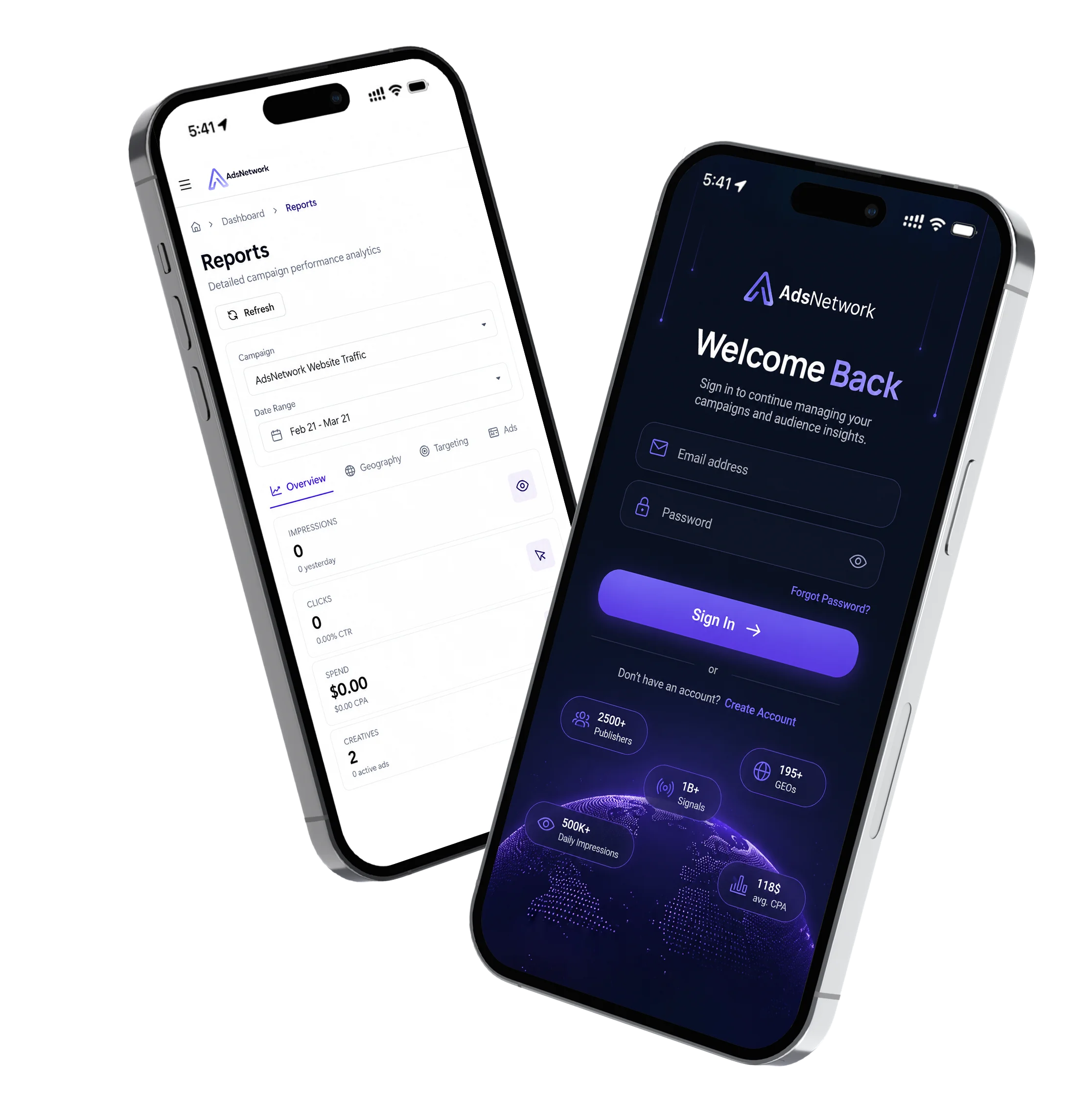
Stay connected to your live AdsNetwork campaigns with our mobile advertising app. Track impressions, clicks, conversions, campaign spend, and overall performance in real time—anytime, anywhere. Available for iOS and Android.