
The difference between a good and a great CPM network can add up to thousands of dollars a month. If you’re a publisher searching for the best CPM ad networks for publishers, choosing wisely can significantly impact your earnings.
You could be running the best CPM ad networks for publishers right now and still earning a fraction of what your traffic is worth. That is not an exaggeration. The network you pick determines your CPM floor, your fill rate, and in some cases, whether your content niche gets monetized at all.

Most publishers find out too late that the biggest names in advertising were never built for their audience. Google AdSense blocks or restricts crypto content. Meta’s ad platform is hostile to Web3 projects. And the CPM rates general networks quote rarely survive contact with real traffic data from niche publishers.
This guide cuts through the noise. Below you will find the best CPM ad networks for publishers in 2026, broken out by use case, with real rate benchmarks, strengths, and the honest limitations each platform carries. Whether you are running a general blog or a DeFi-focused publication, there is a network built for what you do.
What Actually Determines Your CPM Rate
CPM stands for cost per mille, which is Latin for cost per thousand. As a publisher you earn a rate every time your ad inventory is served 1,000 impressions. No click required.
The problem is that CPM is not a fixed number. It moves constantly based on several factors, and understanding them is the only way to evaluate networks honestly:
- Traffic geography. Tier 1 countries such as the US, UK, Canada, Germany, and Australia produce the highest CPMs. The same content reaching Tier 2 and Tier 3 audiences can pay 60 to 80 percent less per thousand impressions.
- Niche and vertical. Finance, crypto, DeFi, and iGaming attract fierce advertiser competition, which pushes CPMs well above general content averages.
- Ad format. Video, native, and interstitial units consistently outperform standard display banners. Format matters as much as network selection.
- Fill rate. A network quoting $15 CPM with a 60 percent fill rate is less valuable than one quoting $9 CPM with a 95 percent fill rate. Always calculate effective CPM.
- Advertiser pool quality. A large pool of vetted, high-budget advertisers means your inventory is competed for. Thin advertiser supply depresses real payouts regardless of headline rates.
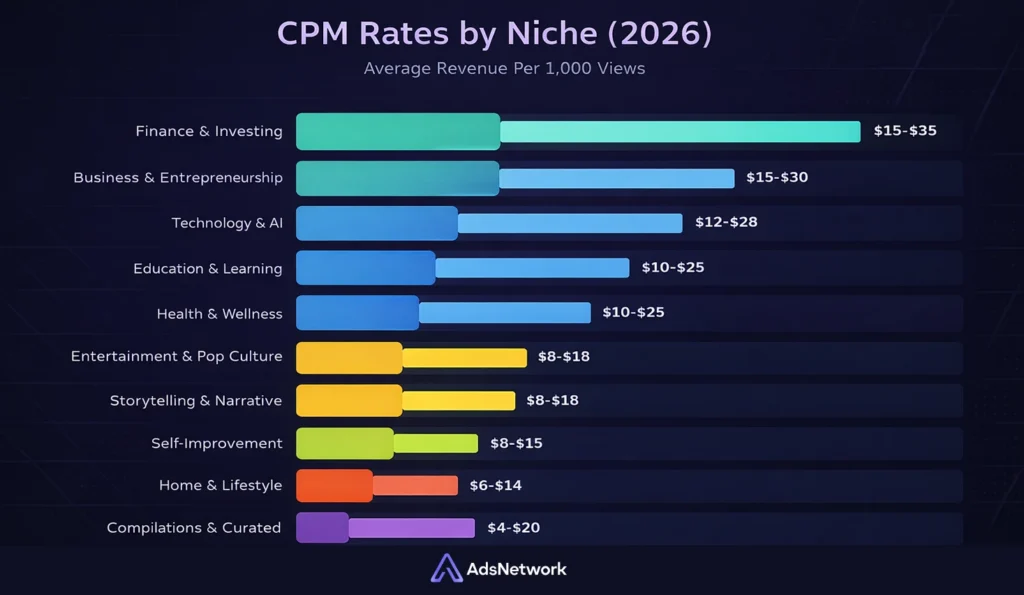
CPM benchmarks vary dramatically by niche and traffic source.
Best CPM Ad Networks for Publishers in 2026
The networks below are organized by publisher type. Not every platform suits every site. Use the strengths and limitations to match your traffic profile.
Google AdSense and Google AdX
Google AdSense is still the default starting point for most publishers, and for good reason. Access to over 2 million advertisers, 450 ad categories, and near-universal brand recognition means high fill rates almost everywhere. Publishers keep 68 percent of ad revenue, with Google retaining 32 percent.
For publishers who qualify for Google AdX, typically those with 5 million or more monthly page views, real-time bidding can push CPMs 20 to 50 percent higher than standard AdSense, often delivering double-digit eCPMs for Tier 1 US display, native, and interstitial placements. According to Publift’s 2026 publisher benchmarks, AdX is one of the clearest paths to premium programmatic rates for high-traffic sites.
Best for: High-traffic general publishers comfortable navigating Google’s compliance requirements.
Limitation: Crypto and Web3 content is routinely restricted or rejected. Account suspensions can come without meaningful warning.
Adsterra
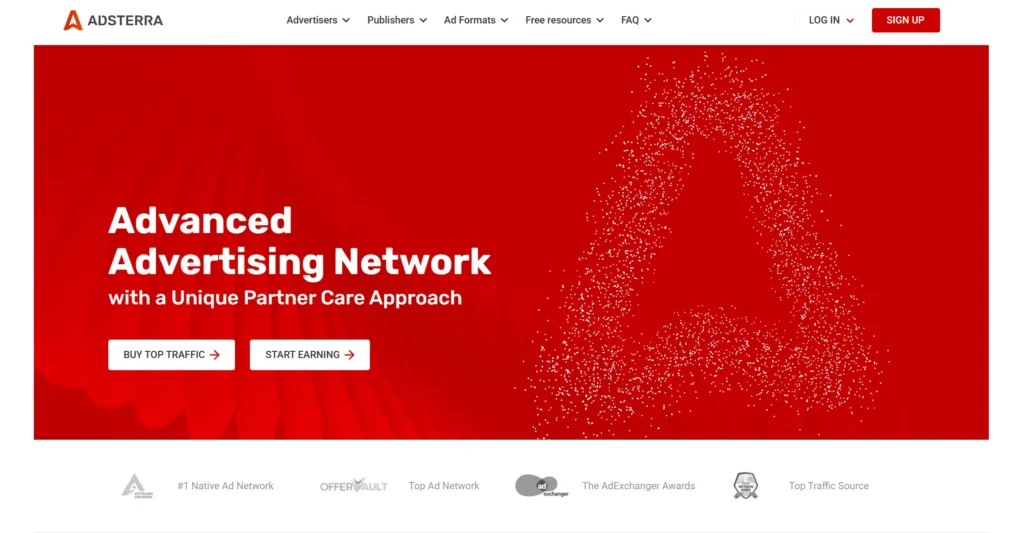
Adsterra is one of the highest-paying standalone CPM networks operating in 2026. Publishers running video ads and rich-media units report CPMs as high as $25 per 1,000 impressions, making it the standout rate performer among open networks, according to Publift’s network comparison data. The platform works with more than 35,000 publishers and 15,000 advertisers and processes over 35 billion impressions annually.
Format options include popunders, native ads, display banners, social bars, and video pre-rolls. Multiple formats per page means publishers can test and optimize without switching platforms entirely.
Best for: Publishers who want high CPMs on video and rich media without strict minimum traffic thresholds.
Minimum payout: $5 for some methods, with weekly cycles available.
Media.net
Media.net runs the second-largest contextual advertising program globally, backed by the Yahoo-Bing network. Publisher clients include Forbes, Reuters, and Hearst. For English-language finance, business, and tech content targeting US and UK audiences, Media.net contextual CPMs frequently compete with AdSense and sometimes beat them. The Media.net publisher overview highlights its relevance for premium content sites with high-intent audiences.
The contextual model matches ads to page content rather than user behavior, which makes it relatively resilient to third-party cookie deprecation and privacy updates.
Best for: English-language finance and business publishers targeting Tier 1 audiences.
Limitation: Lower relevance for non-English traffic and weaker performance outside Tier 1 geos.

Publift
Publift is a Google Certified Publishing Partner with over 15 years in programmatic ad tech. Their published performance data shows publishers who move to Publift’s managed yield optimization see an average 55 percent increase in ad revenue compared to managing AdSense directly. The platform has partnered with more than 250 publishers and app developers worldwide.
Unique formats like sticky footers and miniscrollers help maximize viewable impression counts without burning user experience. As a fully managed service, Publift handles the optimization work on behalf of the publisher.
Best for: Mid-to-large general publishers who want hands-off programmatic management and are willing to share revenue in exchange for better yield.

PropellerAds
PropellerAds covers 195 geographic regions with over 12 billion daily advertising impressions, making it one of the largest multisource networks on the market. Per BusinessOfApps’ CPM network directory, it consistently appears among the most accessible options for publishers with no minimum traffic requirement, including newer and growing sites.
Push notifications, in-page push, popunders, and interstitials are all available. Smart CPA bidding on the advertiser side means campaign quality tends to improve over time as the algorithm optimizes.
Best for: New and growing publishers with global traffic who need fast setup, reliable payouts, and zero traffic minimums.
Limitation: CPMs for general content are on the lower end. This is a volume play, not a premium CPM play.

The Best CPM Ad Networks for Publishers in Crypto and Web3
Crypto publishers operate in a different environment to general content sites. Traditional ad networks either block the content outright or serve generic placements to an audience that deserves better.
A DeFi reader or NFT collector is not a typical web user. They hold assets, they engage with protocols, and they respond to relevant financial products. The right crypto ad network prices that audience correctly. General networks do not.
According to Blockchain-Ads’ 2026 Web3 advertising benchmarks, CPM rates on most Web3 networks sit between $2 and $15, while wallet-targeted campaigns on premium inventory can reach $20 to $40 per thousand impressions. That gap represents the value of audience specificity.
If you want a broader breakdown of how the Web3 ad ecosystem works before picking a network, our covers the full landscape.
Coinzilla
Coinzilla works with over 650 vetted crypto publishers and has been one of the most reliable names in crypto display advertising for several years. Their publisher network overview details banner placements, native ads, floating units, and sponsored posts across a curated publisher base. Deep vetting means the traffic quality on both sides is generally higher than open programmatic exchanges.
For publishers, Coinzilla provides stable brand-direct CPMs from exchanges, DeFi protocols, and token projects. It is a strong fit for established crypto news sites and educational content publishers.
Best for: Established crypto and blockchain media publishers looking for premium, direct-sold CPM campaigns.
Bitmedia
Founded in 2015, Bitmedia is a dedicated crypto advertising network using AI-based targeting and fraud prevention. The platform has worked with brands including Gate.io, OKX, KuCoin, and BitStarz, per Coinbound’s 2026 crypto ad network rankings. Publisher-side features include real-time analytics, transparent reporting, and a fast approval process.
The AI optimization layer helps fill rates stay consistent across regions, and the ad review system actively filters low-quality or misleading creatives. For crypto publishers who want confidence that their inventory is matched with legitimate advertiser demand, Bitmedia delivers that reliability.
Best for: Crypto content sites that want AI-optimized CPMs with transparent reporting and consistent fill from verified advertisers.
AADS (A-ADS)
AADS is one of the oldest crypto ad networks in operation, built around privacy-first values and Bitcoin-native payments. It has no minimum traffic requirement, accepts sites with smaller audiences, and has built a strong reputation in the Bitcoin and privacy communities for consistency and transparency over more than a decade.
CPM rates are not the highest on this list, but AADS delivers something harder to find: a clean, straightforward publisher experience with no policy surprises and reliable payments in Bitcoin. For smaller or privacy-conscious crypto publishers, that dependability is the main draw.
Best for: Privacy-focused crypto publishers and smaller sites that want zero traffic minimums, Bitcoin payouts, and a straightforward setup.
How a Crypto Publisher Can Stack Networks to Maximize CPM Revenue
Relying on a single CPM network is one of the most common monetization mistakes crypto publishers make. Running two or three complementary platforms is now standard practice among experienced operators.
Example: A DeFi news site with 400,000 monthly page views could run Coinzilla for premium brand placements from exchanges at $8 to $15 CPM for Tier 1 traffic, layer AADS for broader fill rate coverage with Bitcoin-paying advertisers, and use a Web3-focused platform like adsnetwork for crypto-native user acquisition campaigns from token projects and protocol teams. Each pool of advertisers competes for different parts of the inventory, which raises the effective CPM floor across the board.
The logic is simple. A crypto reader who bounces off a generic insurance banner represents wasted inventory. That same reader clicking through to a relevant DeFi protocol campaign is a meaningful conversion event for the advertiser, and the advertiser’s willingness to pay reflects that. The more precisely your ad network matches your audience to relevant demand, the higher your real-world CPMs will be.
What Crypto Publishers Actually Need From a CPM Network
The criteria that matter for a general publisher and a crypto publisher are not entirely the same. For Web3 content sites, a few requirements sit above the rest:
- Crypto-friendly ad policies. The network must accept DeFi, NFT, exchange, and token project advertisers without restriction.
- Audience alignment. Ads should be served to readers who have genuine interest and purchasing intent in the crypto space. Generic display demand dilutes CPMs and damages user experience.
- Payment in crypto. Publishers in the Web3 space increasingly expect payouts in USDT, BTC, or ETH rather than waiting on bank wire cycles.
- Transparent reporting. In Web3, community trust is everything. A network that provides clear, real-time data on impressions, fill rates, and revenue is not a bonus feature. It is a baseline requirement.
- Fill rate stability. Consistent demand from a vetted advertiser pool matters more than occasional high-rate spikes. Predictable revenue is what lets publishers plan content investment.
Adsnetwork was built with these requirements as the foundation. The platform connects crypto publishers directly with blockchain projects, DeFi protocols, and Web3 advertisers who are actively looking for relevant publisher inventory. If your current network is serving generic display ads to a DeFi audience, that is the gap AdsNetwork is designed to close.
You can explore publisher options at adsnetwork.
Choosing the Best CPM Ad Networks for Publishers in 2026
The best CPM ad networks for publishers in 2026 are not necessarily the ones with the highest headline rates. They are the ones that pair your specific audience with advertisers who value it.
For general publishers, AdSense, Adsterra, Media.net, and Publift provide solid, scalable options with the fill rates and format diversity to monetize high-traffic content at competitive CPMs.
For crypto and Web3 publishers, the calculus changes completely. Coinzilla, Bitmedia, and AADS offer niche-matched demand that general networks simply cannot replicate. And for publishers who want a platform built around the full Web3 stack, AdsNetwork connects publisher inventory directly to the advertisers who will pay appropriately for that audience.
The worst outcome is applying to the wrong network and watching your CPM average stay flat while your traffic grows. Pick the platform that fits your niche, layer in a second source for fill rate insurance, and measure everything. That is how CPM revenue scales.
Featured Posts
Oct 23, 2026
10 min read
What Is CPM in Advertising? Meaning, Formula and 2026 Rates
CPM is the cost an advertiser pays for 1,000 ad impressions, making it one of the most common…
Read Article
Sep 23, 2026
6 min read
What Is Advertising Technology (AdTech) and How Does It Work?
Advertising technology, commonly known as AdTech, refers to the software, platforms, tools, and systems used to plan, buy,…
Read Article
Sep 16, 2026
8 min read
Media Buying: A Complete Guide for Advertisers
Media buying is the process of purchasing advertising space to reach a target audience. It includes choosing where…
Read ArticleNeed Help?
Our team is ready to help you launch successful campaigns.
AI-Powered Mobile
Monitor Your Campaigns Anywhere
Stay connected to your live AdsNetwork campaigns with our mobile advertising app. Track impressions, clicks, conversions, campaign spend, and overall performance in real time—anytime, anywhere. Available for iOS and Android.