

Ad network and ad exchange are two of the most frequently confused terms in digital advertising. On the surface, they appear to serve the same purpose: connecting advertisers with publishers. However, the way each model works, who controls what, and what each party actually receives are fundamentally different.
Understanding this distinction matters for anyone spending budget on digital campaigns or monetizing web traffic. It shapes how you buy, what you pay, and how much control you exercise over placements. This guide explains each model clearly, compares them directly, and covers what the distinction means for crypto and Web3 advertising.
What Is an Ad Network?
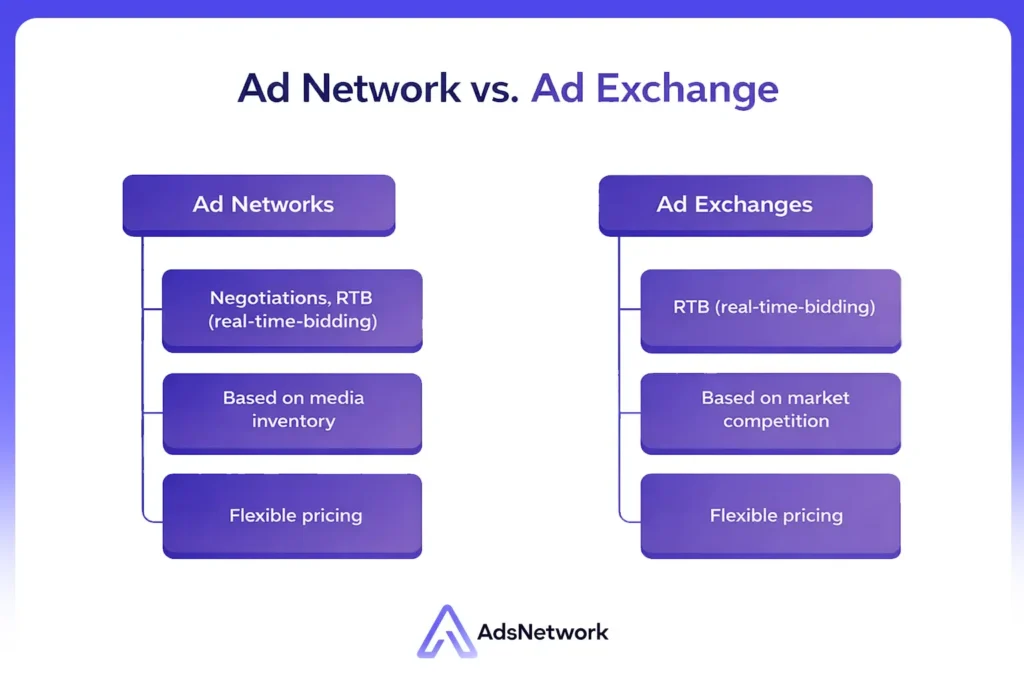
An ad network is a company that acts as an intermediary between advertisers and publishers. It aggregates ad inventory from multiple publishers, packages it into targetable segments, and sells it to advertisers at a markup. The key word here is “company”: an ad network is primarily a business, not just a technology platform.
In practice, the ad network buys inventory from publishers at a negotiated wholesale rate and resells it to advertisers at a higher price. The difference between those two numbers is the network’s margin. Publishers benefit because they no longer need to manage hundreds of individual advertiser deals. Instead, they hand their unsold inventory to the network, which handles monetization on their behalf.
Ad networks typically curate their inventory and offer it in packages organized by audience type, content vertical, geographic market, or device. An advertiser buying from a sports-focused network knows their ads will appear across sports content. However, they often do not know exactly which specific sites their ads are running on. The network manages placement decisions internally.
According to Playwire’s ad tech analysis, ad networks profit from the spread between their purchase price and resale value. That makes them more focused on their own profitability than on maximizing publisher yield. This structural dynamic is important to understand when evaluating ad network relationships as a publisher.
What Is an Ad Exchange?
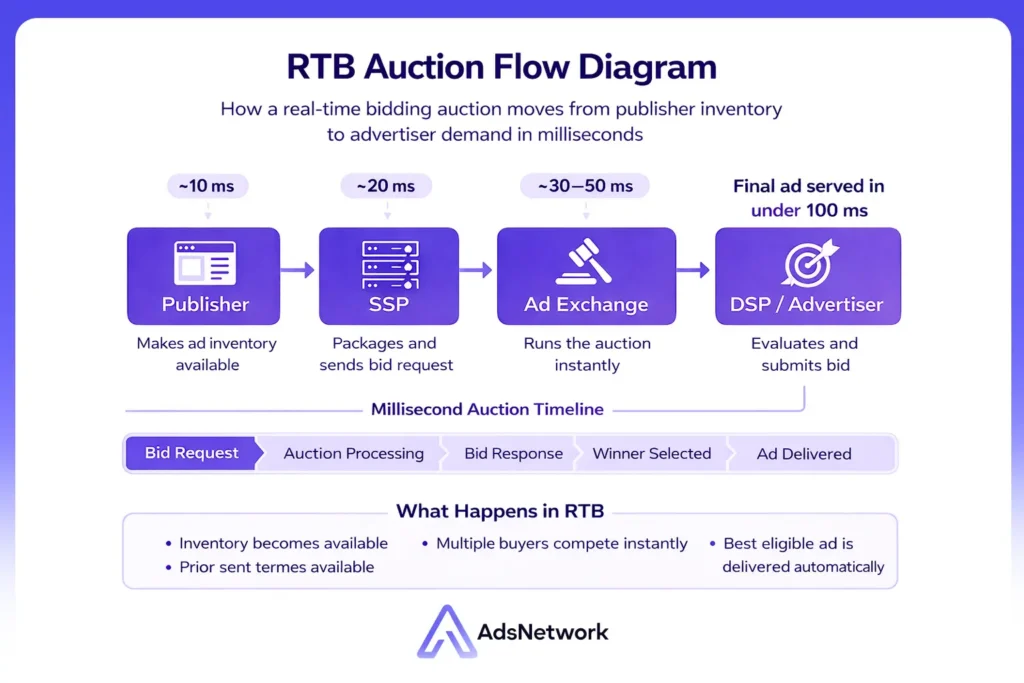
An ad exchange is a digital marketplace: specifically, a piece of technology that enables advertisers and publishers to buy and sell ad inventory through real-time bidding (RTB) auctions. Every time a user visits a connected site, an automated auction takes place in milliseconds. Advertisers submit bids through demand-side platforms (DSPs), and the highest qualifying bid wins.
Unlike an ad network, an ad exchange is fundamentally a technology platform rather than a company acting as an intermediary. It does not buy inventory and resell it. Instead, it provides the infrastructure for buyers and sellers to transact directly, taking a technology fee on each transaction.
Publishers connect to ad exchanges through supply-side platforms (SSPs), which help them set floor prices and manage which advertisers can access their inventory. Advertisers connect through DSPs, which execute bids automatically based on pre-set targeting parameters and budget controls.
The transparency of ad exchanges is significantly higher than ad networks. Advertisers can see exactly which publishers their ads are running on, at what price, and against which audience segments. Publishers can see the actual bids their inventory is receiving. Ad exchanges make more money when more money flows through them, according to Playwire, creating an incentive to maximize publisher inventory prices rather than depress them.
Key Differences: Ad Exchange vs Ad Network
Pricing and Cost Control
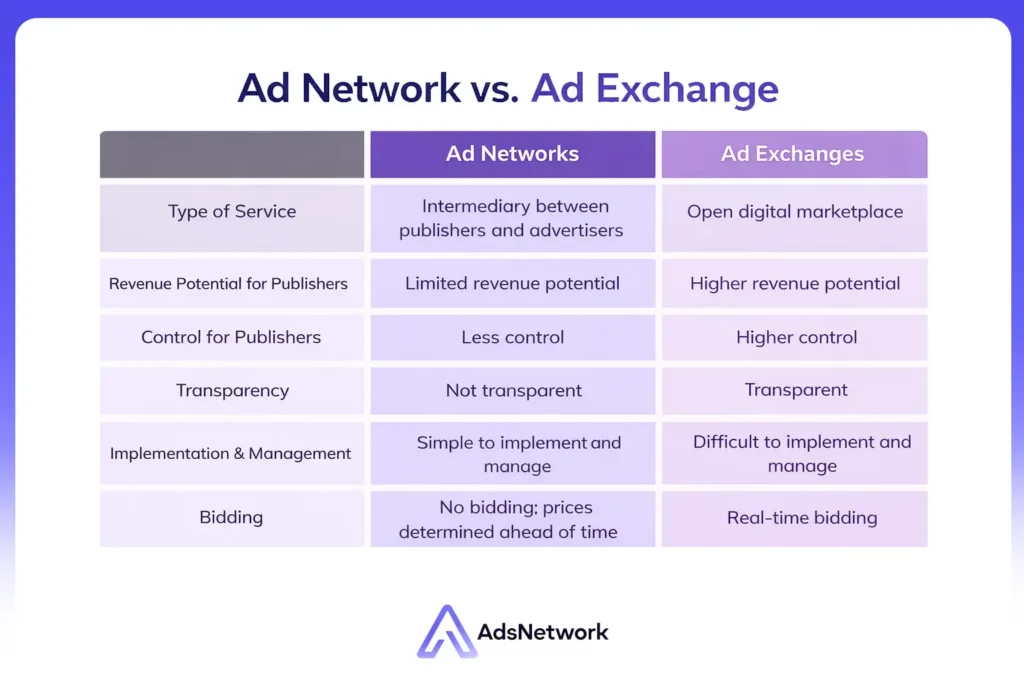
Ad networks use fixed or negotiated pricing. When you buy from an ad network, you pay a rate the network has set for a category of inventory. That rate may be competitive, but you are paying the network’s markup on top of the publisher’s underlying rate. You often have limited visibility into what the publisher is actually receiving.
Ad exchanges use dynamic, auction-based pricing. Every impression goes to the highest bidder above the publisher’s floor price. Consequently, advertisers pay market rates that reflect real demand for each specific impression. Publishers receive competitive bids from multiple demand sources simultaneously, rather than the single rate a network offers. According to Publift’s ad exchange analysis, this auction dynamic benefits publishers because buyers compete to pay more, rather than a single network buying at a discount.
Transparency and Control
Transparency is perhaps the clearest difference between the two models. Ad networks are relatively opaque: advertisers often do not know exactly which sites their ads appear on, and publishers often do not know which advertisers are buying their inventory. The network manages both sides of that relationship.
Ad exchanges, in contrast, provide detailed transaction data to all parties. Advertisers see placement URLs, audience data, bid prices, and performance by publisher. Publishers see which demand sources are bidding and at what prices. This transparency makes ad exchanges better suited to sophisticated advertisers who want granular placement control and publishers who want to optimize yield across multiple demand sources.
Ease of Use and Scale
Ad networks are simpler to use. A publisher adds the network’s ad tag to their site and starts receiving ads. An advertiser creates a campaign and the network handles placement. That simplicity makes ad networks the practical choice for smaller publishers without the resources to manage SSP integrations, and for advertisers who want broad reach without programmatic complexity.
Ad exchanges require more technical infrastructure. Publishers need SSP integration. Advertisers need DSP access. Furthermore, premium exchanges and private marketplace deals are typically available only to publishers and advertisers meeting volume thresholds. However, for larger-scale campaigns, the control and transparency of exchange-based buying often justifies that investment.
Which Should You Use?
The choice between an ad network and an ad exchange depends on your scale, technical resources, and campaign complexity. Ad networks are the right starting point for most advertisers and publishers. They offer broad reach, simplified access to inventory, and managed relationships that do not require deep technical knowledge to operate. For publishers with moderate traffic and limited ad ops resources, a well-chosen ad network delivers reliable monetization without significant operational overhead.
Ad exchanges are better suited to sophisticated teams with the resources to manage programmatic buying. They deliver more transparency, better pricing efficiency, and greater control over where campaigns run and who sees them. For large advertisers running significant display budgets, exchange-based buying is now the standard approach. According to Publift research, global programmatic ad sales will reach $724.8 billion by 2026. The majority of that spend flows through exchange infrastructure rather than traditional network models.
In practice, many advertisers and publishers use both. Ad networks provide a floor of reliable inventory and consistent monetization. Ad exchanges layer on top with dynamic pricing and additional demand sources. The two models complement each other rather than replacing one another.
The Ad Exchange vs Ad Network Distinction in Crypto and Web3
In the Web3 advertising ecosystem, this distinction has practical implications. Most crypto ad networks operate like traditional ad networks: they aggregate inventory from blockchain-focused publishers and sell it to advertisers in packages. That model offers simplicity and audience alignment without requiring sophisticated DSP integration.
As the crypto advertising market matures, programmatic exchange infrastructure is becoming more available to blockchain-focused publishers and advertisers. RTB auction mechanics applied to crypto-native inventory would allow DeFi advertisers to bid on wallet-holder audience segments in real time. That would bring the same impression-level transparency that general programmatic buyers now expect.
AdsNetwork operates as a crypto-native ad network: aggregating verified blockchain publisher inventory and making it accessible to Web3 advertisers through a managed platform. This model prioritizes simplicity and audience quality over programmatic complexity. It is the right fit for most crypto teams who want blockchain audiences without building a full DSP stack.
A Quick Reference Summary : Ad Exchange vs Ad Network
Ad network: A company that aggregates publisher inventory and sells it to advertisers at a markup, using fixed or negotiated pricing, with limited transparency on both sides.
Ad exchange: A technology platform that facilitates real-time bidding between buyers and sellers on individual impressions, using auction-based pricing with full transaction transparency.
Both have a role in modern digital advertising. Furthermore, many platforms today combine elements of both models. Understanding the difference helps you make better decisions about placements and publisher monetization. Visit 51.254.143.217/ to explore how AdsNetwork structures crypto-native ad delivery for both advertisers and publishers.
Featured Posts

Oct 23, 2026
10 min read
What Is CPM in Advertising? Meaning, Formula and 2026 Rates
CPM is the cost an advertiser pays for 1,000 ad impressions, making it one of the most common…
Read Article
Sep 23, 2026
6 min read
What Is Advertising Technology (AdTech) and How Does It Work?
Advertising technology, commonly known as AdTech, refers to the software, platforms, tools, and systems used to plan, buy,…
Read Article
Sep 16, 2026
8 min read
Media Buying: A Complete Guide for Advertisers
Media buying is the process of purchasing advertising space to reach a target audience. It includes choosing where…
Read ArticleNeed Help?
Our team is ready to help you launch successful campaigns.
AI-Powered Mobile
Monitor Your Campaigns Anywhere
Stay connected to your live AdsNetwork campaigns with our mobile advertising app. Track impressions, clicks, conversions, campaign spend, and overall performance in real time—anytime, anywhere. Available for iOS and Android.