
Display banner ads remain one of the most effective tools in digital advertising, yet many advertisers still waste budget on campaigns that never convert. According to Mordor Intelligence, the global display advertising market will reach $242.36 billion in 2026, growing at a 14.26% CAGR through 2031. That growth signals opportunity, but only for advertisers who understand how display banner ads actually work.
If you skip the fundamentals, you risk joining the 43% of marketers who consider display ads their least effective channel, according to Keywords Everywhere. In fact, the difference between success and failure almost always comes down to strategy, not budget. This guide covers what you need: ad formats, targeting methods, and creative best practices. It also explains how programmatic advertising powers the way display inventory is bought and sold today.
What Are Display Banner Ads?
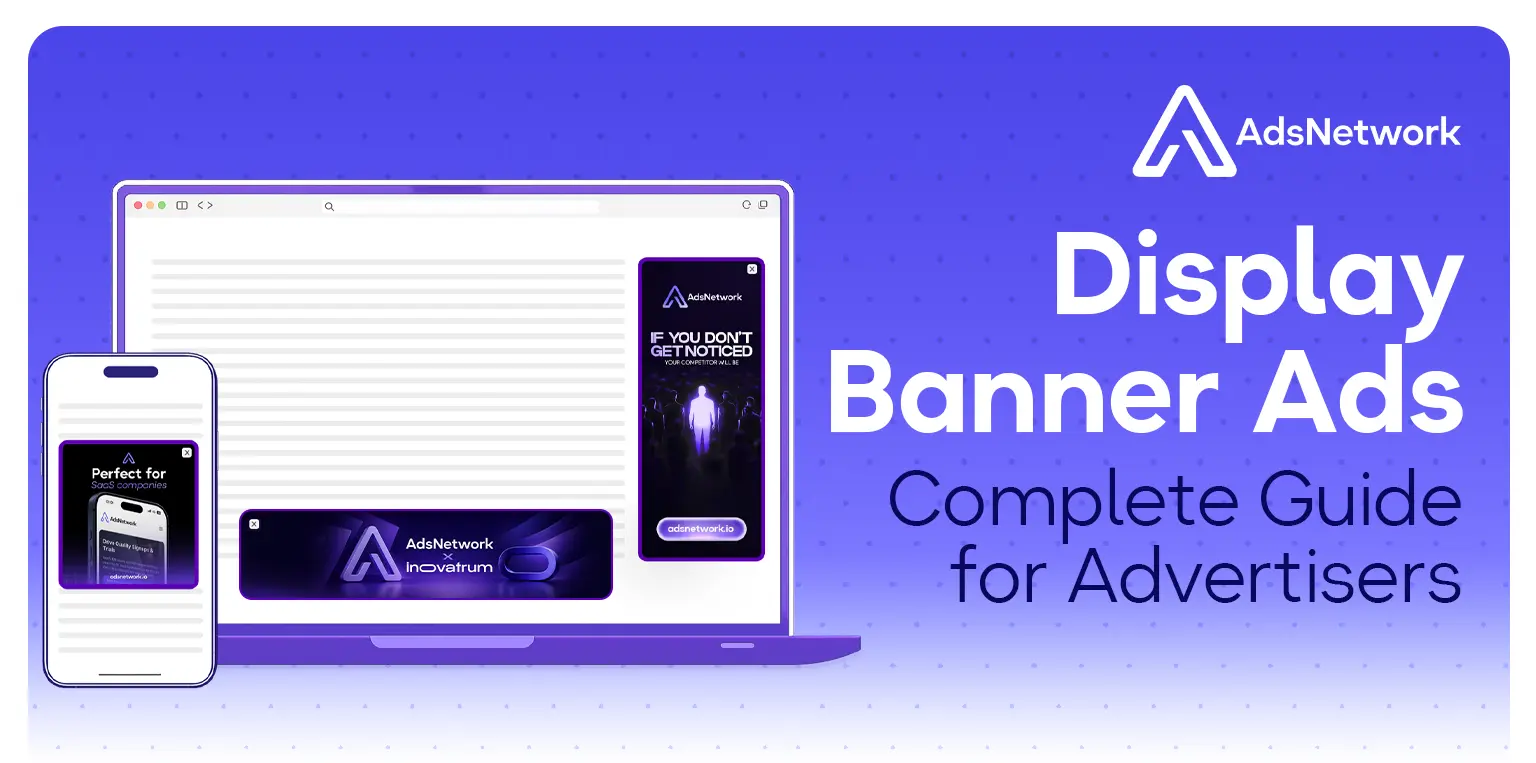
Display banner ads are visual advertisements shown on websites, apps, and platforms within ad networks, programmatic platforms, or direct publisher deals. They combine images, text, and sometimes animation or video to capture user attention. Unlike search ads that appear when someone types a query, display banner ads reach users while they browse content, check email, or watch videos.
The Google Display Network alone reaches over 90% of global internet users, according to Statista. It spans more than 2 million websites and apps, making it the single largest display advertising ecosystem in the world. However, Google is far from the only option. Crypto and Web3 advertisers, for instance, often rely on niche ad networks that serve blockchain-native audiences with significantly higher engagement rates.
Display advertising is also the second most invested-in digital format in the United States, accounting for roughly 30% of total digital ad spend, just behind search. Advertisers who ignore display risk missing a major portion of their target audience. Furthermore, display banner ads are particularly valuable at the top and middle of the funnel, where building brand recognition matters as much as driving immediate clicks.
Display Banner Ad Formats and Sizes
Choosing the right format is critical to campaign success. The wrong size or placement can tank a campaign before it has a chance to perform. Specifically, format choice affects where your ad can appear, how it renders across devices, and ultimately whether users notice it at all. Below are the core formats every advertiser should understand.
Standard Display Banner Ads
Static and animated banner ads are the foundation of display advertising. According to Keywords Everywhere, the 728×90 leaderboard is the most popular banner size, used by 57% of advertisers. The 300×250 medium rectangle generates the most clicks overall. Other high-performing sizes include the 336×280 large rectangle and the 160×600 wide skyscraper, according to PropellerAds. Animated HTML5 banners deliver roughly double the click-through rate of static banners, making them worth the extra production effort for most advertisers.
Responsive Display Ads
Responsive ads automatically adjust their size and layout to fit available placements. A study by Semrush found that 72% of image ads are now responsive, compared to just 28% for standard image ads. As a result, this format reduces production costs and improves reach because a single creative set can serve across thousands of placements. Responsive ads also simplify A/B testing, since the platform optimizes layout combinations automatically.
If you are new to display advertising, PropellerAds recommends starting with static or responsive formats before moving to more complex rich media. This approach lets you establish baseline performance data without high production costs. Once you understand which audiences and placements convert best, you can confidently invest in richer formats that cost more to produce.
Rich Media and Video Display Ads
Rich media formats include expandable banners, interactive elements, and embedded video. According to Marketing LTB, display ads with video content achieve roughly 89% higher click-through rates than standard static banners. Video ads also produce about twice the brand recall of static formats. For advertisers promoting complex products like DeFi protocols or token launches, video-driven display banner ads are especially effective at explaining value quickly.
How Targeting Works for Display Banner Ads
The power of display banner ads lies in targeting precision. Without smart targeting, ads become noise. With the right approach, however, they become a reliable growth engine. Below are the primary targeting methods available to advertisers.
Contextual and Audience Targeting
Contextual targeting places your ads on pages related to specific topics or keywords. Audience targeting goes further by reaching users based on interests, demographics, and online behavior. Because privacy regulations are tightening and third-party cookies are phasing out, contextual targeting has grown by approximately 60%, according to industry estimates from Marketing LTB. For crypto and Web3 advertisers in particular, contextual targeting allows placements on blockchain news sites, DeFi dashboards, and token tracking platforms.
Retargeting with Display Banner Ads
Retargeting serves ads to users who previously visited your site or interacted with your content. This method is a proven conversion booster. Specifically, retargeting display ads deliver 3 to 4 times higher click-through rates compared to standard placements, as reported by Marketing LTB. For crypto projects running token launches, retargeting re-engages visitors who explored a landing page but left before converting.
Retargeting works especially well when combined with a broader acquisition funnel. Build audience pools from past visitors and segment them by engagement depth. Homepage visitors and pricing page visitors, for instance, warrant entirely different messages. Consequently, segmented retargeting converts at significantly higher rates than cold display traffic, making it one of the most efficient budget allocations available in display advertising.
Display Banner Ad Performance Benchmarks
Understanding benchmarks helps set realistic expectations and identify underperforming campaigns early. Specifically, tracking the right metrics from day one is essential for making data-driven optimizations rather than guesswork.
The average click-through rate for display ads across all industries is approximately 0.46%, according to Marketing LTB. That number may look small, but context matters. Display ads are primarily an awareness and retargeting tool, not a direct-response channel like search. Conversion rates average between 0.9% and 1.3% depending on the vertical. Consequently, judging display campaigns solely on CTR misses the full picture.
For Web3 advertisers, crypto-focused ad networks often deliver stronger engagement. Industry benchmarks for crypto display advertising in 2026 show CPM rates between $2 and $15 on most networks, according to Blockchain-Ads. Wallet-targeted campaigns on premium inventory can push CPMs to $20 or higher. In comparison, Google Ads crypto keywords can exceed $15 per click. Niche ad networks therefore deliver crypto-qualified impressions at a fraction of that cost.
How to Measure Display Banner Ad Performance
Beyond CTR and conversion rate, a complete measurement framework for display banner ads includes several additional signals. Viewability rate measures whether your ad was actually seen by a user, defined as at least 50% of the banner visible on screen for at least one second. Ads served below the fold or on pages where users scroll quickly often appear in delivery reports without ever being genuinely viewed.
View-through conversions track users who were exposed to your banner ad but converted later through another channel. This metric is particularly important for display advertising, since the format is primarily awareness-driven. Without view-through tracking, display campaigns are frequently undervalued in attribution models that credit only the last click. Teams relying solely on last-click attribution often cut display budgets prematurely. As a result, they eliminate a channel that was driving latent conversions they simply could not see. Furthermore, frequency should be monitored closely: a rising CPM with a falling CTR on the same audience is a reliable signal that ad fatigue is setting in and creative rotation is overdue.
Creative Best Practices for Display Banner Ads
Creative quality separates winning campaigns from wasted spend. Your banner ad competes with content, navigation, and every other element on the page. The goal is to capture attention in a fraction of a second and deliver a clear reason to click. Here is what the data says works in practice.
Design Principles That Drive Clicks
Clear calls to action are essential. According to Marketing LTB, ads with a visible CTA button increase click-through rates by roughly 45%. Using red or orange CTA buttons can boost clicks by 14 to 21%. Keeping copy minimal also helps: ads with fewer than eight words perform about 12% better in CTR.
Product images outperform conceptual graphics by a factor of two. For crypto projects, this means showing your actual dashboard or wallet interface instead of abstract blockchain visuals. Authenticity builds trust with an audience that has seen too many generic ads promising unrealistic returns.
Avoiding Ad Fatigue
Ad fatigue is a real threat to campaign performance. Industry estimates suggest fatigue sets in after 5 to 7 impressions of the same creative. As PropellerAds notes, banner blindness is a persistent challenge, so rotating creatives frequently is not optional. Therefore, A/B testing headlines, images, and CTA copy helps identify top performers and retire underperformers quickly. Using UTM tags and postback tracking for every variation ensures you can measure true ROI across rotations.
Programmatic Buying and Display Banner Ads
Programmatic advertising has transformed how display banner ads are bought and sold. According to eMarketer, programmatic ad spending now accounts for over 90% of all digital display transactions in the United States. Automated real-time bidding has replaced manual negotiations, letting advertisers reach specific audiences at scale with precise control over budgets and placements.
There are three main channels for buying display banner ads programmatically:
- Ad networks such as the Google Display Network offer the broadest reach across millions of sites
- Demand-side platforms like The Trade Desk or Amazon DSP provide programmatic access with advanced audience targeting
- Direct publisher deals let you negotiate specific placements and pricing with individual sites
The best campaigns often combine multiple buying methods. Each channel serves a different part of the funnel. Specifically, ad networks fill broad awareness needs, DSPs enable precise programmatic optimization, and direct deals lock in premium placements that matter most for brand credibility. Using all three together gives you both scale and precision.
For crypto and Web3 advertisers, programmatic buying solves a critical challenge. Mainstream platforms like Google and Meta restrict most cryptocurrency advertising. Crypto-native ad platforms, instead, offer programmatic access to blockchain publisher inventory, allowing display banner ads to appear on blockchain news sites, DeFi trackers, and token analytics platforms without the compliance barriers of mainstream networks.
Display Banner Ads for Crypto and Web3 Advertisers
Crypto advertising faces unique barriers that mainstream advertisers do not encounter. Google classifies most cryptocurrency products as speculative financial products, restricting ads for tokens, exchanges, and DeFi protocols. Facebook and Instagram follow similarly restrictive policies. Consequently, crypto advertisers face a gap that niche ad networks are specifically built to fill.
Crypto-specific ad networks connect advertisers with audiences already engaged in blockchain. Display banner ads placed on sites like CoinMarketCap, CoinGecko, and niche DeFi dashboards reach users who are more likely to convert. According to Bitmedia, banner ads are a staple format for crypto advertising on high-traffic platforms. They are particularly effective for token announcements, airdrop promotions, and early access campaigns. Furthermore, because these audiences actively seek out blockchain content, display ads feel less intrusive and generate stronger engagement than equivalent placements on general publisher networks.
| Want to run display banner campaigns? Explore AdsNetwork’s display banner ad solutions and start reaching crypto-native and web audiences with high-performing banner formats today. |
Mastering Display Banner Ads in 2026
Display banner ads are not a relic of early internet marketing. They are a scalable, measurable, and increasingly sophisticated advertising channel. The global market is growing past $242 billion for good reason. Advertisers who combine the right formats, smart targeting, strong creative, and programmatic efficiency see real, compounding results. Those who treat display as an afterthought get afterthought returns.
For crypto and Web3 projects, display banner ads offer a direct path to engaged audiences that mainstream platforms restrict. Whether you are launching a token, promoting a DeFi protocol, or driving wallet downloads, the principles in this guide will help you build campaigns that convert. Ready to get started? Visit AdsNetwork to explore formats and launch your first campaign.
Featured Posts
Oct 23, 2026
10 min read
What Is CPM in Advertising? Meaning, Formula and 2026 Rates
CPM is the cost an advertiser pays for 1,000 ad impressions, making it one of the most common…
Read Article
Sep 23, 2026
6 min read
What Is Advertising Technology (AdTech) and How Does It Work?
Advertising technology, commonly known as AdTech, refers to the software, platforms, tools, and systems used to plan, buy,…
Read Article
Sep 16, 2026
8 min read
Media Buying: A Complete Guide for Advertisers
Media buying is the process of purchasing advertising space to reach a target audience. It includes choosing where…
Read ArticleNeed Help?
Our team is ready to help you launch successful campaigns.
AI-Powered Mobile
Monitor Your Campaigns Anywhere
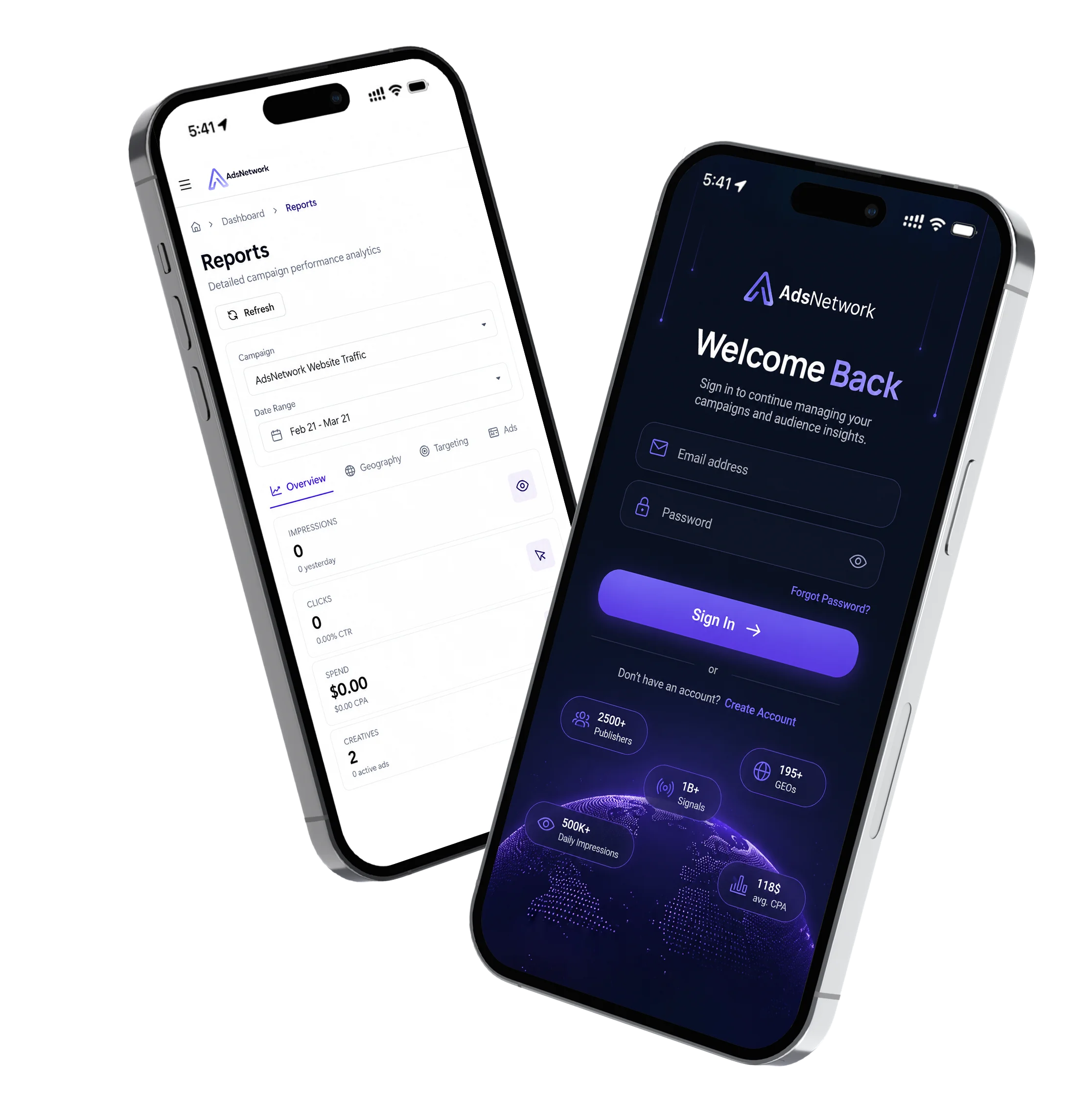
Stay connected to your live AdsNetwork campaigns with our mobile advertising app. Track impressions, clicks, conversions, campaign spend, and overall performance in real time—anytime, anywhere. Available for iOS and Android.