

Native ads are quietly dominating digital advertising, and most marketers are still not using them correctly. According to eMarketer, native display ad spending in the United States will reach $147.98 billion in 2026, growing 13.1% year over year. However, the real story is not the spending. It is the performance gap. This format generates a 0.33% CTR on average compared to just 0.05% for standard display, according to ContentMation. That is more than six times the engagement.
If you are still relying exclusively on banner ads, you are leaving clicks, conversions, and revenue on the table. This guide explains how native ads work, why they outperform traditional display, and how to build campaigns that deliver consistently high CTR.

What Are Native Ads and Why Do They Work?
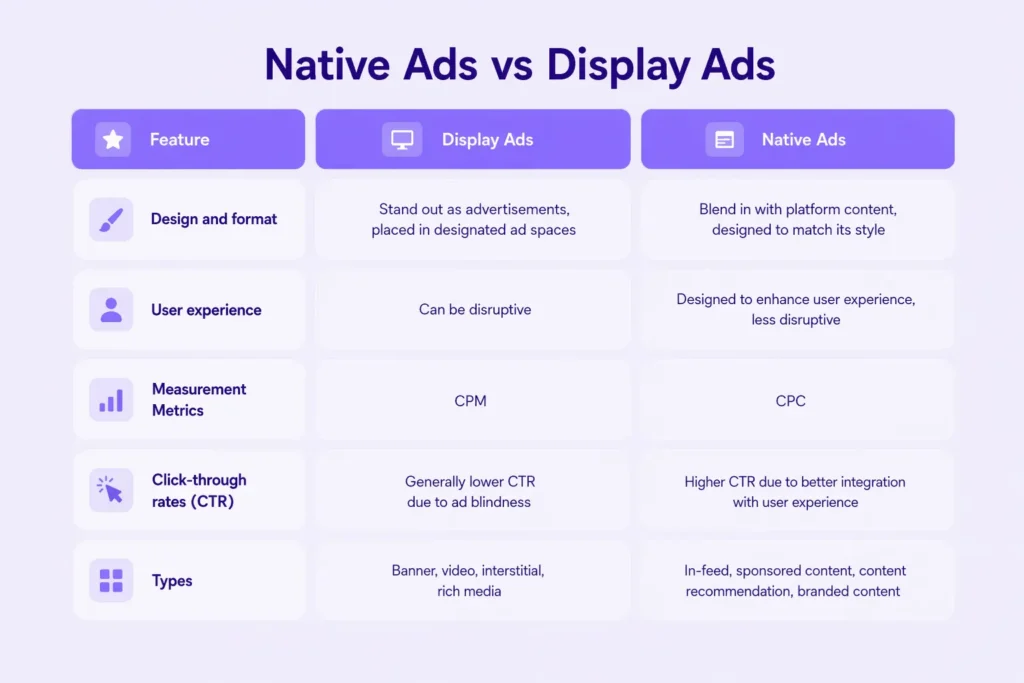
Native ads are paid content designed to match the look, feel, and function of the media where they appear. Unlike banner ads that interrupt the user experience, these placements integrate with surrounding editorial content. As a result, they reduce disruption while maintaining relevance to the audience.
The performance data backs this up consistently. According to Sharethrough via ContentMation, consumers view native advertising 53% more frequently than traditional display ads. Moreover, users look at these placements roughly twice as often as banner formats. Native content also produces measurably higher purchase intent than standard display, because placements feel like editorial content rather than advertising. Industry research including a widely-cited Sharethrough and IPG Media Lab study shows an 18% lift in purchase intent over standard display. This is the core advantage that drives higher CTR across every vertical and platform.
The reason is simple. Native placements feel like content, not interruptions. Because they blend into the editorial environment, users engage with them naturally instead of instinctively ignoring them. Banner blindness, a well-documented phenomenon in display advertising, is largely absent from native formats. The format is therefore especially powerful for brands that need to educate before converting. For crypto and DeFi products with complex value propositions, that education often determines whether a user converts or bounces.
Native Ad Formats That Deliver High CTR
Not all native formats are created equal. Choosing the right one is critical to maximizing your click-through rate. Below are the primary formats advertisers should consider.
In-Feed Native Ads
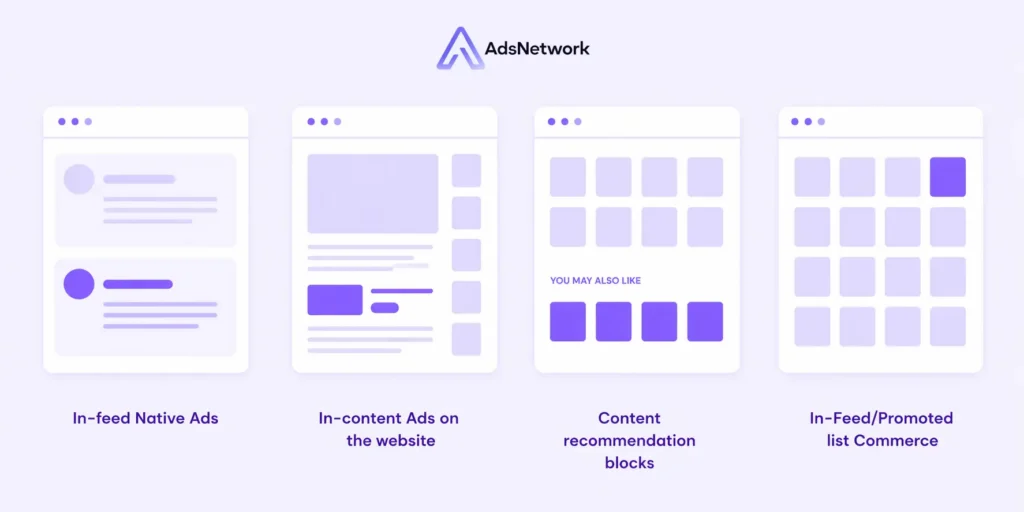
In-feed placements appear directly within a publisher’s content stream, mimicking surrounding articles or posts. According to ContentMation, in-feed native ads on social platforms achieve an average CTR of 1.2%. By contrast, banners in the same positions average just 0.15%. This makes in-feed the highest-performing format for most advertisers. Furthermore, viewability for these placements is typically higher than standard display because they sit directly in the content flow.
Content Recommendation Widgets
Content recommendation widgets appear at the bottom of articles under labels like “You May Also Like” or “Recommended For You.” According to eMarketer, these widgets account for 42% of all native ad spending. They work especially well for discovery campaigns because they catch users at a moment of high engagement, right after finishing an article. However, CTRs for discovery widgets vary widely, from 0.1% to 1.5% depending on creative quality and publisher relevance, as noted by Marketing LTB.
Sponsored Articles and Native Video
Sponsored articles allow brands to tell longer stories in an editorial format. According to ContentMation, branded content articles achieve seven times the time-on-page of standard web articles. Similarly, native video placements deliver nine times higher completion rates than standard pre-roll video. For advertisers with complex products such as DeFi protocols, token utilities, or blockchain infrastructure tools, these formats offer a powerful way to educate and convert simultaneously. The longer dwell time also gives the algorithm more engagement signal to optimize targeting in subsequent impressions.
Not all native formats are created equal. Consequently, choosing the right one is critical to maximizing your click-through rate. Below are the primary formats advertisers should consider.
In-Feed Native Ads
In-feed placements appear directly within a publisher’s content stream, mimicking the surrounding articles or posts. According to ContentMation, in-feed native ads on social platforms achieve an average CTR of 1.2%, compared to just 0.15% for banners in the same positions. This makes in-feed the highest-performing format for most advertisers. Furthermore, viewability for these placements is typically higher than standard display because they sit directly in the content flow.
Content Recommendation Widgets
Content recommendation widgets appear at the bottom of articles under labels like “You May Also Like” or “Recommended For You.” According to eMarketer, these widgets account for 42% of all native ad spending. They work especially well for discovery campaigns because they catch users at a moment of high engagement, right after finishing an article. However, CTRs for discovery widgets vary widely, from 0.1% to 1.5% depending on creative quality and publisher relevance, as noted by Marketing LTB.
Sponsored Articles and Native Video
Sponsored articles, also known as advertorials, allow brands to tell longer stories in an editorial format. According to ContentMation, branded content articles achieve seven times the time-on-page of standard web articles. Similarly, native video placements deliver nine times higher completion rates than standard pre-roll video. For advertisers with complex products, these formats therefore offer a powerful way to educate and convert.
Targeting determines whether your campaigns reach the right audience or get lost in irrelevant placements. Below are the strategies that consistently produce higher click-through rates.
Contextual Targeting for Native Campaigns
Contextual targeting matches your placements to the editorial content on the page. Because native ads are designed to blend with surrounding content, contextual relevance is even more important than with display banners. A/B tests consistently show that content-style thumbnails paired with an editorial tone outperform overtly promotional creative, as observed by Marketing LTB. Ads that educate through how-to content or product comparisons tend to perform best for lead generation.
Behavioral and Retargeting Strategies
Behavioral targeting layers user intent data on top of contextual relevance. Consequently, you can reach users based on their browsing history, purchase behavior, and interest signals. When combined with retargeting, native advertising becomes especially powerful. For example, a DeFi protocol can serve sponsored articles to users who visited their staking page but did not connect a wallet, guiding them through remaining objections in an educational format.
This format works best as part of a full-funnel approach. Moving users from awareness through education to conversion is the native advertising strength that display alone cannot replicate.
Native Ads Performance Benchmarks
Setting the right benchmarks helps you evaluate campaign performance accurately. Understanding how native ads compare to other formats is therefore essential before launching your first campaign.
According to ContentMation, native advertising achieves a CTR of 0.38% on mobile and 0.16% on desktop. In comparison, traditional banner ads average just 0.11% CTR. That means the native format on mobile delivers roughly 3.5 times the engagement of standard banners. Industry research also consistently shows that consumers trust native placements on editorial sites more than ads on social media platforms, a significant advantage for brands working to build credibility with an audience that fact-checks claims.
For crypto advertisers specifically, native placements in the Web3 space deliver even stronger results. According to HypeLab, native ads in crypto achieve CTRs of 0.20% to 0.65%, significantly outperforming display banners that average 0.08% to 0.25%. Placements on DeFi dashboards and token tracking sites in particular reach users with high purchase intent.
Creative Best Practices for High-CTR Native Ads
Creative execution makes or breaks performance in native advertising. The format only works when your ad feels like a natural extension of the surrounding content. Here is what the data shows about creative best practices.
Headlines and Thumbnails That Drive Clicks
Headlines and thumbnails account for most of the CTR variance in native advertising, according to Marketing LTB. Editorial-style headlines that promise useful information outperform promotional copy. Instead of writing “Buy Our Token Now,” try something like “How DeFi Staking Rewards Work in 2026.” Similarly, thumbnails that feel authentic and match the publisher’s visual style consistently beat polished, ad-like graphics.
Content Quality and Landing Pages
The click is only the beginning. Campaigns that link to educational landing pages with 800 to 1,500 words of content perform better for high-consideration products, according to Marketing LTB. Your landing page should match the editorial tone of the ad itself. Additionally, native video content that opens with a strong problem or benefit hook achieves higher completion and conversion rates than videos that lead with branding.
For crypto projects, this means creating content that explains your protocol, walks through use cases, or compares your solution to alternatives. Authenticity builds trust with an audience that is skeptical of promotional hype. Educational content consistently outperforms hard-sell approaches in the Web3 space, as a result.
Why Native Ads Work at Every Stage of the Funnel
One of the frequently overlooked advantages of native advertising is that it performs across the full funnel, not just at the top. At the awareness stage, in-feed placements and content recommendation widgets introduce your brand to new audiences at a moment when users are actively consuming content and receptive to discovering something new.
At the consideration stage, sponsored articles and native video give you the space to build a genuine case for your product. A 1,000-word editorial explaining how your DeFi protocol works converts at a fundamentally different rate than a 300×250 banner. Users who read to the end of a sponsored article are significantly more qualified than those who glanced at a banner.
At the conversion stage, retargeted native placements close the loop by re-engaging users with relevant messaging in the same editorial contexts where they were first exposed. Consequently, the format is as valuable for bottom-of-funnel campaigns as it is for brand building. Furthermore, the trust advantage of native over traditional display compounds at the conversion stage, where user hesitancy is highest.
Native Ads for Crypto and Web3 Projects
Crypto advertisers face a unique problem. Google and Meta restrict most cryptocurrency advertising, limiting access to the two largest ad platforms in the world. Native ads solve this by fitting seamlessly into crypto-native publisher content. Because they match the editorial environment, these placements bypass the trust barrier that Web3 audiences feel toward traditional display banners.
In fact, many crypto projects now combine native advertising with display campaigns as a two-channel strategy. Teams use banners for broad awareness and native placements for deeper engagement and conversion. According to Coinbound, combining a display-focused network with a native or PR-focused network is a common high-performing stack for token launches in 2026.
AdsNetwork supports native ad formats built specifically for Web3 audiences. It connects your campaigns with verified crypto publishers, offering placements that feel like content rather than interruptions. For a comparison of how this format stacks up against display, see our guide to display banner ads for the full picture on both formats.

| Ready to run native ad campaigns? Explore AdsNetwork’s native ads solutions and start reaching crypto-native and web audiences with high-performing placements that convert. |
Building High-CTR Campaigns with Native Ads
Native ads are not a niche format or an experimental channel. Instead, they represent 65% of all digital display spending globally, according to eMarketer. The CTR advantages, trust benefits, and engagement metrics all point in the same direction. This format outperforms traditional display at every stage of the funnel.
For crypto and Web3 projects, native advertising offers a direct path to engaged, high-intent audiences on the platforms they already trust. Whether you are launching a token, promoting a DeFi protocol, or growing your community, the principles in this guide will help you build campaigns that deliver real results. Start running high-CTR campaigns today at 51.254.143.217/native-ads.
Native Ads for Crypto and Web3 Projects
Crypto advertisers face a unique problem. Specifically, Google and Meta restrict most cryptocurrency advertising, limiting access to the two largest ad platforms in the world. Native ads solve this by fitting seamlessly into crypto-native publisher content. Because they match the editorial environment, these placements bypass the trust barrier that Web3 audiences feel toward traditional display banners.
In fact, many crypto projects now combine native advertising with display campaigns as a two-channel strategy. Teams use banners for broad awareness and native placements for deeper engagement and conversion. According to Coinbound, this combination of one display-focused network with one native or PR-focused network is a common high-performing stack for token launches in 2026.
AdsNetwork supports native ad formats built specifically for Web3 audiences. It connects your campaigns with verified crypto publishers, offering placements that feel like content rather than interruptions. Visit 51.254.143.217/ to explore these options and launch your first campaign.
If you want to understand how this format compares to banner advertising, furthermore, our breakdown of Display Banner Ads: Complete Guide for Advertisers covers everything you need to know about the display side of the equation.
Building High-CTR Campaigns with Native Ads
Native ads are not a niche format or an experimental channel. Instead, they represent 65% of all digital display spending globally, according to eMarketer. The CTR advantages, trust benefits, and engagement metrics all point in the same direction. Specifically, this format outperforms traditional display at every stage of the funnel.
For crypto and Web3 projects, moreover, native advertising offers a direct path to engaged, high-intent audiences on the platforms they already trust. Whether you are launching a token, promoting a DeFi protocol, or growing your community, the principles in this guide will therefore help you build campaigns that deliver real results.
Start running high-CTR native ad campaigns today. Explore formats, launch campaigns, and track results at 51.254.143.217/.
Featured Posts
Jul 20, 2026
13 min read
CPA Marketing: What It Is and How to Use It for Advertisers
Search CPA marketing and you will mostly find articles written for affiliates: how to pick offers, join networks,…
Read Article
Jul 19, 2026
15 min read
How to Advertise a Crypto Exchange: A Complete Marketing Guide
Crypto exchange advertising is one of the most lucrative jobs in performance marketing, and one of the most…
Read Article
Jul 17, 2026
13 min read
iGaming Marketing Agency vs In-House: What’s Best for Operators?
Every scaling iGaming operator hits the same fork: hire an iGaming marketing agency, or build a team in-house.…
Read ArticleNeed Help?
Our team is ready to help you launch successful campaigns.
Frequently Asked Questions
FAQ
All major IAB standard sizes: 300×250 (Medium Rectangle), 728×90 (Leaderboard), 160×600 (Wide Skyscraper), 320×50 (Mobile Banner), and 970×250 (Billboard). Served dynamically across desktop, tablet, and mobile placements.
There's no fixed minimum. Our platform works for test campaigns and large-scale media buys alike. Tell us your goal and we'll recommend a budget that makes sense - not one that just meets a threshold.
The minimum initial deposit is $5,000. Our platform supports both test campaigns and large-scale media buys. Tell us about your goals, and we'll recommend a budget that aligns with your campaign objectives.
CPM for awareness and reach. CPC for direct response and conversions. If you're not sure, our team will recommend the right model based on your campaign goal - not the one with the highest margin for us.
Ready to buy crypto traffic that actually converts? Three options for tracking: Pixel (a lightweight tag on your conversion page), Server-to-Server (S2S) for cookieless, privacy-compliant tracking, or Google Tag Manager for no-code setup. All three feed real-time data directly into your campaign dashboard.
Most campaigns are live within 24 hours of account approval and creative submission. Onboarding takes about five minutes. After that, it's just a matter of creative review - which we turn around fast.
Geo, device, interest, behaviour, and contextual targeting as standard. For Web3 campaigns, we also offer on-chain audience targeting - reaching users based on wallet activity and blockchain behaviour. No other network goes this deep.
Still have questions?
Get AccessAI-Powered Mobile
Mobile App Coming Soon
Our mobile app is currently in development. Soon, you’ll be able to manage and monitor campaigns on the move.