

Every time a webpage loads, real-time bidding runs in the background. Across millions of ad slots, advertisers compete for the right to show their message to one specific user. The auction resolves in under 120 milliseconds. Yet most people never notice it. However, real-time bidding now powers more than 70% of all digital display advertising globally, according to industry research. For anyone running digital campaigns, understanding how this system works is not optional. It is essential knowledge for managing spend, reaching the right audiences, and avoiding the costly traps that burn advertiser budgets each year.
What Is Real-Time Bidding?
Real-time bidding is an automated auction process where digital ad impressions are bought and sold programmatically. Specifically, each impression represents one chance to display an ad to one specific user at one specific moment. Instead of negotiating placements directly with publishers, advertisers bid through connected technology in real time. As a result, the system creates a highly efficient, data-driven marketplace that adjusts pricing to reflect demand at any given instant.
The scale of this market is significant. According to IMARC Group, the global real-time bidding market reached $18.8 billion in 2024. It is projected to grow to $92.6 billion by 2033, at a compound annual growth rate of 18.41%. That growth reflects how thoroughly RTB has become the default infrastructure for digital advertising across display, video, mobile, and connected TV.
Furthermore, programmatic channels now deliver more than 70% of digital display ad inventory worldwide. Notably, open auctions hold approximately 58.8% of total RTB market share. In short, the shift from direct media buying to automated bidding is already complete.
The Key Players in a Real-Time Bidding Auction
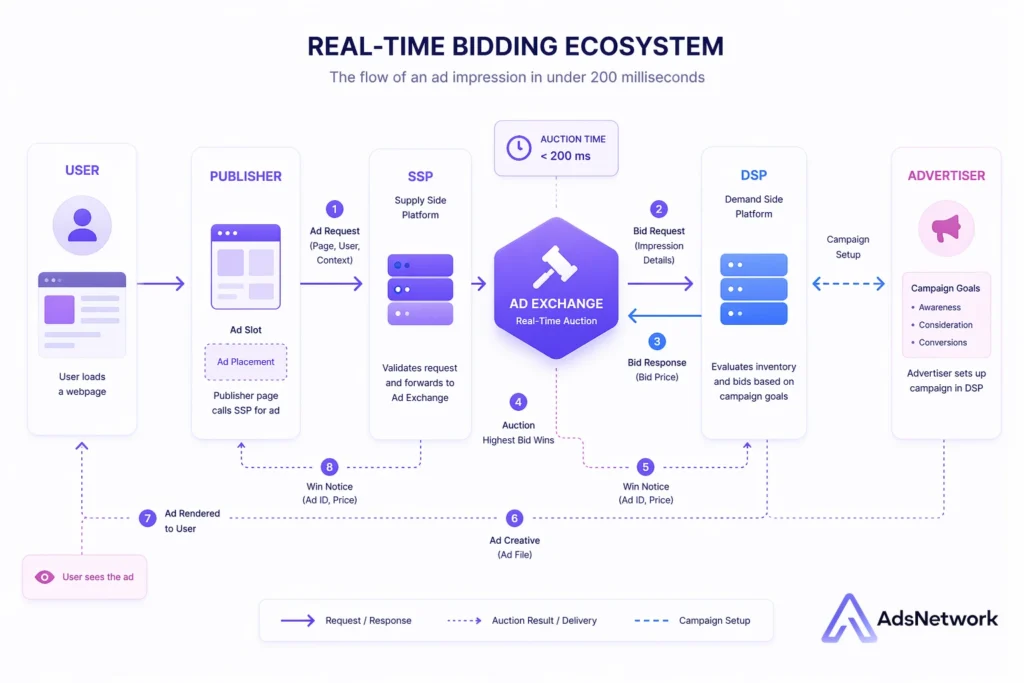
To understand real-time bidding in ad exchanges, you first need to know the ecosystem. Specifically, several distinct platforms participate in every transaction, each serving a defined role in the chain.
Publishers and Supply-Side Platforms
Publishers own the ad inventory. These are websites, apps, and streaming services with audiences to monetize. In practice, a supply-side platform (SSP) represents the publisher within the auction. The SSP puts available impressions up for sale, sets minimum floor prices, and passes bid requests to connected ad exchanges. In essence, the SSP acts as the publisher’s automated sales representative.
Advertisers and Demand-Side Platforms
On the demand side, advertisers want to reach specific audiences efficiently. A demand-side platform (DSP) represents the advertiser in the auction. The DSP evaluates incoming bid requests, matches them against campaign targeting criteria, and submits bids automatically. Typically, targeting data comes from data management platforms (DMPs), first-party customer data, or contextual signals from the page content.
The Ad Exchange and Data Layer
At the center of every transaction sits the ad exchange. It receives bid requests from SSPs and broadcasts them simultaneously to connected DSPs. When bids arrive, the exchange runs the auction and returns the winning creative to the publisher for display. Additionally, data management platforms supply audience segments that help DSPs evaluate each impression more accurately. Together, these layers form the core programmatic infrastructure that powers the modern web.
How a Real-Time Bidding Auction Works Step by Step
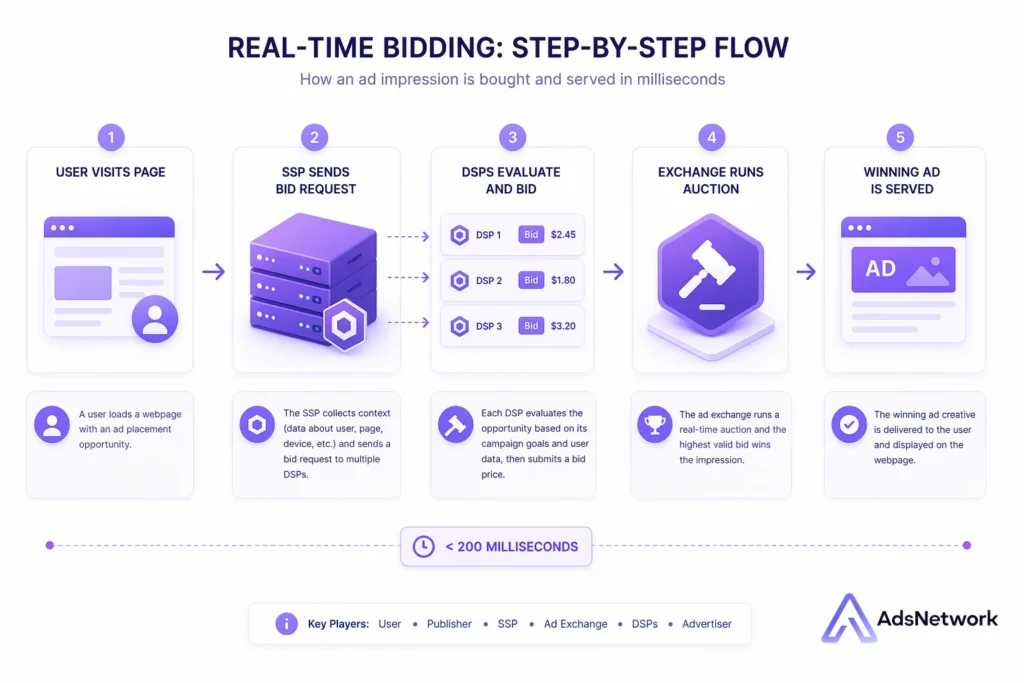
The mechanics behind real-time bidding are more straightforward than they initially appear. In practice, every auction follows the same defined sequence, repeating billions of times each day.
Step 1: The User Visits a Page
A user lands on a publisher’s website or opens a mobile app. The page contains one or more available ad slots. As the page begins to load, the publisher’s ad server detects available inventory and triggers the auction process immediately.
Step 2: The Bid Request Goes Out
The SSP sends a bid request to the ad exchange. This request contains key data: the ad unit size, the page URL, the content category, and the user’s device type and location. It also includes the publisher’s minimum floor price. The exchange then broadcasts this request to all connected DSPs simultaneously.
Step 3: DSPs Evaluate and Submit Bids
Each DSP evaluates the bid request against active campaign criteria. If the impression matches a running campaign, the DSP submits a bid denominated in CPM (cost per thousand impressions). DSPs with no matching campaign simply pass without bidding. Consequently, only relevant advertisers enter the auction for each specific impression.
Step 4: The Auction Resolves
The ad exchange collects all incoming bids and resolves the auction. The highest valid bid above the floor price wins. However, the pricing model, discussed in detail below, determines exactly how much the winner pays. Importantly, the full process from bid request to resolution completes in under 120 milliseconds.
Step 5: The Ad Is Delivered
The winning ad creative is sent back through the SSP to the publisher. The ad renders in the available slot. By the time the user sees the fully loaded page, the entire auction has already concluded. The publisher receives their share of ad revenue, and the advertiser records the impression against their campaign.
Open Auctions vs. Private Marketplaces
Not all real-time bidding inventory is treated equally. The auction format determines who can bid, under what conditions, and at what price level.
In an open auction, any qualified DSP can bid on any available impression. This format offers maximum reach and broad competitive pricing. It accounts for the largest share of RTB volume globally. In contrast, open auctions carry higher risks around brand safety and traffic quality, since inventory comes from a wide and sometimes unvetted publisher pool.
Private Marketplace Deals in Real-Time Bidding
A private marketplace (PMP) works differently. Publishers invite a curated selection of buyers to access premium inventory before it reaches the open exchange. Buyers receive better placements and stronger brand safety guarantees. Publishers, in turn, secure higher CPMs than open competition typically yields. Both parties benefit from greater transparency and more controlled conditions.
There is also programmatic direct, where a buyer and publisher agree on a fixed price for reserved inventory in advance. This removes the auction element entirely. In comparison to open RTB, programmatic direct offers the highest degree of certainty on both placement quality and pricing. Many premium publishers offer all three models simultaneously, giving buyers options based on their campaign priorities.
First-Price vs. Second-Price Auction Models
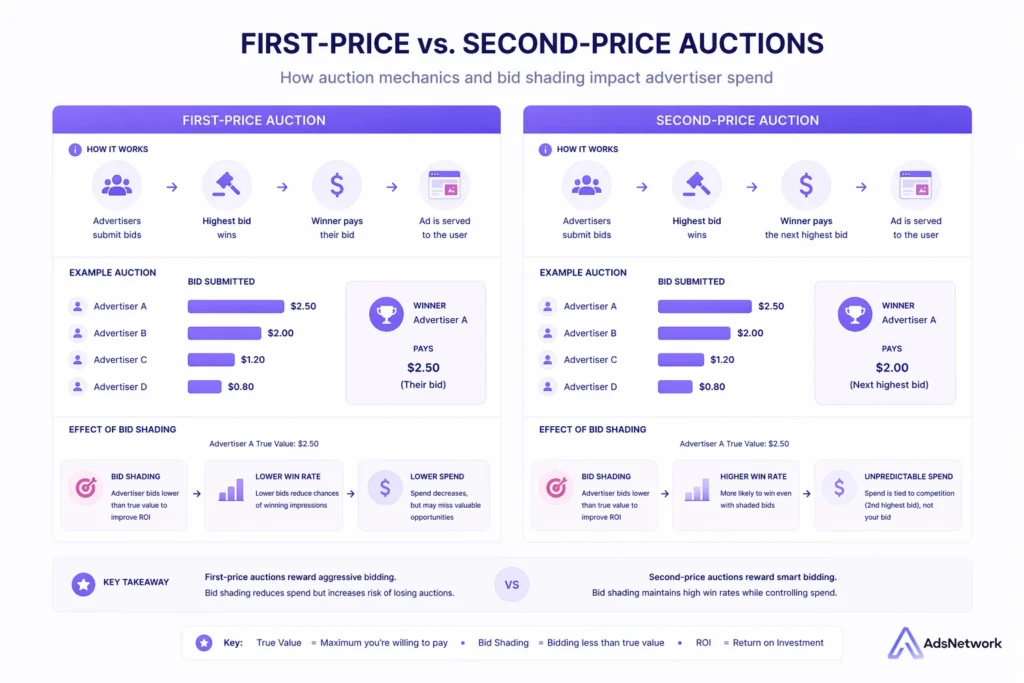
The auction pricing model directly impacts bidding strategy and campaign costs. Therefore, understanding the difference is essential for anyone buying programmatic media.
In a second-price auction, the winner pays the second-highest bid plus a small increment, typically one cent. This model encouraged honest bidding. Advertisers could safely bid their true value without fear of overpaying. For years, it was the industry standard across most major exchanges.
In 2019, Google shifted its exchange to a first-price auction model. In a first-price auction, the winner pays exactly what they bid. As a result, advertisers were forced to adopt bid shading, an algorithmic technique that reduces bids to avoid overpaying. Most major exchanges have since made the same transition. Accordingly, DSPs now require more sophisticated bidding logic to manage costs effectively.
Ad Fraud and Invalid Traffic in Real-Time Bidding
One of the persistent challenges in real-time bidding is invalid traffic and ad fraud. Because transactions happen in milliseconds with minimal human oversight, fraudulent traffic can enter the supply chain rapidly and at scale.
According to Pixalate’s Q1 2024 benchmark report, the global invalid traffic rate across open programmatic mobile in-app advertising reached 23%, a 15% year-over-year increase. Research firm Fraudlogix, analyzing over 105 billion impressions across 2025, found a global invalid traffic rate of 20.64%. Applied to U.S. programmatic ad spend, that rate suggests approximately $37 billion in advertiser dollars may be associated with invalid traffic annually.
Common fraud vectors include bot networks, domain spoofing, ad stacking, and click injection. Moreover, programmatic supply chains often route through multiple intermediaries. Each additional hop adds potential opacity. Without proper verification tools, advertisers routinely pay for impressions that real users never see.
For Web3 advertisers, strong ad fraud prevention strategies are particularly important. Crypto-related content attracts higher bot activity because automated traffic farms specifically target high-value verticals. Additionally, the open nature of many RTB environments means that without active filtering, invalid traffic becomes a structural cost rather than an occasional exception.
Why Real-Time Bidding in Ad Exchanges Matters for Web3 and Crypto Teams
For crypto and Web3 projects, real-time bidding introduces a specific and frequently frustrating layer of complexity. Mainstream programmatic platforms restrict crypto advertisers heavily, regardless of whether those advertisers operate legally and transparently.
Meta bans most direct crypto promotions outright. DeFi protocols, token launches, and NFT projects face policy rejections on Google Ads and Meta in most categories. According to StubGroup, Google suspended 39.2 million advertiser accounts in 2024, a 208% increase from the prior year. Crypto businesses carry a disproportionate share of that enforcement. Notably, even compliant projects such as portfolio trackers, blockchain infrastructure tools, and Web3 developer platforms regularly get flagged by automated review systems.
This is precisely the gap that purpose-built Web3 advertising infrastructure addresses. Rather than routing budget through exchanges that treat crypto as a liability, Web3 teams need RTB-based ad delivery across publisher networks that already serve crypto-native audiences. Understanding programmatic advertising gives teams the foundation to build campaigns around actual performance data instead of guesswork.
Platforms built specifically for Web3 advertising, such as AdsNetwork, offer programmatic delivery to crypto-native publishers without the blanket policy restrictions that hamper campaigns on general exchanges. Instead of navigating repeated disapproval cycles, advertisers can access the same automated targeting, frequency capping, and real-time optimization tools that traditional brands use at scale.
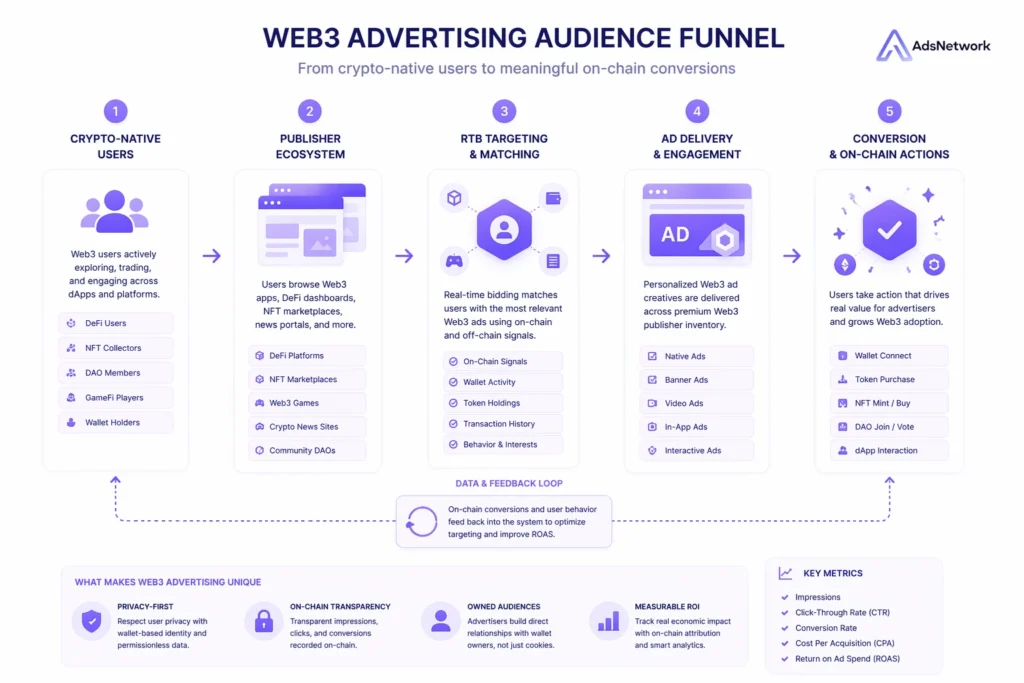
Furthermore, purpose-built Web3 ad platforms maintain verified publisher relationships and transparent targeting standards. As a result, advertisers receive better signal quality than open RTB on general exchanges typically provides. For a token launch team or DeFi protocol, that targeting precision matters considerably. It is the practical difference between a campaign that builds a qualified audience and one that burns budget on users with no interest in crypto products.
Conclusion: Real-Time Bidding in Ad Exchanges Is the Backbone of Modern Advertising
Real-time bidding in ad exchanges has fundamentally changed how digital advertising works. The technology is fast, data-driven, and deeply embedded in the global media ecosystem. For most industries, accessing it through mainstream DSPs is straightforward.
For Web3 and crypto projects, however, the route requires a different infrastructure layer. Mainstream exchanges carry policies that block or restrict most crypto campaign types, regardless of compliance status. Consequently, finding platforms that understand both RTB delivery and the specific compliance landscape of crypto advertising is essential for running effective campaigns at scale.
To explore how AdsNetwork can support your Web3 campaign with purpose-built real-time bidding infrastructure, visit 51.254.143.217/.
Featured Posts
Oct 23, 2026
10 min read
What Is CPM in Advertising? Meaning, Formula and 2026 Rates
CPM is the cost an advertiser pays for 1,000 ad impressions, making it one of the most common…
Read Article
Sep 23, 2026
6 min read
What Is Advertising Technology (AdTech) and How Does It Work?
Advertising technology, commonly known as AdTech, refers to the software, platforms, tools, and systems used to plan, buy,…
Read Article
Sep 16, 2026
8 min read
Media Buying: A Complete Guide for Advertisers
Media buying is the process of purchasing advertising space to reach a target audience. It includes choosing where…
Read ArticleNeed Help?
Our team is ready to help you launch successful campaigns.
AI-Powered Mobile
Monitor Your Campaigns Anywhere
Stay connected to your live AdsNetwork campaigns with our mobile advertising app. Track impressions, clicks, conversions, campaign spend, and overall performance in real time—anytime, anywhere. Available for iOS and Android.