
Most advertisers chase clicks on crowded platforms where costs keep rising and competition gets fiercer every quarter. Pop-under ads take a completely different approach. They open behind the active browser window and wait for the user to finish browsing. When the user closes their active tab, the ad captures undivided attention with a full-page message.
The result is impressive: six times higher CTR than standard banners, 100% viewability once seen, and some of the lowest CPMs in digital advertising. In 2026, pop-under ads remain one of the most cost-effective ways to drive high volume traffic at scale. This guide explains how they work, what performance benchmarks to expect, and how to use them as a scalable traffic strategy.
What Are Pop-Under Ads?
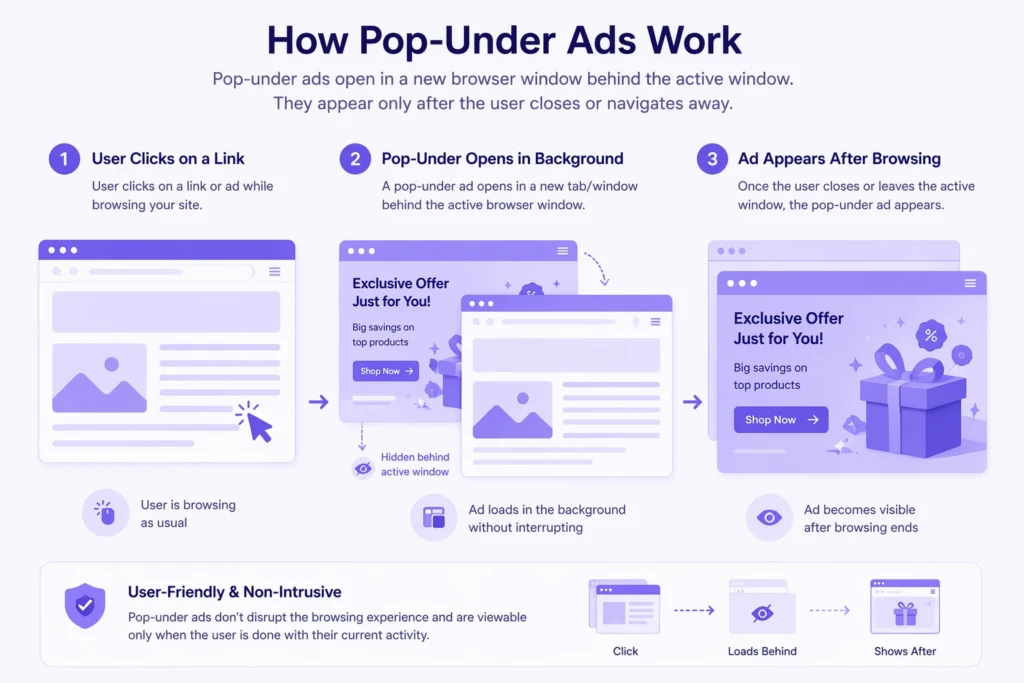
Pop-under ads are full-page advertisements that open in a new browser window behind the user’s active tab. Unlike pop-up ads that interrupt browsing by appearing on top of content, pop-under ads wait in the background. The user discovers them only after closing or minimizing their current window. At that moment, the user has finished their primary task and is naturally more receptive to new content. As a result, pop-under ads capture attention without the irritation that intrusive formats create.
According to CIPIAI, pop-under ads have a 100% viewability rate once seen by the user. Because the ad occupies a dedicated window, it does not compete with other on-page elements. This ensures the entire message is visible, creating higher engagement potential than standard display placements.
Moreover, the format works across both desktop and mobile devices. Pop-under campaigns typically run on a CPM pricing model, making them ideal for high volume campaigns where cost efficiency matters most. Many networks also support CPA and hybrid models, giving advertisers flexibility to align spending with actual conversions.
It is important to distinguish pop-under ads from pop-up ads. Pop-ups appear on top of the active window, interrupting the browsing session. Browsers have increasingly blocked pop-ups, making them unreliable for modern campaigns. Pop-under ads, in contrast, work within browser policies because they do not obstruct the user’s current activity. According to PropellerAds, most affiliates today rely on pop-under traffic because it delivers similar reach without the interruption, leading to more consistent engagement.
The user journey also differs significantly. With a pop-up, the user is forced to deal with the ad immediately, often by closing it without reading. With a pop-under, the user encounters the ad on their own terms, after they have finished what they came to do. Consequently, the psychological context is fundamentally different, and that difference shows up in conversion data.
Why Pop-Under Ads Drive High Volume Traffic
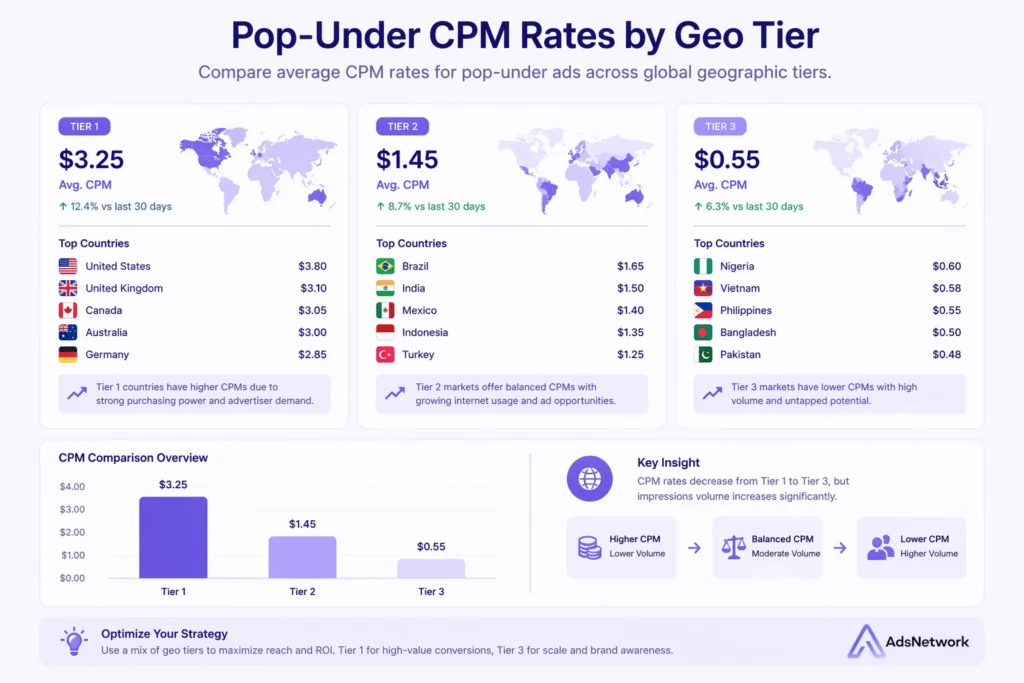
The core advantage of pop-under ads is their ability to generate massive impression volumes at low cost. Specifically, CPMs for pop-under traffic start as low as $0.50 in emerging markets and range from $1.00 to $10.00 in Tier 1 countries, according to Traffic Cardinal. Those rates are a fraction of what advertisers pay on major social media or search platforms.
The format also bypasses banner blindness entirely. Users have become conditioned to ignore small ad units at the edges of web pages. Pop-under ads present the offer in a new, focused environment, breaking through that autopilot response. According to Business of Apps, when the user closes their primary browser window, the ad is the only thing on screen. The message gets full, undivided attention with nothing competing for the user’s focus.
Additionally, pop-under ads are resistant to many common ad blockers. While approximately 27% of internet users employ ad-blocking tools, according to CIPIAI, pop-under formats can still reach audiences that standard display cannot. This makes them especially valuable for campaigns targeting high volume reach across diverse audiences. Furthermore, the sheer inventory scale available through pop-under networks means advertisers can test and optimize faster than on channels with limited impression volume.
Pop-Under Ads Performance Benchmarks
Understanding benchmarks helps you set realistic expectations before launching campaigns. Here are the key metrics every advertiser should track.
Verticals Where Pop-Under Ads Perform Best
Pop-under ads do not perform equally across all verticals. Specifically, the format works best in categories where users are open to discovering offers rather than actively searching for something specific. The top-performing verticals consistently include:
- Gaming and mobile app downloads: users on gaming content sites are receptive to new titles and promotions
- Sweepstakes and offers: the format’s broad reach and low CPM make it ideal for high-volume lead generation
- Crypto and blockchain: token launches and exchange sign-ups benefit from the full-page format and volume
- iGaming and sports betting: regulated verticals that operate on specialist networks benefit from pop-under reach
- Utilities and software: app install campaigns and tool downloads respond well to pop-under landing pages
Conversely, verticals that rely heavily on brand recognition and premium content association tend to see weaker results from pop-under traffic. High-end e-commerce and luxury goods, for instance, are better served by premium programmatic inventory.
CTR and Conversion Rate Benchmarks
Pop-under ads deliver CTR rates approximately six times higher than standard banner advertising, according to Business of Apps. Conversion rates vary by vertical and geography. However, Business of Apps reports that well-optimized pop-under campaigns can achieve conversion rates as high as 300% relative to banner benchmarks. In particular, verticals like sweepstakes, gaming, and utilities tend to see the strongest performance.
CPM and Cost Benchmarks
Pop-under eCPMs range from $0.50 to over $5.00 depending on the vertical and geographic location, according to CIPIAI. Tier 1 countries with high quality traffic often see rates in the $1.00 to $3.00 range. Meanwhile, Traffic Cardinal reports that premium Tier 1 markets can push rates to $3.00 to $10.00 per thousand impressions. These costs are still significantly lower than paid search or social media advertising in the same markets.
Measuring Pop-Under Campaign Success
CTR alone does not tell the full story for pop-under campaigns. In fact, post-click behavior is often more important than initial engagement. Track sign-ups, app installs, deposits, and other conversion events to evaluate true campaign value. Because pop-under traffic is high volume, even modest conversion rates produce strong overall results when multiplied across millions of impressions.
It is also worth tracking return on ad spend (ROAS) at the traffic source level. Different publishers within a pop-under network often perform very differently for the same offer. Specifically, identifying and scaling the best-performing placements while pausing underperformers is the fastest way to improve campaign efficiency without increasing budget. Most networks provide source-level reporting that enables this optimization.
Best Practices for Pop-Under Ads
Running effective pop-under campaigns requires more than buying cheap impressions. Volume without quality is wasted budget. Here is what the data shows about optimizing performance.
Frequency Capping and Timing
Frequency capping is essential. Showing the same pop-under to the same user repeatedly leads to frustration and diminishing returns. Industry best practice limits exposure to one or two impressions per user per day. According to PropellerAds, most affiliates use strict frequency caps to maintain campaign profitability and avoid user fatigue.
Landing Page Optimization
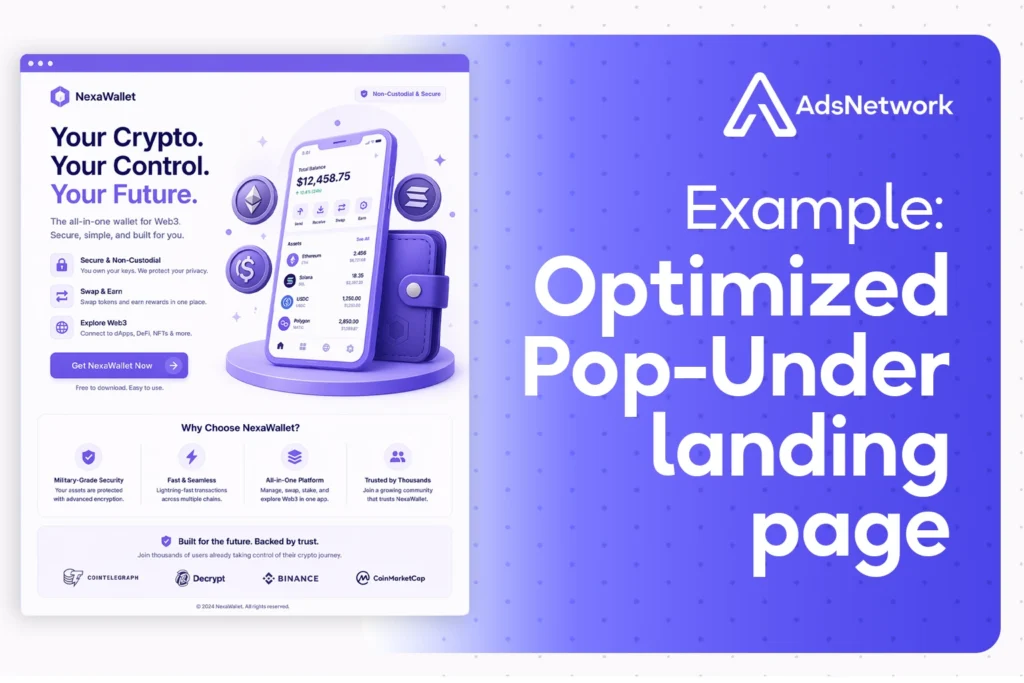
The landing page is where conversions happen or fail. Because pop-under users arrive without prior intent, your landing page must communicate value instantly. Specifically, use clear headlines, strong visuals, and a single prominent call to action. Pre-landers that warm up the user with a brief message before the main offer often improve conversion rates significantly.
Mobile optimization is equally critical. Over 65% of global traffic is now mobile, and pop-under formats that do not adapt to small screens lose conversions instantly. Therefore, responsive layouts, fast load times, and one-tap CTAs are non-negotiable for mobile pop-under campaigns.
Traffic Quality and Anti-Fraud
Not all pop-under traffic is equal. Bot traffic and low quality impressions can inflate metrics while delivering zero real conversions. Consequently, choosing networks with verified anti-fraud filters is critical. Look for platforms that use third-party verification tools and offer granular targeting by geography, device, operating system, and browser.
Pop-Under Ads for Crypto and Web3 Projects
Crypto projects face advertising restrictions on Google and Meta that make reaching large audiences difficult. Pop-under ads offer an alternative channel that bypasses these platform restrictions entirely. Because pop-under networks operate independently of mainstream ad platforms, they accept crypto advertisers without the compliance barriers that limit campaigns on Google or Facebook.
The format is particularly effective for token launches, exchange sign-ups, and airdrop promotions. These campaigns benefit from high volume reach at low cost, exactly what pop-under traffic delivers. A token launch, for instance, can generate thousands of landing page visits in hours rather than days, accelerating community growth during critical launch windows. The full-page format also provides enough space to communicate the value proposition clearly, something a 300×250 banner simply cannot do.
Beyond token launches, pop-under ads also work well for DeFi protocol onboarding and wallet download campaigns. Furthermore, because the user encounters the ad in a focused environment with no competing content, they are more receptive to reading the message and taking action. For complex DeFi products, this focused attention window is a significant advantage over banner formats where users must absorb the offer in half a second.
| Ready to run pop-under campaigns? Explore AdsNetwork’s pop-under ad solutions and start driving high-volume traffic at the lowest CPMs in digital advertising. |
Scaling Traffic with Pop-Under Ads
Pop-under ads are not a relic of early internet advertising. Instead, they are a proven, scalable traffic channel that delivers volume, cost efficiency, and engagement that banner ads cannot match. The data is clear: six times higher CTR than banners, 100% viewability, and CPMs that start at a fraction of mainstream platform costs.
For crypto and Web3 projects, moreover, pop-under ads offer unrestricted access to large audiences during critical launch phases. Whether you are promoting a token launch, driving exchange sign-ups, or scaling community growth, this format delivers the volume and speed that other channels struggle to match. Start driving high volume traffic today at adsnetwork.io.

Featured Posts
Oct 23, 2026
10 min read
What Is CPM in Advertising? Meaning, Formula and 2026 Rates
CPM is the cost an advertiser pays for 1,000 ad impressions, making it one of the most common…
Read Article
Sep 23, 2026
6 min read
What Is Advertising Technology (AdTech) and How Does It Work?
Advertising technology, commonly known as AdTech, refers to the software, platforms, tools, and systems used to plan, buy,…
Read Article
Sep 16, 2026
8 min read
Media Buying: A Complete Guide for Advertisers
Media buying is the process of purchasing advertising space to reach a target audience. It includes choosing where…
Read ArticleNeed Help?
Our team is ready to help you launch successful campaigns.
AI-Powered Mobile
Monitor Your Campaigns Anywhere
Stay connected to your live AdsNetwork campaigns with our mobile advertising app. Track impressions, clicks, conversions, campaign spend, and overall performance in real time—anytime, anywhere. Available for iOS and Android.