

Most crypto founders hit the same wall in their first week of paid marketing. They build a strong product, prepare a launch, then learn that the biggest ad platforms treat crypto advertising as a restricted category. Google gates it behind certification. Meta demands written permission. X allows it in some countries and blocks it in others. So the default plan becomes a scramble of influencer shoutouts and Discord hype, and neither one scales or measures cleanly.
Instead, this guide takes the opposite route. It maps the compliant, performance-driven side of crypto marketing: which channels stay open, which formats convert, how to reach real crypto users, and how to launch without wasting budget. The rules are strict, yet they are navigable. Brands that learn them early gain a genuine edge over rivals still refreshing their token price chart.
The audience justifies the work. Global cryptocurrency ownership reached 741 million people in 2025, a 12.4% jump from 659 million a year earlier, according to Crypto.com’s annual Crypto Market Sizing Report. That is a large, fast-growing, and famously hard-to-reach market. Standard ad platforms see crypto and add friction. Specialist channels see crypto and add precision.
The stakes climb as budgets grow. Digital advertising overall is on track to reach $662 billion in 2026, per Grand View Research, and crypto brands want a measurable slice of it. The catch is familiar: the easiest channels to buy are the hardest for crypto to access.
Why Crypto Advertising Is Different (And Harder)
Every major ad platform built its crypto rules around one fear: scams. Years of fraudulent ICOs and rug pulls pushed Google, Meta, and X toward heavy gatekeeping. As a result, legitimate projects now pay for the sins of bad actors.
The three gatekeepers: Google, Meta, and X
Start with Google. To advertise crypto exchanges, software wallets, hardware wallets, or coin trusts, you must hold the right local license and pass certification before a single ad runs. Its cryptocurrencies and related products policy spells out exactly which categories qualify. In the United States that usually means FinCEN registration as a Money Services Business. In the UK it means FCA registration. Beginning June 2026, those certification applications move from the Help Center into the Google Ads account itself. The workflow changed, but the scrutiny did not. Initial coin offerings, DeFi trading protocols, and token presales stay banned outright.
Meta runs on a permission model. Its cryptocurrency products and services policy requires prior written approval before you can promote exchanges, trading platforms, or staking services. Meta now accepts 27 regulatory licenses, up from just three in 2021, so the door is wider than many founders assume. Account-level approval is not the finish line, though. Each creative still passes review, and any language hinting at guaranteed returns gets flagged quickly.
X reopened to crypto more recently. Its financial services policy permits ads for cryptocurrency products on a country-by-country basis, again tied to local licensing and a separate certification per content category. ICOs, IEOs, and mining services remain off-limits. Approval in one market tells you nothing about the next.
A newer wrinkle raises the bar again. Since March 2026, Meta reviews the ad and the landing page together as a single unit, so a clean creative pointed at a messy page still fails. X added paid-promotion disclosure rules the same year, demanding clear labels on sponsored crypto content. The pattern holds across the board: platforms now judge the whole funnel, not just the headline.
Why crypto brands get pushed off-platform
Here is why this matters. Facing three different gatekeepers, most teams give up and default to paid influencers or Discord campaigns. Those tactics have a place, yet they rarely scale, and attribution stays murky at best. The compliance risk of getting it wrong is real too, since a botched application or a non-compliant landing page can freeze an account for weeks. To advertise crypto with any consistency, you need channels designed for the vertical from the ground up.

The three-gate reality: Google, Meta, and X each apply separate crypto advertising rules by product type and country.
The Channels That Actually Work for Crypto Advertising in 2026
Once you accept that the mainstream giants are only partly open, the map gets clearer. Five channels carry most of the weight for crypto campaigns today. Each one suits a different goal, budget, and risk tolerance.
Why specialist crypto advertising channels win
| Channel | Compliance risk | Typical CPM | Targeting quality | Best for |
| Crypto-specialist ad networks | Low | Mid | High | Awareness to conversion |
| Programmatic via compliant DSPs | Low to medium | Mid to high | Very high | Scaled, data-driven campaigns |
| Native ads on crypto media | Low | Mid | High (contextual) | Trust-building and education |
| Push and pop formats | Low | Low | Medium | Volume and sign-up funnels |
| KOL / influencer | Medium to high | Variable | Medium | Social proof and hype moments |
A few notes on how to read that. Crypto-specialist networks and programmatic advertising (including ad networks for RWA marketing) tend to be the workhorses because they reach crypto-native audiences without the mainstream approval bottleneck. A dedicated Web3 advertising network places your creative across exchanges, wallets, news sites, and dApps where your buyers already spend time. KOL marketing still earns its keep for launches and social proof, yet it performs best as a complement to measurable paid channels, not a replacement.
In Practice
Programmatic deserves a closer look. Buying through a compliant demand-side platform lets you bid on crypto inventory in real time, apply granular targeting, and scale spend up or down by the hour. For data-driven teams, it is the most flexible option on the list.
Native media plays a different role. Crypto readers research before they act, so a well-placed native unit on a trusted news site often persuades better than any banner. Push and pop formats sit at the opposite end, trading precision for raw volume, which suits top-of-funnel awareness and exchange sign-up drives.
The word to keep in mind is fit. A blockchain advertising platform built for the vertical understands crypto context, handles compliance review, and reports on the metrics a token team actually cares about. A generic network does none of that. AdsNetwork sits in this specialist category, with crypto-native inventory and targeting shaped for Web3 campaigns rather than retrofitted from web2.
Beyond reach, one more factor separates the serious networks from the rest: transparency. Ask any partner where your ads will run, how it verifies traffic quality, and what reporting you will see. A network that answers plainly, and shows you placement-level data, is worth more than one promising big numbers with nothing behind them.
Ad Formats That Convert for Crypto Brands
Channel decides where you show up. By contrast, format decides whether anyone acts. Four formats do most of the converting in crypto.
Native ads
Native ads blend into the editorial flow of crypto news sites and content feeds. They read like recommended articles rather than banners, which suits the research-heavy way crypto buyers make decisions. For instance, use them to explain a protocol, introduce a token, or send readers to a long-form landing page. Skip the hard sell, since native rewards real usefulness.
Push notification ads
Push notification ads reach users who already opted in, which makes them strong for re-engagement and high-intent moments. They work well to announce a listing, a staking window, or a limited campaign. Keep the message tight, because the format gives you very little room.
Display banner ads
Display banner ads remain the backbone of brand awareness. Placed on high-traffic crypto sites, they keep your name in front of the right audience at scale. Creative quality drives the result here, so invest in clear, on-brand design rather than busy animation.
Pop-under ads
Finally, pop-under formats deliver volume, which makes them a fit for exchange sign-up funnels and broad awareness pushes. The trade-off is intent, since pop traffic converts at lower rates. In most cases, price your bids and your expectations accordingly.
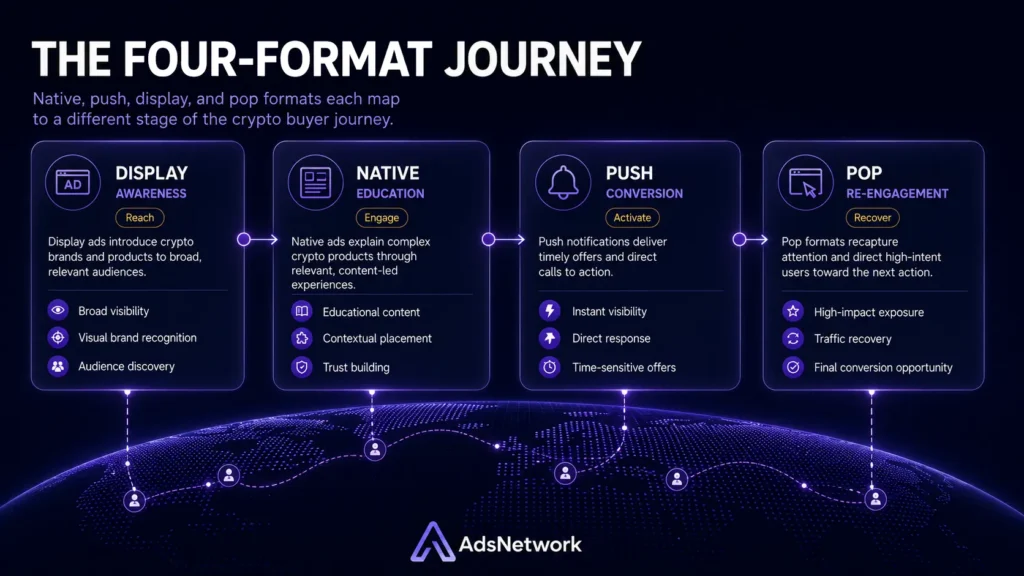
Native, push, display, and pop formats each map to a different stage of the crypto buyer journey.
Targeting Crypto Audiences: How to Reach the Right Wallets
Reaching crypto users has less to do with demographics and more to do with behavior. The strongest crypto advertising strategy reads on-chain and contextual signals that Google and Meta simply cannot match.
Start with context. Placing ads beside crypto news, market analysis, or wallet interfaces puts your message where intent already runs high. Then layer behavior on top: exchange visitors, DeFi users, NFT collectors, and active traders each respond to different hooks. A specialist network can segment by these patterns, and smart audience targeting often separates a campaign that drains budget from one that compounds.
Crucially, on-chain signals add a layer no mainstream platform offers. Wallet activity, token holdings, and protocol usage describe a user far better than an interest checkbox ever could. The practical lesson is simple: match the message to the segment. A DeFi power user and a first-time exchange signup need very different creative.
Retargeting then closes the loop. Crypto buyers rarely convert on first contact, so re-engaging people who viewed your token page or began a sign-up lifts conversion at a low cost. Lookalike modeling extends a list of known depositors to similar users, while sensible frequency caps stop you from burning the same audience. Used together, these tactics turn a single impression into a sequence.
For example, picture a DeFi lending protocol. Contextual placement on yield-tracking sites reaches researchers, on-chain segments surface wallets already active in lending, and retargeting nudges the ones who visited but never connected. That stack outperforms a single broad push every time.
Compliance: What Crypto Advertisers Can and Cannot Do
Compliance is not a footnote in crypto advertising. It is the thing that keeps your account alive. Rules vary by jurisdiction, yet a few principles hold almost everywhere.
First, drop the returns talk. Phrases promising guaranteed profit, risk-free gains, or specific yields trigger rejection across every major platform. Describe what your product does, not what a user might earn. Second, disclose risk clearly. Most jurisdictions expect a visible risk warning, and the EU’s MiCA framework makes a capital-at-risk notice effectively mandatory. Third, respect geography. Several products are restricted or banned in markets such as the United States and China, and serving the wrong page to the wrong country invites real trouble.
When in doubt, go to the source. Regulators such as the UK’s Financial Conduct Authority and the US Securities and Exchange Commission publish guidance worth reading before launch. Local legal advice beats a guess every single time.
Approval is not a one-time event, either. Platforms re-review active ads, and policies shift through the year, so keep your licenses current and audit live creative on a schedule. In practice, a short monthly check beats a suspension that pulls every campaign offline at once.
Setting Up a Crypto Advertising Campaign: Step-by-Step
Theory is cheap. Here is a practical sequence for getting a compliant campaign live.
- Define the goal. Awareness, exchange sign-ups, DeFi TVL, or an NFT mint each call for different formats and metrics, so pick one primary objective.
- Choose the format. Match format to goal: native for education, push for re-engagement, display for reach, pop for volume.
- Set the budget. Start small enough to test and large enough to gather data. Early campaigns usually need iteration before they hit stride.
- Build the targeting. Combine contextual placement with behavioral and on-chain segments. Narrow beats broad in crypto.
- Write compliant creative. Lead with utility and security, drop profit promises, and add a risk line in the ad itself rather than the footer.
- Measure what matters. Track CTR, conversion rate, cost per acquisition, and wallet connects, then feed the learnings back in.
This is where a crypto ad network earns its place. The right partner handles placement, compliance review, and reporting in one workflow, so your team spends its time on strategy instead of approvals. Above all, that is the gap AdsNetwork was built to close for Web3 campaigns.
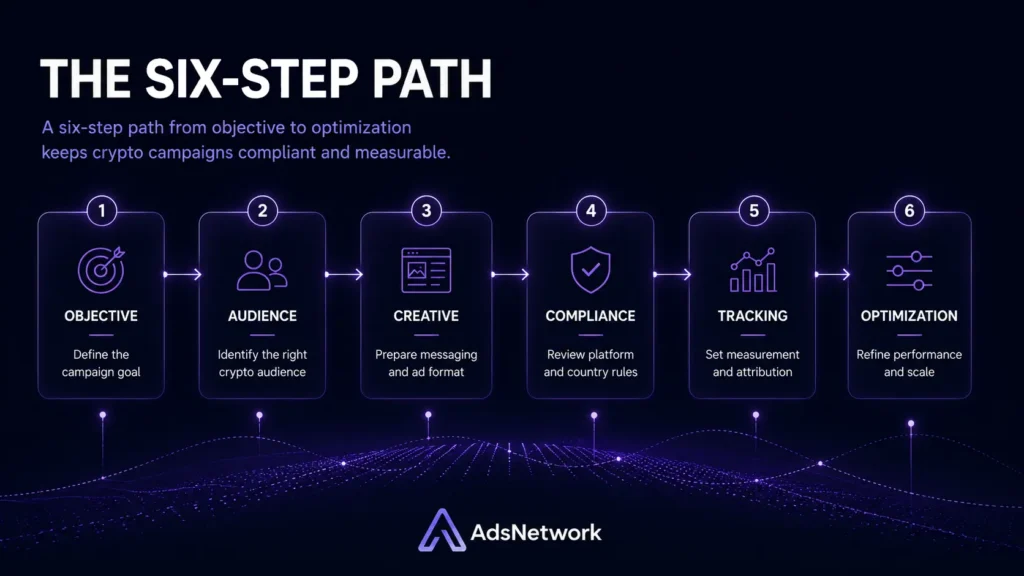
A six-step path from objective to optimization keeps crypto campaigns compliant and measurable.
What does this look like in numbers? Campaigns run through specialist crypto ad networks have posted strong returns. Blockchain-Ads reports that Coinbase acquired 31,896 new traders and $8.1 million in transaction volume at a 124x return on ad spend. In a separate run, Binance picked up 4,600 new traders in 30 days, and OKX brought in 3,095 high-volume traders at a $14.50 cost per acquisition. Naturally, results vary by project and market, yet they show what measurable crypto campaigns can deliver when the channel fits the audience.
How Much Does Crypto Advertising Cost?
Cost depends on format, geography, and campaign quality, so treat any benchmark as a starting point rather than a quote. Broadly, push and pop formats sit at the low end of the CPM range, native and display land in the middle, and premium placements or competitive keywords climb higher. As a rough frame, push and pop CPMs often land in low single digits, while premium native and display on top-tier crypto sites can run several times that.
Paid search is its own story. Crypto keywords on Google run expensive, with reported cost-per-click between $3.80 and $10 according to theKOLLAB, driven by tight competition and high commercial intent. Specialist networks usually deliver measurable outcomes at a lower effective cost than celebrity influencer fees, which can run into five or six figures with little attribution to show for it. The takeaway: judge cost by outcome, not by the sticker on the channel.
Budget for a learning period as well. Crypto campaigns often need a week or two of data before targeting and creative settle, and early disapprovals are common while you fine-tune compliance. Even so, treat that spend as research, not waste. Once a network learns your audience, cost per acquisition usually falls and stays there.
Common Mistakes That Get Crypto Ads Rejected
Most rejections trace back to a short list of avoidable errors. Knowing them in advance saves budget and protects your account health.
- Profit language. Words like guaranteed, risk-free, or specific yield figures fail review on every major platform.
- Funnel mismatch. When the ad promises one thing and the landing page says another, reviewers reject the pair.
- Missing disclosures. A risk warning buried in the footer, or absent entirely, breaches most financial ad rules.
- Wrong geography. Serving a certified market’s page to users in a banned country triggers enforcement fast.
- Weak verification. Incomplete business details or an unverified account stalls approval before a campaign even starts.
Fix these before launch and your approval odds climb sharply. Each rejection also dents account trust, which makes the next ad harder to clear, so prevention pays you back twice.
Frequently Asked Questions
How to advertise crypto in 2026?
To advertise crypto, first confirm which platforms allow your product and where. Mainstream networks like Google, Meta, and X require licensing and certification for most crypto ads. Specialist crypto ad networks offer a faster, compliant route to crypto-native audiences. Define your goal, pick a format, prepare compliant creative, and measure outcomes from day one.
Is crypto advertising allowed on Google?
Crypto advertising is allowed on Google, but only for specific products and only with certification. Exchanges, software wallets, hardware wallets, and coin trusts can run ads once the advertiser holds the right local license and passes Google’s review. Initial coin offerings, DeFi trading protocols, and token presales remain prohibited.
What are the best platforms for crypto advertising?
The right platform depends on your goal. Crypto-specialist ad networks and programmatic channels offer the widest compliant reach to crypto users. Native crypto media builds trust, push and pop formats drive volume, and KOL partnerships add social proof. Most projects combine several rather than betting on one.
How do crypto ad networks work?
Crypto ad networks connect advertisers with publishers across exchanges, wallets, news sites, and dApps. They place native, display, push, and pop creative in front of crypto-native audiences, handle compliance review, and report on performance. Because they specialize in the vertical, they offer targeting and context that mainstream platforms cannot.
Crypto Advertising in 2026: Turn the Restrictions Into an Edge
The restriction landscape feels like a wall when you first hit it. Reframed, it is a moat. Every gate that slows a careless competitor rewards the brand that learns the rules and runs compliant, measurable campaigns. That is the real opportunity in crypto advertising this year.
On balance, the playbook stays straightforward: respect the platform rules, choose channels built for crypto, match format to goal, target on behavior, and judge every dollar by outcome. Do that consistently, and a market of 741 million crypto owners opens up to you. The brands that move now, while the rules still scare off the careless, are the ones that own the next cycle.
Ready to reach crypto-native audiences without the compliance headache? Get Access → at adsnetwork.io.
Featured Posts

Jun 30, 2026
13 min read
Best Crypto Ad Networks in 2026: Top Platforms Compared
Last updated June 2026 Google and Meta still block most crypto ads outright. Exchanges and certified wallets get…
Read Article
Mar 10, 2026
14 min read
iGaming Advertising: The Complete Guide for Operators
The iGaming market crossed $130 billion in 2026, according to Business Research Company market data. With that scale…
Read Article
Mar 6, 2026
14 min read
Crypto Advertising: The Complete Guide for Web3 Brands
Your project has a working product, a growing community, and real on-chain traction. However, scaling that momentum requires…
Read ArticleNeed Help?
Our team is ready to help you launch successful campaigns.
AI-Powered Mobile
Monitor Your Campaigns Anywhere
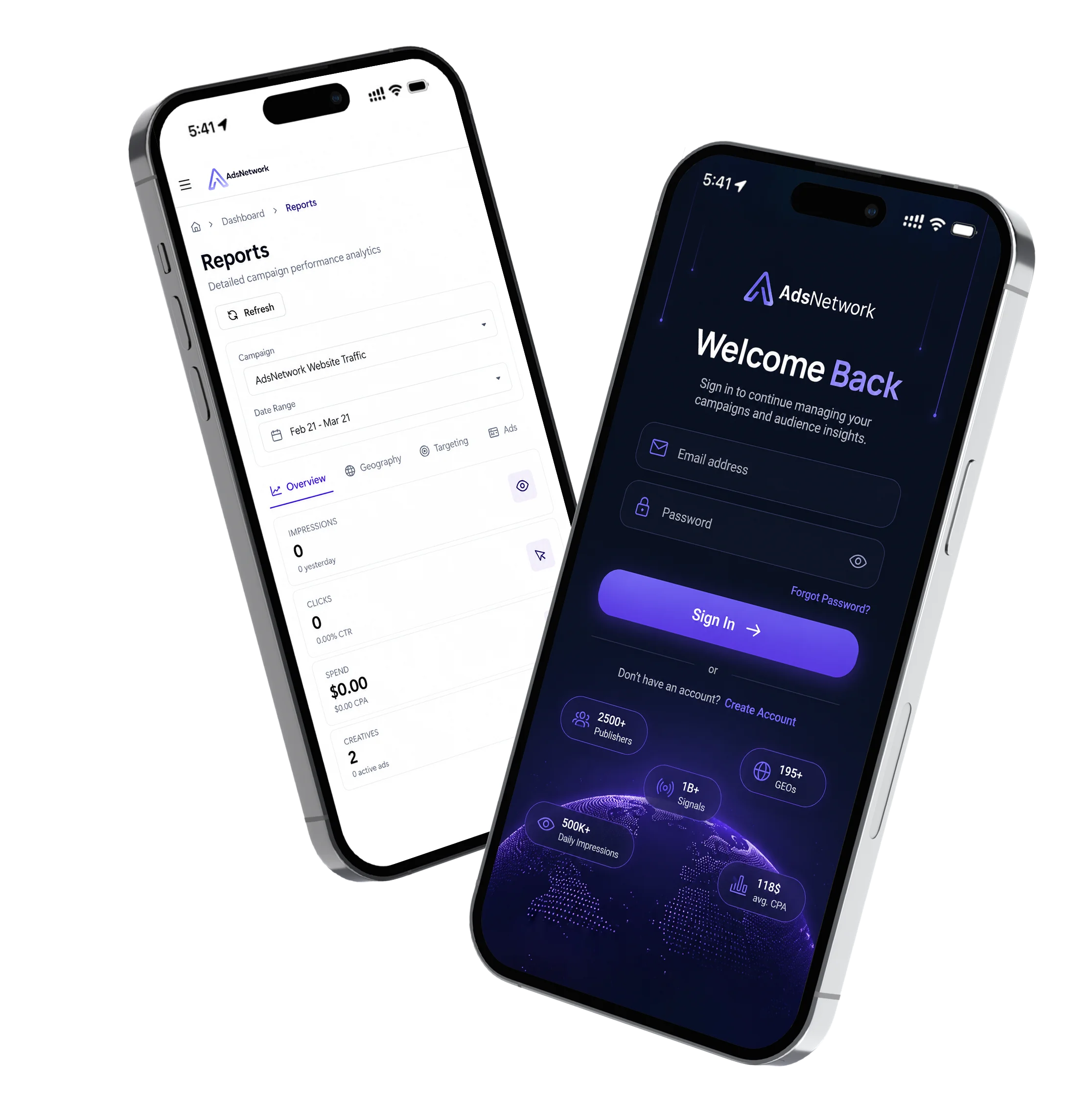
Stay connected to your live AdsNetwork campaigns with our mobile advertising app. Track impressions, clicks, conversions, campaign spend, and overall performance in real time—anytime, anywhere. Available for iOS and Android.