
The blockchain industry is no longer experimental. It has evolved into a mature, competitive ecosystem where blockchain marketing has become the primary growth engine behind successful Web3 brands. Strong technology alone is no longer enough.
New protocols launch every month. Exchanges list hundreds of tokens. Infrastructure projects compete intensely for liquidity, developers, and community attention. However, the projects that win consistently are not the ones with the best code. Instead, they are the ones that approach marketing strategically, combining authority, community building, performance advertising, and measurable analytics.
This guide breaks down the blockchain marketing strategies that drive sustainable growth in 2026, covering the core pillars, the channels that work, and the measurement frameworks that separate disciplined teams from those burning budget without results.

Blockchain marketing has evolved from hype-driven launches into a structured discipline built on authority, community, and measurable performance.
What Makes Blockchain Marketing Different
Traditional marketing focuses on product benefits and brand positioning. Blockchain marketing operates within a different set of constraints. Understanding them before building a strategy prevents wasted spend and credibility damage.
Audiences in the crypto industry are highly skeptical. Many investors and users have experienced market volatility, failed projects, and overpromised roadmaps. As a result, claims without proof are dismissed immediately. Blockchain products are also inherently technical, so education is not optional. Whether you are marketing a Layer 2 solution, a DeFi protocol, or an NFT platform, audiences need to understand the product before they trust it.
Regulatory environments add another layer of complexity. Compliance requirements vary by jurisdiction, and marketing messages must balance clarity, transparency, and legal standing. Consequently, blockchain marketing must prioritize transparency over exaggeration, education over aggressive promotion, and measurable growth over vanity metrics. In short, projects that ignore these realities struggle to build long-term traction.
The Core Pillars of Blockchain Marketing
Effective blockchain marketing is not a collection of random tactics. Instead, it functions as an integrated system built on several foundational pillars, each reinforcing the others.
1. Authority Through Content and SEO
At the center of successful blockchain marketing lies educational authority. Search engines reward depth, structure, and expertise. At the same time, investors and users reward transparency and clarity. High-quality content accomplishes both.
Successful strategies typically include long-form pillar content, technical explainers, tokenomics transparency pages, ecosystem updates, and detailed use-case breakdowns. These assets generate organic traffic long after publication. According to a 2026 digital marketing benchmark report, blockchain-related search queries grew over 40% year-on-year. Projects ranking in the top three positions for high-intent terms convert at four to six times the industry average for paid campaigns. SEO optimizations including keyword clustering, structured headings, and internal linking ensure visibility compounds month after month.
2. Community as Brand Equity
In blockchain, community is not a marketing channel. It is the brand itself. Unlike traditional companies where a brand is defined by advertising, blockchain brands are defined by their holders, builders, and governance participants. The strength of your community directly determines your brand’s resilience through market cycles.
For established blockchain brands, community management means governance participation, protocol update communication, and ecosystem developer engagement, not just Discord moderation. Brands that build genuine two-way relationships with their communities create advocates who promote, defend, and extend the brand without being paid to do so. That compounding advocacy is one of the few genuinely defensible competitive advantages in a space where the technology can be forked.
3. Paid Advertising for Scalable Expansion
While authority grows gradually, paid blockchain marketing accelerates momentum at key milestones. Token launches, exchange listings, funding announcements, and major product releases all benefit from paid amplification. High-performing teams combine display advertising, native placements on crypto publications, retargeting campaigns, and geographically compliant targeting strategies.
Scaling paid acquisition requires disciplined analytics. Monitoring cost per acquisition, lifetime value, and conversion rates ensures growth remains sustainable. In other words, paid traffic amplifies strategies that already work. It cannot compensate for weak positioning or unclear messaging.
4. Strategic Partnerships and Ecosystem Positioning
In blockchain, credibility functions as currency. Therefore, partnerships with reputable protocols, integrations with established infrastructure providers, and collaborations within broader ecosystems significantly strengthen market positioning. These relationships provide two advantages: they expand exposure across new communities and signal validation to investors, developers, and users.
Consequently, blockchain marketing that highlights meaningful collaborations builds both investor confidence and media attention. In decentralized markets, alignment strengthens authority faster than self-promotion.
5. Influencer Campaigns with Performance Controls
Influencers and KOLs play a meaningful role in blockchain marketing. However, short-term hype without measurement often creates volatility rather than sustainable growth. According to theKOLLAB’s 2026 analysis, crypto influencer campaigns return an average of $6.50 for every $1 spent. Micro-KOLs with more targeted audiences consistently outperform macro-influencers on conversion quality and long-term holder retention.
Effective campaigns track referral traffic, wallet registrations, token conversions, and engagement rates. The most successful teams integrate influencer campaigns into a broader marketing framework rather than relying on them as the primary driver. Influencers can amplify momentum, but they cannot replace a well-structured strategy.
6. Public Relations and Media Authority
Public relations remains one of the most powerful components of blockchain marketing. Funding announcements, product launches, ecosystem updates, and strategic partnerships all create opportunities for media coverage in outlets like CoinDesk, The Block, and Decrypt.
PR campaigns contribute to multiple marketing objectives simultaneously. They increase brand visibility, strengthen backlink acquisition, improve domain authority, and enhance investor perception. Blockchain marketing strategies that combine SEO and PR generate long-term credibility that paid campaigns alone cannot replicate.

Blockchain marketing operates across six strategic pillars, from brand authority to ecosystem positioning.
Ecosystem Marketing: The Strategy Unique to Blockchain
Traditional marketing is brand-to-consumer. Blockchain marketing has an additional layer that no other industry has: brand-to-ecosystem. Established blockchain protocols do not just market to users. Instead, they market to developers, validators, liquidity providers, governance participants, and partner protocols simultaneously. Each of these audiences requires different messaging and different channels.
Protocol Composability as a Marketing Asset
In DeFi, composability means other protocols can build directly on top of yours. Every integration is a marketing event. When Curve integrates with Convex, or when Aave adds a new collateral type, both protocols gain distribution and credibility through each other’s communities. Blockchain brands that actively court integrations grow their surface area faster than those relying solely on direct user acquisition.
The marketing implication is concrete. Tracking which protocols have integrated with yours, actively promoting those integrations, and creating co-marketing opportunities with ecosystem partners generates distribution that no paid campaign can replicate. In other words, your protocol’s GitHub is a marketing asset as much as your Twitter account.
Developer Relations as Long-Term Brand Building
For infrastructure protocols, Layer 2 networks, and blockchain development tools, developers are the primary marketing audience. A developer who builds on your chain is a long-term brand ambassador. Consequently, every application they ship is distribution. Developer relations, therefore, is one of the highest-ROI marketing investments an established blockchain brand can make.
Specifically, effective developer marketing includes structured grant programs, hackathon sponsorships, technical documentation quality, and developer education content. Ethereum’s documentation standards, Solana’s developer tooling investments, and Polkadot’s Treasury-funded grants programs all reflect this principle. The developers you attract today define your ecosystem’s value proposition for the next five years.
Grant Programs and Ecosystem Incentives
Grant programs are a distinctly blockchain-native marketing strategy. They distribute capital to builders who strengthen the ecosystem while simultaneously generating organic brand advocacy from recipients. Uniswap’s grants program, Arbitrum’s ecosystem fund, and Optimism’s RetroPGF mechanism have each generated substantial developer activity and media coverage that no traditional advertising budget could have produced.
Structuring grants as marketing requires clear criteria, public reporting, and active community involvement in decisions. Transparency in grant allocation builds more trust than any press release. Furthermore, grantee projects often become vocal advocates who independently produce content, social media presence, and user acquisition that extends your brand’s reach considerably.
On-Chain Data as Marketing Intelligence
Blockchain brands have access to a marketing intelligence layer that no traditional company possesses: their own transaction data. Wallet activity, TVL movements, protocol usage patterns, and holder distribution are all public and analyzable. Consequently, blockchain marketing teams can identify which user segments are most active, which features drive retention, and which competing protocols are attracting their users, all without a survey or focus group.
Advanced teams use this data to inform content strategy, targeting decisions, and product roadmap communication. For example, a protocol that publicly shares its on-chain growth metrics as part of its marketing narrative demonstrates transparency and earns credibility that competitors relying on self-reported statistics cannot match. In other words, your on-chain data is not just internal intelligence. It is a public marketing asset.
The Blockchain Marketing Funnel: From Awareness to Retention
Top-performing blockchain marketing teams think in systems rather than isolated campaigns. The full funnel has four stages, and neglecting any one of them creates leaks that undermine the others. Each stage requires distinct tactics and channels.
Awareness is generated through:
- SEO, paid crypto advertising, PR coverage, and influencer collaborations
Consideration is developed through:
- Technical documentation, community engagement, and transparent development updates
Conversion requires:
- Optimized landing pages, simplified onboarding, and clear explanations of token utility
Retention, which is often overlooked, depends on:
- Email marketing, governance engagement, feature updates, and ecosystem incentives
Without retention infrastructure, acquisition costs increase and growth becomes unstable. Therefore, blockchain marketing must cover the entire lifecycle of user engagement, not just the top of the funnel.
Brand-Level Analytics for Blockchain Marketing
Measuring blockchain brand performance requires a different metric set than project-level campaign tracking. Individual campaign KPIs matter, but brand-level analytics answer a more important question: is the brand building durable authority in its ecosystem, or just buying temporary attention?
Brand-level metrics that matter for established blockchain companies:
- Share of developer mind: growth in GitHub contributors, open-source forks, and documentation page views
- Protocol TVL and usage trends: on-chain activity that reflects genuine ecosystem adoption, not marketing spend
- Ecosystem expansion: number of protocols built on top of your infrastructure, new wallet integrations, partnership announcements
- Organic share of voice: branded search volume, social mentions, and earned media coverage relative to competitors
- Community quality score: governance participation rates, Discord and Telegram retention after 90 days, proposal activity
The most advanced blockchain marketing teams combine on-chain analytics with traditional web metrics. A brand that is growing its on-chain activity while also growing organic search traffic and community participation is building compounding value. A brand growing only through paid acquisition is renting attention rather than owning it. For execution-level campaign metrics, see our guide to how to market a crypto project successfully.
Common Blockchain Marketing Mistakes
Despite the industry’s rapid growth, many Web3 projects repeat the same strategic errors. Recognizing them early, therefore, prevents wasted budget and reputational damage.
- Overpromising technical capabilities without delivering verifiable proof
- Ignoring compliance considerations in marketing messages
- Relying entirely on influencer spikes without supporting infrastructure
- Failing to communicate roadmap progress consistently
- Neglecting SEO infrastructure during early development stages
As a result, visibility becomes temporary and long-term growth remains unstable. Blockchain marketing requires structure, discipline, and credibility above all else.
Budget Allocation for Blockchain Marketing in 2026
A balanced blockchain marketing budget prioritizes content and SEO as the foundation. Afterward, teams invest in paid acquisition, community management, influencer collaborations, and strategic PR distribution. Early-stage projects benefit most from building authority before scaling paid campaigns. Once the organic foundation is strong, scaling becomes significantly more efficient and cost-effective.
The Future of Blockchain Marketing
Blockchain marketing in 2026 is becoming increasingly data-driven and AI-assisted. Emerging capabilities include AI-powered campaign optimization, on-chain analytics integration, privacy-focused targeting models, and multi-chain ecosystem strategies. Brands can now deliver wallet-specific messaging based on a user’s actual on-chain behavior, which makes personalization more precise than anything available in traditional digital marketing.
Despite these technological changes, one principle remains constant. Trust grows faster than hype. Consequently, the brands that combine technological sophistication with genuine transparency will continue to outperform those chasing short-term attention.
Blockchain Marketing Strategies: Final Takeaways
Blockchain marketing has evolved into a structured and systematic discipline. The Web3 brands that dominate the market combine authority-building content, strong SEO infrastructure, active community engagement, strategic paid acquisition, partnership positioning, and disciplined performance analytics. They do not simply chase attention. Instead, they build credibility.
In an industry defined by decentralization, transparency and measurable growth are the true competitive advantages. Ready to reach blockchain audiences with on-chain targeting? Explore AdsNetwork’s blockchain and crypto advertising solutions to build campaigns that reach the right users at the right time.
Featured Posts
Sep 23, 2026
6 min read
What Is Advertising Technology (AdTech) and How Does It Work?
Advertising technology, commonly known as AdTech, refers to the software, platforms, tools, and systems used to plan, buy,…
Read Article
Sep 16, 2026
8 min read
Media Buying: A Complete Guide for Advertisers
Media buying is the process of purchasing advertising space to reach a target audience. It includes choosing where…
Read Article
Sep 7, 2026
8 min read
Programmatic Advertising vs Display Advertising: What’s the Difference?
Programmatic and display advertising are often used interchangeably, but they describe two different parts of digital advertising. Display…
Read ArticleNeed Help?
Our team is ready to help you launch successful campaigns.
AI-Powered Mobile
Monitor Your Campaigns Anywhere
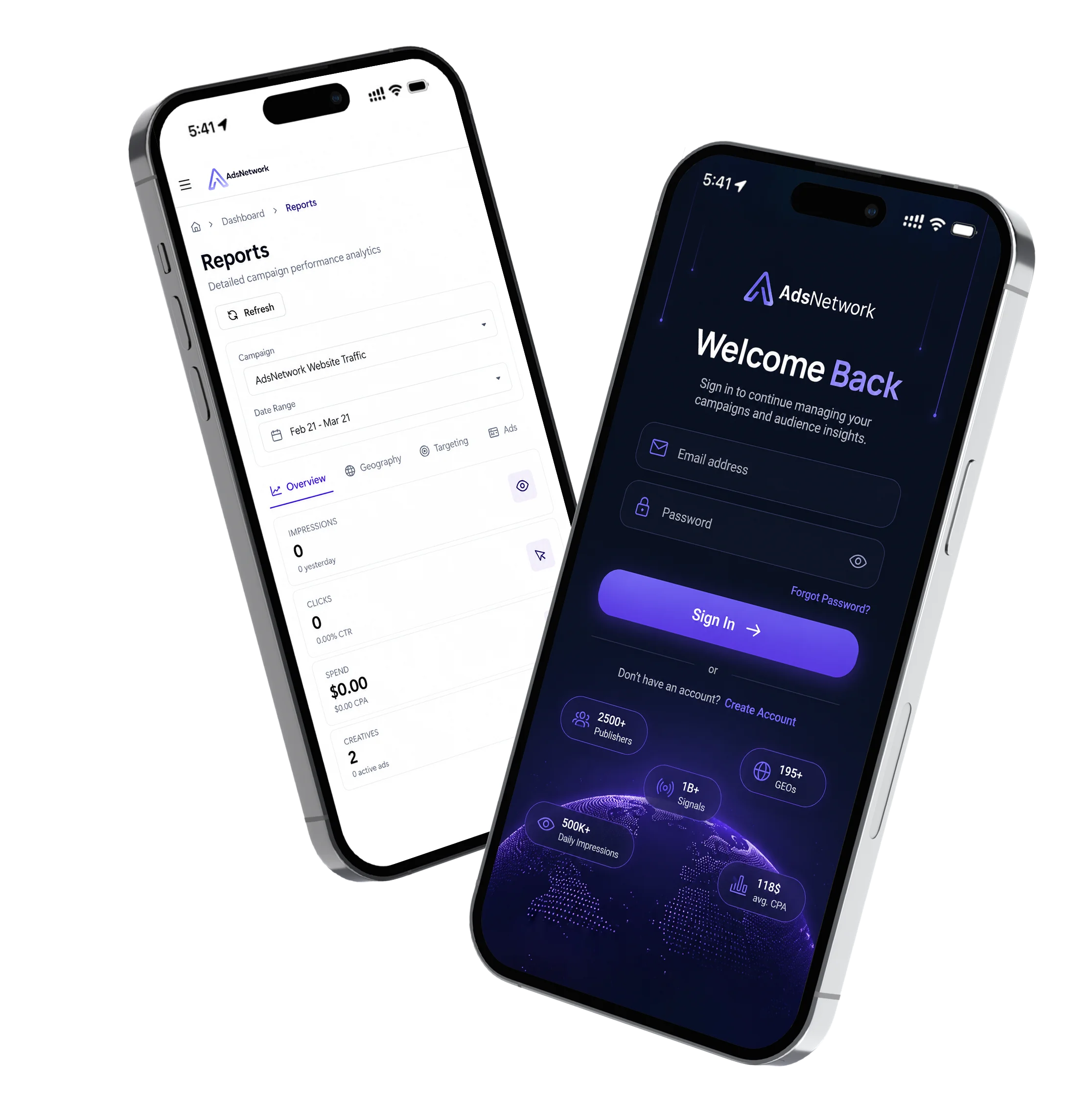
Stay connected to your live AdsNetwork campaigns with our mobile advertising app. Track impressions, clicks, conversions, campaign spend, and overall performance in real time—anytime, anywhere. Available for iOS and Android.