
Native advertising is one of the most misunderstood formats in digital media. The term gets used for all kinds of placements, from sponsored articles and advertorials to recommended-content widgets at the bottom of news pages and branded social posts. Some of these are native ads. Others aren’t.
That confusion can lead to poor decisions. Advertisers may buy the wrong placement, use the wrong metrics to judge its performance, and decide that native advertising simply doesn’t work. In many cases, the problem isn’t the format itself. It’s choosing the wrong type of native ad or measuring it against the wrong goal.
This guide breaks down what native advertising actually means and how to use it effectively. We’ll look at the main types of native ads, how they differ from display advertising, real-world examples, creative best practices, suitable use cases, and the metrics that give you a more accurate picture of performance.
What Is Native Advertising?
Native advertising is a form of paid advertising that matches the look, feel, and function of the content surrounding it. Instead of appearing as a traditional banner or disruptive ad, a native ad is designed to fit naturally into the platform or publisher’s experience while still being clearly labelled as advertising.
That is the core principle, and it is worth stating plainly: native fits in, display advertising stands out. Both are legitimate. They just work through opposite mechanisms. Display buys attention by contrast. Native earns it by belonging.
The format grew for a practical reason: banner performance kept falling as readers learned to ignore rectangular ad shapes, and a large share of users now run ad blockers. Native sidesteps both problems, not by hiding, but by being worth looking at in the first place. That is a meaningful distinction, and it is the reason disclosure and native can coexist.
Types of Native Ad Formats
A simple way to understand native advertising is to look at the different ad formats and placements it can take.
| Format | What it looks like | Where it appears | Best use case |
|---|---|---|---|
| In-feed / in-content | A card or story unit styled like the surrounding items | Content, social, and product feeds; between article paragraphs | Consideration and direct response at scale |
| Content recommendation | A grid or list of suggested reads with image and headline | Beside, between, or below editorial content | Traffic to content, top-of-funnel discovery |
| Branded / native content | Editorial-style content in the publisher’s own format | Publisher article pages and content hubs | Trust building, complex or considered products |
Other Native Advertising Formats
The taxonomy gives you a starting point, but it doesn’t cover every buying option. Several of the ad placements you can actually purchase fall under these three types:
- Promoted listings. Sponsored products in a commerce or marketplace grid, now classified under in-feed.
- In-app native. Feed and content-stream units inside apps, which behave like in-feed on mobile.
- In-ad native elements. Standard IAB ad slots carrying native-styled components, a hybrid the IAB removed as its own type.
- Native video. Out-stream and in-article video, which is an execution within the types above rather than a separate category.
For most performance buyers, in-feed and content recommendation carry the bulk of the volume. Both are widely available programmatically, which is how most native ads get bought today, through auctions rather than direct publisher deals.
Native Ads vs Display Ads
This is the comparison advertisers ask for most, and the answer is not that one beats the other. They solve different problems.
| Factor | Native ads | Display ads |
|---|---|---|
| Visual approach | Blends into the page | Stands out from the page |
| Attention model | Earns it through relevance | Buys it through contrast |
| Typical strength | Engagement and consideration | Reach and awareness |
| Creative input | Content-led: headline and image | Design-led: banner and offer |
| Production speed | Slower, needs written angles | Faster, one design set scales |
| Ad-blindness risk | Lower, reads as content | Higher, banner shape is learned |
| Best for | Trust-dependent and considered offers | Retargeting, promos, brand presence |
Native advertising and display advertising differ mainly in how they appear to users. Native ads are designed to match the format and feel of the surrounding content, while display ads use standalone formats such as banners that are visually separate from the page.
The native advertising mechanic can work well when an offer needs some context or explanation. Display advertising is often a better fit for straightforward messages focused on brand awareness, promotions, product launches, or retargeting.
The two formats can also work together. Native ads can introduce a product and generate interest, while display ads can build awareness or bring previous visitors back. The right choice depends on the campaign objective, audience, and stage of the buying journey.
Native Advertising Examples: What Good Looks Like
Definitions only go so far. Here are three native advertising examples, each broken down by anatomy and by why it works. The design team should render each as an inline visual.
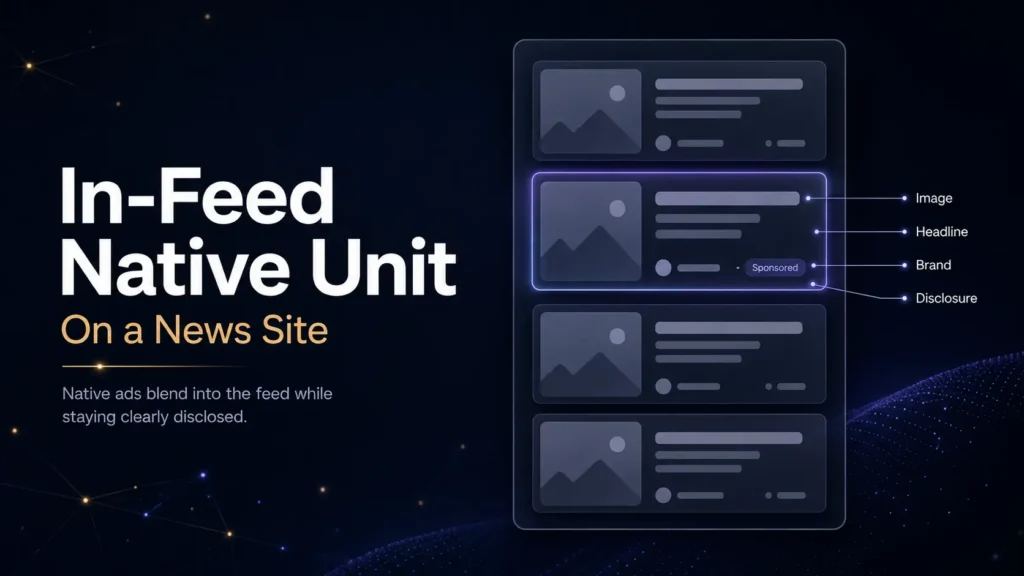
Example 1: In-feed native on a news site
The unit sits in the article feed, styled like the stories around it: a thumbnail image, a headline, the brand name, and a small sponsored label. It works because the headline promises something specific and useful, not a hard sell. The anatomy matters here. The image earns the scroll-stop, the headline earns the click, the brand name builds recognition, and the label keeps it honest.
Example 2: Content recommendation unit
Below an article sits a row of suggested reads, one or more of them paid. It works when the recommendation genuinely matches the interest of someone who just finished that article. The anatomy is the same four parts, but the ad context does more work: the reader is already in discovery mode, so relevance to the article they just read is the whole game. Mismatch it and the unit becomes the thing people scroll past.

Example 3: Native ad for a crypto or iGaming offer
On a crypto news site, a native unit runs alongside market coverage: a clean image, a headline explaining a platform feature, the brand name, and a label. It works because the editorial context does the trust work that a banner cannot. In categories where readers are sceptical, the fact that an ad reads like the surrounding analysis rather than a flashing promise is exactly why it converts. The compliant angle is education, never a return claim.

Across all three, the pattern holds. The unit matches its surroundings, the label stays visible, and the headline offers something worth the click. Remove any one of those and the format stops working.
| Ready to run native advertising where your audience already reads? Get Access → |
How to Write Native Ad Creative That Converts
Native lives or dies on the headline and image. There is no banner design to hide behind, so the writing carries the campaign.
- Combine curiosity with clarity. The reader should know roughly what they will get and still want to find out more. Pure curiosity is clickbait, and it bounces.
- Choose authentic images over polished ones. Slick stock photography reads as an ad. Real, specific imagery reads as content and holds attention longer.
- Match the publisher’s tone. Native inherits its context, so copy that sounds like the site it runs on performs better than copy shouted in brand voice.
- Give one clear next step. A single call to action, and a landing page that delivers exactly what the headline promised.
- Avoid the ad-blindness trap. Rotate creative before performance decays, because a native unit that becomes familiar stops being noticed.
The landing page is part of the creative, even though most guides treat it separately. Native sets an editorial expectation, so a click that lands on a hard sales page breaks the promise the headline made. The pages that convert native traffic tend to continue the story: they open by delivering what the headline offered, then move toward the action. Match the tone, not just the topic, and post-click conversion improves without touching the ad itself.
Common native creative mistakes
A few errors show up again and again in underperforming native campaigns:
- Writing in brand voice instead of the publisher’s voice, so the unit reads as an intrusion.
- Using a logo as the image, which signals advertisement before the headline gets a chance to work.
- Overpromising in the headline, which buys clicks and loses conversions.
- Running one creative for months, until fatigue quietly erodes performance.
- Hiding the disclosure, which risks both reader trust and regulatory trouble for no real gain.
Where Native Advertising Works Best
Native buying works differently from display advertising in one key way: you don’t upload a finished ad creative. Instead, you provide individual elements such as a headline, image, brand name, and sometimes a short description. The publisher or platform then combines these elements within its own ad template. As a result, the same campaign can look different from one website to another.
This also affects how you approach creative. A headline might be fully visible on one site but truncated on another. An image might appear as a square on one feed and as a wide image on another. To account for these differences, write headlines that still make sense when shortened and use images that remain clear when cropped. Otherwise, a campaign can underperform simply because its creative doesn’t adapt well to different placements.
Measuring Native Advertising Performance
Native has a measurement problem, and pretending otherwise helps nobody. Engagement metrics tend to look excellent. The question is whether that engagement turns into anything.
The metrics that matter
- Click-through rate. Useful, but read it in context. Native CTR is not comparable to display CTR, because the units, placements, and reader intent differ.
- Engagement and time on content. How long people stay after the click, and whether they read or bounce.
- Post-click conversion. The metric that decides whether the campaign worked.
- Viewability. Whether the unit was actually in view, which matters for units placed below content.
- Attention metrics. Newer measures of active engagement, useful for comparing placements at the top of the funnel.
The trap is optimising for the most flattering metric. A campaign can generate strong click-through rates and time-on-page but little revenue if the headline attracts curiosity rather than intent. Track post-click conversions by placement, not just campaign, and hold native to the same cost-per-outcome standards as other channels.
Benchmark against your own performance, not industry averages. Native CTR varies widely by placement, vertical, and format, so build your own baseline and compare new placements against it. Source-level reporting helps identify which placements are driving results and which are wasting budget.
Native often sits mid-funnel, so last-click attribution can undervalue it. If a user discovers your brand through native but converts later through search, search gets the credit. Use attribution that accounts for assisted conversions to see native’s full contribution.
Running Native Campaigns with AdsNetwork
AdsNetwork provides native advertising inventory across crypto, Web3, iGaming, and finance publishers, with programmatic buying, targeting, and placement-level reporting in one platform.
Advertisers can choose from formats such as in-feed and content recommendation ads, target audiences by geo, device, context, and other signals, and monitor performance at the placement level.
A typical campaign involves choosing the right format, setting targeting, testing several creative variations, confirming conversion tracking, and optimising based on conversions rather than clicks.
Explore AdsNetwork’s native advertising platform
Conclusion
Native works because it respects the reader. Instead of demanding attention with contrast and motion, it offers something worth reading in a place the reader already trusts, then labels itself honestly. That combination makes it the highest-trust paid format available, and the one best suited to offers that need explaining before they can convert. Get the format right, write for the context, disclose clearly, and measure past the click. Do all four, and native advertising stops being the misunderstood format and starts being the dependable one.
Frequently Asked Questions
1. What is native advertising in simple terms?
Native advertising is paid content designed to match the format and user experience of the platform where it appears. Unlike traditional display ads, native ads are made to fit naturally within surrounding content while still being clearly identified as advertising.
2. What is an example of native advertising?
A sponsored article appearing in a news website’s content feed is one example of native advertising. Other examples include in-feed ads, content recommendation widgets, sponsored content, and promoted product listings.
3. How does native advertising work?
Advertisers provide assets such as headlines, images, descriptions, and brand information. A publisher or advertising platform then places these elements within a native ad format that matches the surrounding content. Users can interact with the ad and visit the advertiser’s website or landing page.
| Put native advertising to work across crypto, iGaming, and finance. Get Access → |
Featured Posts
Oct 23, 2026
10 min read
What Is CPM in Advertising? Meaning, Formula and 2026 Rates
CPM is the cost an advertiser pays for 1,000 ad impressions, making it one of the most common…
Read Article
Sep 23, 2026
6 min read
What Is Advertising Technology (AdTech) and How Does It Work?
Advertising technology, commonly known as AdTech, refers to the software, platforms, tools, and systems used to plan, buy,…
Read Article
Sep 16, 2026
8 min read
Media Buying: A Complete Guide for Advertisers
Media buying is the process of purchasing advertising space to reach a target audience. It includes choosing where…
Read ArticleNeed Help?
Our team is ready to help you launch successful campaigns.
AI-Powered Mobile
Monitor Your Campaigns Anywhere
Stay connected to your live AdsNetwork campaigns with our mobile advertising app. Track impressions, clicks, conversions, campaign spend, and overall performance in real time—anytime, anywhere. Available for iOS and Android.