
Two things are happening at once in digital advertising. Budgets keep shifting to video, and buying keeps shifting to automation. Programmatic video advertising is where those trends meet.
The trouble is the vocabulary. In-stream and out-stream. CTV and OTT. VAST, SIMID, and a standard called VPAID that you should no longer use. Buyers who handle display without blinking often stall here, because video adds a technical layer that display never had.
The numbers explain why it is worth learning. US connected TV ad spend is forecast at roughly $37.95 billion in 2026, and CTV upfront commitments are set to pass primetime linear TV for the first time, per eMarketer. Better still for buyers, most of that inventory is bought through auctions rather than phone calls.
This guide covers the whole picture: what programmatic video is, where the ads run, which formats and specs matter, how buying works, and when to use it. We assume you know programmatic basics, so the depth sits on the video layer.

What Is Programmatic Video Advertising?
Programmatic video advertising is the automated, auction-based buying of video ad inventory across sites, apps, and connected TVs. The mechanics match display buying. Only the creative and the placement change.
Keep two terms apart, because people mix them up constantly. Programmatic video is a buying method. Video ads are a creative format. You can buy video ads directly from a publisher, which is not programmatic. You can also buy them through an auction, which is.
The underlying process will look familiar. A player requests an ad, buyers bid on that impression, and the winning ad plays. If you want the full auction mechanics, our guide to programmatic advertising walks through each step.
One point often gets missed. Programmatic video spans two worlds: online video on phones and desktops, and connected TV in the living room. Those environments share buying pipes but differ in almost everything else, from creative length to measurement. So treat them as related, not identical.
Video Ad Placements: In-Stream vs Out-Stream Video Ads and CTV
Placement is the first real decision in programmatic video advertising. Three families cover nearly all video inventory, and each behaves differently.
Before the detail, one framing that helps. Ask what the viewer was doing when your ad appeared. That single question predicts most of what follows, including cost, completion, and the creative you should run.
In-stream video
In-stream ads play inside video content. The viewer came to watch something, and your ad runs before, during, or after it. Those three slots are pre-roll, mid-roll, and post-roll.
Attention is the strength here. Someone waiting for a video will usually sit through a short ad, so completion rates run high. The trade is cost, because this inventory is in demand.
Out-stream video
Out-stream ads run where there is no video content at all. The unit appears inside an article, in a feed, or between page sections, and it usually starts muted as the reader scrolls past.
Reach is the strength. Out-stream turns any page into video inventory, which massively widens supply and lowers cost. Completion rates fall, though, because nobody arrived to watch a video. In practice it behaves more like display advertising with motion.
Connected TV and OTT
Two acronyms need separating. OTT means over-the-top, which is any content streamed over the internet instead of cable. CTV means connected TV, which is a television connected to the internet, whether smart or through a stick or console.
So every CTV impression is OTT, but not every OTT impression is CTV. A show watched on a phone is OTT alone. The same show on a Roku is both.
Connected TV advertising combines living-room reach with digital targeting. Ads are usually non-skippable, sound is on, and the screen is large. Completion rates are therefore very high. The catch is price and creative, since CTV expects broadcast-quality video.
| Placement | Where it runs | Strength | Watch out for |
|---|---|---|---|
| In-stream | Inside video content | High attention and completion | Higher CPMs, limited supply |
| Out-stream | Articles, feeds, non-video pages | Huge reach, lower cost | Lower completion, muted starts |
| CTV / OTT | Streaming apps on TV screens | Big-screen impact, sound on | Highest CPMs, no clicks |
Note the last row carefully. Nobody clicks a television, so CTV cannot be judged on click-through. Plan for reach, completion, and downstream effect instead.

Programmatic Video Ad Formats and Specs
Now the practical layer of programmatic video advertising. Video ad formats break down by position, by length, and by whether the viewer can skip.
| Format | Length | Skippable | Best for |
|---|---|---|---|
| Pre-roll | 6 to 30 seconds | Often, after 5 seconds | Awareness and direct response |
| Mid-roll | 15 to 60 seconds | Sometimes | Longer content, engaged viewers |
| Post-roll | Any | Usually | Retargeting and reinforcement |
| Bumper | 6 seconds | No | Frequency and quick recall |
| CTV spot | 15 or 30 seconds | No | Brand reach on the big screen |
Pre-roll remains the workhorse of online video, mainly because it guarantees a viewing moment before the content starts. That makes video pre-roll ads the usual starting point for advertisers new to the channel. Bumpers work well alongside it, since six seconds is cheap and hard to avoid.
Mid-roll deserves a note of caution. It interrupts content someone is already watching, so it works best in longer videos where a break feels natural. Drop a mid-roll into a two-minute clip and you mostly generate irritation.
The standards that actually matter
Video needs standards because players, devices, and ad servers must all agree on how an ad arrives. Four acronyms cover it.
- VAST. Video Ad Serving Template. An XML file that tells a player what to play and what to track. This is the core standard.
- SIMID. Secure Interactive Media Interface Definition. Handles interactive video ads safely.
- OMID. Open Measurement Interface Definition. Handles viewability and verification.
- SSAI. Server-side ad insertion. Stitches ads into the stream on the server, which is now standard for premium CTV.
Here is the part many guides still get wrong. VPAID, the old interactive standard, is deprecated. IAB Tech Lab replaced it with SIMID and OMID, and VPAID is invalid in VAST 4.3. It cannot run on CTV or through server-side insertion at all, because those environments have no browser to execute its JavaScript.
So the practical instruction is simple. Ask partners for VAST 4.x tags with SIMID and OMID support. If a vendor still ships VPAID, expect those tags to fail on the fastest-growing inventory you want to buy.
File and duration specs
Keep creative practical. MP4 with H.264 encoding plays almost everywhere. Supply both 16:9 landscape and a vertical cut for mobile feeds. Keep file sizes modest so ads load fast, and always caption for muted playback, since out-stream and feed placements start silent.
Length follows placement. Six seconds for bumpers, fifteen to thirty for pre-roll and CTV. Front-load the message either way, because most viewers who leave do so in the first five seconds.
How Programmatic Video Buying Works
Mechanically, programmatic video advertising mirrors display buying. A video player sends a request, demand-side platforms bid, and the winner serves in milliseconds.
Our guides to real-time bidding and DSP vs SSP cover that machinery in depth. Four differences matter for video specifically.
Targeting gains a device layer
Alongside the usual audience and contextual controls, video adds device and environment targeting. That matters most on CTV, where you can select by device type, app, content genre, and often household. Frequency capping deserves particular care here, because the same household may see one campaign across several apps.
Measurement changes shape
Display leans on clicks. Video leans on completion. The key metrics are the video completion rate, quartile reporting that shows how many viewers reached 25%, 50%, 75%, and 100%, plus viewability and audibility.
Quartiles are more useful than they look. If most viewers drop at the first quartile, the opening is weak. If they stay to 75% and leave, the ending needs work. That is creative feedback no click can give you.
Pricing sits higher
Expect to pay more. Video CPMs run well above display, and CTV runs highest of all, with common benchmarks in the region of $15 to $35 per thousand impressions depending on inventory. The premium buys attention, sound, and completion, so judge it on outcomes rather than on unit cost.
Brand safety carries more weight
A banner next to bad content is awkward. A full-screen video ad in the same place is worse, because it commands the whole screen with sound. So apply content controls, inventory filters, and exclusion lists more strictly than you would for display.
One more habit saves money. Test placements separately rather than blending them in one line item. In-stream, out-stream, and CTV produce such different completion numbers that a blended average tells you almost nothing useful.
Why Use Programmatic Video Advertising?
So why choose programmatic video advertising over cheaper formats? The case rests on four points, and one honest caveat.
- Precision at scale. You get television-style creative with digital targeting, across thousands of apps and sites.
- Living-room reach. CTV puts you on the biggest screen in the house, with the audience that left cable.
- Strong attention signals. Completion and quartile data show whether people actually watched, which display cannot match.
- Full-funnel use. Video builds awareness, explains complex products, and retargets, all with the same asset library.
Now the caveat. Video costs more on both sides of the ledger. Media is pricier than display, and production is a real budget line, since you need actual video rather than a resized banner set. So plan for both before committing. Our guide to how to increase ROAS covers the return side of that equation.
A sensible way in is to start small. Test one placement type with two or three creative lengths, measure completion by placement, then scale what holds attention. Buying every format at once is how video budgets get spent without learning anything.
Running Programmatic Video Campaigns with AdsNetwork
AdsNetwork runs video inventory across crypto, Web3, iGaming, and finance publishers. For advertisers in those verticals, that matters, because mainstream video platforms restrict the categories and often reject the creative outright.
- Vertical video inventory. Pre-roll and in-stream placements on sites your audience already visits.
- Programmatic targeting. Geo, device, contextual, and behavioural controls, including on-chain signals for crypto audiences.
- Current spec support. VAST 4.x tags with modern measurement, so campaigns run cleanly across devices.
- Placement-level reporting. Completion and delivery data by source, not just campaign averages.
For restricted verticals, that last point does more work than it appears to. Video budgets are large, so a campaign average can hide a weak placement for weeks. Reporting by source lets you spot it in days. AdsNetwork exposes that detail rather than rolling it up.
Launching takes five steps:
- Pick the placement. In-stream for attention, out-stream for reach.
- Prepare creative in two lengths. A six-second cut and a fifteen or thirty-second version.
- Set targeting and frequency caps. Match geo to your licensed markets, and cap exposure per user.
- Check tags before scaling. Confirm VAST tags fire and tracking reports correctly.
- Optimise on completion, then conversion. Cut placements that lose viewers early, and scale the ones that hold them.
The wider buying discipline behind all of this sits in our guide to media buying.
| Ready to run programmatic video across crypto, iGaming, and finance inventory?Get Access → |
Frequently Asked Questions
What is programmatic video advertising?
What is programmatic video advertising? It is the automated buying of video ad inventory through real-time auctions, across websites, apps, and connected TVs. The buying mechanics match display, but the creative is video and the measurement centres on completion rather than clicks. It covers both online video and CTV.
How does programmatic video buying work?
How does programmatic video buying work? A video player sends an ad request when a viewer loads content. Demand-side platforms bid on that impression in real time, and the winning ad serves in milliseconds. A VAST tag tells the player what to play and what to track, then reports completion back to the buyer.
What is the difference between in-stream and out-stream video ads?
What is the difference between in-stream and out-stream video ads? In-stream ads play inside video content as pre-roll, mid-roll, or post-roll, so attention and completion run high. Out-stream ads appear in articles and feeds where no video exists, which gives far wider reach at lower cost but weaker completion.
What are the best programmatic video ad formats?
What are the best programmatic video ad formats? Pre-roll suits most advertisers, since it guarantees a viewing moment before content. Bumpers of six seconds add cheap frequency. CTV spots of fifteen or thirty seconds deliver big-screen reach. The best choice depends on your goal, budget, and the creative you can produce.
Programmatic Video Advertising: Where Performance Video Is Heading
Video is the most engaging format available, and programmatic is the most efficient way to buy it. Put them together and you get television-quality creative with the targeting and measurement of digital.
Getting there takes a little more care than display. Choose the placement to match the goal, build creative in more than one length, ship modern VAST tags rather than legacy ones, and judge results on completion before clicks. Do that, and video stops being the expensive experiment on your plan. It becomes the part that people actually watch.
| Put programmatic video to work on inventory built for your vertical.Get Access → |
Featured Posts

Sep 23, 2026
6 min read
What Is Advertising Technology (AdTech) and How Does It Work?
Advertising technology, commonly known as AdTech, refers to the software, platforms, tools, and systems used to plan, buy,…
Read Article
Sep 16, 2026
8 min read
Media Buying: A Complete Guide for Advertisers
Media buying is the process of purchasing advertising space to reach a target audience. It includes choosing where…
Read Article
Sep 7, 2026
8 min read
Programmatic Advertising vs Display Advertising: What’s the Difference?
Programmatic and display advertising are often used interchangeably, but they describe two different parts of digital advertising. Display…
Read ArticleNeed Help?
Our team is ready to help you launch successful campaigns.
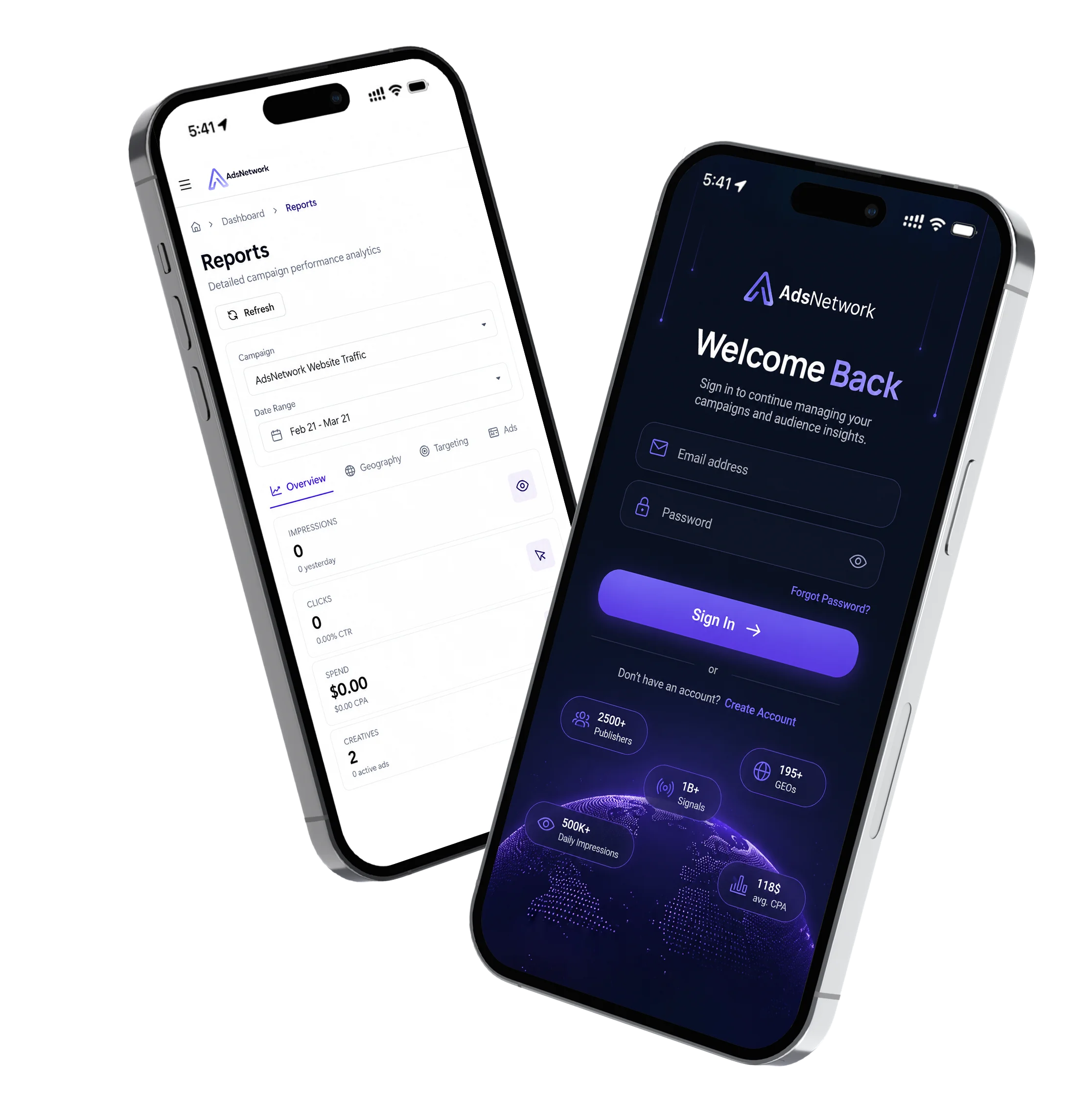
AI-Powered Mobile
Monitor Your Campaigns Anywhere
Stay connected to your live AdsNetwork campaigns with our mobile advertising app. Track impressions, clicks, conversions, campaign spend, and overall performance in real time—anytime, anywhere. Available for iOS and Android.