
Supply is up. Buyers are down. That is the NFT market today, and it explains why NFT marketing has stopped being optional. A collection that once sold out on Twitter alone now competes with more than a billion other tokens. Free reach collapsed, and NFT advertising replaced it.
The data is blunt. NFT sales fell about 37% in 2025 to roughly $5.63 billion, down from $8.9 billion a year earlier, while total supply climbed past 1.34 billion tokens, according to CryptoSlam data reported by Cointelegraph. Average sale value slipped below $100. In other words, far more collections now chase far less money.
None of that means NFTs are finished. It means the cheap distribution is finished. Projects that still clear their mints treat a launch the way consumer brands treat a product release: defined audience, paid reach, measured conversion, deliberate retention.
This guide explains how to promote an NFT project under those conditions. It covers where advertising is permitted, which formats move mints, how to target buyers who hold, and how to structure spend across the full launch cycle.

What NFT Marketing Looks Like in 2026
Between 2021 and 2023, distribution was almost free. A Discord server, a handful of influencer posts, and a countdown were enough to clear a mint. That era ended quietly.
Social algorithms now deprioritise crypto content. Audiences burned by failed roadmaps are slower to trust. Meanwhile, the buyers who remain are fewer and far more deliberate.
The Numbers Behind the Reset
Art NFTs show the correction most clearly. Trading volume fell 93% from its 2021 peak, dropping from $2.9 billion to $23.8 million in the first quarter of 2025, while active traders collapsed 96% from an all-time high of 529,101 to just 19,575.
Activity has returned since then, although not in the shape founders expect. DappRadar’s Q3 2025 report recorded 18.1 million NFTs sold against $1.58 billion in trading volume. Unique wallets trading NFTs rose from 1.66 million in Q1 to 2.14 million in Q3, while the sales count jumped 158% across the same window.
Read those numbers together. Existing participants traded far more. New ones barely arrived. Holdings per active wallet doubled, from roughly 4.2 NFTs to 8.4.
That is a retention market, not a discovery market. Effective NFT marketing now competes for a fixed pool of experienced buyers rather than an expanding pool of newcomers.
Why the Old NFT Marketing Playbook Stopped Working
Hype scaled when attention cost nothing. Today every impression carries a price, so an NFT marketing strategy has to earn that price back. Teams shipping successful drops define an audience, buy access to it, measure what converts, and reinvest.
None of this is unique to Web3. Consumer brands have worked this way for decades. What changed is that NFT projects finally have to do it too, because no organic channel will carry a launch on goodwill alone.
What Replaced Free Reach
Three things, mostly. Paid contextual reach on crypto inventory, where the audience already reads about NFTs. Wallet-level targeting, which no mainstream platform offers. And measurement that ties spend to mints, allowlist signups, and secondary volume rather than impressions.
Projects still growing treat those three as infrastructure rather than experiments. They also accept a harder truth. A sold-out mint funded by flippers is worth less than a slow mint funded by holders.
Where You Can Advertise NFT Projects
Begin with what is actually permitted. The rules are narrower than most founders assume, and NFT marketing budgets go furthest where those rules are clear.
Mainstream Platforms Are Partly Open
Google Ads permits promotion of blockchain-based games involving NFTs. However, it prohibits games where players wager or stake NFTs for real-world value, social casino games that reward NFTs, and destinations that aggregate or compare crypto issuers, under its cryptocurrency ads policy. Exchanges and wallets require certification.
Meta is less restrictive than its reputation suggests. Its advertising standards state that blockchain-based products which are not virtual currencies, such as NFTs, need no prior written permission. Trading, staking, and swapping do. Even so, creative promising floor appreciation still gets rejected.
X sits between the two. Its financial services ads policy permits NFTs and related products with restrictions, subject to country-specific licensing and prior certification. Approval for NFTs does not extend to cryptocurrency products, which need a separate request.
Read all three policies before writing a single line of ad copy. Then read them again before each renewal, because they change.
Crypto-Native Channels Carry the Weight
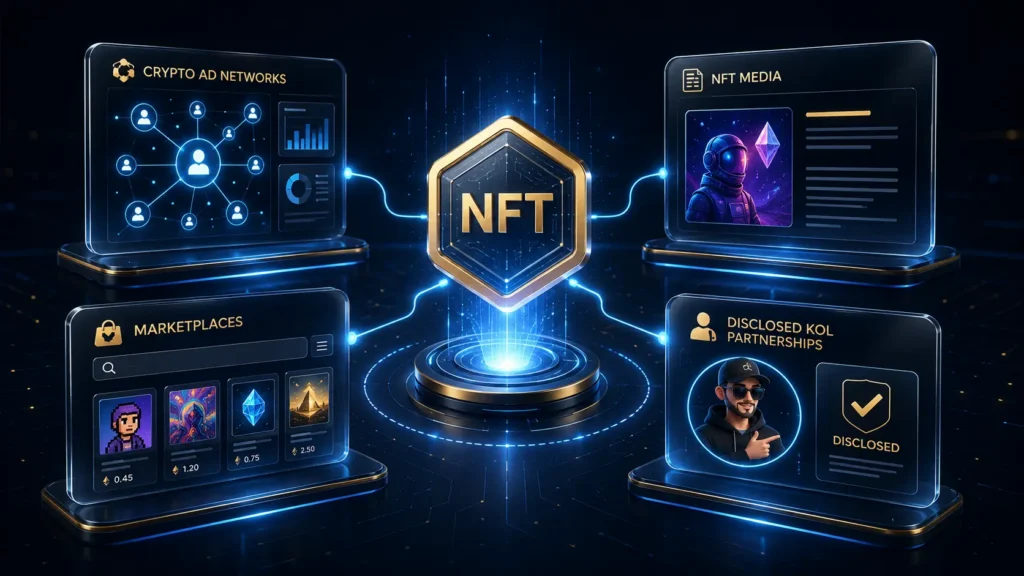
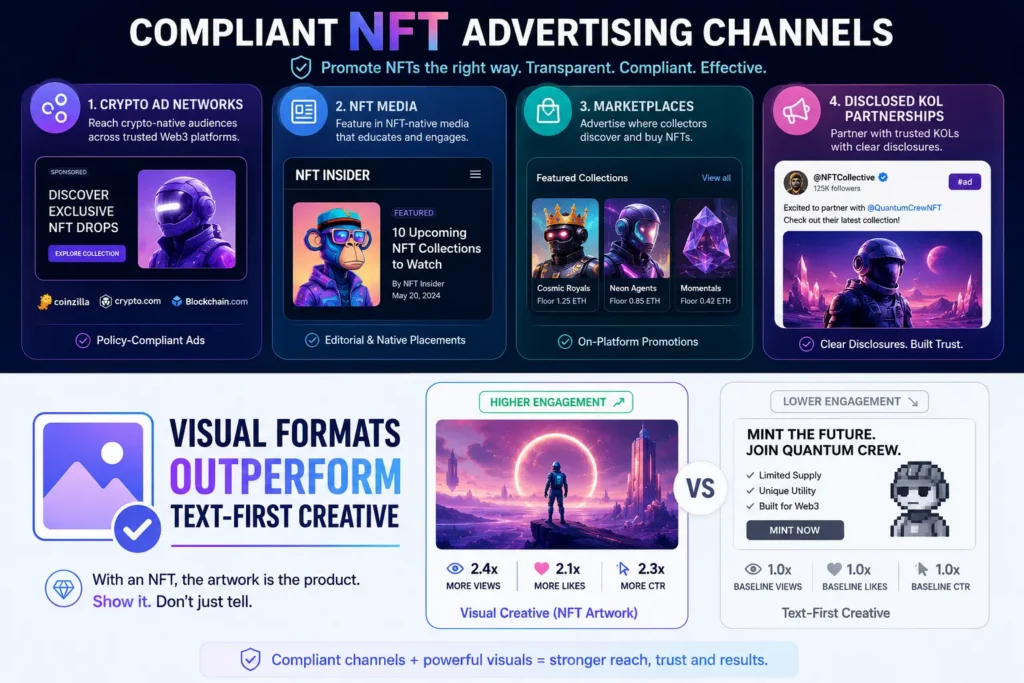
For most collections, a specialist crypto ad network handles the bulk of paid reach. These platforms sell inventory across NFT marketplaces, analytics dashboards, crypto media, and Web3 apps. Contextual placement is the core play: reach people while they are already reading about NFTs.
That context does real work. A banner beside a marketplace listing reaches somebody who has already connected a wallet. The same banner on a general news site reaches somebody who has not.
Beyond networks, three channels stay reliable:
- Native placements inside crypto and NFT publications
- Display inventory on marketplaces and portfolio trackers
- Push formats for mint-day countdowns and allowlist reminders
AdsNetwork sits in that first category, serving contextual crypto inventory across a publisher network rather than waiting on mainstream platform approval.
KOLs and Community Partnerships
Influencer campaigns still convert in Web3, provided teams handle them as paid media rather than favours. Brief the creator, agree the claim set in writing, and require disclosure on every post.
Disclosure is not optional. FTC guidance for social media influencers requires any material connection between brand and endorser to be obvious, and it holds both parties responsible. A hashtag buried under twelve others does not qualify.
Crypto audiences punish undisclosed shilling harder than regulators do. Transparency costs less than the reputational repair afterwards.
What Gets NFT Ads Rejected
The fastest way to stall an NFT marketing campaign is investment framing. Most rejections trace to a short list of patterns:
- Investment framing, including floor targets, expected returns, or price charts
- Urgency built on scarcity of profit rather than scarcity of supply
- Landing pages that promise something the ad copy did not
- Missing disclosure on paid endorsements
Frame the NFT as a product, a collectible, or a key to utility. That framing survives review on every platform. It also reads as more honest to an audience that has seen the alternative.
Ad Formats That Drive NFT Mints and Sales
An NFT is a visual product. Consequently, formats that show the art outperform formats that describe it. Format choice should follow the launch phase, never personal preference. This is where NFT marketing turns creative decisions into conversions.
Display Banners
Display puts the collection itself in front of the buyer. PFP art, generative work, and gaming assets all benefit from a format that shows rather than tells.
Use standard IAB sizes so a single creative set covers desktop and mobile placements. Run tight variants, then rotate on performance. Marketplaces, portfolio trackers, and analytics dashboards carry the highest-context inventory available.
Native Ads
Native ads sit inside editorial content on crypto media. They borrow the publication’s credibility, which matters enormously to a skeptical audience.
Use them for the story a banner cannot carry: who the artist is, what the utility does, why the roadmap is credible. Native works hardest during the pre-mint window, while a reader is still deciding whether the project deserves attention.
Push Formats
Push is the mint-day workhorse. Countdown alerts, allowlist reminders, and drop notifications reach users who are primed but distracted.
In-page push carries an operational advantage worth knowing. It needs no subscription opt-in, and it reaches iOS users that browser push often cannot. Frequency capping matters here more than anywhere else.
Programmatic Video
Video carries narrative. Thirty seconds of animation explains a utility layer better than any static banner.
Reserve it for collections with a genuine story: a game, an identity layer, an IP universe. For a straightforward art drop, video usually costs more than it returns.
Creative Rules for Every Format
Testing follows the same discipline across all four. Build three to five variants per format, then let performance data decide which survives. Kill the rest early, before they drain the budget.
Two rules hold everywhere. First, lead with the artwork, never the ticker. Second, describe the product, never the return. Compliance and conversion happen to want the same thing here.
Targeting the Right NFT Audience
Every mint attracts two crowds. One buys to hold. The other buys to flip within the hour. Targeting decides the ratio between them, which makes it the point where NFT marketing budgets are won or lost.
Signals That Predict Holders
Three signal types are worth buying against:
- Wallet behaviour, meaning past minters and holders of adjacent collections
- Contextual placement across marketplaces, NFT media, and analytics dashboards
- Geography and language matched to where the community already lives
Wallet data separates NFT campaigns from most other verticals. A wallet that minted three collections last quarter tells you more than any stated interest ever will. Holders of adjacent collections are the highest-value pool, because they already understand custody, gas, and secondary listings.
Geography matters more than founders expect. Community language and time zone shape mint-day attendance. A countdown that lands at three in the morning converts nobody.
Retargeting the Allowlist
Retarget allowlist visitors who never finished the form. That group carries the highest intent in the funnel and the lowest cost per acquisition.
Good NFT advertising treats that pool as a warm audience, not a lost one. Segment them further wherever the data allows. Somebody who read the roadmap page deserves different creative from somebody who bounced off the homepage. Cap frequency at a level that reminds rather than harasses.
Then build a second retargeting pool from minters themselves. They are the audience for the next drop, the token, or the merchandise line.
Holders or Flippers, and How to Tell
Avoid broad crypto interest targeting. It fills the mint with mercenary capital, and secondary volume punishes that within a week.
One metric exposes the difference. Track what share of minters still hold at day thirty. If that number collapses, the targeting bought flippers rather than a community, and no amount of roadmap posting will repair it.
Feed the number back into the campaign. Placements producing day-thirty holders get more budget. The rest get cut.
NFT Advertising Strategy: Pre-Mint, Mint, and Post-Mint
A complete NFT marketing plan runs as three campaigns with three separate goals, three sets of formats, and three definitions of success.
Pre-Mint
Start four to six weeks out. The objective is allowlist signups, not awareness for its own sake.
Native and display carry the message: the artist, the concept, the utility. Contextual placements on NFT media reach people already in a collecting mindset.
Measure cost per signup, then measure signup quality. An allowlist stuffed with airdrop farmers converts worse than a smaller one built from collectors.
Mint Day
The window runs roughly 48 hours. The objective is conversion.
Push and retargeting handle urgency, supply, and mechanics. Creative should answer three questions quickly: what is the supply, when does minting open, and what does a holder actually get.
Measure cost per mint and sell-through rate. Watch network conditions too, since congestion quietly raises the real price of entry.
Post-Mint
This phase is ongoing, and most teams skip it. The objective is secondary volume and retention, which is where NFT advertising stops being a launch cost and becomes a growth channel.
Display and video communicate roadmap delivery and holder benefits. Measure holder count over time, plus the listing ratio, meaning what share of supply sits on sale at any moment.
Most budgets go entirely to the middle phase. As a result, plenty of collections sell out and then go silent. Yet the post-mint phase is where a collection stops being a drop and becomes a brand.
Two Projects That Got the Post-Mint Phase Right
Pudgy Penguins offers the clearest example. Instead of defending a floor price, the team pushed its IP into physical retail. Pudgy Toys generated more than $13 million in retail sales and over one million units sold across Walmart, Target, and Walgreens.
The mechanism matters more than the number. Each toy carried a code into the digital experience, which turned retail shelves into an acquisition channel. The NFT stopped being the product. It became the licence.
Doodles ran a smaller version of the same idea. Its Kellogg’s Froot Loops collaboration sold 500 collectible boxes at $50 each, each paired with a digital collectible, and cleared out within hours.
Neither campaign promised a return. Both placed the artwork where a non-crypto audience would encounter it. Distribution did the work, not hype.
How to Launch an NFT Advertising Campaign with AdsNetwork
Whatever platform you choose, the sequence stays the same.
- Pick one phase and one goal. Allowlist signups, mints, or secondary volume. Never all three at once.
- Buy contextual inventory. NFT and crypto placements, not general display.
- Match format to phase. Display and native for awareness, push for urgency, video for narrative.
- Write product-framed creative. Describe the collectible, the utility, the art. Skip floors, returns, and guarantees. This keeps campaigns compliant, and it converts better with burned audiences.
- Instrument conversions before launch. Allowlist submissions, mint transactions, wallet connections. If you cannot measure it, do not buy it.
- Launch small, then scale what holds. Cut placements that deliver flippers.
How to Choose a Distribution Partner
Platforms differ more than their homepages suggest. Four questions separate them.
- Does the inventory sit in genuine NFT and crypto context, or is it general display repackaged?
- Can targeting reach wallet behaviour, not merely interest categories?
- Does reporting expose placement-level performance, so weak placements can be cut?
- Does the compliance team understand NFT creative, or will every ad sit in review?
Any partner serious about NFT marketing answers those four without hesitation. AdsNetwork meets the criteria, and so do several other crypto ad networks worth comparing before budget moves. Ask each one for placement-level reporting from a comparable campaign. A network that will not show where the impressions went is telling you something.
Setting the Budget Across Phases
NFT marketing budgets rarely fail on size. They fail on sequencing. No universal split exists, though a useful starting point weights the pre-mint phase heavily. Build the allowlist first, because mint-day spend converts an audience that already exists rather than creating one from nothing.
Hold back a meaningful reserve for post-mint. That reserve turns a sold-out drop into a collection people still discuss a quarter later. Treat it as the cost of retention, never as leftover budget.
Ready to put your collection in front of real NFT buyers?
Reach wallet-verified NFT audiences across contextual crypto inventory.
Conclusion: NFT Marketing Is Product Marketing Now
The projects that survive market cycles are rarely the loudest. Rather, they are the ones that understood early that attention has a price and holders have a lifetime value. NFT marketing has become the work of finding the right thousand people instead of shouting at the wrong hundred thousand.
Trust compounds slowly in this market. Every ad that promises returns spends credibility a project will need later. Every ad that shows the work earns some back.
With 1.34 billion tokens in circulation and demand contracting, advertising is how a collection builds a real holder base. The mint lasts a day. The community is the asset. NFT marketing is simply the discipline connecting the two.
FAQ
How do you advertise an NFT project?
Knowing how to advertise an NFT project starts with channel selection. Crypto ad networks carry contextual inventory across NFT media, marketplaces, and Web3 apps. Google, Meta, and X permit limited NFT categories under restrictions. Match the format to the launch phase, frame the collection as a product, then track mints and allowlist signups rather than clicks.
How do you market an NFT collection?
Build the audience before the mint, convert it during, and retain it afterwards. Pre-mint campaigns grow the allowlist. Mint-day campaigns create urgency. Post-mint work protects secondary volume and holder count. Strong NFT marketing spreads budget across all three phases instead of concentrating everything on drop day.
Where can you advertise NFTs?
You can advertise NFTs on crypto ad networks, NFT and crypto publications, marketplace and analytics sites, and Web3 applications. Those channels carry most NFT marketing spend today. Push and display inventory covers mint-day reach. Google allows blockchain-based NFT games under conditions. Meta permits NFT products that are not virtual currencies.
Is NFT advertising allowed on Google?
NFT advertising is allowed on Google in specific cases. Its cryptocurrency policy permits promotion of blockchain-based games involving NFTs. Meanwhile, it prohibits games where NFTs are wagered or staked for real-world value, social casino games rewarding NFTs, and destinations aggregating crypto issuers. Certification applies to exchanges and wallets.
Build holders, not flippers.
Launch your next NFT campaign on contextual crypto inventory with AdsNetwork.
Featured Posts
Oct 23, 2026
10 min read
What Is CPM in Advertising? Meaning, Formula and 2026 Rates
CPM is the cost an advertiser pays for 1,000 ad impressions, making it one of the most common…
Read Article
Sep 23, 2026
6 min read
What Is Advertising Technology (AdTech) and How Does It Work?
Advertising technology, commonly known as AdTech, refers to the software, platforms, tools, and systems used to plan, buy,…
Read Article
Sep 16, 2026
8 min read
Media Buying: A Complete Guide for Advertisers
Media buying is the process of purchasing advertising space to reach a target audience. It includes choosing where…
Read ArticleNeed Help?
Our team is ready to help you launch successful campaigns.
AI-Powered Mobile
Monitor Your Campaigns Anywhere
Stay connected to your live AdsNetwork campaigns with our mobile advertising app. Track impressions, clicks, conversions, campaign spend, and overall performance in real time—anytime, anywhere. Available for iOS and Android.