
Last reviewed: August 2026
This article provides an overview of key considerations in iGaming advertising compliance.
In most industries, an advertising mistake costs you budget. In iGaming, it can cost you a licence.
That is the difference that makes iGaming advertising compliance a board-level concern rather than a marketing detail. A creative that overpromises, a campaign that leaks into an unlicensed market, or an affiliate running claims you never approved can all trigger regulatory action against the operator, not just the agency or the network. Fines, licence reviews, and platform bans follow.
This guide is a practical operator’s reference. It covers the principles that hold almost everywhere, the shape of the major-market landscape, the channel-by-channel rules, what you cannot say in a creative, and a pre-launch checklist you can actually work through. Before any of that, one thing needs stating clearly.
| IMPORTANT: GENERAL GUIDANCE, NOT LEGAL ADVICE This article is general guidance for advertising and marketing teams. It is not legal advice, and it does not create any advisory relationship. Nothing here should be relied on as a statement of the law in any jurisdiction.Gambling regulation changes frequently, and it varies by country, by state or province, by product, and by channel. Every jurisdiction-specific point below is described as of the date of last review, with the responsible regulator named so you can check the current position at source.Before you launch anything, confirm requirements with qualified local counsel and the relevant regulator in each market you intend to target. Where this guide and a regulator disagree, the regulator is right. |
Why iGaming Advertising Compliance Is So Complex
Operators are rarely confused about whether rules exist. What makes iGaming advertising compliance genuinely hard is that four different variables move at once, and a change in any one of them can invalidate a campaign that was compliant last quarter.
- Jurisdiction. Gambling advertising regulations are set nationally, and sometimes sub-nationally. What is routine in one market is a breach next door.
- Product. Casino, sports betting, poker, bingo, and lottery are often treated differently within the same country, with different permissions and different restrictions.
- Channel. Broadcast, outdoor, digital display, paid social, affiliate, and influencer marketing each carry their own rules, and platform policy adds another layer on top of the law.
- Time. The rules move. Several major markets have tightened materially in recent years, and more changes are in progress as of writing.
Licensing determines where you can advertise at all
This is the foundation, and it comes before every other question. In regulated markets, the right to advertise generally follows the licence. If you are not licensed to offer your product in a market, you should not be advertising there, and in many jurisdictions promoting an unlicensed operator is itself an offence that can capture publishers, affiliates, and networks alongside the operator.
That single principle resolves a surprising number of iGaming advertising compliance questions. Before asking whether a specific creative is acceptable, ask whether you are permitted to be in that market at all.
What a breach actually costs
Consequences escalate across three levels. Advertising regulators can require ads to be amended or withdrawn and can publish rulings that name the operator, which carries reputational weight in a licensing context. Gambling regulators can impose financial penalties and open licence reviews. Platforms can suspend or permanently ban advertiser accounts, which removes a channel overnight regardless of what the law says.
The third of those is often underestimated. A platform ban is a commercial decision, not a legal one, so it can arrive faster than any regulatory process and with less room for appeal. This is why iGaming advertising compliance has to be owned jointly by marketing and compliance rather than handed to one of them.

The Universal Principles of Compliant iGaming Advertising
Jurisdictions differ in the detail, but a set of iGaming advertising rules recurs almost everywhere. These principles are the most durable part of iGaming advertising compliance, and they are the safest foundation to build on, because a campaign designed around them will usually need adjustment rather than reinvention when it crosses a border.
- Advertise only into licensed markets. Hold the relevant permission for every geography you target, and target only those geographies.
- Never target minors or vulnerable people. This covers audience targeting, placement, and creative content, including imagery and characters likely to appeal strongly to under-18s.
- Do not mislead. No guaranteed wins, no misrepresented odds, and no offer whose significant conditions are hidden or hard to find.
- Include responsible gambling messaging. Responsible gambling advertising practice means age statements, help resources, and self-exclusion signposting presented clearly rather than buried.
- Age-gate and geo-gate. Apply technical controls at the campaign level, not just on the landing page, and be able to demonstrate that they worked.
- Keep records. Retain creative versions, approvals, targeting settings, and placement reports. If you cannot evidence compliance, you may be treated as non-compliant.
The record-keeping point is the one operators most often treat as optional, and it is the one that matters most when a regulator or platform asks questions months later. Evidence is a core part of iGaming advertising compliance, not an administrative afterthought. Build the audit trail while the campaign runs, because reconstructing it later is difficult and unconvincing.
The Major-Market Landscape: Verify Current
What follows is a high-level orientation, not a rulebook. Each entry names the responsible regulator so you can check the current position at source. Treat every row as a prompt to verify, not a conclusion to rely on.
| VERIFY CURRENT BEFORE ACTING Every item in this table is a simplified summary as of August 2026. Rules in several of these markets are actively under review. Confirm the present position with the named regulator and local counsel before you plan or launch a campaign. |
| Market | Regulator(s) | Headline position (as of writing) |
|---|---|---|
| United Kingdom | Gambling Commission; ASA and CAP/BCAP | Licensed advertising permitted under detailed content codes. Strong protections against appeal to under-18s. A voluntary industry restriction limits betting ads around live televised sport. |
| Malta | Malta Gaming Authority | Established licensing hub with its own advertising and player-protection requirements. An MGA licence does not by itself grant permission to advertise into other member states. |
| Germany | Gemeinsame Gluecksspielbehoerde der Laender (GGL) | Advertising permitted for licensed operators but subject to notable timing and content restrictions. |
| Netherlands | Kansspelautoriteit (Ksa) | Among the strictest regimes. Untargeted advertising banned since July 2023, sports sponsorship banned from July 2025, with strict audience-targeting evidence requirements. Further tightening proposed. |
| United States | State gaming commissions; tribal authorities | Regulated state by state. Permissions, creative rules, and affiliate treatment differ between states. There is no single national position. |
| Brazil | Secretaria de Premios e Apostas (SPA), Ministry of Finance | Regulated market with prescriptive advertising rules, including mandatory warning messaging on betting ads. |
| Grey and unregulated markets | No applicable licensing regime | High risk. Advertising into markets where you are not licensed can expose the operator, its partners, and its licences elsewhere. |
A closer look at three moving markets
The United Kingdom operates a layered system: the Gambling Commission licenses operators, while the Advertising Standards Authority enforces the CAP and BCAP content codes. Rulings turn on whether an ad could appeal strongly to under-18s or encourage irresponsible play, and the ASA has upheld complaints even where operators used platform tools to target adults, on the basis that targeting controls do not by themselves make unsuitable imagery acceptable. Verify current requirements with both bodies.
The Netherlands illustrates how fast a regime can tighten. The Kansspelautoriteit oversees a market that banned untargeted gambling advertising in 2023 and extended restrictions to sports sponsorship in 2025, alongside demanding evidence that campaigns actually reach permitted age groups. Further restrictions have been proposed. Any operator planning Dutch activity should treat published guidance as the starting point and confirm the current position directly.
Brazil is the clearest example of a market where the rulebook is being written in real time. Advertising is regulated by the Secretariat of Prizes and Betting within the Ministry of Finance, and recent ordinances have introduced prescriptive requirements including mandatory warning messaging on betting advertisements. Because the framework is still developing, check the Ministry of Finance’s betting secretariat for the current rules rather than relying on secondary summaries, including this one.
The pattern across all three is worth internalising. Markets do not simply permit or prohibit gambling advertising. They permit it conditionally, and the conditions change. Practical iGaming advertising compliance therefore depends less on memorising rules than on maintaining a process that re-checks them.
Channel-Specific Advertising Rules
Legal permission is necessary but not sufficient. Each channel adds its own layer of iGaming advertising compliance, and platform policy can be stricter than the law in the same market.
Paid search and social
The major platforms operate their own gambling policies, generally requiring advertisers to obtain certification or written permission before running, and to demonstrate that they are licensed in each market targeted. Approval is typically granted country by country, and platforms have been tightening certification standards, in some cases weighing an advertiser’s compliance history alongside its licensing status. Platform approval never substitutes for the legal permissions required under national law.
Programmatic and display
Here the controls are technical. Geo-gating must be configured to your licensed markets and verified, not assumed. Inventory suitability matters too, since serving gambling creative against content aimed at children creates exposure regardless of where the click came from. Mainstream inventory often restricts the category entirely, which is one reason operators use specialist iGaming advertising inventory built for the vertical.
Affiliates: the biggest risk area
This deserves the most attention, because it is where operators most often get caught. In many regimes the operator is held responsible for how its affiliates promote it. An affiliate’s misleading bonus claim, non-compliant creative, or promotion into an unlicensed market can become the operator’s regulatory problem.
Manage it contractually and operationally. Put compliance obligations in affiliate terms, specify approved creative and claims, require disclosure, monitor actively rather than relying on self-certification, and retain the right to terminate for breach. Assume you will be asked to evidence that monitoring.
Push, native, and content formats
Format does not change the content rules. A push notification, a native unit, and a display banner promoting the same offer are all subject to the same restrictions on claims, targeting, and required messaging. Native carries a particular consideration, since content that reads editorially must still be identifiable as advertising, and the same applies to online casino advertising delivered through content-led placements.
Influencers and KOLs
Influencer activity attracts two overlapping requirements: advertising disclosure rules, and gambling-specific restrictions on who may promote gambling and how. Rules in several markets limit the use of people likely to appeal to younger audiences. Treat influencer content as advertising you are responsible for, brief it accordingly, and review it before publication rather than after.

What You Cannot Say in an iGaming Ad
Creative-level rules are the most consistent part of iGaming advertising compliance across markets. The specifics vary, but the following claims cause problems almost everywhere.
- Guaranteed wins or implied certainty. Any suggestion that winning is assured or that a strategy removes risk.
- Risk-free framing. Heavily restricted, particularly where a bonus carries wagering conditions that make the offer not risk-free at all.
- Misrepresented odds or returns. Presenting odds, payouts, or win rates in a way that overstates the realistic outcome.
- Gambling as a solution to money problems. Any framing that positions gambling as income, a way out of debt, or an alternative to employment.
- Pressure and urgency tactics. Countdowns and act-now framing that push impulsive play, and anything implying that not gambling means missing out.
- Content appealing to minors. Cartoon styling, animated characters, or cultural references with strong under-18 appeal, regardless of audience targeting settings.
- Hidden significant conditions. Wagering requirements, time limits, and eligibility rules that are omitted or buried below the fold.
What usually has to be present
Most regimes also require positive elements rather than only prohibitions. Expect to include an age restriction statement, responsible gambling messaging with a route to help, and licensing information identifying the operator and its regulator. Several markets specify how prominent that messaging must be, and at least one has moved to prescribe the wording and the proportion of the ad it must occupy. Check the format requirements per market, since a compliant message presented too small can still fail.
A practical habit helps here: build creative templates with the required elements locked in as fixed components, so a designer cannot accidentally ship a version without them.
A Pre-Launch iGaming Advertising Compliance Checklist
Work through this before a campaign goes live. It will not substitute for legal review, but it catches the iGaming advertising compliance failures that occur most often.
- Licence confirmed for every target market. You hold the relevant permission for each geography, for the specific product being advertised.
- Geo-gating configured and tested. Targeting is restricted to licensed markets, and you have verified delivery rather than trusting the setting.
- Age controls applied. Audience settings, placement selection, and inventory exclusions all restrict exposure to under-age audiences.
- Responsible gambling messaging present and prominent. Age statement, help resources, and self-exclusion signposting appear in the required form for each market.
- Creative reviewed against prohibited claims. No guaranteed wins, risk-free framing, misrepresented odds, urgency pressure, or under-18 appeal.
- Significant conditions disclosed clearly. Wagering requirements and material terms are visible with the offer, not only on a separate page.
- Channel policy and certification confirmed. Platform approvals are in place for each market, and network or publisher policies have been checked.
- Affiliate compliance terms in place. Contracts specify obligations and approved claims, and an active monitoring process exists.
- Legal sign-off obtained. Local counsel has reviewed the campaign for each market where the position is uncertain.
- Audit trail established. Creative versions, approvals, targeting configurations, and placement reports are retained and retrievable.
How AdsNetwork Supports Compliant iGaming Advertising
A network cannot carry your compliance obligations, and any partner claiming otherwise should worry you. Legal responsibility sits with the operator and its licences. What a specialist partner can do is make operational compliance easier to execute and easier to evidence, and that is the role AdsNetwork plays in an operator’s iGaming advertising compliance process.
- Geo-targeting to licensed markets. Campaign-level geographic controls so delivery matches your permissions.
- iGaming-experienced placement. Inventory and teams familiar with the vertical’s constraints rather than learning them on your budget.
- Inventory suitability. Publisher contexts appropriate for gambling advertising, with exclusions available.
- Format support. Creative specifications that accommodate required age and responsible gambling messaging.
- Placement-level reporting. Records showing where campaigns ran, which supports the audit trail regulators expect.
For operators building an acquisition programme around these constraints, our guide to iGaming performance marketing covers the strategy side, and the iGaming ad network overview sets out available inventory and targeting.
To get started: confirm your licensed markets, share your approved creative and required messaging, set geo and audience targeting to match your permissions, and keep the reporting you will need if anyone asks. The division of labour should stay clear throughout. Compliance decisions remain yours, and AdsNetwork executes against them with the targeting controls and reporting to match.
| Ready to run iGaming campaigns on compliance-aware inventory?Get Access → |
Frequently Asked Questions
What are the rules for iGaming advertising?
What are the rules for iGaming advertising? They vary by market, but common principles apply: advertise only where you are licensed, never target minors or vulnerable people, avoid misleading or guaranteed-win claims, include responsible gambling messaging, and apply age and geo controls. Confirm the specific requirements with each market’s regulator and local counsel.
Is gambling advertising legal?
Is gambling advertising legal? In many regulated markets, yes, for licensed operators and subject to conditions. Some jurisdictions restrict it heavily or prohibit most forms, and others ban it outright. Legality depends on the market, the product, and the channel, so verify the current position with the relevant regulator before advertising anywhere.
Where can you legally advertise iGaming?
Where can you legally advertise iGaming? Generally only in markets where you hold the appropriate licence and where advertising is permitted for your product. Regulated markets each set their own conditions, and requirements differ within countries such as the United States. Advertising into markets where you are unlicensed carries serious regulatory risk.
What can you not say in a gambling ad?
What can you not say in a gambling ad? Avoid guaranteed wins, risk-free framing, misrepresented odds, and any suggestion that gambling solves financial problems. Avoid urgency or pressure tactics and content appealing to under-18s. Significant conditions such as wagering requirements must be disclosed clearly rather than hidden.
iGaming Advertising Compliance Is the Moat, Not the Barrier
It is easy to treat compliance as the thing standing between you and growth. The operators who scale sustainably see it the other way around. Rules that are difficult to meet are also difficult for competitors to meet, and markets that demand licensing and disciplined creative are markets where unlicensed rivals cannot follow you. Build the checks into the campaign process rather than bolting them on at the end, keep the evidence, verify every jurisdiction at source, and iGaming advertising compliance stops being a brake and starts being an advantage.
One closing reminder, because it matters more here than anywhere else on this site: this guide is general information as of August 2026, not legal advice. Confirm everything with your regulator and your counsel before you spend.
| Build your iGaming acquisition on inventory designed for regulated markets.Get Access → |
Featured Posts

Sep 23, 2026
6 min read
What Is Advertising Technology (AdTech) and How Does It Work?
Advertising technology, commonly known as AdTech, refers to the software, platforms, tools, and systems used to plan, buy,…
Read Article
Sep 16, 2026
8 min read
Media Buying: A Complete Guide for Advertisers
Media buying is the process of purchasing advertising space to reach a target audience. It includes choosing where…
Read Article
Sep 7, 2026
8 min read
Programmatic Advertising vs Display Advertising: What’s the Difference?
Programmatic and display advertising are often used interchangeably, but they describe two different parts of digital advertising. Display…
Read ArticleNeed Help?
Our team is ready to help you launch successful campaigns.
AI-Powered Mobile
Monitor Your Campaigns Anywhere
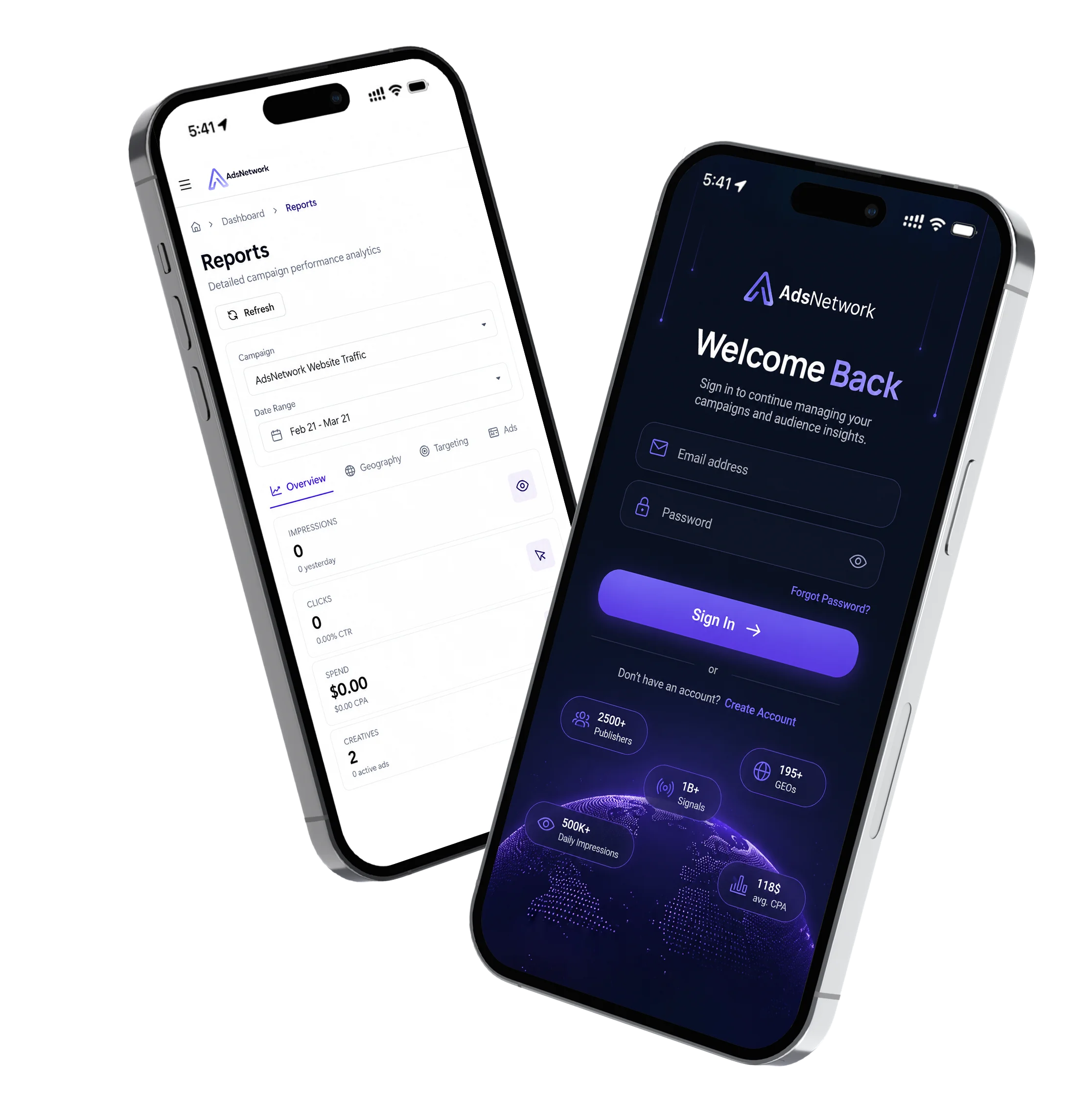
Stay connected to your live AdsNetwork campaigns with our mobile advertising app. Track impressions, clicks, conversions, campaign spend, and overall performance in real time—anytime, anywhere. Available for iOS and Android.