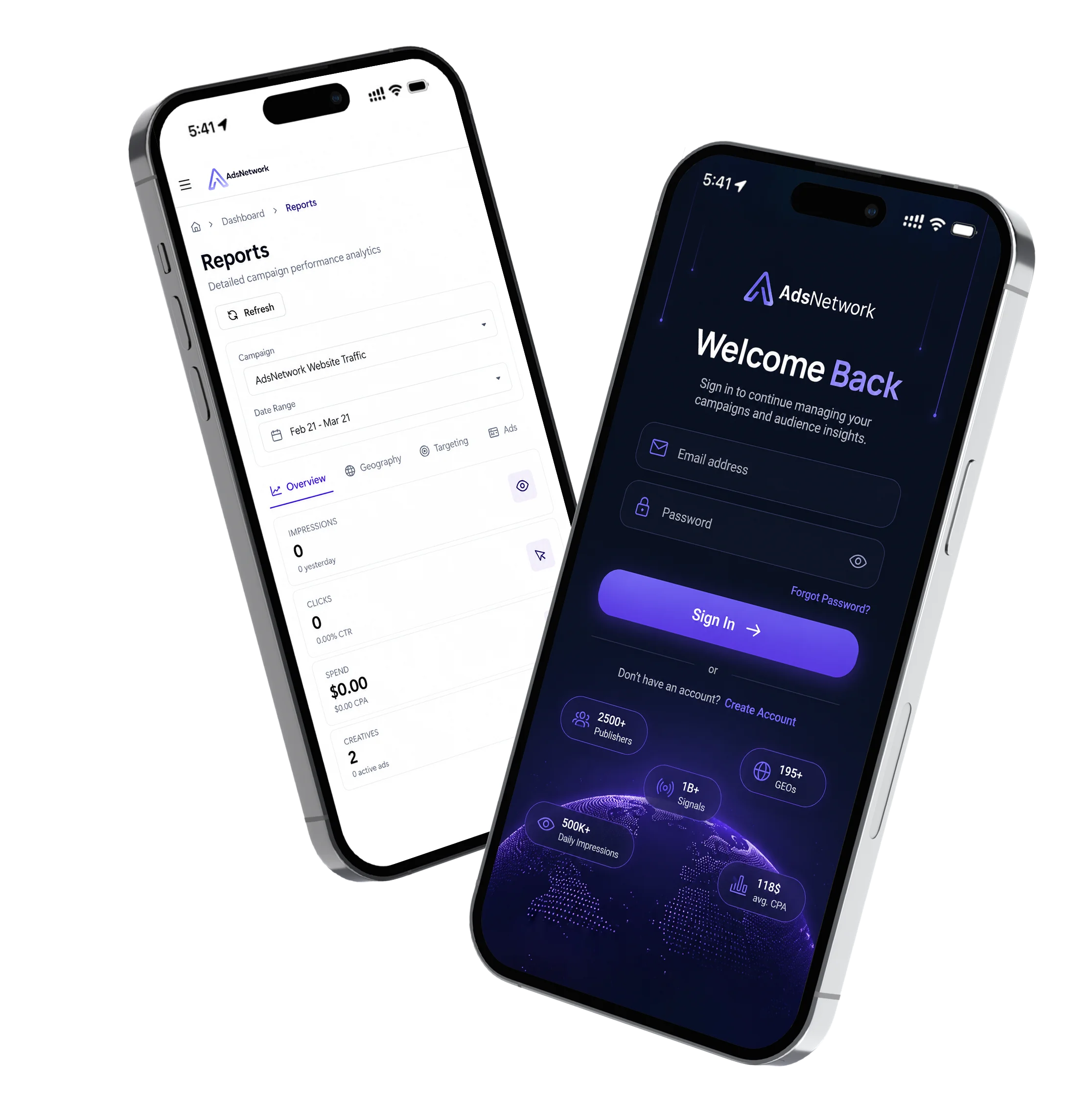


Most crypto banner ads are bad. They are cluttered, hype-heavy, and easy to ignore. Crowd a banner with three logos, a countdown timer, and a promise of 10x returns, and a skeptical crypto audience scrolls straight past it.
Crypto media is a crowded, noisy place, and its readers have seen every trick. That makes crypto display advertising harder than it looks. Generic banner advice does not survive contact with a Web3 audience.
This guide is practical and example-led. You will see what a high-performing crypto banner looks like, the sizes and specs that matter, the compliance lines you cannot cross, and worked examples of good versus bad. Clarity beats gloss here, every time.

Why Crypto Banner Ads Are Different
Banner advice written for e-commerce or SaaS falls flat in crypto. The audience is different, the media is different, and the rules are different. Three forces shape what works.
- A skeptical audience. Crypto users have watched projects fail and scams spread. They distrust anything that looks like a pump. A flashy banner reads as a red flag, not a reason to click.
- Crowded, cluttered media. Crypto news sites, price trackers, and dashboards pack a lot onto every screen. Your banner competes with charts, tickers, and a dozen other ads. Clarity is how you stand out.
- Policy restrictions on mainstream display. Google and Meta still gate crypto ads behind certification and category limits. Many projects cannot run there at all, which pushes crypto creative onto crypto-native inventory.
That last point is worth sitting with. Google Ads policy requires certification for exchanges and wallets, bans categories like token presales and most DeFi outright, and applies to every ad format. So blockchain banner ads often live or die on crypto-native networks rather than the open web.
There is a design culture point too. Crypto audiences reward restraint. The projects that look trustworthy tend to advertise like fintech, not like a casino. If banners are not the right fit for a message, native ads that read as editorial content are the usual alternative. But for direct response and awareness, a disciplined banner still does the job.
Get this wrong and the cost is not just a low click-through rate. A hype-heavy banner damages the thing crypto projects need most, which is credibility. Once an audience files you under scam, no amount of spend buys that trust back. So the stakes on crypto creative run higher than a normal display campaign, where a weak banner is simply ignored and forgotten.
Crypto Banner Ad Best Practices
Good crypto banner ads follow a short, strict set of rules. None of them are complicated. The discipline is in leaving things out.
- One message per banner. Pick a single idea: a listing, a sign-up bonus, a launch. Say it once and clearly. A banner that tries to say three things says nothing.
- Credible claims only. No price predictions. No guaranteed returns. State a real benefit, like low fees or fast settlement, and let it stand on its own.
- High contrast, legible type. Your banner may render at 320 by 50 pixels. If the headline is not readable at a glance on a phone, it fails. Big type, strong contrast, few words.
- One clear call to action. A single button with a plain verb. Trade, join, mint, claim. Do not make the user guess what happens next.
- A recognizable brand mark. Show the logo once, small and clean. Recognition builds trust in a market where trust is scarce.
- Motion, used sparingly. HTML5 animation can lift attention, but a frantic loop reads as spam. One calm transition beats a strobe.
Trust signals that credible crypto banner ads use
In a skeptical market, proof does more than persuasion. Where it is true and compliant, a banner can carry a light trust signal: a recognizable backer, a completed audit, or a real user or volume number. Keep it factual and specific. Vague hype like best in class means nothing, while audited by a named firm or backed by a known fund earns a second look. Never fake these signals. In crypto, the community checks.
Design mobile-first. Most crypto reading happens on a phone, so build the small formats first and scale up, not the other way around. A banner that only works at full desktop width is a banner most of your audience never really sees.
One more discipline ties these together: write for a skeptic, not a fan. Assume the reader has been burned before and is looking for a reason to distrust you. Then remove every element that gives them one. That single habit, designing against doubt rather than for hype, is what separates crypto banner ads that convert from the ones that get scrolled past.
Crypto Banner Sizes and Specs That Matter
A handful of sizes carry most crypto display inventory. They come from the IAB standard ad unit portfolio, which crypto publishers and networks follow like everyone else. Build these six and you can run almost anywhere.
| Size (px) | Name | Where it works in crypto |
|---|---|---|
| 300×250 | Medium Rectangle | The workhorse. Sits in sidebars and inline on mobile. Highest impression share. |
| 728×90 | Leaderboard | Top-of-page desktop slot on crypto news and price sites. |
| 320×50 | Mobile Banner | Anchors mobile inventory, where much crypto reading happens. |
| 300×600 | Half Page | High-impact desktop unit with room for a real message. |
| 160×600 | Wide Skyscraper | Vertical rail on articles and dashboards. |
| 970×250 | Billboard | Premium above-the-fold placement for launches. |
Specs matter as much as size. Keep files light, typically under 150 KB on initial load, and keep any animation under 15 seconds, since most networks reject heavier or longer creative. Static PNG or JPG works everywhere and loads fast. HTML5 adds motion and interactivity, but test it renders cleanly before you scale. When you brief a designer, ask for every display banner ads size as a set, in both static and HTML5, so one campaign covers the whole page.
A quick spec checklist to hand over: the six sizes above, static and HTML5 versions, files under 150 KB, animation under 15 seconds, one CTA per size, and legible type at mobile scale. Get that package right and you avoid the rejections and reruns that quietly eat a launch timeline.
On static versus HTML5, pick by goal, not by habit. Static banners are fast, universally accepted, and simple to test, which makes them the safe default for a first campaign. Whatever you choose, keep the last frame readable on its own, because many placements freeze animation after a few seconds.
Crypto Banner Ad Examples: What Works and What Doesn’t
Rules are easier to trust with examples. Here are three common crypto banner ads, each shown as a good version and a cluttered one. The design team should render each as a side-by-side inline visual.
Example 1: Exchange sign-up banner
The cluttered version stuffs in a logo, a mascot, three coin icons, a countdown, and the words risk-free. It is loud and says nothing a skeptic believes.
The clean version leads with one benefit, trade with low fees, shows the logo once, and offers a single Join button on a calm dark background. It looks like a real financial product, which is exactly the point.

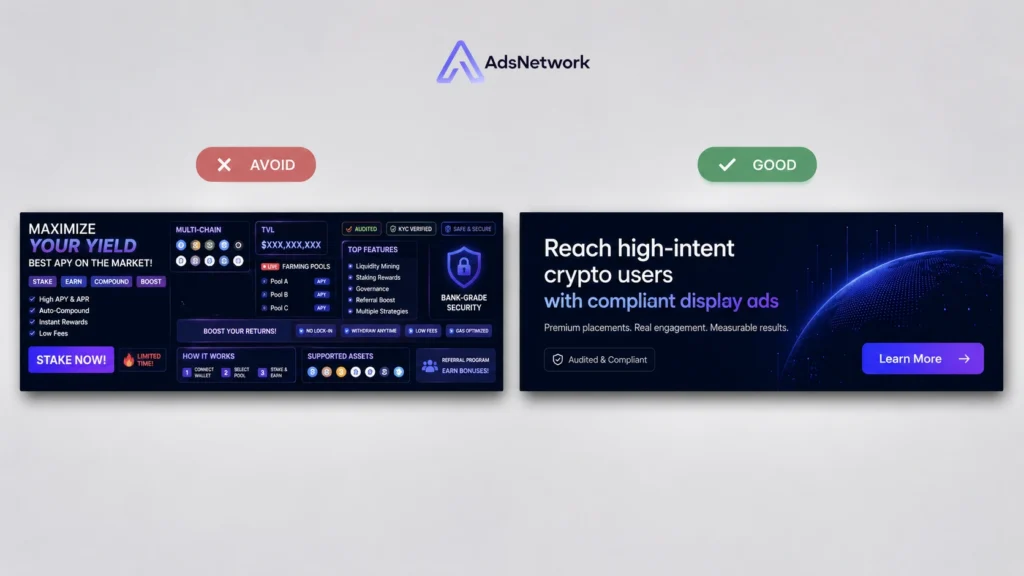
Example 2: DeFi protocol awareness banner
The weak version shows a wall of numbers, an APY figure, and jargon only insiders parse. It promises yield and triggers every compliance alarm at once.
The strong version explains what the protocol does in plain words, earn on your assets on-chain, names a real trust signal like a completed audit, and keeps one link to learn more. It informs instead of hyping.
Example 3: NFT drop banner
The busy version crams in ten preview thumbnails, a glowing countdown, and the word moon. It reads as a cash grab, and collectors know the type.
A clean version features one striking piece of art, the collection name, the mint date, and a single Mint button. Here the art does the selling, and the message stays honest.
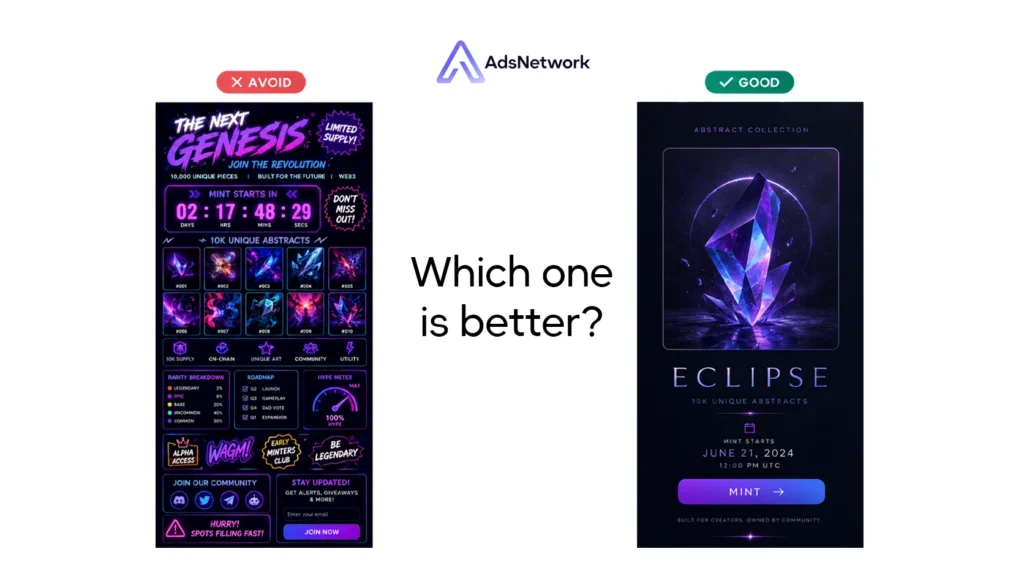
Across all three, the pattern is the same. A bad version adds; a good version subtracts. Every element you remove makes the one that remains work harder. When you review a crypto banner, count the messages. If there is more than one, you have found your problem.
Where to Run Crypto Banner Ads
Great creative on the wrong inventory still fails. Placement decides who sees the banner and whether it is even allowed to run. For crypto, three homes matter most.
- Crypto media. News sites, price trackers, and analytics dashboards put your banner in front of readers who already care about the space. Context does half the targeting for you.
- Crypto ad networks. Networks with crypto-native display inventory reach vetted blockchain publishers and often add on-chain or wallet-based targeting that generic display cannot match.
- Contextual targeting on crypto content. Serving banners against relevant articles and tokens keeps the message aligned with intent, which lifts both relevance and compliance.
Crypto-native inventory beats generic display for one simple reason: relevance and compliance come built in. A crypto advertising network already works with publishers that welcome the category, so you skip the certification friction of the open web. The performance gap is real. HypeLab benchmarks put crypto display banner CTR at roughly 0.08% to 0.25%, with the crypto ad market crossing $1.2 billion in 2025. Precise, wallet-aware targeting is what moves you toward the top of that range.
Generic display networks create two problems at once. First, your banner lands next to unrelated content, so relevance drops and so does CTR. Second, many of those placements will not run crypto creative at all, which limits scale before you start. A crypto-native network like AdsNetwork solves both. It also tends to offer targeting that generic inventory cannot, such as reaching users by the tokens they hold or the protocols they use. That is the difference between paying for impressions and paying for the right impressions.
Running Crypto Banner Campaigns with AdsNetwork
AdsNetwork is built for exactly this problem: reaching crypto audiences that mainstream platforms restrict. It runs display banners across a network of vetted crypto and Web3 publishers, with the specs and targeting a serious campaign needs.
- Crypto-native inventory. Placements on crypto news, dashboards, and Web3 sites, not generic open-web traffic.
- On-chain and behavioral targeting. Reach users by wallet activity and behavior, so budget lands on people who actually transact.
- HTML5 and static support. Run every IAB size in both formats from one dashboard, with unified tracking.
- Compliance-aware placement. Inventory that welcomes the crypto category, without the certification queue of mainstream display.
Launching is straightforward: prepare your banner set in the six core sizes, pick your targeting, set a CPC or CPM bid, and go live. Watch CTR and post-click conversion together, cut weak placements, and scale the winners. A real result shows the upside. One DeFi campaign drove 4,600 new users on a $25,000 budget for a 19.8x return, per HypeLab, proof that disciplined crypto display can pay for itself.
Two habits separate campaigns that scale from campaigns that stall. The first is testing more than one creative from day one, so the network has something to optimize toward. The second is judging banners on conversions, not clicks. A high CTR with weak sign-ups usually means the banner promised something the landing page did not deliver. Keep the promise consistent from banner to page, and the whole funnel holds together.
| Ready to run crypto banner ads that convert and stay compliant? Get Access → |
Crypto Banner Ads FAQ
What makes a good crypto banner ad?
What makes a good crypto banner ad is discipline. One clear message, a credible claim with no price promises, high contrast, legible type at mobile size, a recognizable logo, and a single call to action. In a skeptical market, clarity and honesty convert better than flash or hype.
What banner sizes work for crypto ads?
What banner sizes work for crypto ads are the six IAB standards: 300×250, 728×90, 320×50, 300×600, 160×600, and 970×250. The 300×250 medium rectangle and 320×50 mobile banner carry the most crypto inventory, since most readers arrive on a phone. Build the full set for coverage.
Where to run crypto banner ads?
Where to run crypto banner ads comes down to crypto-native inventory. Crypto news sites, price trackers, analytics dashboards, and crypto ad networks reach engaged audiences and welcome the category. Mainstream platforms restrict or ban most crypto ads, so crypto-focused networks are usually the practical and compliant choice.
Are crypto banner ads effective?
Are crypto banner ads effective? Yes, when creative and targeting are right. Display CTRs are low by nature, but wallet-aware targeting on crypto inventory lifts performance well above generic display. One audited DeFi case study returned nearly 20x on ad spend, showing that disciplined crypto display can drive real, measurable growth.
Crypto Banner Ads: Why Discipline Wins
In a skeptical, crowded market, the clear banner beats the flashy one. Say one thing, say it credibly, size it for mobile, and run it where crypto audiences already are. Creative discipline is the whole game. Get it right, and crypto banner ads become one of the most cost-effective ways to reach real Web3 users.
| Put disciplined crypto banner ads to work on your next campaign. Get Access → |
Featured Posts
Oct 23, 2026
10 min read
What Is CPM in Advertising? Meaning, Formula and 2026 Rates
CPM is the cost an advertiser pays for 1,000 ad impressions, making it one of the most common…
Read Article
Sep 23, 2026
6 min read
What Is Advertising Technology (AdTech) and How Does It Work?
Advertising technology, commonly known as AdTech, refers to the software, platforms, tools, and systems used to plan, buy,…
Read Article
Sep 16, 2026
8 min read
Media Buying: A Complete Guide for Advertisers
Media buying is the process of purchasing advertising space to reach a target audience. It includes choosing where…
Read ArticleNeed Help?
Our team is ready to help you launch successful campaigns.
AI-Powered Mobile
Monitor Your Campaigns Anywhere
Stay connected to your live AdsNetwork campaigns with our mobile advertising app. Track impressions, clicks, conversions, campaign spend, and overall performance in real time—anytime, anywhere. Available for iOS and Android.