

Advertising networks sit at the center of a $835 billion global digital ad market. However, most advertisers and publishers interact with them daily without fully understanding how advertising networks make money or how they generate revenue. That gap matters. When you understand how an ad network makes money, you understand why it behaves the way it does. That understanding leads to better decisions about where to spend and where to publish.
This guide breaks down every major revenue model that advertising networks use. It covers the mechanics of each pricing model, how the network takes its cut, what publishers and advertisers actually receive, and how these models apply in the Web3 advertising ecosystem.
The Core Business Model: The Spread
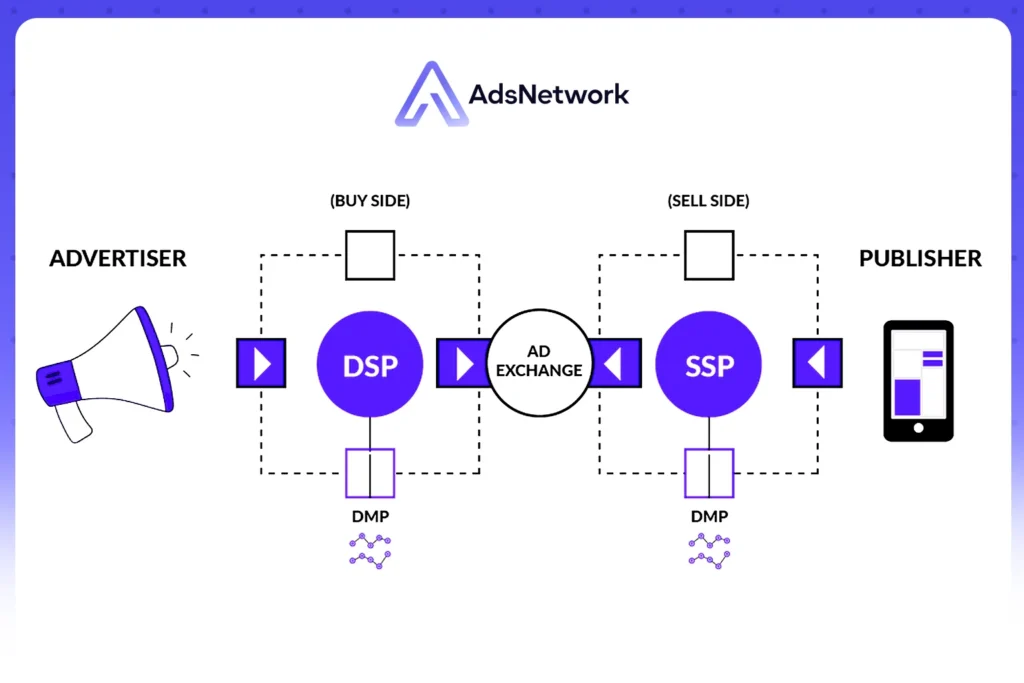
At its foundation, an advertising network makes money through margin. The network buys ad inventory from publishers at one price and sells it to advertisers at a higher price. The difference between those two numbers is the network’s revenue.
Specifically, the network acts as an intermediary that aggregates supply from many publishers and demand from many advertisers. Publishers benefit because the network saves them the work of finding and managing individual advertiser relationships. Advertisers benefit because they can access a broad range of publisher inventory without negotiating separate deals with each one.
However, this intermediary model creates an inherent tension. The network makes more money when it pays publishers less and charges advertisers more. That dynamic is worth understanding before choosing any network relationship. It applies whether you are a publisher maximizing yield or an advertiser minimizing waste.
For context, Google AdSense pays publishers 68% of ad revenue while retaining 32%, according to Publift. That split is publicly disclosed. Many networks are less transparent about their margin, making it difficult for publishers to benchmark their effective revenue share.
CPM: Paying for Impressions
CPM, or cost per mille, is the most common pricing model in display advertising. Advertisers pay a fixed rate for every 1,000 ad impressions delivered. The network collects that payment, passes a share to the publisher, and keeps the margin.
From the network’s perspective, CPM campaigns are predictable and scalable. Revenue scales directly with impression volume, so networks have a strong incentive to maximize fill rates across their publisher inventory. That is why many ad networks prioritize high-traffic publishers with consistent viewability.
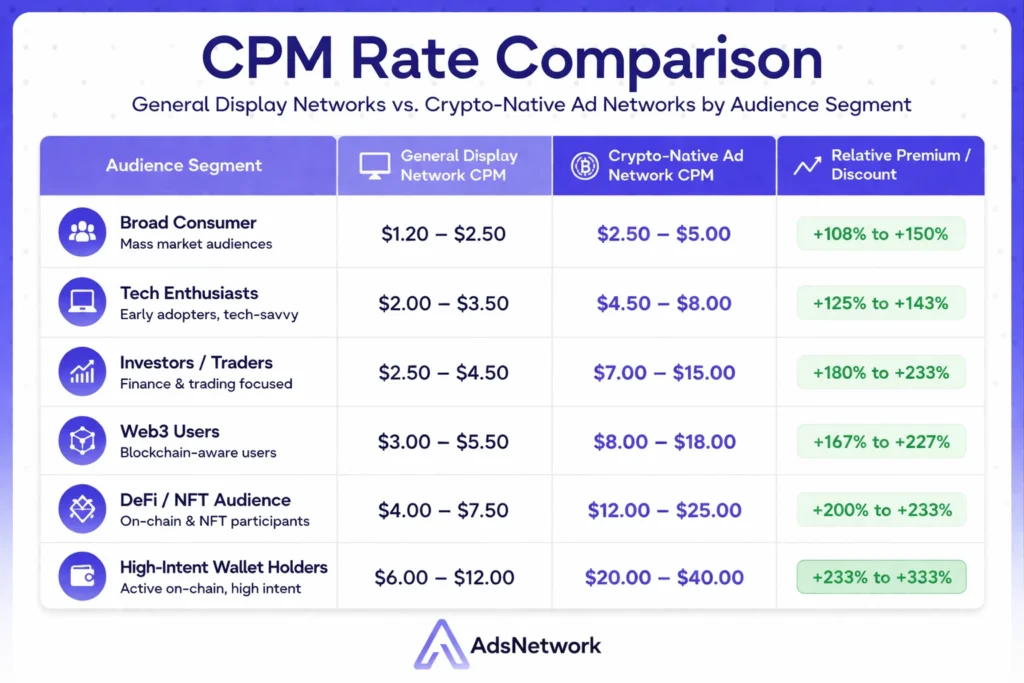
CPM rates vary significantly by audience, format, and context. According to Epom’s ad tech benchmarks, narrower audience targeting consistently produces higher CPMs. A general display CPM might sit around $1 to $3 for broad audiences. Highly targeted or premium placements can reach $15 to $30 or more. For the network, that premium is pure margin expansion. If it charges the advertiser $20 CPM but pays the publisher a rate reflecting $12 CPM, the spread is $8 per thousand impressions.
In the crypto space, specialized networks like AdsNetwork charge higher CPMs than general display networks. The audiences are specifically interested in blockchain products. That premium reflects real targeting value. A DeFi advertiser paying $10 to $22 CPM for a crypto-native audience reaches users far closer to their conversion event than the same budget on a general audience at $2 CPM.
CPC: Paying for Clicks
In the CPC model, advertisers pay only when a user clicks their ad. The network earns revenue per click rather than per impression. Publishers typically receive a share of each click payment.
CPC benefits advertisers because they only pay for demonstrated engagement. However, networks running CPC models carry more risk: they deliver impressions at cost and only earn when clicks occur. To manage this, CPC networks optimize heavily for click-through rates, which is why CPC placements often feature more prominent, attention-grabbing formats.
CPC rates vary widely by industry and intent level. According to Business of Apps CPC data, Google Search Network CPCs averaged around $2.69 in recent years, while Display Network CPCs sat around $0.63. LinkedIn, by contrast, averages $5.58 per click due to its high-value B2B audience. The network collects these amounts and pays the publisher a share, retaining the difference as margin.
Many networks blend CPM and CPC dynamically. They sell inventory as CPM to advertisers but optimize delivery to maximize click-through rates, earning more per impression when ads perform well. That hybrid approach is increasingly common as networks deploy AI bidding systems to maximize effective CPM (eCPM) across mixed pricing models.
CPA and Performance-Based Revenue
CPA, or cost per action, takes performance pricing one step further. Advertisers pay only when a user completes a specific action: a purchase, a sign-up, a download, or a wallet connection. The network earns only when the conversion happens.
CPA models put the most pressure on networks to deliver quality traffic. Because revenue depends on downstream conversion events, the network has a direct financial incentive to send audiences that actually convert. That alignment of incentives makes CPA attractive to performance-focused advertisers who want to eliminate wasted spend.
In practice, CPA networks often operate differently from CPM or CPC networks. Rather than aggregating publisher inventory and taking a margin on each transaction, many CPA networks function more like performance marketplaces. They pass traffic from affiliate publishers to advertisers. Publishers receive a bounty per confirmed conversion, and the network keeps a commission on each successful action.
For crypto projects, CPA models aligned to wallet-level events represent the most accountable form of advertising spend. Paying per verified wallet connection eliminates the bot traffic and airdrop-hunter problem. That problem routinely inflates CPM and CPC metrics across blockchain advertising campaigns.
Revenue Share: Aligning Publisher and Network Incentives
Revenue share is the model that governs most long-term publisher relationships with ad networks. The publisher receives a fixed percentage of the gross advertising revenue generated by their inventory, and the network keeps the remainder.
The specific percentage varies by network, publisher tier, traffic quality, and negotiating leverage. Google AdSense’s 68% publisher share is a widely known benchmark. Other networks may offer different splits depending on their business model. Premium ad networks managing high-value publisher inventory sometimes offer publishers 70% to 80% revenue share. Performance networks with more speculative traffic might pay significantly less.
For publishers evaluating ad network relationships, the revenue share percentage is only part of the equation. The effective eCPM matters more than the headline percentage. A network paying 80% revenue share on low CPM inventory may deliver less total publisher revenue than one paying 65% on premium inventory from quality advertisers.
Programmatic Revenue: The RTB Layer
Programmatic advertising has added another layer to how networks generate revenue. In real-time bidding (RTB) environments, the network operates as either a supply-side platform (SSP) connecting publisher inventory to advertisers, or as a demand-side partner. The latter role helps advertisers access multiple exchanges through a single interface.
For programmatic models, the network typically earns a technology fee on each transaction. Rather than profiting from the buy-sell spread alone, it charges a percentage of media spend for access to its infrastructure, optimization tools, and audience data. According to Publift analysis, global programmatic ad sales are projected to reach $724.8 billion by 2026. That makes programmatic technology fees a significant and growing revenue line for networks with SSP or DSP capabilities.
Additionally, many networks now earn revenue from data products. The audience behavioral data collected across publisher inventory is itself valuable. Networks may license audience segments to advertisers, offer audience extension products, or use first-party data to improve targeting performance. Each of these products commands premium pricing above the base media fee.
How Crypto and Web3 Ad Networks Generate Revenue
Crypto-native ad networks like AdsNetwork follow the same fundamental revenue models described above. However, the audience premium they command is significantly higher than general display networks. Advertisers pay more per impression because the audiences are specifically interested in blockchain, DeFi, and on-chain products. Publishers earn more because that same audience demand drives higher eCPMs than general web traffic.
Furthermore, the Web3 advertising context introduces transparency considerations that are increasingly valued by both advertisers and publishers. Advertisers want to know that their budget is reaching verified blockchain users, not bot traffic. Publishers want to know that the network is paying fair rates for their crypto-specific audience. Networks that provide verifiable audience data and transparent revenue splits build stronger long-term relationships on both sides of the marketplace.
Understanding that distinction helps both advertisers and publishers choose the right infrastructure for their campaigns.
Why Understanding Ad Network Revenue Models Matters
The pricing model an ad network uses shapes everything about how it operates. CPM networks maximize impression volume. CPC networks optimize for click-through rate. CPA networks focus on downstream conversion quality. Revenue share models align publisher and network incentives around total yield. Each model creates different behaviors, different conflicts of interest, and different outcomes for advertisers and publishers.
Consequently, the choice of network is not just a targeting decision. It is a decision about which set of financial incentives you want working on your behalf. The network that earns from clicks has different optimization priorities from the one that earns from confirmed wallet connections. Knowing the difference puts you in control of your advertising and monetization strategy.
If you are looking for a crypto-native ad network with transparent revenue models built for Web3 advertisers and publishers, visit AdsNetwork.
Featured Posts
Oct 23, 2026
10 min read
What Is CPM in Advertising? Meaning, Formula and 2026 Rates
CPM is the cost an advertiser pays for 1,000 ad impressions, making it one of the most common…
Read Article
Sep 23, 2026
6 min read
What Is Advertising Technology (AdTech) and How Does It Work?
Advertising technology, commonly known as AdTech, refers to the software, platforms, tools, and systems used to plan, buy,…
Read Article
Sep 16, 2026
8 min read
Media Buying: A Complete Guide for Advertisers
Media buying is the process of purchasing advertising space to reach a target audience. It includes choosing where…
Read ArticleNeed Help?
Our team is ready to help you launch successful campaigns.
AI-Powered Mobile
Monitor Your Campaigns Anywhere
Stay connected to your live AdsNetwork campaigns with our mobile advertising app. Track impressions, clicks, conversions, campaign spend, and overall performance in real time—anytime, anywhere. Available for iOS and Android.