

The Ultimate Guide to Digital Advertising in 2026

Digital advertising just crossed a threshold that would have sounded impossible five years ago. For the first time in history, total global ad spend is forecast to exceed $1 trillion in 2026, with digital channels accounting for 68.7% of that investment. The market is bigger, faster, and more complex than ever before. For crypto and Web3 marketers, that complexity cuts both ways. More channels mean more opportunities. But more noise also means it is easier to waste budget on the wrong placements, the wrong formats, and the wrong metrics.
This guide covers everything you need to know about digital advertising in 2026: the channels driving growth, the AI transformation reshaping how ads are bought and sold, the fraud problem eating into budgets, and where Web3 advertising fits into the bigger picture.
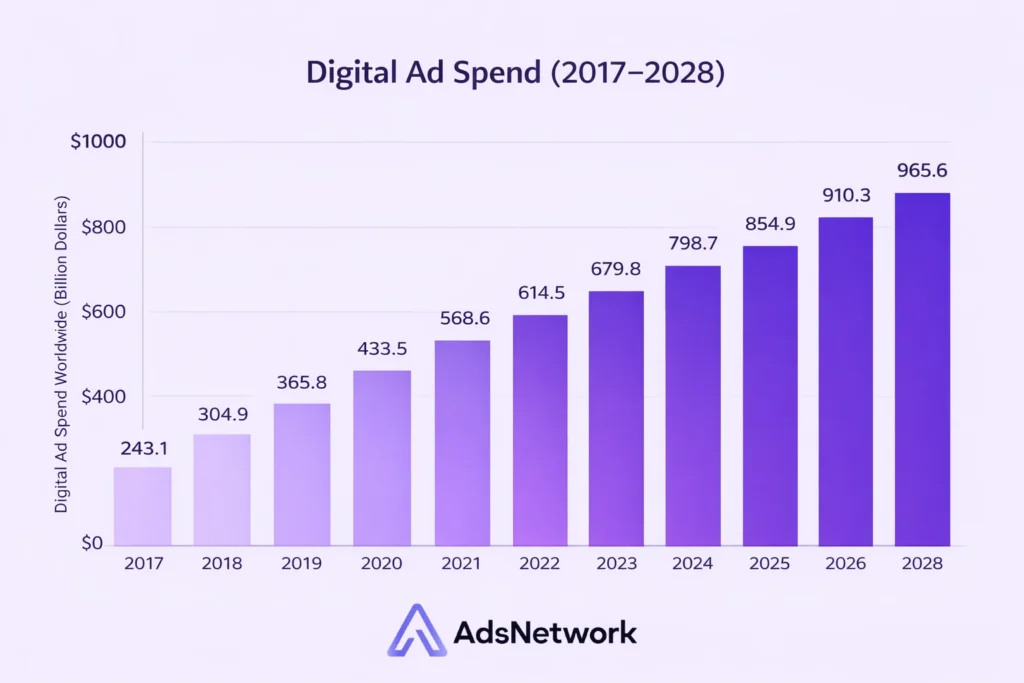
Digital Advertising in 2026: The Numbers That Define the Moment
The scale of the market is staggering. Global digital ad spend is projected to reach $835.82 billion or more in 2026, growing at 6.7% year over year. That growth outpaces the broader economy and reflects continued confidence from brands that paid digital channels deliver measurable returns.
A few headline numbers are worth bookmarking:
- $835.82 billion: projected global digital ad spend in 2026 (Statista / eMarketer)
- 68.7%: share of total ad investment going to digital channels (Dentsu)
- 81.4%: of all digital display spend traded programmatically (Dentsu)
- 71.6%: of total ad spend driven by algorithms in 2026, rising to 76% by 2028 (Dentsu)
- $63 billion: estimated ad spend lost to invalid traffic in 2025 alone (Lunio, Global IVT Report 2026)
That last number deserves its own section. We will get to fraud shortly. First, it is worth understanding which channels are actually growing.
What Is Growing Fastest in 2026
Not all channels are equal. According to Dentsu’s Global Ad Spend Forecasts, the fastest-growing digital channels this year are:
- Retail media: +14.1% YoY, the fastest-growing digital channel for the fifth consecutive year
- Social media advertising: +11.4% YoY
- Online video: +11.5% YoY
- Connected TV (CTV): +9.5% YoY
Traditional linear TV, meanwhile, is essentially flat, and print continues its long decline. The signal is clear: spend is flowing toward digital channels that combine reach, targeting precision, and closed-loop measurement.
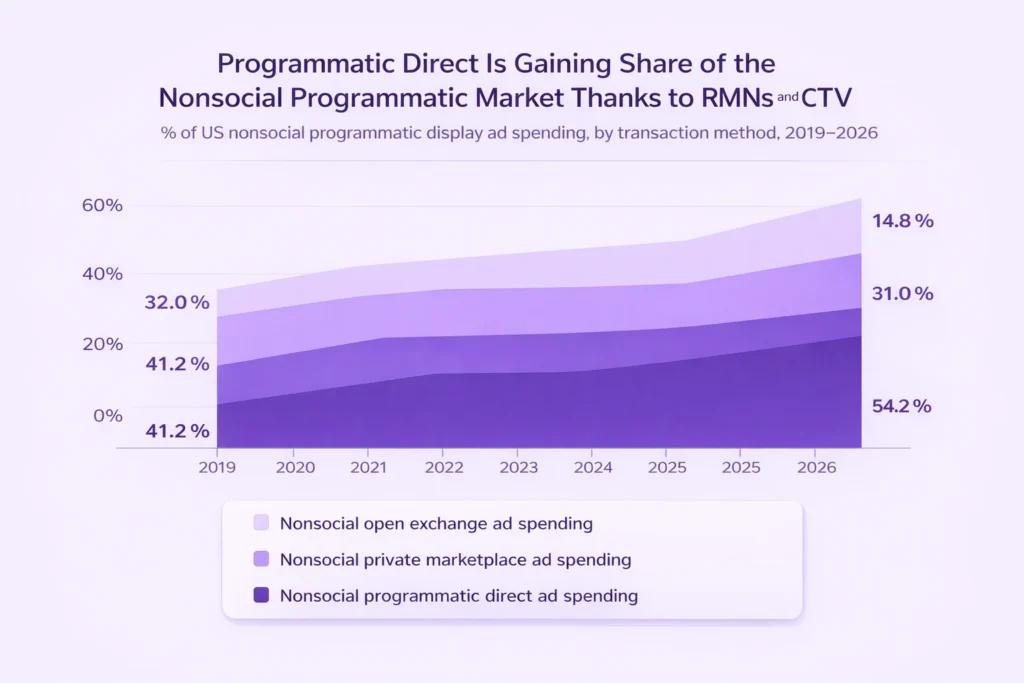
The Major Digital Advertising Channels in 2026
Retail Media: The Fastest Growing Channel
Retail media is the most significant structural shift in digital advertising over the last three years. It refers to ads placed on retailer-owned platforms, think Amazon, Walmart, and a growing list of regional retail networks, where advertisers can reach shoppers close to the point of purchase using the retailer’s own first-party data.
In 2025, retail media programmatic display spending grew more than twice as fast as total programmatic display, according to Basis Technologies’ analysis. The appeal is straightforward: retail data connects ad exposure directly to transaction signals, which makes attribution far cleaner than standard display or social.
For Web3 marketers, retail media is largely out of reach for now. But it is worth watching. As crypto products move toward mainstream retail, expect retail-adjacent placements to open up for exchanges, wallets, and DeFi products.
Social and Short-Form Video
Social advertising remains a core pillar for most brands. Global social media ad spend is forecast to reach $227.95 billion in 2026, with mobile accounting for over 82.9% of all social ad spending. Short-form video continues to outperform every other format, delivering engagement rates 2.5 times higher than long-form content, according to industry analysis.
The challenge for crypto and Web3 projects is policy. Google and Meta restrict direct crypto promotions to pre-approved advertisers with compliance documentation. Most token projects and DeFi platforms hit policy walls almost immediately on these platforms. That friction is a large part of why crypto-native ad networks exist and why they continue to grow.
Programmatic Advertising and Connected TV
Programmatic advertising now accounts for over 90% of digital display ad dollars in the US, according to industry data from Fluency. The system works through real-time auctions: when a user loads a page, an auction occurs in milliseconds and the winning bid determines which ad they see. It is fast, scalable, and increasingly AI-driven.
CTV is the fastest-growing format within programmatic. Smart TV platforms now offer homescreen-first ad formats, and 75% of CTV ads are now bought programmatically, according to Digiday. Programmatic video ad spending is projected to surpass $110 billion this year, representing 75% of new programmatic ad dollars from 2024 through 2026.
For publishers, programmatic access to a quality can significantly lift yield. For advertisers, the key is selecting supply paths that prioritize verified inventory over cheap impressions.
How AI Is Reshaping Digital Advertising
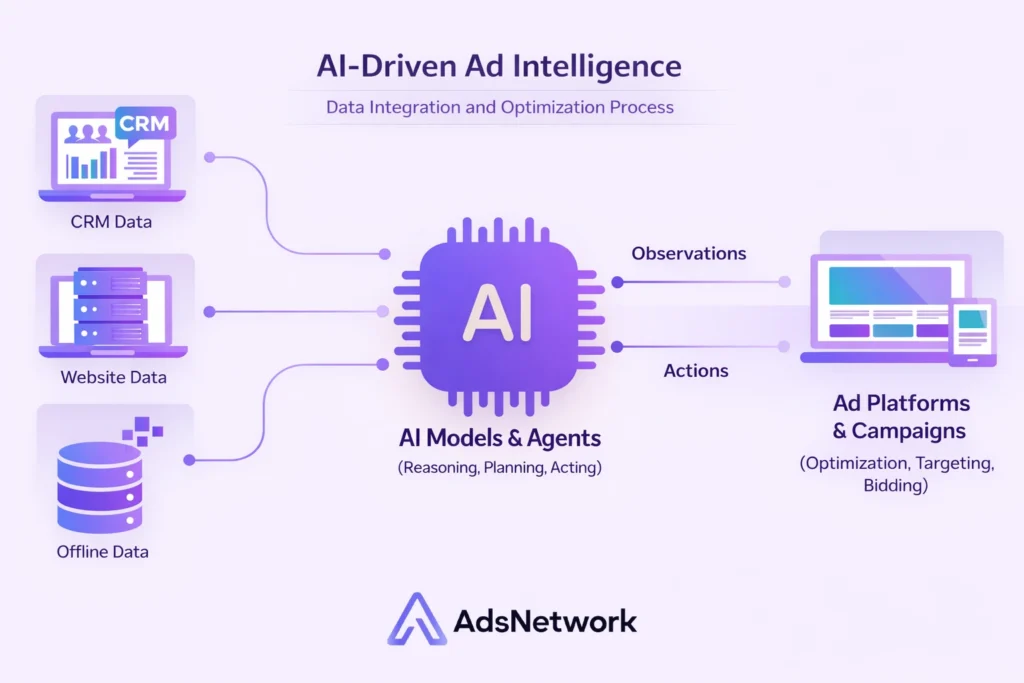
Dentsu forecasts that 71.6% of all ad spend will be algorithm-driven by 2026, rising to 76% by 2028. The manual buying of media, negotiating placements, setting bids by hand, reviewing creative performance in weekly reports, is being replaced by systems that execute these tasks in real time.
According to EMARKETER, 2026 will mark the beginning of the end for manual programmatic buying. Generative AI is now embedded across campaign planning, creative optimization, audience segmentation, and bidding. Agentic AI systems, which can autonomously adjust campaigns based on performance signals, are moving from pilot to production across major advertisers.
The operational upside is real. Marketers who adopt automation have seen productivity lift by as much as 20%, with AI dynamically allocating budgets, optimizing creative, and adjusting bids in real time. The downside is also real: when AI learns from contaminated data, it optimizes toward the wrong outcomes. Which brings us to fraud.
Ad Fraud: The Hidden Cost in Every Digital Advertising Budget
This is the conversation most marketers avoid, and the one most worth having. Ad fraud is not a fringe problem. It is a structural cost baked into digital advertising at scale.
The Global Invalid Traffic Report 2026 by Lunio found that 8.51% of all digital ad traffic worldwide is invalid, translating into an estimated $63 billion in wasted ad spend in 2025 alone. Juniper Research projects global ad fraud losses will exceed $100 billion in 2026.
A separate analysis of 105.7 billion ad impressions by Fraudlogix found an overall invalid traffic rate of 20.64%, meaning roughly one in five impressions showed characteristics of fraudulent or non-human activity. Desktop traffic is worse than mobile, with a 27% IVT rate on desktop compared to 19% on mobile.
The real damage goes beyond wasted spend. When invalid traffic enters your campaigns, it corrupts the data your AI bidding systems learn from. The algorithm trains itself to find more of the same low-quality traffic, compounding losses over time and making performance metrics increasingly unreliable.
For Web3 marketers, this problem is especially acute. Bot traffic and mercenary airdrop hunters can inflate wallet connection counts and sign-up numbers, making campaigns look successful while delivering zero genuine community growth. Working with the Best Advertising Networks for Crypto and Web3 that use on-chain verification and fraud filtering is not optional. It is table stakes.
Web3 and Crypto Advertising in the 2026 Digital Advertising Landscape
Crypto and Web3 projects operate in a parallel advertising ecosystem. Google and Meta restrict most direct crypto promotions. That forces blockchain companies toward specialist channels: crypto-native ad networks, community platforms, KOL campaigns, and on-chain marketing tools.
Crypto-focused ad networks typically charge higher CPMs than general display networks because the audiences are specifically interested in blockchain products. That premium is worth paying when the alternative is cheap impressions from users who will never open a wallet.
The most sophisticated Web3 teams are now layering traditional digital advertising metrics with on-chain measurement. Cost per wallet, wallet retention rates, and on-chain ROAS are becoming standard alongside CTR and CPA.
AdsNetwork is built specifically for this intersection: a crypto and Web3 advertising platform that delivers display and native ad formats to blockchain-native audiences, with reporting tools designed for teams that need to track both browser-based and on-chain signals.
Building Your Digital Advertising Strategy for 2026
The biggest mistake most teams make is treating their channel mix as a set-and-forget decision. Digital advertising in 2026 rewards continuous reallocation based on performance data, not annual plans built on assumptions.
A few principles that hold across verticals and channels:
- Match the channel to the goal. Awareness campaigns belong in programmatic and video. Conversion campaigns belong in search, social retargeting, and crypto-native networks where audiences are close to taking action.
- Prioritize first-party data. With third-party cookies phased out across most major browsers, campaigns that use your own audience data consistently outperform those relying on third-party targeting.
- Audit for fraud before scaling. Before increasing budget on any channel, verify that traffic quality meets minimum standards. Invalid traffic rates above 10% on any placement should trigger a review.
- Track the right advertising metrics. Vanity metrics like total impressions and raw click counts are easy to inflate. Focus on conversion rate, CPA, ROAS, and for Web3, cost per wallet. Review our guide to Advertising Metrics Every Crypto and Web3 Marketer Should Know for a full breakdown.
For Web3 projects specifically, the most effective strategy in 2026 combines a crypto-native ad network for targeted display reach with community-driven amplification through KOLs and owned channels. Neither works as well alone as they do together.
Digital Advertising in 2026: Where to Focus
The trillion-dollar milestone is a landmark, but it is also a warning. As the market grows, so does the competition for attention, the sophistication of fraud, and the complexity of channel selection. The brands that win in 2026 will not be the ones with the biggest budgets. They will be the ones with the clearest strategy, the cleanest data, and the right channel mix for their audience.
For crypto and Web3 marketers, that means leaning into platforms built for blockchain audiences, measuring beyond the browser, and treating traffic quality as a non-negotiable standard. If you are ready to build campaigns on infrastructure designed for Web3, explore what is available at adsnetwork.io.
Frequently Asked Questions
How big is the digital advertising market in 2026?
Global digital ad spend is projected to reach $835.82 billion in 2026, according to data from Statista and eMarketer. Total advertising spend, including traditional media, is forecast to surpass $1 trillion for the first time, with digital channels accounting for 68.7% of that total. Retail media is the fastest-growing digital channel at 14.1% growth year over year, followed by social media at 11.4% and online video at 11.5%.
What is ad fraud and how much does it cost advertisers in 2026?
Ad fraud refers to invalid traffic: clicks, impressions, and conversions generated by bots or fraudulent sources rather than real human users. Lunio’s Global IVT Report 2026 estimates that $63 billion in ad spend was wasted on invalid traffic in 2025 alone. The global invalid traffic rate across all channels is approximately 8.5%, with some channels and regions significantly worse. Juniper Research projects total global ad fraud losses will exceed $100 billion in 2026.
Why can’t crypto projects just advertise on Google and Meta?
Google restricts crypto advertising to pre-approved advertisers who meet specific compliance and certification requirements. Meta bans most direct crypto promotions outright. This applies to token projects, exchanges, DeFi platforms, and NFT products. The restrictions exist due to regulatory uncertainty and the history of scam ads in the crypto space. As a result, most Web3 projects rely on specialist crypto ad networks, KOL partnerships, and community-driven channels that operate outside these policy restrictions and are designed specifically for blockchain audiences.
Ready to Get Started?
Launch your advertising campaign today and reach your target audience effectively.
Start Your CampaignAbout the Author
Hana Mori
Content specialist focused on digital advertising and marketing strategies. Passionate about helping businesses grow through data-driven campaigns.
Related Articles

Best Web3 Advertising Networks in 2026: Complete Guide for Crypto Marketing
The growth of blockchain startups, DeFi protocols, and NFT platforms has created a new challenge: how do you advertise to real crypto users? As more projects emerge, many are searching for the best web3 advertising networks to reach their target audience. Traditional advertising platforms like Google Ads and Meta still restrict many crypto campaigns, making […]
9 min read

Why Blockchain Marketing Determines Who Survives
The blockchain industry is no longer experimental. Today, it is rapidly evolving into a mature and competitive ecosystem. As a result, the strategies behind blockchain marketing are becoming increasingly important. New protocols launch every month. Meanwhile, exchanges list hundreds of tokens and infrastructure projects compete intensely for liquidity, developers, and community attention. Therefore, strong technology […]
7 min read

Crypto Content Marketing Strategy for Web3 Growth in 2026
Key Takeaways The Web3 ecosystem is more competitive than ever. Blockchain startups, DeFi platforms, NFT marketplaces, and crypto exchanges are all competing for the same global audience. In this environment, crypto content marketing is no longer about publishing blog posts for visibility alone. It is about building authority, earning trust, and systematically converting traffic into […]
6 min read