
Every digital advertising budget eventually faces the same decision: buy programmatically or buy direct. On the surface, the choice seems straightforward. In practice, it involves trade-offs between cost, control, scale, and brand safety that change depending on the campaign type, the audience, and the publisher relationship. Programmatic vs direct advertising is not a question with one right answer. It is a strategic choice that affects every dollar you spend. According to BidsCube, the IAB’s 2024 report shows programmatic advertising revenue grew 18% year over year, reaching $134.8 billion. Non-programmatic revenues, meanwhile, declined nearly 5% to $20.9 billion. The scale of that divergence makes understanding the difference between these two models more important than ever.
What Is Direct Advertising?
Direct advertising is exactly what it sounds like: an advertiser negotiates and purchases ad placements directly with a publisher. No auction. No intermediary platform. The advertiser contacts the publisher, agrees on a price, specifies the placement, and the campaign runs as agreed. Historically, this was how all digital advertising worked. Sales teams at media companies managed relationships with agencies and brand advertising teams.
In practice, direct buys typically involve a guaranteed number of impressions delivered in a specific location on a specific publisher’s site. For example, an advertiser might buy the homepage takeover of a major crypto news site for a fixed period at a fixed CPM. The publisher commits to delivering those impressions. The advertiser commits to paying the agreed rate. Neither party is subject to auction volatility during the campaign.
Notably, direct advertising still plays a significant role in premium inventory. Publishers with strong audiences and brand recognition can command CPMs of $10 to $20 or more on direct deals, according to inBeat Agency. In contrast, programmatic CPMs typically range from $1 to $5. That difference reflects the value publishers place on guaranteed placements and brand-controlled environments.
What Is Programmatic Advertising?
Programmatic advertising uses automated software to buy and sell ad impressions in real time. Instead of negotiating fixed placements in advance, advertisers set targeting parameters, bid ranges, and campaign goals inside a demand-side platform. The DSP then evaluates available impressions through RTB auctions and purchases those that match the campaign criteria automatically.
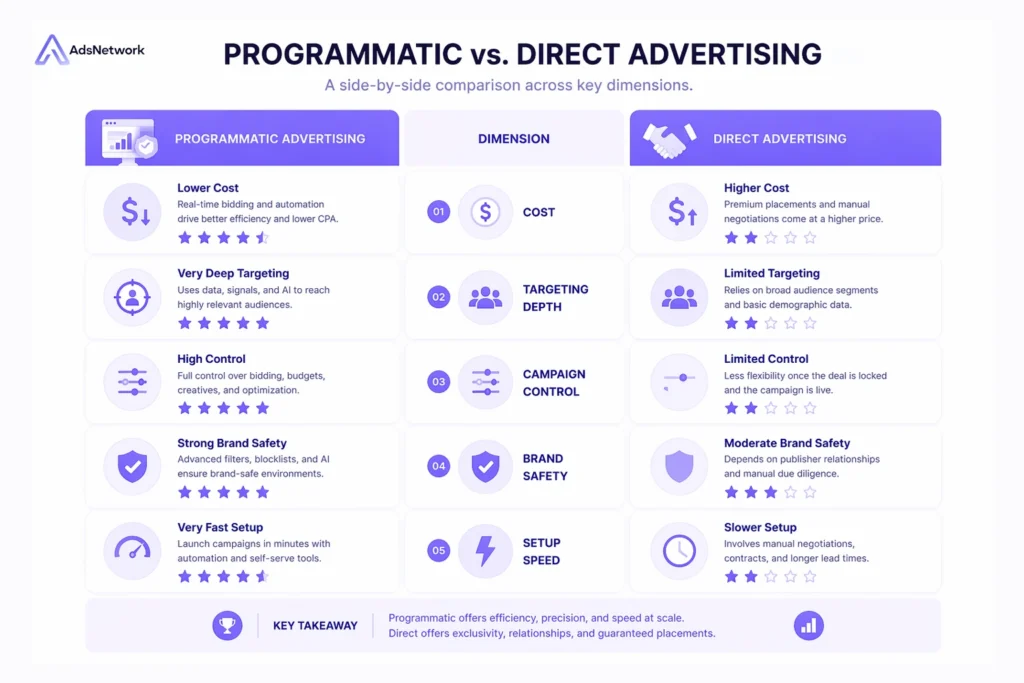
The scale of programmatic adoption reflects its efficiency advantages. According to SEO Design Chicago, US programmatic ad spend reached $264.7 billion in 2024 and is projected to surpass $270 billion in 2025. By 2026, programmatic is expected to account for 90% of global digital display ad spending. The key advantages driving this adoption are targeting precision, real-time optimization, and access to inventory at scale that direct buying cannot replicate. For a deeper look at what drives these advantages, see our overview of the advantages of programmatic advertising platforms.
Programmatic vs Direct Advertising: Core Differences
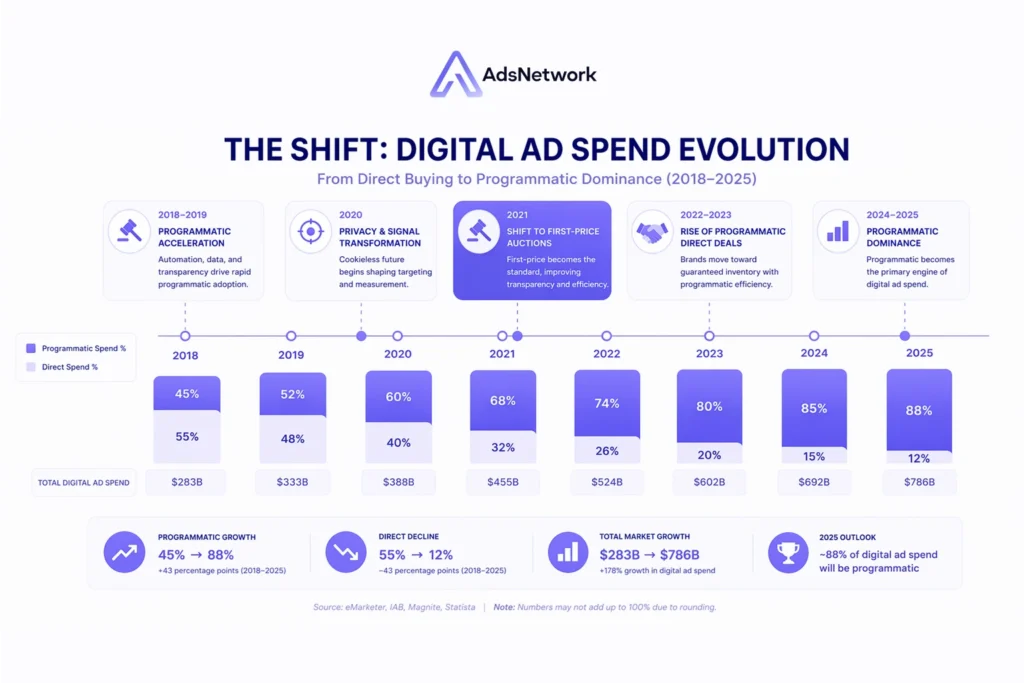
Understanding programmatic vs direct advertising means comparing these models across several dimensions. Each has genuine strengths, and neither dominates across every use case.
Cost and CPM
Direct buys carry higher CPMs by design. Publishers price them at a premium because they guarantee delivery in specific, high-visibility placements. Programmatic inventory, by contrast, is priced through competitive auctions where the clearing price reflects real-time demand. Advertisers typically see 25 to 45% lower CPMs with programmatic compared to direct-buy display, according to industry benchmarks via Marketing LTB. However, lower CPM does not always mean better value. A $2 CPM impression from low-quality inventory delivers less than a $15 CPM impression on a premium site with a highly engaged audience.
Targeting and Audience Precision
Programmatic advertising offers significantly deeper targeting than direct buys. DSPs can evaluate each impression against behavioral data, device signals, contextual page content, first-party audience segments, and geographic signals simultaneously. Direct buying, in contrast, targets audiences at the publisher level. An advertiser buying placement on a DeFi news site knows the general audience but cannot filter by specific behavioral signals within that audience.
For performance campaigns where conversion matters more than context, programmatic targeting precision is a substantial advantage. Retargeted programmatic ads achieve click-through rates ten times higher than standard display, according to the same SEO Design Chicago benchmark data. Furthermore, cross-channel programmatic campaigns achieve 166% higher engagement than single-channel approaches. Direct buys cannot replicate this level of audience-level targeting at comparable scale.
Brand Safety and Placement Control
Direct advertising offers the highest level of placement certainty available in digital media. An advertiser buying a specific placement on a specific publisher knows exactly where the ad will appear. There is no ambiguity about site quality, content adjacency, or audience composition. This certainty is particularly important for brands where reputation risk is high and content adjacency matters.
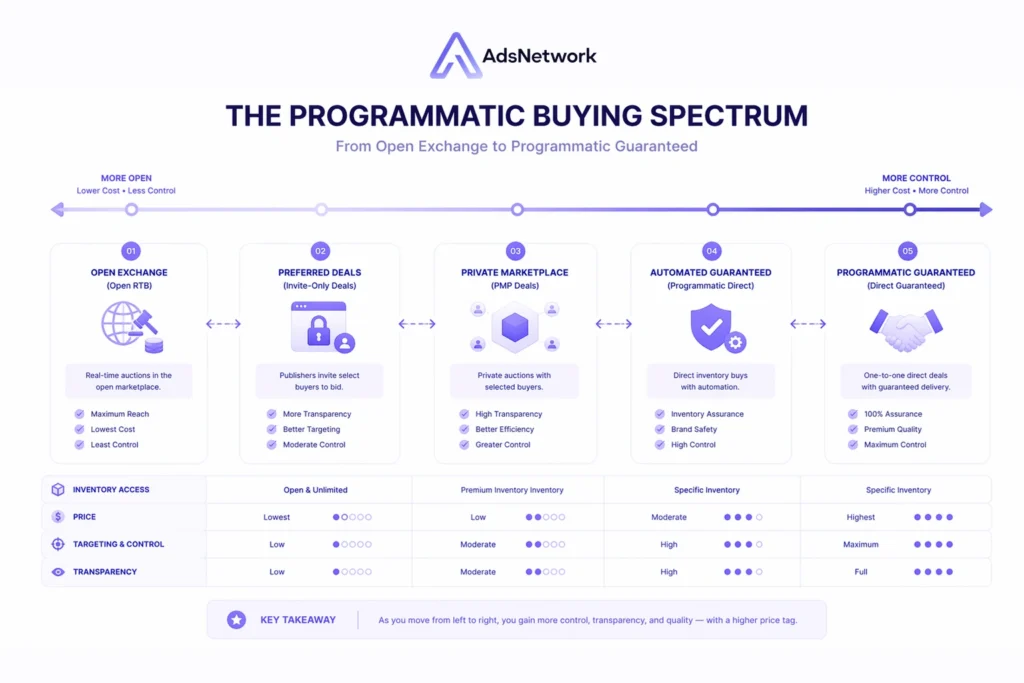
Programmatic advertising, in contrast, involves varying degrees of placement uncertainty depending on the buying environment. Open exchange RTB exposes campaigns to a wide range of publishers, not all of whom meet brand safety standards. However, this concern has reduced significantly as verification tools have improved. According to Basis Technologies, more than 91% of US programmatic display spend in 2025 flows to private marketplaces and programmatic direct deals rather than open exchange, reflecting advertisers’ growing preference for curated, controlled environments. Private marketplace deals offer most of the targeting advantages of programmatic while providing placement certainty closer to direct buys.
Setup Speed and Campaign Flexibility
Direct advertising requires negotiation. An advertiser must identify the right publisher, contact their sales team, agree on terms, provide creatives, and wait for the campaign to launch. This process typically takes days or weeks. Programmatic campaigns can launch the same day a DSP account is configured and creatives are uploaded. Consequently, programmatic is the only viable option when campaign timing is urgent or when continuous optimization is required.
Additionally, programmatic campaigns can be adjusted in real time. If a placement underperforms, the campaign shifts budget away automatically. If an audience segment converts well, bids increase toward it. Direct buys, once purchased, run as contracted. Pausing or modifying a direct campaign typically requires contacting the publisher and renegotiating terms. This rigidity makes direct advertising a poor fit for performance campaigns that depend on continuous optimization.
Programmatic Direct: The Hybrid Model
Not all programmatic advertising operates through open auctions. Programmatic direct, also called programmatic guaranteed, combines the efficiency of automated delivery with the certainty of a direct deal. An advertiser and publisher agree on a fixed price, a guaranteed number of impressions, and specific placement parameters. The campaign then delivers through programmatic infrastructure rather than a manual insertion order.
This model has grown substantially. Programmatic direct deals represent approximately 21 to 29% of global programmatic spend, according to industry estimates via Marketing LTB. Private marketplace deals, which function as invitation-only RTB auctions rather than fully guaranteed contracts, make up a further significant share. Together, these premium programmatic formats represent the majority of total US programmatic display spend in 2025. They reflect how the industry has evolved past the binary choice between open exchange programmatic and traditional direct buying.
When to Use Programmatic vs Direct Advertising
Neither model is universally superior. The right choice depends on campaign objectives, budget, and publisher relationships.
When Direct Advertising Makes Sense
Direct advertising performs best when placement certainty is the primary requirement. Specifically, homepage takeovers, site sponsorships, and premium editorial environments benefit from direct deals because the publisher can guarantee both the placement and the context. For brand awareness campaigns tied to specific publisher audiences, such as a crypto exchange sponsoring a major blockchain media brand, direct advertising signals commitment to that audience in a way that programmatic cannot replicate. Moreover, direct deals often include value-added elements like newsletter placements, editorial mentions, or social promotion that programmatic channels do not offer.
When Programmatic Advertising Performs Better
Programmatic advertising outperforms direct buying in most performance and reach scenarios. Specifically, campaigns focused on conversions, retargeting, or audience expansion benefit from programmatic’s targeting depth and real-time optimization. Programmatic is also the only viable option when campaigns need to reach audiences across many publishers simultaneously. The ability to optimize in real time, shift budget between inventory sources, and apply audience signals at the impression level creates performance advantages that direct buying cannot match at equivalent scale.
According to Attekmi, programmatic advertising consistently outperforms direct advertising in ROI on performance campaigns. This advantage stems from the precision of data-driven targeting, continuous real-time adjustments, and automated optimization. These are functions that human-negotiated direct buys cannot replicate at the speed or scale that programmatic infrastructure provides.
Programmatic vs Direct Advertising for Web3 and Crypto Projects
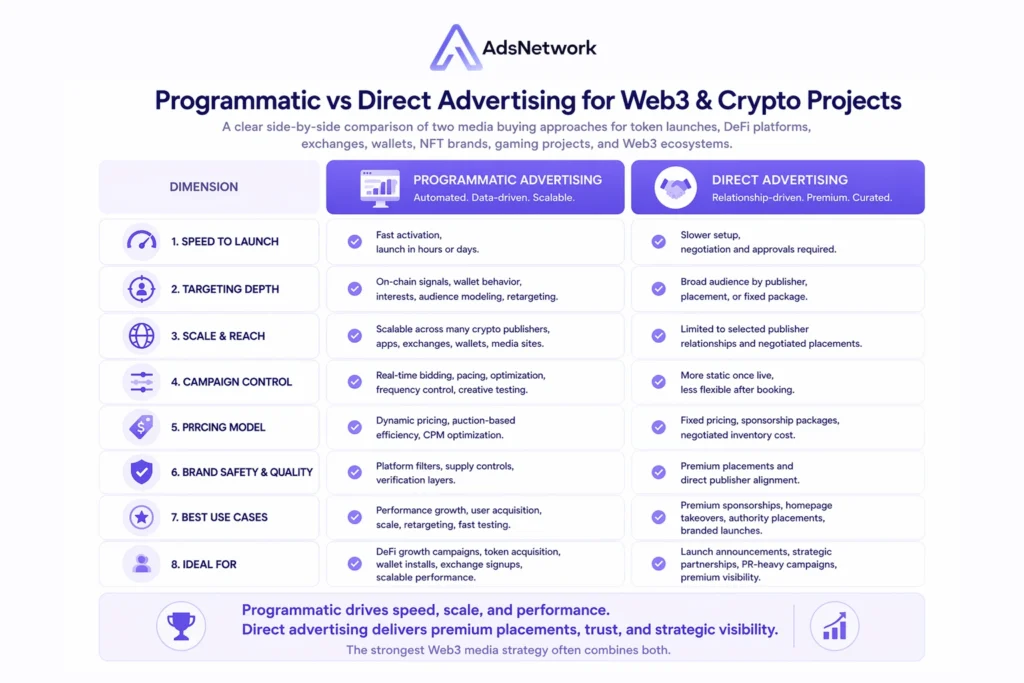
For Web3 and crypto projects, the programmatic vs direct advertising comparison involves an additional layer of complexity. Most mainstream programmatic exchanges restrict crypto-related advertising categories, regardless of compliance status. DeFi protocols, token launch campaigns, and NFT projects face automatic rejections on general DSPs. This restriction effectively removes open exchange programmatic as an option for many Web3 advertisers.
Direct advertising from crypto-native publishers, by contrast, has always been accessible. A DeFi protocol can approach a blockchain media site directly, negotiate a placement, and run without any policy friction. However, direct buying at scale is time-consuming, lacks targeting precision, and does not provide the real-time optimization that performance campaigns require.
The most effective approach for Web3 projects is purpose-built programmatic infrastructure that operates without the blanket restrictions of mainstream exchanges. AdsNetwork provides exactly this: programmatic ad delivery across crypto-native publisher inventory, with RTB auction mechanics, audience targeting calibrated for Web3 audiences, and the operational efficiency that direct-only buying cannot match. Teams can access the DSP vs SSP explained framework within a single platform designed for the specific context of crypto advertising.
Additionally, direct deal relationships with crypto publishers remain valuable for brand awareness and sponsorship campaigns. The most effective Web3 media strategy typically combines programmatic for performance and scale with selective direct placements for brand positioning on premium crypto properties.
Conclusion: Programmatic vs Direct Advertising Is a Strategic Choice, Not a Binary One
Programmatic vs direct advertising is ultimately a question of what each campaign needs. For scale, targeting precision, and performance optimization, programmatic advertising provides structural advantages that direct buying cannot match. For brand-specific placement, publisher relationships, and premium editorial environments, direct advertising offers certainty and context that programmatic still struggles to guarantee in open exchange settings.
The most mature advertising strategies use both. Programmatic handles reach, retargeting, and continuous performance optimization. Direct handles anchor placements and brand-aligned publisher relationships. For Web3 projects specifically, finding programmatic infrastructure that operates within the crypto ecosystem, rather than against it, is the essential starting point. Visit 51.254.143.217/ to explore both programmatic and direct advertising options built for crypto and Web3 campaigns.
Featured Posts
Oct 23, 2026
10 min read
What Is CPM in Advertising? Meaning, Formula and 2026 Rates
CPM is the cost an advertiser pays for 1,000 ad impressions, making it one of the most common…
Read Article
Sep 23, 2026
6 min read
What Is Advertising Technology (AdTech) and How Does It Work?
Advertising technology, commonly known as AdTech, refers to the software, platforms, tools, and systems used to plan, buy,…
Read Article
Sep 16, 2026
8 min read
Media Buying: A Complete Guide for Advertisers
Media buying is the process of purchasing advertising space to reach a target audience. It includes choosing where…
Read ArticleNeed Help?
Our team is ready to help you launch successful campaigns.
AI-Powered Mobile
Monitor Your Campaigns Anywhere
Stay connected to your live AdsNetwork campaigns with our mobile advertising app. Track impressions, clicks, conversions, campaign spend, and overall performance in real time—anytime, anywhere. Available for iOS and Android.