

Crypto exchange advertising is one of the most lucrative jobs in performance marketing, and one of the most constrained. Exchanges are the one crypto category the mainstream platforms will actually let you run, and also one of the hardest to advertise well. The reason comes down to a single word: certification.
Get certified, in an approved country, and Google and Meta open up. Skip it, or operate outside their approved list, and the mainstream door stays shut. That gate is the dividing line in exchange acquisition, and which side you are on shapes every channel decision you make.
This guide is about crypto exchange advertising specifically: the paid execution, not the broader brand and community work. We cover both sides of the gate, what you can run on mainstream platforms once certified, and what you run everywhere else. If you want the wider strategy picture, that is a separate discipline. Here, we stay on how to advertise a crypto exchange through paid channels that convert.

Why Advertising a Crypto Exchange Is Uniquely Hard
Exchanges live at the intersection of two hard problems, and that intersection is what makes crypto exchange advertising uniquely difficult. They are crypto, so they inherit every platform restriction aimed at the category. And they are financial services, so they also carry the weight of financial regulation. Few other businesses have to satisfy both at once.
That double burden shows up everywhere. Google requires certification. Meta requires prior written permission. Both geo-gate heavily, so an approval in one country does not travel to the next. And the penalty for getting it wrong is not just wasted budget. A compliance failure can trigger an account ban, which sets your acquisition back by months.
The prize justifies the difficulty. Global crypto ownership reached about 741 million people in 2025, per Crypto.com’s Market Sizing Report. Exchanges are how most of those people buy and trade, which makes them the highest-lifetime-value customer type in crypto. High LTV pulls in fierce competition, and competition pushes acquisition costs up. Advertising an exchange is expensive because the customer is valuable.
One scope note before we go further. Brand, PR, community, and listings all matter to an exchange, and they feed acquisition. They are simply a different discipline from paid media. For that side of the picture, our companion guide to crypto exchange marketing covers strategy, content, and community. This article stays on advertising: the channels, formats, targeting, compliance, and measurement.
This is why crypto exchange advertising rewards specialists over generalists. The margin for error is thin, and one non-compliant creative can cost an account that took months to certify. Operators who treat advertising as an afterthought tend to learn this the expensive way, through a ban rather than a warning, which is why the discipline is worth building deliberately.
Google Ads Certification for Crypto Exchanges
Start with the gate itself, because it defines what is possible on mainstream platforms. Can you advertise a crypto exchange on Google? Yes, but only if you are certified and only in approved countries.
Google’s certification for crypto exchanges asks for three things: you hold the required licensing or registration in the country you want to target, your ads and business comply with local law, and you complete Google’s certification application. As of 2026, that application runs inside the Google Ads account rather than a separate web form. Crucially, certification is granted country by country. An approval for the United States does not cover Germany, and each target market needs its own application.
Google restricts crypto ads to roughly 50 approved jurisdictions where regulation offers enough consumer protection, including the United States, Canada, the United Kingdom, most of the European Union, Japan, South Korea, Hong Kong, the United Arab Emirates, Australia, and more recently Indonesia. You can confirm the current requirements and country list on the official Google Ads crypto policy page, which is the source of truth and changes over time.
Meta runs a parallel gate. To advertise a crypto exchange or trading platform on Facebook and Instagram, you need prior written permission from Meta, granted through the Authorizations and Verifications process once you submit a recognized regulatory license, per Meta’s own policy. Like Google, Meta reviews the whole journey, so a mismatched landing page or a missing risk disclosure can sink an otherwise compliant ad.
What certification does and does not cover
Certification is narrow on purpose. It covers exchanges, software wallets, hardware wallets, and coin trusts. It does not open the door to everything else in crypto.
| Allowed with certification | Not allowed on Google |
|---|---|
| Licensed crypto exchanges | Initial coin offerings and token presales |
| Software and hardware wallets | DeFi yield and staking-return promotions |
| Cryptocurrency coin trusts | Price predictions and profit guarantees |
| Compliant, licensed trading platforms | Unlicensed or unregistered operators |
For a licensed exchange, certification is worth pursuing, because it grants restricted access to the largest ad platforms on earth. It is the backbone of mainstream crypto exchange advertising. The process takes time, though. While you wait for approval, or if you operate outside the approved country list, you are not stuck.
Do not treat the wait as downtime. Build and test creative, warm up your crypto-native channels, and gather first-party data on who actually funds an account. That way, the day certification lands, your crypto exchange advertising is already primed to scale rather than starting from a cold list. That is where the rest of the channel map comes in.
Where Else Crypto Exchanges Can Advertise
Mainstream platforms are one lane, not the whole road. Most exchanges run the bulk of their paid acquisition through crypto-native channels, where the audience is already self-selected and the compliance friction is lower.
A specialist crypto ad network puts your message where traders already are: crypto news sites, price trackers, and analytics dashboards. These places do half your targeting for you, because everyone reading them already cares about the market. This is the core of practical crypto advertising for exchanges, and it does not depend on a certification queue.
Where crypto exchange advertising performs best
For most exchanges, crypto-native inventory carries the majority of crypto exchange advertising spend, certified or not. The channel map beyond mainstream display looks like this:
- Crypto-specialist ad networks. Access to vetted crypto publishers and inventory that welcomes the category.
- Native ads on crypto editorial. Message that reads as content on the sites traders trust, which suits a financial product.
- Display on high-intent trading contexts. Banners on price trackers and dashboards, in front of people actively watching markets.
- Push for reactivation. Alerts that bring dormant traders back around market moves and promo windows.
- Programmatic via crypto-friendly DSPs. Scaled buying across crypto inventory with wallet and behavioral targeting.
Crypto-native inventory outperforms generic display for exchange intent for one simple reason: relevance. A trader reading a price chart is a warmer prospect than a random visitor on a general news site. The context pre-qualifies the audience, which lifts both conversion and compliance at the same time.
Even after certification, few exchanges move all their budget to mainstream platforms. The approved lane is narrow and expensive, and it does not reach every market you might be licensed in. Crypto-native channels fill those gaps, which is why they stay the backbone of exchange acquisition rather than a temporary stopgap while you wait for Google.

Ad Formats That Drive Exchange Sign-Ups and First Trades
Format choice is where crypto exchange advertising gets tactical. Match the format to the job, because each one has a natural place in the exchange funnel, and each needs a compliant creative angle that stays away from profit claims.
| Format | Exchange use case | Funnel stage |
|---|---|---|
| Native | Trust-building on crypto editorial | Consideration |
| Display banners | Presence on price trackers and dashboards | Consideration to action |
| Push | Reactivating dormant accounts, market alerts | Retention and reactivation |
| Mobile interstitial | App installs for the exchange app | Acquisition |
| Video | Brand trust at the top of the funnel | Awareness |
Native is the workhorse for a financial product. Because it reads as editorial, it builds the trust an exchange needs before someone hands over their identity and money. The compliant angle is education: explain a feature or a market, do not promise a payout.
Display banners keep you present where traders live. On price trackers and analytics dashboards, a clean banner with one clear benefit, low fees or deep liquidity, earns attention without shouting returns. Push is a reactivation tool: a market-move alert or a promo window brings dormant accounts back, and it is one of the cheapest re-engagement channels in crypto.
Mobile interstitial ads drive app installs, and the exchange app is a core acquisition surface, since most trading now happens on mobile. Video sits at the top of the funnel, building brand trust that later formats convert. Across all of them, the creative rule is the same: clarity and credibility, never hype.
Targeting Traders: Who to Reach and Where
Targeting is half of crypto exchange advertising. Exchange audiences are not one group: they split into segments that want very different things, and the creative has to speak to each on its own terms.
- First-time buyers. They need reassurance and education: how to buy, how custody works, why the exchange is safe. Lead with clarity, not features.
- Active traders. They care about fees, liquidity, and available pairs. Speak to execution and cost, because that is what moves them between platforms.
- Whales and pro traders. They want depth, API access, and advanced products such as margin trading and leveraged products, where markets permit them. Speak their language and respect the restrictions.
Placement and setup matter as much as the message. Use contextual targeting on price and analytics content, so your ad sits next to what the audience already reads. Set geo-targeting to licensed markets only, and treat that as a hard rule, not a preference, since serving outside your approved jurisdictions is both a compliance risk and wasted spend. Split by device, because the mobile app trader and the desktop trader behave differently. And retarget the people who started sign-up but stalled at identity verification, since a KYC drop-off is a warm lead, not a lost one.
Your most valuable audience is your own funded traders. Build lookalikes and suppression lists from first-party data: model new prospects on the users who actually deposit and trade, and stop paying to reach people who already signed up. This is where crypto exchange advertising compounds, because each cohort of real traders sharpens the targeting for the next one.
Compliance and Creative Rules for Exchange Ads
Compliance is not a footnote in crypto exchange advertising. It is the ground the whole thing stands on, and the difference between a running campaign and a banned account. The guardrails are consistent across platforms, even where the details differ by market.
The creative rules that keep ads alive:
- No guaranteed returns. Never promise or imply profit. This is the fastest way to a rejection or a ban.
- No price predictions. Do not forecast a coin’s value or suggest it only goes up.
- No get-rich framing. Avoid lifestyle bait and urgency built on greed.
- Include required risk disclosures. Many markets require a clear risk statement in or around the ad and on the landing page.
- Geo-lock to licensed jurisdictions. Serve only where you are permitted, and match the ad to that market’s rules.
- Handle margin and leveraged products carefully. These are heavily restricted in several markets, so gate them by geo and follow local limits.
Regulators shape all of this. The FCA in the United Kingdom, the MiCA framework in the European Union, and the SEC in the United States each set rules that touch how financial and crypto products can be promoted. Treat their guidance as the boundary of your creative, and consult qualified counsel for your specific markets. This is practical guidance, not legal advice.
In practice, most rejections trace to four causes: a profit or returns claim, a landing page that does not match the ad, a missing risk disclosure, or the wrong geo. Fix those four, keep the ad and the page consistent, and approval rates climb.
Measuring Crypto Exchange Acquisition
Measurement is the discipline that separates profitable crypto exchange advertising from expensive guesswork. Here is where most exchange campaigns quietly fail: they measure the wrong thing. A sign-up is a vanity metric. Anyone can create an account and never fund it, so counting sign-ups flatters a campaign that may be delivering nothing of value.
Real crypto exchange user acquisition is measured deeper down the funnel. The metrics that matter are the verified sign-up after KYC, the first deposit, the first trade, the 30-day active user, and lifetime value by channel. Each step filters out noise and gets closer to a customer who actually trades.
The KYC drop-off problem
Identity verification is where attribution gets distorted. A channel can look brilliant on raw sign-ups and terrible on verified users, because its traffic stalls at KYC. If you optimize on sign-ups, you pour budget into the channel that produces the most accounts, not the most traders. Optimize on cost per verified user instead, and the picture often flips. That single benchmark, cost per verified user, is the truest read on channel quality.
Put a number on it. Suppose Channel A delivers sign-ups at five dollars, but only one in ten clears KYC and funds. Its true cost per verified, funded user is around fifty dollars. Channel B costs twelve dollars per sign-up, but half of them fund, for a real cost near twenty-four. Raw cost per sign-up says A wins. Cost per verified user says B does, by a wide margin, and B is where the budget should go.
A real campaign shows what disciplined acquisition looks like. When the exchange OKX ran a crypto-native campaign, it reported acquiring 3,095 active traders at a cost per action of about $14.50, for a 25.5x return on ad spend, according to Blockchain-Ads. Numbers like that come from measuring active traders, not accounts, and from buying where the intent already lives.
One more measurement wrinkle is unique to exchanges: attribution across app and web. Many users discover you on the web and convert in the app, or the reverse. Without joined-up tracking, you will misattribute the channels that actually drive funded traders. Stitch app and web together before you trust any channel report.
Running Exchange Campaigns with AdsNetwork
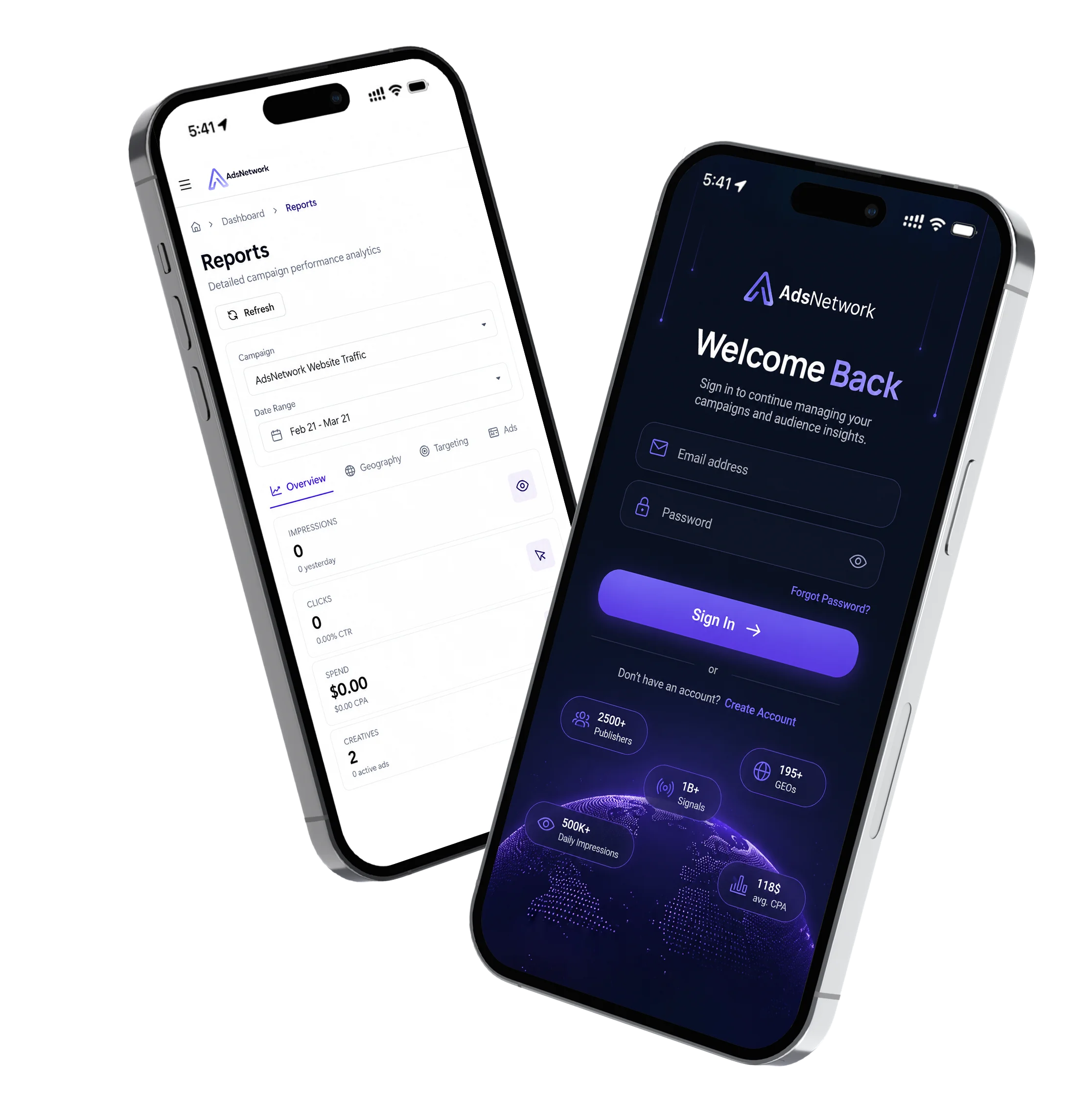
AdsNetwork is built for the side of the gate that most crypto exchange advertising budgets spend on: crypto-native inventory, run compliantly. It places ads where traders already are, across the formats an exchange funnel needs, without the certification queue of mainstream display.
- Crypto-native inventory. Placements on crypto news, price trackers, and dashboards, in front of an audience that already trades.
- Compliance-aware placement. Inventory that welcomes the category, with geo-targeting you can lock to licensed markets.
- Full-funnel formats. Native, display, push, and interstitial from one dashboard, matched to each stage.
- On-chain and behavioral targeting. Reach users by wallet activity and behavior, so budget lands on real traders.
Launching is straightforward: confirm the markets you are licensed for, pick formats by funnel stage, set geo and audience targeting, load compliant creative, and go live. Then optimize on cost per verified user, not raw sign-ups, and scale the channels that produce funded traders. For the crypto-native side of your crypto exchange advertising, AdsNetwork works as the layer that runs alongside any certified mainstream activity.
| Ready to run compliant crypto exchange advertising where traders already are?Get Access → |
Frequently Asked Questions
How do you market a crypto exchange?
How do you market a crypto exchange? Marketing spans brand, content, community, listings, PR, and paid advertising together. Advertising is the paid execution layer: certified mainstream channels where eligible, plus crypto-native networks, native, display, and push. The broader brand and community work is a separate discipline that supports and amplifies the paid channels.
Can you advertise a crypto exchange on Google?
Can you advertise a crypto exchange on Google? Yes, but only with certification and only in approved countries. Google requires that you hold the necessary local licensing, comply with local law, and complete its certification application, which is granted country by country. It does not permit ICOs, DeFi yield promotions, or price-prediction claims.
Where can you advertise a crypto exchange?
Where can you advertise a crypto exchange? On mainstream platforms like Google and Meta once you are certified and approved, and on crypto-native channels everywhere else. Most exchanges run the bulk of paid acquisition through crypto ad networks, native placements on crypto media, price-tracker display, and push, where the audience already trades.
How do crypto exchanges get new users?
How do crypto exchanges get new users? Through paid acquisition across certified mainstream channels and crypto-native inventory, backed by disciplined measurement. Winning exchanges optimize on verified sign-ups, first deposits, and first trades rather than raw account counts, and they target traders contextually on the crypto content those users already read.
Crypto Exchange Advertising: Winning on Both Sides of the Gate
Certification opens a door, but it does not fill the funnel. It grants restricted access to mainstream platforms, in approved markets, for licensed exchanges that clear the bar. That is worth having. It is not, on its own, a growth strategy. That is the real shape of crypto exchange advertising: a narrow certified lane, plus a wide crypto-native one, measured honestly. The exchanges that win run crypto-native channels alongside certification, measure verified users rather than sign-ups, and keep every creative on the right side of the compliance line. Do that, and crypto exchange advertising becomes a repeatable acquisition engine rather than a compliance headache.
| Build a crypto exchange advertising engine that reaches real traders.Get Access → |
Featured Posts
Oct 23, 2026
10 min read
What Is CPM in Advertising? Meaning, Formula and 2026 Rates
CPM is the cost an advertiser pays for 1,000 ad impressions, making it one of the most common…
Read Article
Sep 23, 2026
6 min read
What Is Advertising Technology (AdTech) and How Does It Work?
Advertising technology, commonly known as AdTech, refers to the software, platforms, tools, and systems used to plan, buy,…
Read Article
Sep 16, 2026
8 min read
Media Buying: A Complete Guide for Advertisers
Media buying is the process of purchasing advertising space to reach a target audience. It includes choosing where…
Read ArticleNeed Help?
Our team is ready to help you launch successful campaigns.
AI-Powered Mobile
Monitor Your Campaigns Anywhere
Stay connected to your live AdsNetwork campaigns with our mobile advertising app. Track impressions, clicks, conversions, campaign spend, and overall performance in real time—anytime, anywhere. Available for iOS and Android.