
Every scaling iGaming operator hits the same fork: hire an iGaming marketing agency, or build a team in-house. Most treat it as a simple yes or no. That is the wrong question.
The real decision has three parts, not two. Who does the work. Who owns the data and the relationships. And what you buy media through. Operators collapse all three into one choice, then wonder why the setup underperforms later.
This guide separates them. We will cover what an agency actually does, the honest case for each route, a side-by-side comparison, and the distinction most operators miss. Get your iGaming marketing structure right, and the rest of the machine runs better. This is a framework, not a verdict, because the right answer depends on your situation.

What an iGaming Marketing Agency Actually Does
Before comparing routes, it helps to be precise about the work. An iGaming marketing agency is not a single service. It is a bundle, and the bundle varies a lot from one agency to the next.
A full-service iGaming marketing agency typically covers some or all of the following:
- Media buying. Planning, buying, and optimizing paid campaigns across networks and channels.
- Creative. Banners, video, and landing pages built for gambling audiences and offers.
- Affiliate management. Recruiting, vetting, and managing the affiliate partners that drive much of iGaming traffic.
- SEO and content. Organic visibility for review terms, brand terms, and game content.
- Compliance-aware campaign management. Keeping creative and targeting inside the rules of each licensed market.
- CRM and retention. Sometimes, though many operators keep retention in-house.
Specialist versus generalist iGaming marketing agency
Not all agencies are equal here. A specialist iGaming marketing agency lives in the vertical: it knows the offers, the affiliate networks, the compliance quirks, and the seasonal rhythms. A generalist agency with one gaming client on its roster does not. When you evaluate an agency, what you are really buying is three things: expertise you do not have to hire, relationships you do not have to build, and speed you cannot match from a standing start.
The Case for an iGaming Marketing Agency
The agency route has real, honest advantages. For the right operator, they are decisive.
- Immediate specialist expertise. No hiring ramp. A good agency is productive in week one, not month six.
- Existing publisher and affiliate relationships. Agencies bring a network of partners that would take an in-house team months or years to build.
- Compliance experience across markets. Agencies that run many operators have seen the edge cases. That matters when platform rules bite: gambling advertisers on Meta must clear an authorization process that commonly takes 45 to 90 days, per one iGaming affiliate analysis.
- Elastic capacity for spikes. A major tournament or a new-market launch needs a surge of work. Agencies flex up and down without you hiring or firing.
- Cross-client benchmarking. An agency sees what is working across many accounts, which can shortcut your own testing.
Affiliate relationships deserve a special mention, because in iGaming they often are the channel. A large share of player traffic arrives through affiliates, and the strongest partners are relationship-gated. An agency that already works with them can open doors a cold in-house team cannot, at least not quickly. That head start is worth real money in a market where good traffic is contested.
This matters most where costs run high and mistakes are expensive. In mature iGaming markets, the cost per first-time depositor commonly runs from $250 to $650, Yogonet reports. At those numbers, weak iGaming user acquisition is not a rounding error. It is the difference between a profitable cohort and a loss. Best fit for the agency route: new market entry, small teams, seasonal campaigns, and testing a vertical before you commit headcount.

The Case for an In-House iGaming Marketing Team
Building an in-house iGaming marketing team has an equally honest set of advantages, and they compound over time in a way agency work often does not.
- You own the data, creative, and relationships. Everything built stays with you, including the platform accounts and the affiliate contacts.
- No media markup. You pay for media and salaries, not a margin on top of every impression.
- Institutional knowledge compounds. Your team gets smarter about your players every month, and that knowledge does not walk out with a contract.
- Tighter product-marketing loop. In-house marketers sit next to product and can move with launches and features in real time.
- Better retention integration. Acquisition and CRM share the same roof, so lifetime value gets managed as one system.
The costs are just as real. Building competence takes time, often six to twelve months before a new team is firing on all cylinders. Specialist iGaming talent is scarce and expensive, and poaching it is a market of its own. And a small in-house team carries key-person risk: when one lead leaves, a lot of knowledge can leave with them. Best fit for in-house: consistent spend at scale, a single-market focus, and product-led differentiation where the marketing has to know the product cold.
The payoff arrives with scale and time. Once spend is steady and the team has learned your players, an in-house unit compounds: every cohort teaches the next, and the marketing gets sharper without a new invoice each month. The trade is patience. You are investing in an asset that is slow to build and hard to replace, which is exactly why it is worth owning once the volume is there.

iGaming Agency vs In-House: The Honest Comparison
Here is the trade-off in one view. Neither column is the winner. The right choice depends on which rows matter most for your operation right now.
| Dimension | Agency | In-house team |
|---|---|---|
| Cost structure | Retainer or media markup; lower fixed cost | Salaries and overhead; higher fixed cost |
| Speed to launch | Fast, team and tools ready now | Slow, six to twelve month ramp |
| Specialist expertise | Immediate and cross-client | Built over time, brand-deep |
| Data and relationships | Often held by the agency | Owned by you |
| Scalability | Elastic, flexes for events | Fixed, harder to flex fast |
| Compliance capability | Multi-market experience | Focused on your markets |
| Best for | New markets, testing, small teams | Consistent spend, single market |
Reading the trade-offs
Cost structure is the row operators fixate on, and it is more subtle than it looks. An agency looks cheaper upfront because you avoid salaries, but a media markup scales with spend, so at high volume it can cost more than a salaried team. In-house is a higher fixed cost that gets more efficient per dollar as you scale.
Speed to launch favors the agency plainly. They are ready now. An in-house build is a multi-month project before it produces results, which is why pre-launch operators rarely start in-house.
Specialist expertise is immediate with an agency and gradual in-house, but the two are not identical. An agency knows the vertical broadly. A mature in-house team knows your brand and your players deeply. Both are valuable, at different stages of growth.
Scalability tilts toward the agency. Events and launches create spikes that a fixed team struggles to absorb, while an agency flexes capacity on demand. In-house handles steady-state better than sudden surges.
Compliance capability is closer than operators expect. Agencies bring cross-market pattern recognition, but an in-house team focused on two or three licensed markets can go deeper on each. Neither is automatically safer, and this is practical operational readiness, not legal advice.
Data and relationship ownership favors in-house just as plainly. When an agency holds your ad accounts and affiliate contacts, switching later is painful. When you hold them, you keep the asset no matter who executes. That single row drives the section most operators skip, which comes next.
The Decision Most Operators Miss: Platform vs People
Here is the point that reframes the whole debate. Agency versus in-house is a people decision. Which ad network you buy media through is a separate platform decision, and it outlives whichever people choice you make.
Think it through. Agencies buy through networks. In-house teams buy through networks. If you start with an agency and later build in-house, the platform relationship is the thing you want to keep. The people can change. The pipes should not have to.
So choose the platform on its own merits, not as a byproduct of the people decision. The questions that matter are inventory quality, iGaming compliance readiness, targeting depth, and transparent reporting. This is where a specialist iGaming advertising network earns its place. AdsNetwork sits at this platform layer, not the people layer. It is not an agency and does not compete with one, which is why it works in all three scenarios: an agency can buy through it on your behalf, your in-house team can buy through it directly, or a hybrid setup can share access.
The practical rule: keep the platform account in your name. Whether you run an iGaming ad network relationship through an agency or your own team, the login, the data, and the history should belong to the operator. That way a change in people never means starting the platform relationship from zero.
How to judge an iGaming platform
Judge a platform the way you would judge any long-term supplier, on four things:
- Inventory quality. Real, brand-safe iGaming publishers, not recycled junk traffic that inflates numbers and burns budget.
- Compliance readiness. The network understands gambling rules and the realities of restricted markets, so campaigns run where they are allowed.
- Targeting depth. You can reach the players you actually want, by geo, device, and behavior, rather than spraying spend.
- Reporting transparency. You see where spend goes and what it returns, in your own account, not filtered through someone else’s dashboard.
A network built around these criteria for the gambling vertical, as AdsNetwork is, fits an agency-run, in-house, or hybrid setup equally, because the platform question does not care who pushes the buttons. That neutrality is the point: the right platform is the one you would keep no matter how your team is structured.
The Hybrid Model: What Most Scaling Operators Actually Do
In practice, the binary rarely survives contact with a real operator. Most scaling businesses land on a hybrid, and it tends to look the same across the industry.
Keep the core in-house: strategy, data, brand, and retention. These are the functions where ownership and institutional memory pay off most. Then use an agency or specialist for the things that spike or specialize: surge capacity around a major event, entry into a new regulated market, or a niche channel your team has not mastered yet.
The hybrid works because it matches each job to the structure that does it best. It fails in one specific way, and it is worth naming. The common failure is letting the agency own your platform accounts. When the agency holds the logins, the data, and the affiliate relationships, you are not really hybrid. You are dependent. Keep media buying platform access in-house regardless of who executes the day-to-day work, and the hybrid stays balanced.
Structuring the split
A clean hybrid writes the split down. Decide which functions live in-house and which are outsourced, then put account ownership in the contract: the operator holds the platform logins and the affiliate contracts, and the agency operates them. Review the arrangement each quarter, and keep the option to pull more in-house as you grow. Because the platform sits underneath both sides, a network like AdsNetwork can be run by your agency today and handed to your in-house team later without changing pipes or losing history.
How to Choose: A Decision Framework
Skip the ideology and match the structure to your situation. Four common cases cover most operators.
- Pre-launch or single new market. Start with an agency or a light hybrid. You need speed and expertise before you need ownership.
- Scaling with consistent spend. Build an in-house core. At steady, high volume, ownership and no markup win on both cost and control.
- Multi-market with event spikes. Run a hybrid. Keep the core in-house and flex agency support around tournaments and launches.
- Testing a new vertical. Use an agency to test before you commit headcount. Bring it in-house only once the numbers justify it.
Whichever route fits today, one rule holds across all of them: own your platform relationships. The people structure can and should change as you grow. The platform you buy through is the constant, so treat that choice as the durable one. That is the decision worth getting right first.
Revisit the people question on a schedule, not just in a crisis. What suits a pre-launch operator rarely suits the same business two years and several markets later. A quick annual review of cost, control, and speed keeps the structure honest, and it stops you paying agency rates for work you could now own, or straining an in-house team against spikes it was never built to absorb.
| Own the platform layer, whoever runs your iGaming marketing.Get Access → |
Frequently Asked Questions
Should iGaming operators use a marketing agency?
Should iGaming operators use a marketing agency? It depends on stage and spend. Agencies suit pre-launch operators, new-market entry, small teams, and seasonal campaigns, because they bring instant expertise and relationships. Operators with consistent, high-volume spend often do better building an in-house core. Many run a hybrid of both.
What does an iGaming marketing agency do?
What does an iGaming marketing agency do? An iGaming marketing agency plans and runs marketing for gambling operators. That usually spans media buying, creative, affiliate management, SEO, and compliance-aware campaign management, and sometimes CRM and retention. Specialist agencies also bring vertical expertise and established publisher and affiliate relationships that speed up launches.
How much does an iGaming marketing agency cost?
How much does an iGaming marketing agency cost? Pricing usually takes one of three forms: a fixed monthly retainer, a percentage markup on media spend, or a performance fee tied to results. Costs vary widely by scope and market. Because a media markup scales with spend, agencies can cost more than an in-house team at high volume.
Is in-house iGaming marketing cheaper than an agency?
Is in-house iGaming marketing cheaper than an agency? Not at first. In-house carries higher fixed costs in salaries and overhead, plus a six to twelve month ramp. At consistent high volume, though, it often becomes cheaper per dollar because you avoid media markup and own the assets. Below that threshold, an agency is usually more efficient.
iGaming Marketing Agency or In-House: Own the Platform Either Way
There is no universal answer on the people question. An iGaming marketing agency wins on speed and expertise. An in-house team wins on ownership and long-run cost. A hybrid captures much of both, and most scaling operators end up there. Choose the structure that fits your stage, and be ready to change it as you grow. The one decision that stays yours in every scenario is the platform you buy through. Own that, and whoever runs the marketing, you keep the foundation.
| Make the platform decision that survives any team change.Get Access → |
Featured Posts
Oct 23, 2026
10 min read
What Is CPM in Advertising? Meaning, Formula and 2026 Rates
CPM is the cost an advertiser pays for 1,000 ad impressions, making it one of the most common…
Read Article
Sep 23, 2026
6 min read
What Is Advertising Technology (AdTech) and How Does It Work?
Advertising technology, commonly known as AdTech, refers to the software, platforms, tools, and systems used to plan, buy,…
Read Article
Sep 16, 2026
8 min read
Media Buying: A Complete Guide for Advertisers
Media buying is the process of purchasing advertising space to reach a target audience. It includes choosing where…
Read ArticleNeed Help?
Our team is ready to help you launch successful campaigns.
AI-Powered Mobile
Monitor Your Campaigns Anywhere
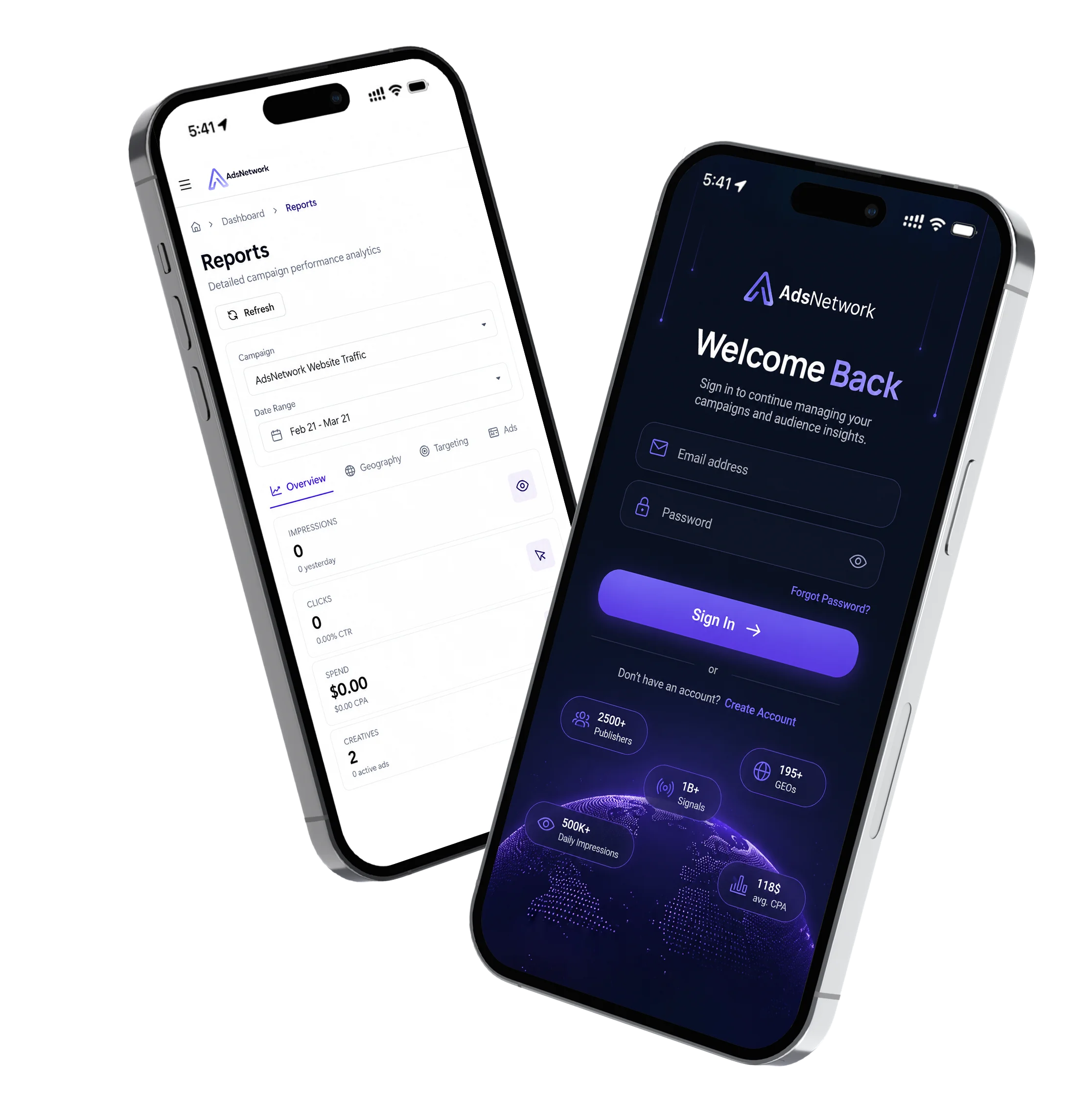
Stay connected to your live AdsNetwork campaigns with our mobile advertising app. Track impressions, clicks, conversions, campaign spend, and overall performance in real time—anytime, anywhere. Available for iOS and Android.