
Programmatic and display advertising are often used interchangeably, but they describe two different parts of digital advertising.
Display advertising refers to the ad format or inventory, while programmatic advertising refers to the way that inventory is bought.
A banner, rich media unit, or other visual ad can be display advertising whether it is purchased directly from a publisher or through a programmatic platform. Programmatic advertising can also be used to buy other types of digital inventory, including video, audio, and connected TV.
In simple terms:
Display = what the ad is.
Programmatic = how the ad is bought.
Understanding this distinction makes it easier to choose the right buying approach and understand where programmatic display fits into your advertising strategy.
Programmatic vs Display Advertising at a Glance
| Programmatic Advertising | Display Advertising | |
|---|---|---|
| What it describes | How advertising inventory is bought | The advertising format or inventory |
| Main purpose | Automate media buying | Deliver visual advertising |
| Typical formats | Display, video, audio, CTV, and more | Banners, HTML5, rich media, video |
| Buying process | Automated | Direct or programmatic |
| Targeting | Often data-driven and automated | Depends on the buying method |
| Can they overlap? | Yes | Yes |
| Example | A DSP automatically bids on an impression | A 300 × 250 banner shown on a website |
The easiest way to understand the relationship is to think of display ad as the ad itself and programmatic ad as the process used to buy the ad.
What Is Display Advertising?
This form of advertising is the broad category of visual ad formats served across websites, apps, and digital media properties. Display advertising commonly includes banners, HTML5 ads, rich media, and other visual ad formats served across websites and apps. This advertisement can be purchased directly from publishers, through ad networks, or programmatically, depending on the campaign and inventory.
A display advertising guide typically covers formats such as banners, HTML5 ads, rich media, and video, along with targeting, costs, and campaign measurement.
How direct display buying works
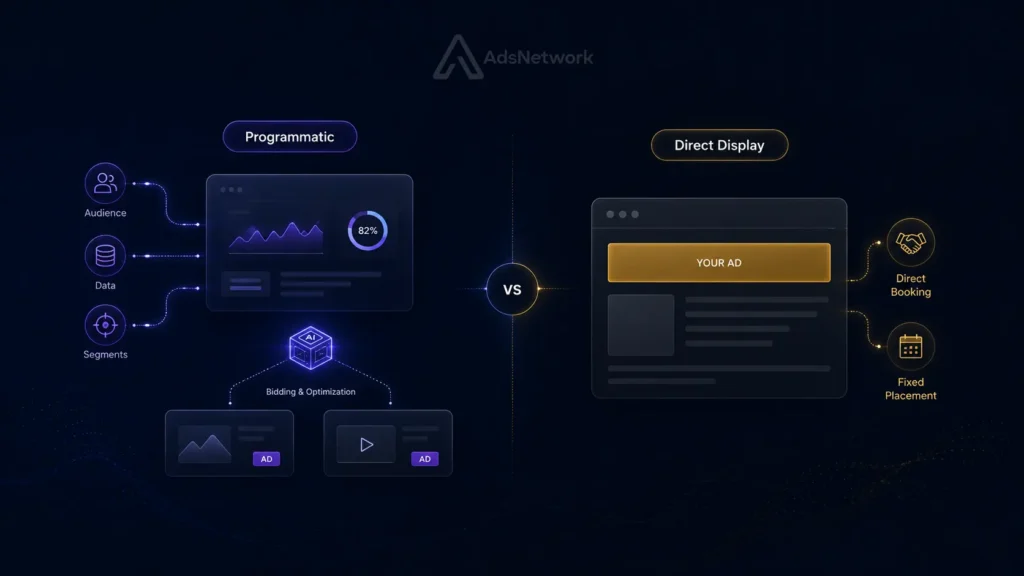
In a traditional display buy, a media planner contacts a publisher or goes through a rep firm. Both sides negotiate the placement, format, run dates, and a flat CPM or fixed fee. The advertiser knows exactly which site will run the ad, when it runs, and how many impressions are guaranteed.
Targeting in a direct display buy is broad by design. You select a site because its audience skews toward your demographic or its content matches your category. In effect, you are buying the placement, not the user. Every visitor to that page sees your ad, regardless of whether they fit your ideal customer profile.
Display ad formats in this model
Common formats bought through direct or ad network channels include:
- Standard IAB banner sizes (leaderboard, medium rectangle, half page)
- Rich media banners with video or interactive elements
- Native placements that match the editorial style of the publisher
- Sponsored content or takeover units negotiated directly with the publication
Direct display still has a clear use case. It offers full placement control, a known publisher environment, and certainty about where your creative surfaces. For brands that require tight editorial alignment or rely on established publisher relationships, it remains a viable channel.
What Is Programmatic Advertising?
Programmatic advertising is the automated buying and selling of digital advertising inventory using software.
Instead of manually contacting publishers and negotiating individual placements, advertisers can use platforms such as demand-side platforms (DSPs) to access available inventory and set campaign parameters such as audience, budget, bid, and targeting.
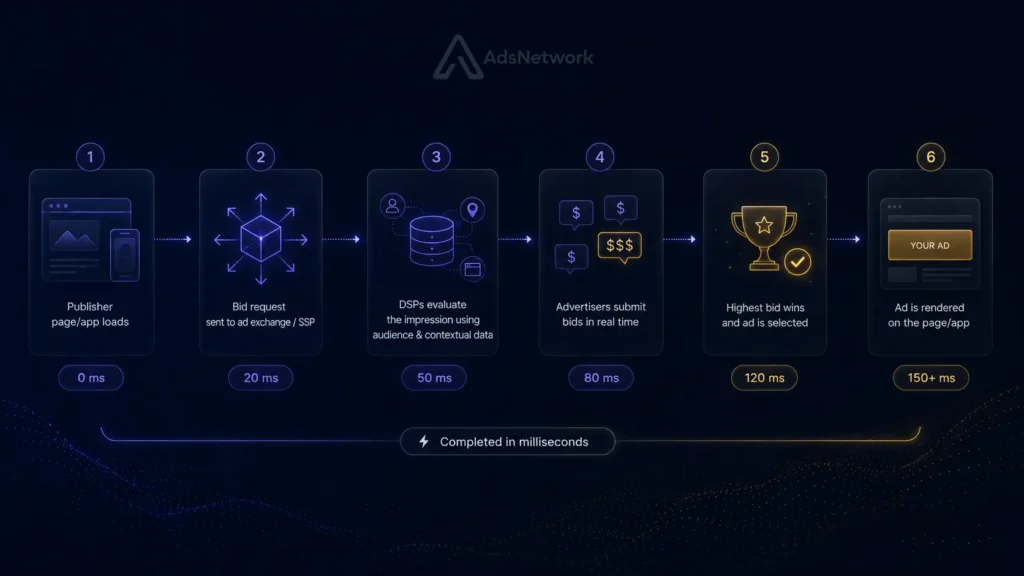
When an eligible ad impression becomes available, programmatic technology can evaluate the impression and determine which advertiser should win it. In real-time bidding environments, this process can happen in milliseconds.
The programmatic ecosystem typically includes:
- DSPs: Platforms advertisers use to buy digital advertising inventory.
- SSPs: Platforms publishers use to make their inventory available to buyers.
- Ad exchanges: Marketplaces that connect buyers and sellers of digital advertising inventory.
Programmatic buying can be used for more than display advertising. Depending on the platform, advertisers can also use it to purchase video, audio, connected TV, and other digital inventory.
Is Programmatic Advertising the Same as Display Advertising?
No.
The two terms describe different parts of the advertising process.
For example, imagine an advertiser wants to show a 300 × 250 banner to people interested in cryptocurrency.
The 300 × 250 banner is the display advertisement.
If the advertiser uses a DSP to automatically bid for impressions where that audience is available, the buying process is programmatic.
So the same campaign can be both:
Display + programmatic
This is known as programmatic display advertising.
Display advertising can also be purchased without programmatic technology. An advertiser might negotiate directly with a publisher for a specific banner placement, agree on a price and campaign dates, and receive guaranteed inventory.
Programmatic buying, meanwhile, can extend beyond display to other formats such as video, audio, and connected TV.
This is why programmatic and display shouldn’t be treated as competing advertising channels. They operate at different levels of the advertising process. Amazon Ads and Salesforce make the same distinction: display refers to the ads themselves, while programmatic refers to the automated process used to buy them.
What Is Programmatic Display Advertising?
Programmatic display advertising combines the two concepts.
It refers to display ads purchased through automated advertising technology.
For example, an advertiser could use a DSP to target users based on location, interests, browsing behaviour, or other available signals and automatically bid on display impressions across relevant websites.
The advertisement remains a display ad. The automated purchase is what makes it programmatic.
Programmatic display can give advertisers access to a larger pool of inventory than negotiating individually with publishers. It can also allow campaigns to adjust bids, targeting, and budget allocation based on performance.
Programmatic vs Direct Display Buying
Display inventory can generally be purchased through direct publisher deals or programmatic channels.
| Direct Display Buying | Programmatic Display | |
|---|---|---|
| Buying process | Negotiated with a publisher | Automated through advertising technology |
| Scale | Usually focused on selected publishers | Can access broader inventory |
| Speed | More manual | Automated |
| Placement control | High for negotiated placements | Depends on the platform and deal |
| Targeting | Often publisher or context based | Can use multiple targeting signals |
| Optimisation | More manual | Can be automated |
| Best suited to | Premium placements and publisher relationships | Scale, targeting, and automation |
Direct Display Buying
With direct buying, an advertiser works directly with a publisher to agree on a placement, price, campaign dates, and other terms.
This approach can be useful when an advertiser wants a specific placement, such as a homepage takeover, category sponsorship, or guaranteed position on a particular website.
The trade-off is that direct deals are generally more manual and less scalable than automated buying.
Programmatic Display Buying
Programmatic buying uses technology to automate the purchase of advertising impressions.
Advertisers can set campaign parameters and allow the platform to evaluate available impressions based on factors such as audience, placement, bid, and budget.
This makes programmatic useful when an advertiser needs to reach audiences across a larger pool of inventory without negotiating individually with every publisher.
When Should You Use Programmatic Advertising?
Programmatic can be a good fit when you want to:
- Reach audiences across multiple publishers
- Scale a campaign efficiently
- Use audience-based targeting
- Automate media buying
- Optimise campaigns based on performance
- Run retargeting campaigns
- Access multiple digital advertising formats
It can be particularly useful when scale and automation matter more than securing a specific publisher placement.
However, programmatic campaigns still require careful management. Advertisers should pay attention to inventory quality, brand safety, frequency, targeting, and campaign performance.
When Should You Use Direct Display Buying?
Direct buying can make more sense when you want:
- A specific publisher
- A guaranteed placement
- A homepage takeover
- A category sponsorship
- A fixed campaign position
- A direct relationship with a publisher
- Greater control over where the advertisement appears
For example, a financial brand may want to appear in a particular section of a highly relevant publisher’s website. A direct deal can provide more certainty about that placement than broad programmatic buying.
Can You Use Programmatic and Direct Buying Together?
Yes. In fact, advertisers don’t necessarily have to choose one approach.
A campaign might use direct buying for premium placements on selected publishers while using programmatic to reach broader audiences across additional inventory.
For example, a brand could negotiate a sponsored placement with a high-value publisher and simultaneously use programmatic display to retarget visitors or reach similar audiences across other websites.
The two approaches can therefore serve different roles within the same advertising strategy.
Conclusion
Programmatic and display advertising aren’t competing concepts. Display describes the ad format or inventory, while programmatic describes how that inventory is bought.
This means a display ad can be purchased directly from a publisher or programmatically through an advertising platform. For many advertisers, using both approaches can provide a balance between placement control and scalable audience reach.
The right choice depends on your campaign goals. Use direct buying when specific publishers or placements matter most, and consider programmatic when automation, targeting, and scale are the priority.
| Ready to run programmatic ads across Web3, crypto, and iGaming audiences? Get Access → |
FAQ: Programmatic vs Display Advertising
Is programmatic the same as display advertising?
No. Display advertising refers to visual advertising formats, while programmatic advertising refers to the automated process used to buy digital advertising inventory.
What is the difference between programmatic and display advertising?
The main difference is that display describes what is being advertised, while programmatic describes how the advertising inventory is purchased.
Can display advertising be programmatic?
Yes. Display ads can be purchased programmatically through platforms such as DSPs. This is commonly referred to as programmatic display advertising.
Featured Posts
Sep 23, 2026
6 min read
What Is Advertising Technology (AdTech) and How Does It Work?
Advertising technology, commonly known as AdTech, refers to the software, platforms, tools, and systems used to plan, buy,…
Read Article
Sep 16, 2026
8 min read
Media Buying: A Complete Guide for Advertisers
Media buying is the process of purchasing advertising space to reach a target audience. It includes choosing where…
Read Article
Sep 7, 2026
7 min read
What Is Display Advertising? Types, Examples, Sizes & Benefits
Display advertising is a form of digital advertising that uses visual ads to promote a brand, product, service,…
Read ArticleNeed Help?
Our team is ready to help you launch successful campaigns.
AI-Powered Mobile
Monitor Your Campaigns Anywhere
Stay connected to your live AdsNetwork campaigns with our mobile advertising app. Track impressions, clicks, conversions, campaign spend, and overall performance in real time—anytime, anywhere. Available for iOS and Android.