
Traffic is not the goal. Revenue is. But without consistent, quality traffic, no online business can generate the leads it needs to convert. The real challenge is not getting visitors to a website. There are dozens of ways to send visitors to any page in large numbers. The real challenge is getting the right visitors: people with a genuine reason to be there, a problem your product solves, and the intent to take action when they arrive.
Not all traffic sources are equal. Some channels send browsers. Others send buyers. Email traffic converts at 19.3%. Social media traffic converts at 1.5%. Consequently, the source of your traffic determines whether your site generates revenue or just burns server costs. This guide covers the best traffic sources for online businesses, conversion benchmarks for each channel, how to evaluate traffic quality, and what changes for crypto and Web3 projects.
Why Traffic Quality Matters More Than Traffic Volume
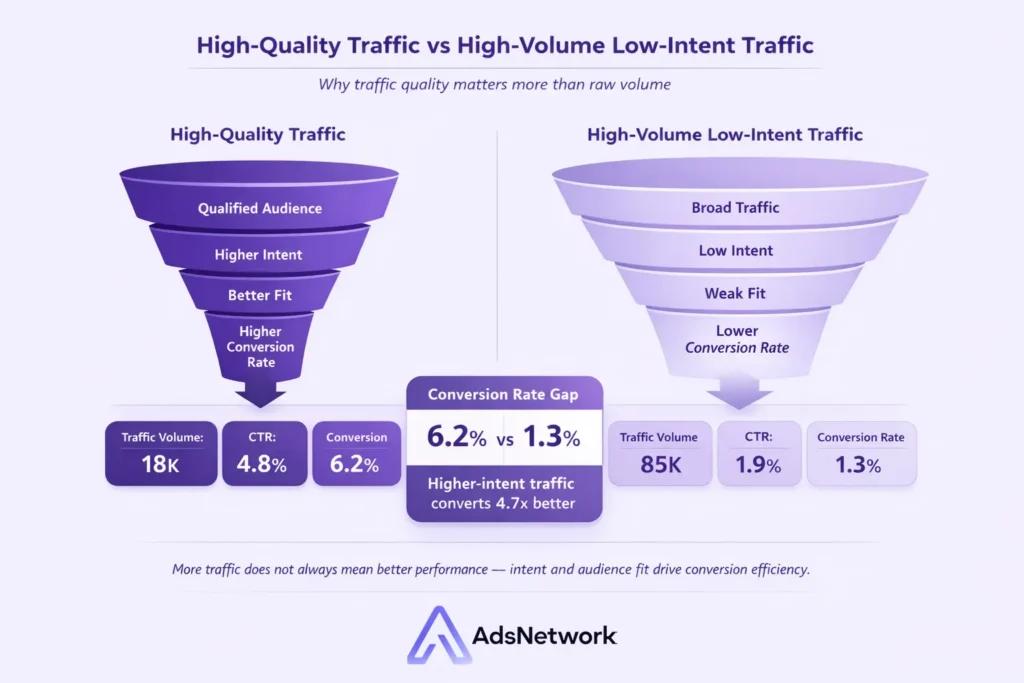
The average website conversion rate across all industries is between 2% and 3%, according to Martal Group benchmarking data. However, that average masks a wide spread. Traffic from email converts at 19.3%. Traffic from social media converts at 1.5%. Consequently, a business generating 10,000 monthly visits from a targeted email list will typically outperform one generating 100,000 visits from poorly targeted social posts. Ten times more traffic, ten times fewer results.
That is what traffic quality means in practice. Consequently, optimizing for traffic volume without understanding source quality is one of the most common budget mistakes online businesses make. For Web3 projects specifically, quality gaps are even more pronounced. Bot traffic, airdrop hunters, and mercenary wallet users can inflate engagement metrics while generating zero sustainable value. Therefore, every strategy in this guide focuses on attracting visitors with genuine intent, not just filling a dashboard with numbers.
What High-Quality Traffic Actually Looks Like
Before optimizing for traffic quality, you need to define what a quality visitor looks like for your specific site. A quality visitor for an ecommerce store is someone close to a purchase decision. For a SaaS product, it is someone experiencing the problem your software solves. For a DeFi protocol, it is a wallet holder actively looking for yield or liquidity opportunities.
Traffic quality can be measured through several proxies: time on site, pages per session, bounce rate, and most importantly, conversion rate by source. Specifically, segment your analytics by traffic channel and examine which sources produce the highest conversion rates. That data tells you where your highest-quality visitors are already coming from, and therefore where to invest more.
In contrast, sources with high volume but low conversion rates deserve a different analysis. Low conversion might mean the audience is wrong, the landing page is misaligned, or the offer is unclear. Furthermore, diagnosing which problem applies before cutting or scaling any channel is essential. Cutting a channel too early based on volume alone is one of the most common optimization mistakes.
Traffic Source Conversion Benchmarks at a Glance
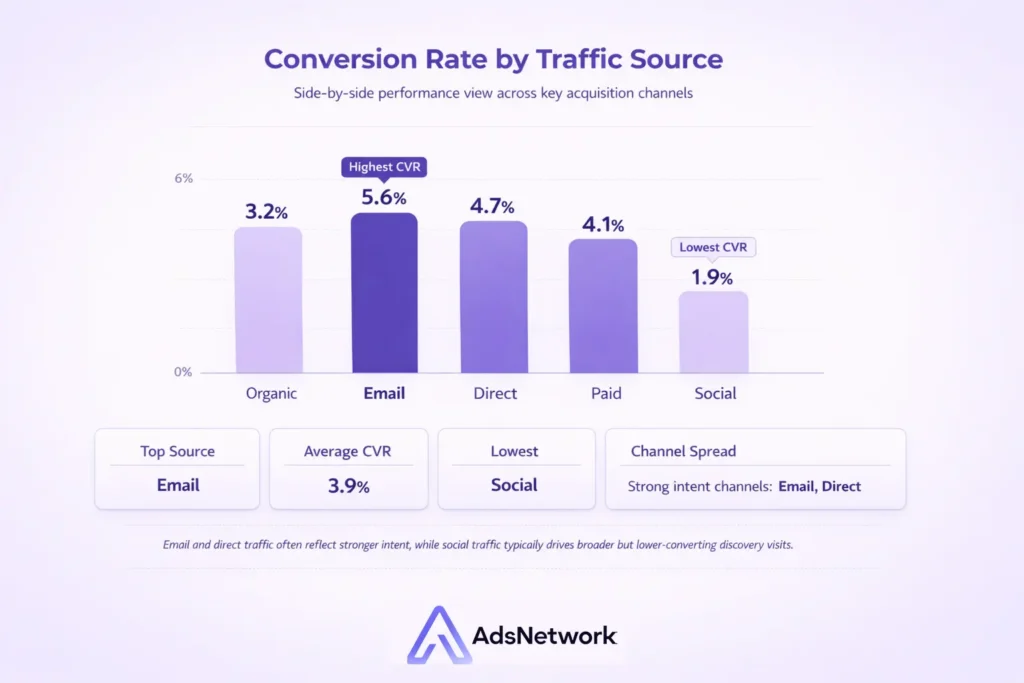
Before covering each channel in depth, here is a side-by-side comparison of average conversion rates across the best traffic sources. These figures come from multiple independent research sources and represent averages across industries.
- Email traffic: 19.3% conversion rate (Genesys Growth)
- Direct traffic: ~3.3% conversion rate (Keywords Everywhere)
- Referral traffic: ~2.9% conversion rate (Martal Group)
- Organic search: ~2.7% conversion rate (Ruler Analytics)
- Paid search: ~1.5 to 2.0% conversion rate (Martal Group)
- Social media: ~1.5% conversion rate (Ruler Analytics)
These benchmarks are starting points, not fixed targets. Your actual conversion rates depend on how well your content, offer, and landing pages serve each traffic type. However, the ranking is consistent across sources: email and direct traffic convert best; social media converts least. Understanding this hierarchy is therefore the most important starting point for any traffic strategy review.
Organic Search: High-Intent Traffic at Scale
Organic search is the largest single traffic source for most online businesses. Demand Sage data shows that organic search accounts for 53% of all website traffic across the web. It is also one of the highest-converting channels. Research from Ruler Analytics puts the average conversion rate for organic search at 2.7% across industries. And 49% of marketers say it is the most profitable channel they use.
The appeal of organic search is compounding returns. A well-ranked piece of content brings traffic month after month without additional spend. The cost per visit drops over time as the content accumulates authority. As a result, organic search is one of the best long-term investments for any online business with the patience to build it properly.
To attract high-quality organic traffic, keyword strategy must prioritize intent over volume. High-intent keywords signal commercial or transactional purpose. For example, “best DeFi yield aggregator” carries far stronger purchase intent than “what is DeFi.” The first visitor is evaluating options. The second is still learning the category. Additionally, content depth matters. The average first-page result on Google contains 1,447 words, according to Digital Silk. Comprehensive, specific content ranks better and attracts visitors serious enough to read it.
The drawbacks are real. Organic search takes time. New pages rarely rank within the first three months. Algorithm updates can reset months of work. Furthermore, AI Overviews now reduce clicks by 58% on affected queries, per Ahrefs. That does not make organic search less valuable. It makes the content strategy behind it more important.
Organic Search for Crypto and Web3 Projects
For crypto and Web3 projects, organic search is a critical long-term channel. Protocol documentation, explainer content, and comparison pages all capture users actively researching blockchain products. That intent is high. For example, a user searching “how to stake on Ethereum” is further down the decision path than a social media browser. Consequently, organic search consistently produces some of the best-qualified visitors any Web3 project can attract without ongoing ad spend.
Email: The Highest-Converting Traffic Channel
Email is the most underrated traffic source for online businesses that already have an audience. The conversion numbers are exceptional. Research from Genesys Growth found that email traffic converts at 19.3%, the highest of any channel. That is 77% higher than paid search performance on the same landing pages.
The ROI benchmark reinforces this. Email marketing generates between $36 and $42 for every $1 spent, according to Litmus benchmarks cited by InboxAlly. No other traffic source consistently approaches that return. However, email traffic requires an existing list. It is not a new audience acquisition channel. It is therefore a retention and conversion channel for audiences you have already earned through other means.
Building that list takes time, but once it exists, email compounds in a way that paid traffic cannot replicate. Every subscriber is a future source of high-intent traffic that costs nothing to reach again. In contrast to paid traffic that stops when the budget runs out, an email list grows more valuable over time. Similarly, the segmentation and personalization available in email produce far more relevant messaging than any channel that relies on audience estimates rather than known subscribers.
Email for Web3 Community Retention
For Web3 projects, email is a powerful channel for community retention. Wallet holders who subscribe receive updates on governance proposals, protocol upgrades, and product releases. That regular contact keeps qualified users engaged between active on-chain events, reducing churn and maintaining a warm, high-intent audience. Because early-stage protocols often experience long gaps between major on-chain activity cycles, email is frequently the thread that holds a community together. Furthermore, email allows segmentation that community channels cannot: wallet holders can receive different messages than non-wallet subscribers based on their on-chain activity level.
Paid Traffic: Qualified Reach When Targeted Correctly
Paid traffic sources, including search ads, display advertising, and paid social, deliver immediate reach. You set a budget, launch a campaign, and traffic starts the same day. That speed is the primary advantage over organic channels, which require months to build momentum. Consequently, paid traffic is also the fastest way to test a new offer, product page, or audience. Run a campaign, measure the conversion rate, and know within weeks whether the hypothesis holds.
However, paid traffic quality depends entirely on how well the targeting matches the audience with the offer. Paid search converts at an average of 1.5 to 2% across industries, lower than organic search on average. But paid placements reach audiences who were not yet looking for your specific brand. Well-targeted paid campaigns can deliver consistently high-quality visits at predictable cost. The key is specificity: broad keywords attract researchers; specific, long-tail keywords attract buyers.
Display advertising serves a different purpose: it builds awareness and retargets warm audiences rather than capturing intent directly. At roughly 90% of digital display ad spend now traded programmatically, display campaigns have become highly automated. The best-performing display strategies combine top-of-funnel awareness with retargeting sequences for users who have already visited the site. For a complete guide to building retargeting campaigns that convert, see our guide to retargeting ads strategy that converts.
Paid Traffic for Crypto and Web3 Projects
The constraint for crypto and Web3 projects is policy. Google and Meta restrict most direct crypto advertising to pre-approved accounts. Most token projects, DeFi platforms, and NFT products are blocked outright on mainstream networks. Consequently, that is why crypto-native ad platforms exist. AdsNetwork connects crypto advertisers to blockchain-native audiences across display and native formats without the policy friction that mainstream platforms impose.
Additionally, wallet-based targeting through platforms designed for the Web3 ecosystem reaches verified on-chain users. These audiences are active participants, not just crypto-curious browsers. That distinction makes them among the highest-quality paid traffic sources available to any blockchain project.
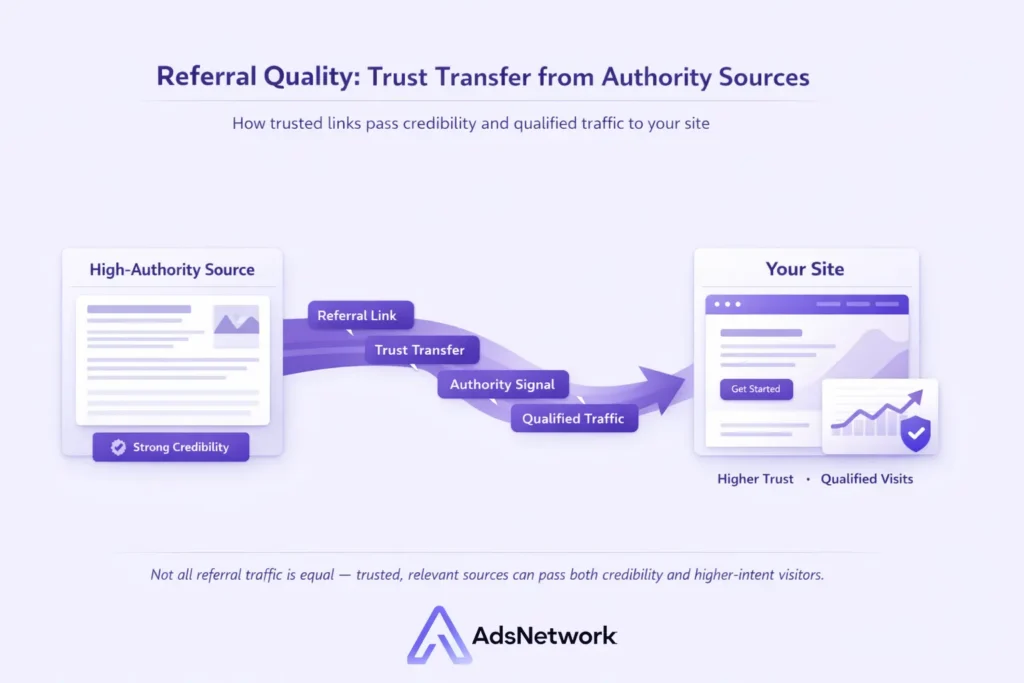
Referral Traffic: Borrowed Trust That Converts
Referral traffic arrives when another site links to yours and a user clicks that link. It includes directory listings, press mentions, review sites, partner links, and community posts. The conversion quality is strong. Martal Group benchmarks show referral traffic converting at around 2.9%, above the overall industry average. Specifically, that above-average rate reflects the context in which the user arrived.
That performance reflects context. A user arriving from a trusted review site or editorial mention carries a pre-formed positive signal about your brand. The publication vouched for the visit before the user even arrived. Moreover, referral links also build domain authority, improving organic search rankings over time. The two benefits compound: better referral traffic today, and better organic traffic quality in the months that follow. In particular, links from high-authority domains in your specific niche deliver significantly more SEO value than general directory placements.
Referral traffic is difficult to engineer at scale, but it rewards the same investments that build organic search authority. Publishing quality content, earning placement in relevant directories, and getting mentioned in industry media all generate referral links. Furthermore, these activities compound over time: the domain authority earned from referral links improves organic search rankings, making both channels stronger simultaneously.
Crypto Media and Referral Quality
For crypto projects, referral traffic from crypto media is particularly valuable. Coverage on CoinTelegraph, Decrypt, The Block, or BeInCrypto sends audiences already deep in the Web3 ecosystem. A trusted crypto publication carries more weight with DeFi users than a general finance mention. Similarly, a positive review on a DeFi aggregator or token analytics platform sends users who are actively evaluating similar products, making them among the most qualified cold audiences any protocol can attract.
Social Media Traffic: Reach and Community Over Conversion
Social media drives awareness and community more than direct conversions. The conversion benchmarks reflect this. Social media traffic converts at an average of 1.5% across industries, according to Ruler Analytics. That is lower than organic search, email, and referral. However, paid social adds targeting precision that can improve results on specific audiences, even though the fundamental dynamic of this channel remains upper-funnel.
That does not make it less valuable. For brand building, community growth, and audience development, social media is unmatched. Facebook accounts for 71.58% of social media referral traffic globally, according to Demand Sage. Additionally, Instagram, X (formerly Twitter), and LinkedIn fill specific roles depending on your industry and audience profile, making the right platform selection more important than simply being active on all of them.
The important rule with social traffic is not to optimize campaigns for direct conversion. The conversion rate will always disappoint relative to search or email. Instead, optimize social for reach, engagement, and audience growth. Then let retargeting and email do the conversion work downstream. In particular, the audiences built through social engagement become the most responsive segments for email and retargeting campaigns, making social media a valuable first step in a multi-channel acquisition funnel.
Crypto’s Social Media Landscape
In the crypto space, X remains the dominant organic social channel for real-time project news and KOL amplification. Discord and Telegram serve community retention functions rather than traffic acquisition. TikTok and YouTube Shorts are growing channels for reaching younger crypto audiences through educational short-form content. Furthermore, because crypto audiences on these platforms are highly skeptical of promotional content, organic community-driven posts consistently outperform paid social placements for trust-building and quality engagement. Specifically, user-generated content and KOL posts outperform brand-posted promotional content by a significant margin on every crypto-adjacent social platform.
Direct Traffic: The Signal That Everything Else Is Working
Direct traffic arrives when someone types your URL into a browser or clicks a bookmark. It is not a traffic source you can buy or build with a campaign. It is the result of everything else working.
Direct traffic has the highest intent of any source. Users who navigate directly to your site already know your brand and have a reason to visit. Conversion rates for direct traffic average around 3.3%, above any paid channel benchmark. However, a growing share of direct traffic is also misattributed. Clicks from social posts, messaging apps, or dark social channels like Slack or WhatsApp often register as direct. Consequently, treat it as a directional signal of brand recognition, not a precise channel measurement.
For crypto projects, direct traffic growth is a reliable indicator of community health. When protocol users navigate directly to your documentation or governance portal, the product is embedded in their regular workflow. As a result, that is the kind of engagement that sustains a protocol through market downturns and slow news cycles, since it reflects genuine utility rather than speculative interest.
How to Build a Traffic Mix That Converts
No single traffic source is sufficient for a mature online business. The best-performing businesses combine channels strategically, with each source serving a different role in the acquisition and retention funnel. Specifically, the interplay between channels is as important as the performance of each one individually.
A practical framework for traffic channel allocation by funnel stage:
- Awareness: paid display, social media, short-form video, and crypto-native ad networks for broad reach
- Consideration: organic search, referral from trusted publications, and content marketing for high-intent visitors
- Conversion: email sequences, retargeting campaigns, and direct traffic for audiences already familiar with the brand
- Retention: email newsletters, community channels, and direct product communications for existing users
The interplay between channels is as important as the performance of each one individually. For a detailed breakdown of the tradeoffs between paid and organic strategies, see our analysis of paid traffic vs organic traffic. Organic search and referral build the long-term foundation. Paid traffic provides immediate reach and rapid testing. Email converts the audience built by both. Social media maintains top-of-mind presence and community engagement.
How Crypto and Web3 Projects Attract High-Quality Traffic
Crypto and Web3 audiences are among the most skeptical on the internet. They have seen rug pulls, hollow launches, and communities built entirely on speculation. As a result, traffic quality for Web3 projects depends heavily on trust signals that mainstream businesses do not need to emphasize. Volume without credibility converts at near-zero rates in this space.
The highest-quality crypto audiences come from three primary sources. First, organic search from protocol documentation and educational content attracts users who are already researching the category seriously. Second, referral traffic from respected crypto publications brings pre-qualified readers who trust the publication’s editorial judgment. Third, community channels like Discord and X provide warm, engaged audiences who are already following the project actively. Notably, these three sources often reinforce each other: organic content earns media coverage, which drives referral traffic and community growth simultaneously.
Additionally, wallet-based targeting through platforms designed for the Web3 ecosystem reaches verified on-chain users. These audiences are not just crypto-curious. They are active participants. That distinction makes them among the highest-quality traffic sources available to any blockchain project. As a result, AdsNetwork serves this role for paid acquisition, connecting Web3 advertisers with crypto-native audiences already engaged with blockchain products.
Best Traffic Sources: Matching the Right Channel to Your Goals
The best traffic sources for your online business depend on your stage, objectives, and audience. The data provides a clear hierarchy: email and direct traffic convert best; organic search and referral convert consistently; social media builds reach. Understanding where each channel performs and where it does not therefore shapes every investment decision that follows.
Traffic quality is not a single lever you can pull. It is the result of every targeting, creative, and channel decision you make. Organic search delivers quality through keyword intent. Email delivers quality through prior consent and relationship. Paid traffic delivers quality through precise targeting. Referral delivers quality through borrowed trust. The common thread across all of these channels is relevance: the right person, the right message, the right context. Ready to drive high-quality traffic from crypto-native audiences? Visit 51.254.143.217/ to explore campaign options designed for Web3 advertisers.
Featured Posts
Oct 23, 2026
10 min read
What Is CPM in Advertising? Meaning, Formula and 2026 Rates
CPM is the cost an advertiser pays for 1,000 ad impressions, making it one of the most common…
Read Article
Sep 23, 2026
6 min read
What Is Advertising Technology (AdTech) and How Does It Work?
Advertising technology, commonly known as AdTech, refers to the software, platforms, tools, and systems used to plan, buy,…
Read Article
Sep 16, 2026
8 min read
Media Buying: A Complete Guide for Advertisers
Media buying is the process of purchasing advertising space to reach a target audience. It includes choosing where…
Read ArticleNeed Help?
Our team is ready to help you launch successful campaigns.
AI-Powered Mobile
Monitor Your Campaigns Anywhere
Stay connected to your live AdsNetwork campaigns with our mobile advertising app. Track impressions, clicks, conversions, campaign spend, and overall performance in real time—anytime, anywhere. Available for iOS and Android.