

Search CPA marketing and you will mostly find articles written for affiliates: how to pick offers, join networks, and run them for commission. That is a real business, but it is not this one. This is CPA marketing for advertisers, the people paying for those actions, not the ones chasing them.
From the advertiser’s chair, CPA looks very different. The question is not which offers pay the most. It is what a completed action actually costs you, when paying per action beats paying per click, how to set a target that does not wreck your margin, and where CPA quietly goes wrong. Where affiliates ask how to profit from an offer, advertisers ask what that offer is costing them. Media buyers know that last part. Affiliate guides never mention it.
Performance-based buying is mainstream now, not niche. US affiliate and performance marketing spend passed roughly $12 billion in 2025, per Statista. This guide covers CPA marketing end to end from the buyer’s side of the table: the model, the math, the fraud, and the verticals where it earns its place.
What Is CPA Marketing?
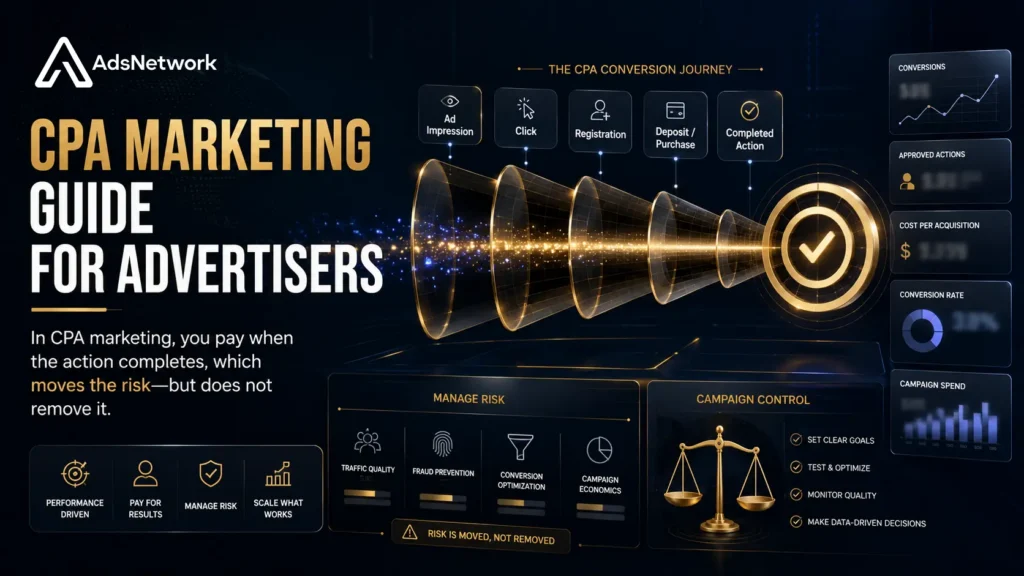
What is CPA marketing? CPA marketing is a pricing model where you pay only when a defined action is completed. The acronym stands for cost per action, and it is sometimes read as cost per acquisition. Advertisers use both readings interchangeably, and in practice they mean the same thing: money changes hands on the action, not before it.
The action is whatever you define. It might be a sign-up, an app install, a deposit, a sale, or a qualified lead. No completed action, no charge. That is the entire appeal, and also the source of every problem later in this guide.
Set against the other pricing models, the contrast is clean. CPM means you pay per thousand impressions, whether or not anyone acts. CPC means you pay per click, whether or not the click converts. CPA means you pay per completed action, and nothing until then. Each model parks the risk in a different place, and choosing one is really a choice about who carries that risk.
The two readings of the acronym are worth pinning down, because they change what you are actually buying. Cost per action can mean any event you nominate, including shallow ones like a page view or a click-through. Cost per acquisition usually means a deeper event: a real customer. In practice, the depth of the action you choose decides how much of CPA marketing works for you and how much of it works against you, a theme that runs through the rest of this guide.
How Does CPA Marketing Work?
CPA advertising runs on a simple exchange of risk. The advertiser defines the action and the payout. A publisher or network drives the traffic. When someone completes the action, tracking fires, and the advertiser pays the agreed amount for that validated action.
Tracking is the whole game. In CPA advertising, a conversion is usually recorded by a postback, meaning a server-to-server or S2S signal, or by a pixel that fires on the confirmation page. If that tracking is wrong, everything downstream is wrong. Break attribution and you break CPA, because you end up paying for actions you cannot verify, or missing ones you should have credited.
Who carries the risk explains the pricing. With CPM and CPC, the advertiser carries delivery risk, since you pay for impressions or clicks that may never convert. With CPA, the publisher carries that risk, because they only get paid on a conversion. That is why CPA payouts are higher per unit than a click or an impression. You are buying certainty, and certainty always costs more.
The attribution window is part of that machinery, and it quietly decides who gets paid. A window is the period after a click or view during which a conversion still counts. Set it too wide and you pay for actions your ads did not really cause. Set it too narrow and you deny publishers credit they earned, and they stop sending you traffic. Agree the window up front, in writing, before a single dollar moves.
When to Use CPA vs CPC vs CPM
No model is best in the abstract. Each one fits a situation, and picking well is half the battle.
| Model | You pay for | Best when | Main risk to you |
|---|---|---|---|
| CPA | A completed action | Offer is proven, tracking is clean, budget is risk-averse | Fraud and low-quality actions |
| CPC | Each click | Testing creative, driving traffic, funnel unproven | Clicks that never convert |
| CPM | 1,000 impressions | Awareness, reach, brand presence | Paying for unseen or unsold attention |
CPA fits a proven offer with clean tracking and a clearly defined conversion, especially when the budget cannot absorb waste. CPC fits testing, unproven funnels, and driving qualified traffic you will convert yourself. CPM fits awareness and reach, where the goal is presence rather than an immediate action.
The models are not mutually exclusive, either. Many advertisers blend them: test creative and audiences on CPC, then move the proven winners to CPA once the funnel converts predictably. Hybrid deals exist too, such as a smaller CPA payout paired with a revenue share, which splits the risk between advertiser and publisher rather than dumping it entirely on one side. Treat the model as a dial, not a switch.
One honest caveat that affiliate content skips: CPA deals are harder to get and often lower in volume. Publishers price risk in, so they favor CPC or CPM unless your offer converts reliably. A brand-new funnel rarely earns premium CPA inventory, because the publisher has no reason to trust it yet. For a full head-to-head on all three, see our comparison of CPM vs CPC vs CPA.
How to Set a CPA Target That Protects Your Margin
This is the section affiliate content never writes, and it is where the money is made or lost. Your CPA target is not a number you copy from a benchmark. You work it out from your own economics, or you set yourself up to lose money efficiently.
Start from lifetime value and work backwards. Your target CPA has to sit below your contribution margin per customer, not below revenue. Revenue is not yours to spend. Margin is. Anchor the target to margin and you cannot accidentally buy customers at a loss.
A worked example (illustrative, not a benchmark)
Here is an illustrative example, not an industry benchmark. Say a new customer is worth $200 in first-year revenue, and your contribution margin is 40%, which is $80 per customer. That $80 is your ceiling. Pay more than that to acquire them and the first year loses money on every sale. In practice you set the target below the ceiling, perhaps $50, to leave profit and a buffer for customers who churn early. The exact figures are yours. The logic is universal.
Two more factors move the target. The first is your payback window: if you can wait longer to recoup the cost, you can pay more per action, so a 12-month payback tolerates a higher CPA than a 1-month one. The second is blended versus channel CPA. Your blended average hides your worst channels, so judge each channel on its own CPA, or the good ones quietly subsidize the bad ones.
Test into the target, then tighten
In practice you rarely nail the number on day one. Most advertisers test into a CPA target rather than setting it from a spreadsheet alone. Start on CPC or a conservative CPA, gather real conversion and retention data, then tighten the target as you learn what a funded, retained customer truly costs. Cash flow matters here too: paying on action is easier on the wallet than paying up front, because spend and revenue move closer together in time.
There is a trap on the other side, too. An aggressive CPA target starves volume. Set it too low and publishers cannot deliver profitably, so they simply stop sending traffic, and you are left with a beautiful CPA on almost no conversions. The right target balances efficiency against scale. To push the margin side of the equation further, our guide to how to increase ROAS goes deeper on the math.
The CPA Problem Nobody Talks About: Fraud and Quality
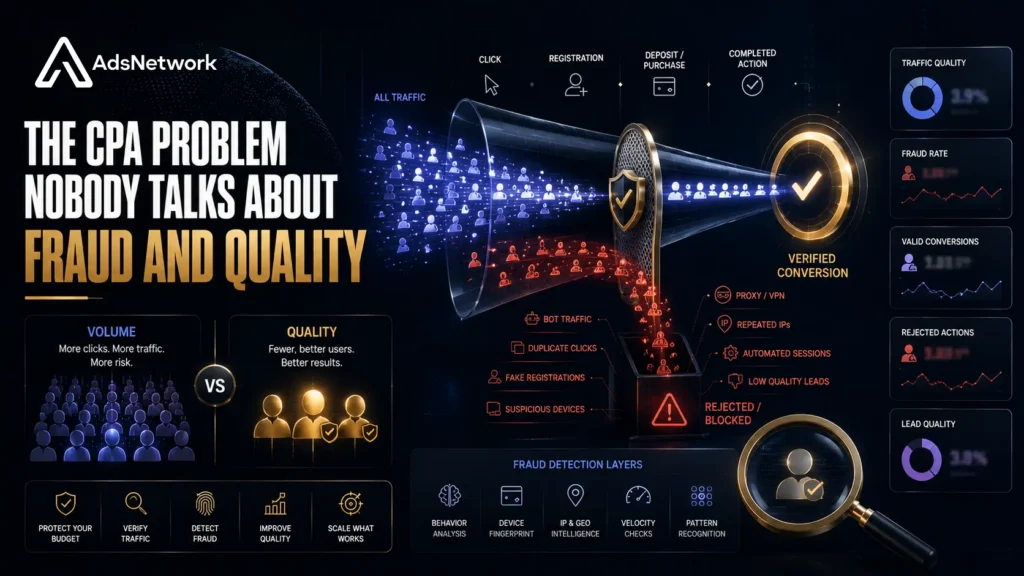
CPA has a dark side that affiliate guides never cover: it attracts fraud like no other model. The reason is structural. In CPA, the payout is the target, so the incentive is to fake the action. In CPM you fake impressions and in CPC you fake clicks, but in CPA you fake conversions, which is worse, because a fake conversion looks exactly like a real one in your dashboard.
The scale is not trivial. Juniper Research projects global ad fraud losses to pass $100 billion in 2026, as widely reported. Incentivized, CPA-style traffic sits at the high-risk end of that range, because the reward for faking an action is immediate and direct.
The quality problem takes several forms: incentivized traffic, where users are bribed to complete an action they do not care about; bot-driven conversions; cookie stuffing; and slow lead-quality decay, where the actions technically fire but never turn into paying customers.
The damage runs deeper than the wasted payout. Fake conversions poison the data your optimization depends on. Feed a bidding algorithm a diet of fraudulent actions and it learns to chase more of them, scaling the exact traffic that will never convert. That is the hidden tax on sloppy CPA marketing: you do not just lose the money on the fake action, you train your whole account to waste more. Clean data is not a nice-to-have here, it is the difference between a program that compounds and one that quietly rots.
How to defend CPA marketing from fraud
The defences are practical, and none of them are exotic:
- Postback validation, so only confirmed, verified actions trigger a payout.
- Conversion quality scoring, to separate real actions from noise before you pay for them.
- Hold periods, so you can claw back reversed or fraudulent actions inside a review window.
- Source-level reporting, so you can see which publisher or placement drives quality versus junk.
- Transparent partners, meaning a CPA network that shows you sources instead of hiding them.
That last point matters most. A CPA network that will not show you source-level data is asking you to trust a black box, and black boxes are where fraud hides. The advertisers who win on CPA insist on transparency. Platforms like AdsNetwork provide source-level reporting precisely so you can police quality yourself, rather than taking a vendor’s word for it.
Which Verticals Work Best on CPA
Model theory only takes you so far. Whether CPA earns its place depends heavily on the vertical, because the shape of the conversion changes from one industry to the next, and so does the ease of faking it.
CPA fits some verticals far better than others. The pattern is consistent: it works where the action is clear, valuable, and hard to fake at scale.
- iGaming. The classic CPA action is the first-time deposit, or FTD. Payouts are large and the event is unambiguous, which makes iGaming the archetypal CPA vertical.
- Crypto. The action is a verified sign-up or first deposit, but KYC drop-off complicates it. A raw sign-up may never verify, so define the CPA action past identity verification.
- Finance and fintech. The action is usually a qualified lead or a completed application. Lead quality is the entire battle, so score it before you pay for it.
- Gaming. Install or first in-app purchase. Installs are cheap to fake, so the first purchase is the safer action to pay on.
- SaaS. A free trial or a booked demo. The trap is trials that never convert to paid, so tie the CPA to a qualified trial, not any trial.
Across every one of them, the rule repeats: define the action deep enough that faking it is hard and a paid action means a real customer. Shallow actions invite fraud. Deep actions filter it out.
Running CPA Campaigns with AdsNetwork
AdsNetwork supports performance buying across the funnel, with the transparency CPA demands. It runs formats from native to display to push, offers source-level reporting so you can see quality by placement, and supports postback and S2S tracking so your CPA actions fire cleanly and pay out only when they should.
Getting started is straightforward:
- Define your action and payout. Pick a conversion deep enough to mean a real customer.
- Set your CPA target from margin. Work backwards from contribution margin, not revenue.
- Load tracking and confirm postbacks. Test that conversions fire before you spend at scale.
- Launch and watch the source, not the average. Judge each placement on its own quality, not the blended CPA.
- Cut junk, scale winners. Kill sources that deliver low-quality actions and pour budget into the ones delivering customers.
The discipline from the rest of this guide still applies. What the platform adds is source-level visibility and clean tracking, which are exactly the tools CPA needs to work in your favor rather than against you.
| Ready to run CPA campaigns with real source-level transparency?Get Access → |
Frequently Asked Questions
What is CPA in advertising?
What is CPA in advertising? CPA, meaning cost per action or cost per acquisition, is a pricing model where the advertiser pays only when a defined action completes, such as a sign-up, install, deposit, or sale. The publisher carries delivery risk, which is why CPA payouts run higher per unit than clicks or impressions.
How does CPA marketing work?
How does CPA marketing work? The advertiser defines an action and a payout, a publisher or network drives traffic, and tracking fires when someone completes the action. The advertiser then pays per validated action, usually confirmed by a server-to-server postback or a pixel. Clean tracking is essential, because broken attribution breaks the entire model.
What is a good CPA for advertising?
What is a good CPA for advertising? A good CPA is any target that sits comfortably below your contribution margin per customer, not below revenue. There is no universal number, because it depends on your margins, lifetime value, and payback window. Work backwards from your own economics rather than copying an industry benchmark.
Is CPA better than CPC?
Is CPA better than CPC? Neither is universally better. CPA suits proven offers with clean tracking and risk-averse budgets, since you pay only for results. CPC suits testing, unproven funnels, and driving qualified traffic you convert yourself. Many advertisers test on CPC, then move proven offers to CPA once the funnel is reliable.
CPA Marketing: Move the Risk, Not the Discipline
CPA moves risk from you to the publisher, but it does not remove it. It changes shape. The delivery risk you avoid comes back as fraud risk and quality risk, and the target you set decides whether the model makes money or quietly loses it. The advertisers who win on CPA do two things well: they set the target from margin rather than a benchmark, and they police conversion quality at the source. Do both, and CPA marketing becomes one of the most efficient ways to buy growth. Skip either, and you are just paying a premium to be defrauded more precisely.
| Build a CPA program on clean tracking and source-level transparency.Get Access → |
Featured Posts
Oct 23, 2026
10 min read
What Is CPM in Advertising? Meaning, Formula and 2026 Rates
CPM is the cost an advertiser pays for 1,000 ad impressions, making it one of the most common…
Read Article
Sep 23, 2026
6 min read
What Is Advertising Technology (AdTech) and How Does It Work?
Advertising technology, commonly known as AdTech, refers to the software, platforms, tools, and systems used to plan, buy,…
Read Article
Sep 16, 2026
8 min read
Media Buying: A Complete Guide for Advertisers
Media buying is the process of purchasing advertising space to reach a target audience. It includes choosing where…
Read ArticleNeed Help?
Our team is ready to help you launch successful campaigns.
AI-Powered Mobile
Monitor Your Campaigns Anywhere
Stay connected to your live AdsNetwork campaigns with our mobile advertising app. Track impressions, clicks, conversions, campaign spend, and overall performance in real time—anytime, anywhere. Available for iOS and Android.