
Web3 game advertising has a structural problem, and it is not the creative. It is the channels.
Studios usually discover this the hard way, a few weeks into a launch campaign, when the install numbers look fine and nobody is playing.
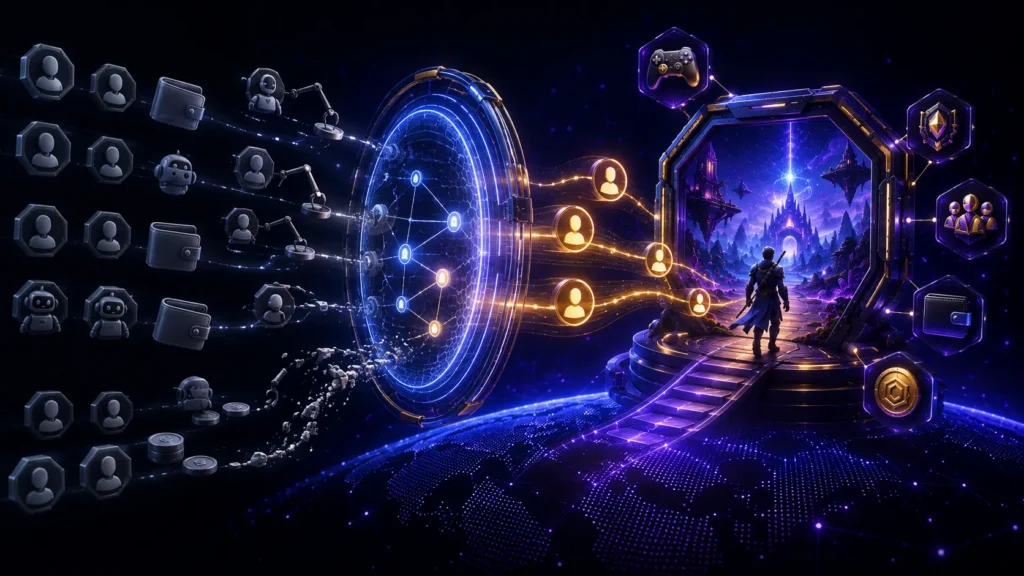
A Web3 game has to recruit from two different populations. There are gamers, who may hold no crypto and care only whether the game is good. And there are crypto users, who understand wallets and tokens but may not be gamers at all. Those groups sit in different places, respond to different messaging, and rarely overlap as much as pitch decks assume.
The channels make it harder. Mainstream game user acquisition networks restrict token mechanics, so the places built to drive installs will not run half your message. Meanwhile, generic crypto ad networks reach traders and speculators, not players. Studios end up choosing between reach and relevance.
This guide covers how to advertise a Web3 game across both worlds. We work through the channel map, the formats that drive installs, the targeting problem that separates players from farmers, and how to structure Web3 game advertising by launch phase.
Why Advertising a Web3 Game Is Different
Three things make blockchain game marketing unlike either standard game UA or standard crypto advertising. Each one changes how you plan a Web3 game advertising campaign, and each one is easy to miss if you have only worked on one side of the divide.
The dual-audience problem
You are acquiring two user types, and they want different things. Players want a game worth their time: mechanics, art, progression, community. Token holders want an asset with a future. Sometimes they are the same person. Often they are not, and their incentives can actively conflict, since a holder optimising for asset value is not always a player optimising for fun.
Most studios pick one audience by accident, usually by writing creative that speaks to holders because that is who funded the round. Then they wonder why retention looks poor. Decide deliberately which audience each campaign serves.
A practical way to handle it is to run separate campaigns rather than one blended message. Player campaigns lead on gameplay and live on gaming inventory. Holder campaigns speak to the economy and live on crypto inventory. Splitting them keeps the messaging honest to each group, and it lets you compare which audience actually retains once the launch noise dies down.
Mainstream game UA channels restrict token mechanics
The big install-driving platforms will run Web3 games, but with rules that shape your creative. Google Play permits tokenized assets while requiring developers to disclose blockchain elements and, per its policy update, explicitly stating that developers may not promote or glamorize any potential earning from playing or trading activity. Apple’s rules are tighter still on external purchase flows.
Read that restriction carefully, because it is not just a compliance box. It is a strategy instruction. The platforms that deliver the most installs will not let you advertise earnings, which means your creative has to sell the game on its own merits anyway. Policy and good practice point the same direction here.
The mercenary farmer problem
Earnings-led acquisition works, briefly. It brings in users who extract value and leave the moment a better opportunity appears. They inflate your launch metrics, drain your token economy, and churn.
The scale of that distortion is well documented. Analysts have found that bots and farmers accounted for a large share of activity in some Web3 titles, with reporting on the sector noting that in certain top games on one major chain, bots made up around 70% of monthly active users. Numbers built on that foundation tell you nothing about whether anyone is playing.
The market context matters too. Blockchain gaming still draws millions of daily active wallets, roughly 4.66 million per day in one recent quarter, but DappRadar’s own assessment is blunt: despite holding the top spot among dapp categories, Web3 gaming struggles to attract gamers. Wallet counts are not player counts, and advertising that optimises for the former buys you the wrong users.

Where to Reach Web3 Gamers
Because your audience lives in two worlds, a Web3 game advertising plan needs presence in both. Buying only crypto inventory gets you speculators. Buying only gaming inventory limits your reach among the crypto-native users most likely to understand wallets and onboarding.
A specialist crypto ad network covers the Web3 side: crypto news sites, analytics dashboards, and Web3 gaming media, where audiences already have wallets and know what an in-game asset is. That solves onboarding friction, since these users do not need convincing that a wallet is safe to connect.
The full channel map for Web3 game advertising looks like this:
- Crypto and Web3 ad networks. Reach the crypto-native side, on inventory that welcomes token mechanics.
- Gaming and Web3-gaming media. Games portals, review sites, and GameFi publications, where the reader is a player first.
- Native placements on gaming and crypto editorial. Editorial context does the trust work a banner cannot, which matters for a category with a mixed reputation.
- Push for re-engagement. Season starts, events, and content drops, aimed at players who already installed.
- Owned channels. Discord, guilds, and community partnerships, which paid media should feed rather than replace.
Contextual targeting is what ties the two sides together. Serving ads against genuine gaming content reaches players in a gaming mindset, while crypto content reaches wallet-ready users. Run both, tag them separately, and compare retention by source rather than install volume. That comparison usually reveals which world your real players come from.
Paid media is only one part of the picture. Community, content, and partnerships all feed the same funnel, and our broader guide to Web3 game marketing covers that wider scope. This article stays on the paid side: channels, formats, targeting, and measurement.
Ad Formats That Drive Web3 Game Installs
Format choice follows the goal. In Web3 game advertising the creative rule cuts across all formats: show the game. Gameplay footage, art, and mechanics do the persuading, not tokenomics.
| Format | Web3 game use case | Creative angle |
|---|---|---|
| Mobile interstitial | Installs, the core game UA surface | Full-screen gameplay moment, clear install prompt |
| Native | Trust building on crypto and gaming media | Explain the game and its world, editorial tone |
| Display | Awareness on gaming portals and dashboards | Strong key art, game name, one clear action |
| Push | Re-engagement, seasons, events, content drops | Short alert tied to something new in the game |
| Video | Gameplay showcase at the top of the funnel | Fifteen to thirty seconds of actual play, no promises |
Video deserves emphasis for games specifically. Nothing sells a game like watching it played, and video is where a Web3 title can prove it is a real game rather than a token wrapper. Lead with the moment that makes the game fun. If the first three seconds show a chart or a wallet, you have already selected for the wrong audience.
Mobile interstitials carry the install volume, because a full-screen unit at a natural break in another app is where mobile UA actually happens. Native and display do the earlier work of making the name familiar. Push then handles the part most Web3 studios neglect: bringing existing players back for a new season instead of endlessly buying new ones.
One creative note specific to this category. Your ad has to answer a question a traditional game ad never faces: is this a real game? Web3 titles carry a reputational burden from a wave of projects that shipped an economy with a thin game attached. Showing sustained gameplay, not a montage of assets, is the fastest way to answer that question before a sceptical player scrolls past.
Targeting Players, Not Farmers
This is the section that decides whether a campaign builds a game or a queue of extractors. Web3 gaming marketing has an unusual failure mode: you can hit every acquisition target and still end up with users who never play.
The mechanism is simple. Creative that leads with earning attracts people who came for the earning. When the earning slows, they leave, because nothing else held them. Creative that leads with the game attracts people who came for the game, and those users tolerate the inevitable bumps in a token economy.
This is the single biggest lever in Web3 game advertising, and it costs nothing to pull. The change happens in the brief, not the budget. Swap the promise in the headline, swap the first three seconds of the video, and the audience you attract changes with it.
Signals that select for players
- Gaming interest over speculation signals. Target gaming behaviors and genre affinity, not pure trading activity.
- Contextual placement on real gaming content. Reviews, guides, and gameplay coverage attract players; airdrop hunting content attracts farmers.
- Genre matching. Reach people who already play your genre, since a strategy player is not a casual puzzle player.
- Geo strategy with intent. Some markets deliver cheap installs with poor retention. Judge geos on retained players, not install cost.
- Retargeting engaged users. People who watched most of a gameplay video or reached a tutorial step are worth more than raw new reach.
Measure player quality, not installs
Change the metric and the campaign changes with it. In Web3 game advertising, installs and wallet connections are the easiest numbers to buy and the least informative. Track day 7 and day 30 retention, session frequency, progression depth, and in-game spending, then attribute those back to the channel that delivered the user.
Quality players are worth pursuing, because engaged Web3 audiences do monetise. Immutable reported that its Gods Unchained players transact over $130 monthly and play 24% more daily than the top quartile of mobile games. That value only appears if you acquired players in the first place.
Web3 Game Advertising Strategy by Launch Phase
A Web3 game does not run one campaign. Web3 game advertising works in three phases, and the goals differ enough that the channel mix should change with each.
Pre-launch
The goal is a warm audience, not installs. Pre-launch Web3 game advertising builds a waitlist, grows the community, and manages allowlist demand if the game has NFT assets. Native and display on crypto and gaming media suit this phase, because you are introducing a name that nobody knows yet. Keep the messaging on the world and the gameplay, and let the asset mechanics be a detail rather than the headline.
Launch
Now the goal is installs and activation. Mobile interstitials and video carry the weight, supported by display for presence. Watch the activation rate closely, meaning the share of installs that finish onboarding and complete a first session. Web3 games lose people at wallet connection, so a strong install number with weak activation usually points at onboarding friction rather than bad traffic.
Post-launch
The goal shifts to retention and reactivation, which is where most Web3 studios underinvest. Push and retargeting bring players back for seasons, events, and content updates. LiveOps gives you a reason to advertise again to people who already know the game, and reactivating a lapsed player is almost always cheaper than acquiring a new one.
Budget should follow that arc rather than front-loading everything into launch week. A common pattern is to spend modestly pre-launch to build a warm list, heavily at launch when store ranking and momentum matter, then steadily post-launch against seasons and updates. Studios that spend everything on day one often have no budget left when they finally have a retention story worth advertising.
Running Web3 Game Campaigns with AdsNetwork
AdsNetwork covers both sides of the gap this article opened with. It runs inventory across crypto and Web3 contexts and gaming contexts, so a studio can handle Web3 game advertising from one platform rather than stitching together two. That means reaching wallet-ready users and genuine players in the same campaign structure.
- Reach across both worlds. Crypto media and dashboards alongside gaming inventory, in one campaign structure.
- Install-driving formats. Interstitial, video, native, display, and push, matched to launch phase.
- Compliance-aware placement. Inventory that accepts token mechanics, without the creative restrictions of mainstream UA.
- Targeting depth. Contextual, behavioral, and on-chain signals, so you can separate gaming interest from speculation.
The practical benefit is fewer blind spots. Running Web3 game advertising through one platform means the gaming and crypto sides report into the same dashboard, so you can see which world produced the players who stayed. AdsNetwork supports that comparison with source-level reporting rather than blended campaign averages.
Launching follows the logic of this guide:
- Define the audience for each campaign. Player acquisition and holder acquisition are separate briefs, not one blended one.
- Pick formats by phase. Native and display pre-launch, interstitial and video at launch, push after.
- Build creative that shows the game. Gameplay first, no earnings claims, no return language.
- Split gaming and crypto sources. Tag them separately so you can compare retention, not just installs.
- Optimise on retained players. Cut sources that deliver installs without day 7 retention, and scale the ones that do.
| Ready to reach real Web3 gamers across crypto and gaming inventory?Get Access → |
Frequently Asked Questions
How do you advertise a Web3 game?
How do you advertise a Web3 game? Run paid campaigns across both crypto and gaming inventory, since your audience spans both. Use interstitial and video for installs, native and display for awareness, and push for re-engagement. Lead creative with gameplay rather than token mechanics, and measure retained players instead of raw installs.
Where can you advertise blockchain games?
Where can you advertise blockchain games? On crypto and Web3 ad networks, gaming and GameFi media, gaming portals, and mainstream app-install channels within their policy limits. Owned channels like Discord and guild partnerships extend reach. Crypto-native networks reach wallet-ready users; gaming inventory reaches players who may be new to crypto.
How do you get players for a Web3 game?
How do you get players for a Web3 game? Target gaming interest signals rather than pure speculation signals, place ads contextually on genuine gaming content, and lead with gameplay in every creative. Then measure day 7 and day 30 retention by source. Optimising for installs alone tends to buy users who extract and leave.
Can you advertise play-to-earn games on Google?
Can you advertise play-to-earn games on Google? Within limits. Google Play permits tokenized assets and NFTs when developers disclose blockchain elements, but its policy prohibits promoting or glamorizing potential earnings from playing or trading. So the game can be advertised; the earning angle cannot. Check current platform policies before launching.
Web3 Game Advertising: Lead With the Game
The channel gap is real, and it is not going away soon. Mainstream UA restricts token mechanics, crypto networks reach speculators, and a Web3 studio has to work across both to find enough of the right people. The advertisers who manage it share one habit. They lead with the game. Gameplay in the creative, gaming signals in the targeting, retained players in the reporting. Do that and the acquisition compounds, because players who came for the game are still there next season. Web3 game advertising works when it recruits players, not farmers.
| Put your game in front of players, across crypto and gaming inventory.Get Access → |
Featured Posts
Sep 23, 2026
6 min read
What Is Advertising Technology (AdTech) and How Does It Work?
Advertising technology, commonly known as AdTech, refers to the software, platforms, tools, and systems used to plan, buy,…
Read Article
Sep 16, 2026
8 min read
Media Buying: A Complete Guide for Advertisers
Media buying is the process of purchasing advertising space to reach a target audience. It includes choosing where…
Read Article
Sep 7, 2026
8 min read
Programmatic Advertising vs Display Advertising: What’s the Difference?
Programmatic and display advertising are often used interchangeably, but they describe two different parts of digital advertising. Display…
Read ArticleNeed Help?
Our team is ready to help you launch successful campaigns.
AI-Powered Mobile
Monitor Your Campaigns Anywhere
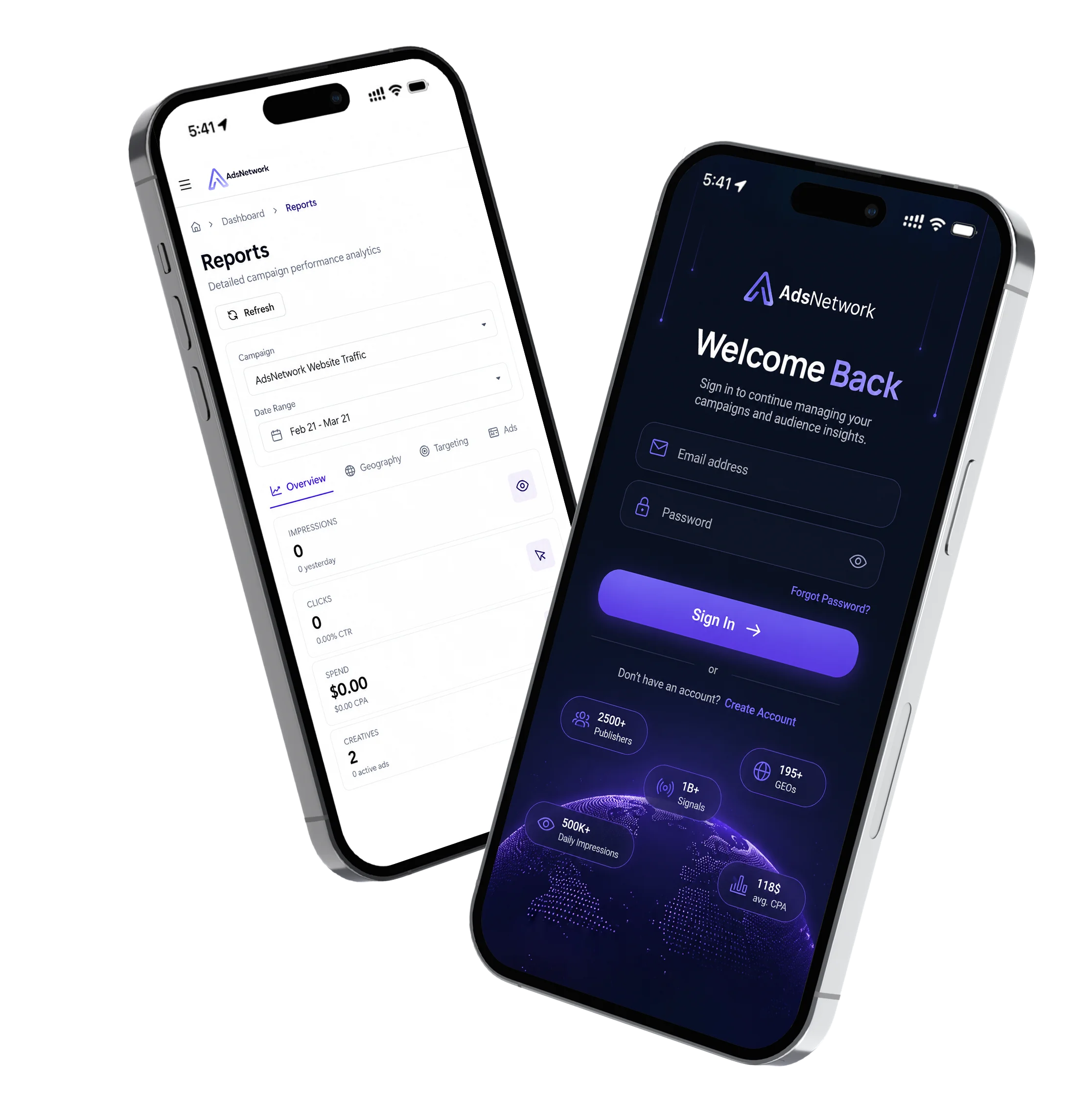
Stay connected to your live AdsNetwork campaigns with our mobile advertising app. Track impressions, clicks, conversions, campaign spend, and overall performance in real time—anytime, anywhere. Available for iOS and Android.