
Most digital advertisers are still spending money on campaigns they cannot fully control. They negotiate placements manually, wait days for approvals, and only find out what worked after the budget is gone. The advantages of programmatic advertising platforms address these problems directly. Automation handles the buying, targeting, and optimization. Consequently, the result is speed, precision, and measurability that manual methods simply cannot match.
According to Statista, global programmatic ad spend reached an estimated $595 billion in 2024. Spending is on track to approach $800 billion by 2028. That growth reflects a real performance edge that automation delivers consistently. For a complete technical overview of how the ecosystem works, see our guide to programmatic advertising.
What Makes Programmatic Advertising Platforms Different
Programmatic advertising platforms replace human negotiation and manual insertion orders with software-driven automation. Advertisers set campaign parameters, audience criteria, and budget limits. The platform handles everything else. It finds available inventory, evaluates impressions, submits bids, and delivers ads in milliseconds.
In contrast to traditional media buying, programmatic operates in real time. Conditions change and the platform adapts automatically, without requiring human input. Specifically, the ecosystem consists of four interconnected components:
- Demand-Side Platforms (DSPs): the advertiser’s tool for buying inventory and managing campaigns
- Supply-Side Platforms (SSPs): the publisher’s tool for selling inventory and maximizing revenue
- Data Management Platforms (DMPs): centralized systems that handle audience data and segmentation
- Ad Exchanges: the real-time marketplace where inventory is bought and sold between DSPs and SSPs
Understanding how real-time bidding works in ad exchanges is the foundation for appreciating why this infrastructure delivers consistent results.
Advantage 1: Precision Audience Targeting
Data-Driven Targeting at Scale
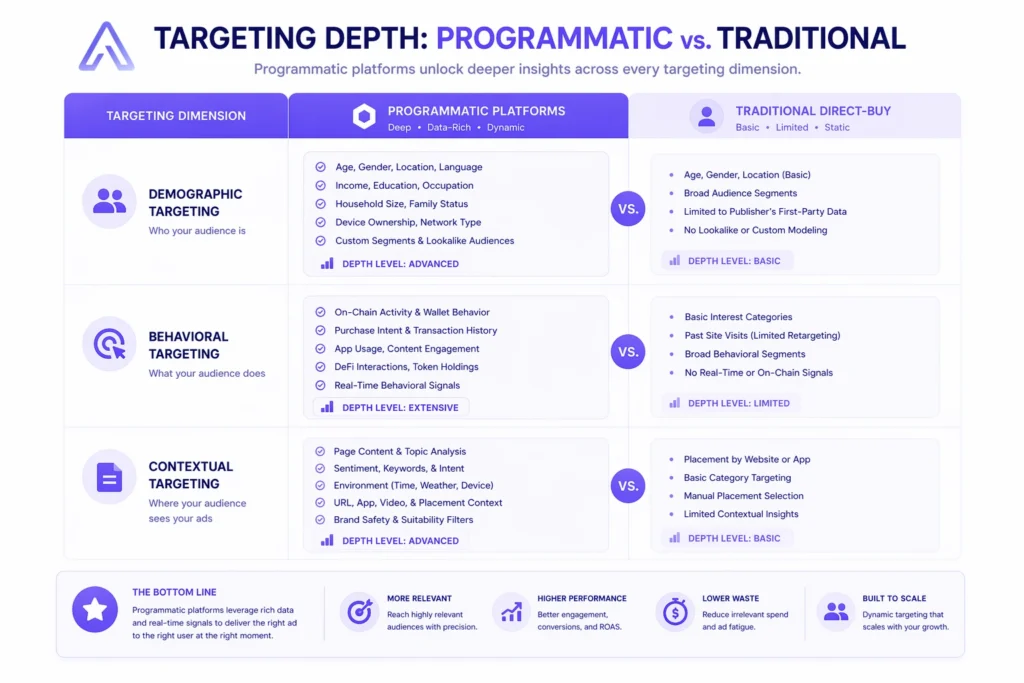
Perhaps the most recognized advantage of programmatic advertising platforms is audience targeting depth. Instead of buying broad demographic blocks, advertisers target based on behavioral data, browsing history, device type, geographic location, and purchase intent signals. This level of precision was previously limited to the largest advertisers with private data agreements. However, programmatic changes that entirely, making granular targeting available at any budget level.
Platforms pull from first-party advertiser data, second-party partner data, and third-party audience segments from data providers. As a result, even mid-sized campaigns can reach users who have shown interest in a product category or recently visited a competitor’s site. According to SEO Design Chicago, retargeted programmatic ads achieve click-through rates 10 times higher than standard display. Furthermore, cross-channel programmatic campaigns achieve 166% higher engagement than single-channel approaches.
Targeting for Web3 and Crypto Audiences
For crypto and Web3 advertisers, precision targeting is not a nice-to-have. It is essential. Web3 audiences are highly specific. They include DeFi users, NFT collectors, on-chain traders, and blockchain developers. Reaching these groups through broad display campaigns wastes budget on disinterested users.
Programmatic platforms that support Web3-native audience segments are far more effective. Instead of broad interest categories, they allow token launch teams and DeFi protocols to target by wallet behavior and engagement with crypto content. That specificity dramatically improves efficiency at any budget level. Additionally, targeting precision at this level creates a meaningful cost advantage over general programmatic campaigns running on mainstream exchanges.
Advantage 2: Real-Time Optimization and Measurability
Another core advantage of programmatic advertising platforms is continuous campaign optimization. Traditional advertising is a set-and-wait process. Programmatic changes that model entirely. The platform analyzes performance data as it arrives. It shifts budget toward placements and audience segments that convert. It reduces spend on those that do not. This happens automatically, in real time, without requiring manual campaign adjustments.
According to the ANA’s 2024 Programmatic Transparency Benchmark Study, 43.9 cents of every $1,000 entering a DSP now reaches consumers as viewed ad impressions. That figure is up 7.9 percentage points compared to 2023. The improvement reflects better supply chain transparency and more aggressive real-time optimization. In other words, more of each advertising dollar is now doing actual work.
Measurability is equally important. Programmatic platforms provide granular reporting at the impression level. Advertisers can see:
- which placements drove conversions
- which audience segments performed best
- what time of day produced the highest engagement
- which creatives drove results across different formats and placements
Consequently, every campaign generates data that makes the next campaign smarter. This feedback loop explains why firms with integrated attribution models see significantly improved programmatic ROI year-over-year. Over time, programmatic campaigns become more efficient as the algorithm accumulates conversion data, making each successive campaign better than the last.
Advantage 3: Cost Efficiency and Budget Control
Lower CPMs and Reduced Wasted Spend
Cost efficiency is one of the most compelling advantages of programmatic advertising platforms. Programmatic buying gives advertisers access to inventory across thousands of publishers simultaneously. This creates genuine price competition. Specifically, advertisers typically see 25 to 45% lower CPMs with programmatic compared to direct-buy display, according to industry benchmarks. Automated bidding algorithms ensure advertisers pay a market-reflective price. This avoids the inflated rates that negotiated publisher deals often carry.
Waste reduction is another dimension of cost efficiency. Traditional campaigns accept significant audience spillage. They show ads to users who fall far outside the intended target. Programmatic platforms, however, evaluate each bid request before committing spend. Frequency capping prevents over-serving the same user. These controls work at the impression level in real time. No manual adjustments are required.
Flexible Budgeting and Campaign Pacing
Programmatic platforms also offer budget flexibility that direct buys do not. Specifically:
- Advertisers can start with small test budgets and evaluate performance before scaling
- Underperforming campaigns can be paused or redirected instantly
- Budget pacing tools distribute spend evenly, preventing front-loaded delivery that exhausts budgets early
- Daily and total caps prevent overspend without requiring manual monitoring
For Web3 projects with irregular funding cycles, this level of control is particularly valuable. A campaign can accelerate during a token launch window and scale back between milestones, all without renegotiating a placement deal. Furthermore, because budget adjustments take effect immediately, teams can respond to market conditions or community events in real time rather than waiting for a campaign cycle to end.
Advantage 4: Massive Reach Across Multiple Channels
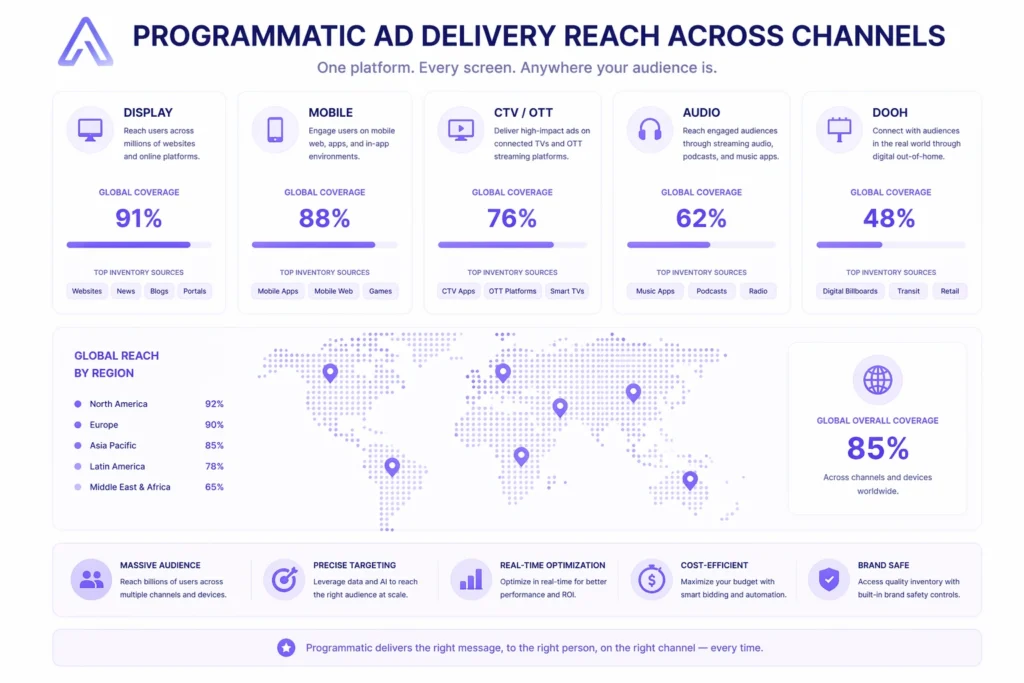
Programmatic advertising platforms provide access to inventory across a vast publisher ecosystem. Negotiating individually with each publisher would be impossible at this scale. In the US, programmatic buying now accounts for over 90% of all digital display ad spending, according to Basis Technologies. Beyond display, programmatic infrastructure extends to:
- Connected TV (CTV) and streaming platforms
- Digital audio including podcasts and streaming services
- Mobile apps, where mobile accounts for 71% of all programmatic ad spend globally
- Digital out-of-home placements
- Video pre-roll across news, entertainment, and crypto content publishers
For Web3 advertisers, broad reach matters because crypto adoption cuts across demographics and geographies. A DeFi protocol may have potential users in Southeast Asia, Europe, and Latin America simultaneously. Programmatic platforms allow a single campaign to reach all these audiences in parallel. Bids and creative adjust dynamically by region. Consequently, no separate local negotiations are required. This scale is simply not achievable through manual media buying at a reasonable cost.
Advantage 5: Transparency and Brand Safety Controls
One of the growing advantages of programmatic advertising platforms is the expansion of transparency tools. Modern DSPs offer log-level data access. This gives buyers a full record of every impression served. For each impression, advertisers can see:
- the publisher and placement where the ad ran
- the audience signal used to target the impression
- the price paid at auction
- the viewability outcome for that placement
This level of visibility helps advertisers audit their supply chains. It identifies wasteful placements and supports cleaner media planning over time. Moreover, advertisers who actively use placement reports to build publisher exclusion lists consistently see lower CPMs over time, since budget stops flowing to non-converting inventory.
Brand safety has also improved considerably. Programmatic platforms now support contextual safety filters, domain blocklists, viewability thresholds, and third-party verification integrations. Notably, ad spending on made-for-advertising sites dropped from 15% in 2023 to 6.2% in 2024, according to the ANA Benchmark Study. That reduction shows how advertisers are using these tools to clean up supply paths. For Web3 projects specifically, where reputation risk is high, these controls help ensure ads appear alongside credible content rather than low-quality traffic sources.
Programmatic vs Direct Buying: What Changes
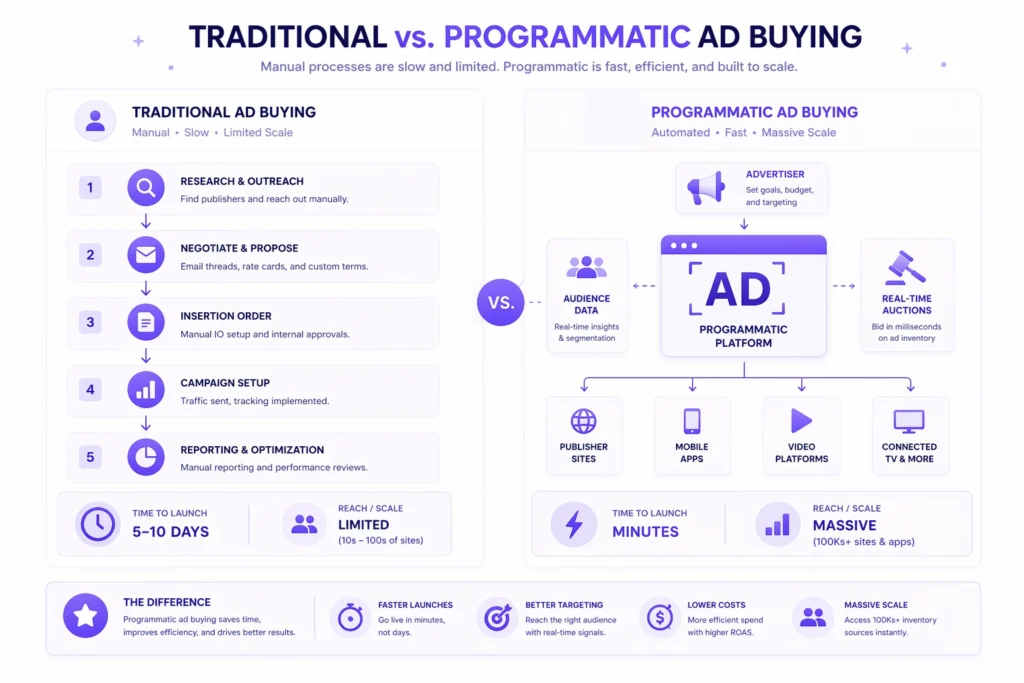
The advantages of programmatic advertising become clearest when placed side by side with the traditional direct buying model. Both approaches deliver digital ads, but the operational reality of each is fundamentally different.
With direct buying, an advertiser identifies publishers, requests media kits, negotiates pricing, signs insertion orders, and waits for the publisher to traffic the campaign. The process typically takes several days to several weeks. The ads run for a fixed period at a fixed price. Reporting arrives as aggregated data after the campaign ends. If the placement underperforms, however, renegotiation is the only option, and that takes additional time.
Programmatic reverses this entirely. A campaign can launch within hours of setup. Targeting is applied at the individual impression level. Pricing is determined by real-time auction competition. Reporting is available in real time. Underperforming placements are excluded automatically or paused within minutes. Consequently, programmatic is not simply faster than direct buying. It is a structurally more efficient approach for most performance advertising objectives.
Direct buying still has a role. Premium sponsorships, exclusive editorial integrations, and homepage takeovers often require direct publisher relationships. However, for campaigns focused on user acquisition, retargeting, and measurable conversion goals, the advantages of programmatic advertising consistently outweigh the control tradeoffs that direct deals offer.
Why Web3 Projects Need Programmatic Platforms Built for Crypto
The advantages of programmatic advertising platforms are available to any advertiser. However, Web3 projects face a structural barrier when accessing mainstream programmatic infrastructure. Meta restricts most direct crypto promotions. Google imposes strict pre-approval requirements on crypto advertisers. DeFi protocols, token launches, and NFT projects face rejections on general exchanges regardless of their compliance status.
Consequently, accessing the full advantages of programmatic advertising requires platforms built specifically for the crypto ecosystem. AdsNetwork provides Web3 projects with RTB-based ad delivery across crypto-native publisher inventory. It operates without the blanket policy restrictions that block campaigns on mainstream exchanges. Token launch teams can run real-time bidding campaigns. DeFi protocols can target wallet-connected users. Blockchain games can reach players already active in the on-chain ecosystem.
Furthermore, purpose-built Web3 advertising platforms offer audience data that general programmatic platforms do not have. On-chain behavior, wallet interactions, and DeFi usage are not available from standard DMPs. As a result, Web3 advertisers using crypto-native infrastructure gain targeting precision that goes far beyond general exchanges. They also avoid the inflated costs and policy restrictions that plague crypto campaigns on mainstream platforms.
The Advantages of Programmatic Advertising Platforms Are Decisive
The advantages of programmatic advertising platforms, including precision targeting, real-time optimization, cost efficiency, massive reach, and transparent reporting, represent a fundamental shift in how advertising works. For most industries, accessing these advantages through mainstream DSPs is straightforward. For Web3 and crypto projects, however, the path requires purpose-built infrastructure that understands the audience, the compliance landscape, and the technology stack. In particular, platforms that support on-chain targeting deliver a precision advantage that general programmatic infrastructure simply cannot match.
To access programmatic advertising advantages designed specifically for the Web3 ecosystem, explore AdsNetwork’s advertising solutions.
Featured Posts
Oct 23, 2026
10 min read
What Is CPM in Advertising? Meaning, Formula and 2026 Rates
CPM is the cost an advertiser pays for 1,000 ad impressions, making it one of the most common…
Read Article
Sep 23, 2026
6 min read
What Is Advertising Technology (AdTech) and How Does It Work?
Advertising technology, commonly known as AdTech, refers to the software, platforms, tools, and systems used to plan, buy,…
Read Article
Sep 16, 2026
8 min read
Media Buying: A Complete Guide for Advertisers
Media buying is the process of purchasing advertising space to reach a target audience. It includes choosing where…
Read ArticleNeed Help?
Our team is ready to help you launch successful campaigns.
AI-Powered Mobile
Monitor Your Campaigns Anywhere
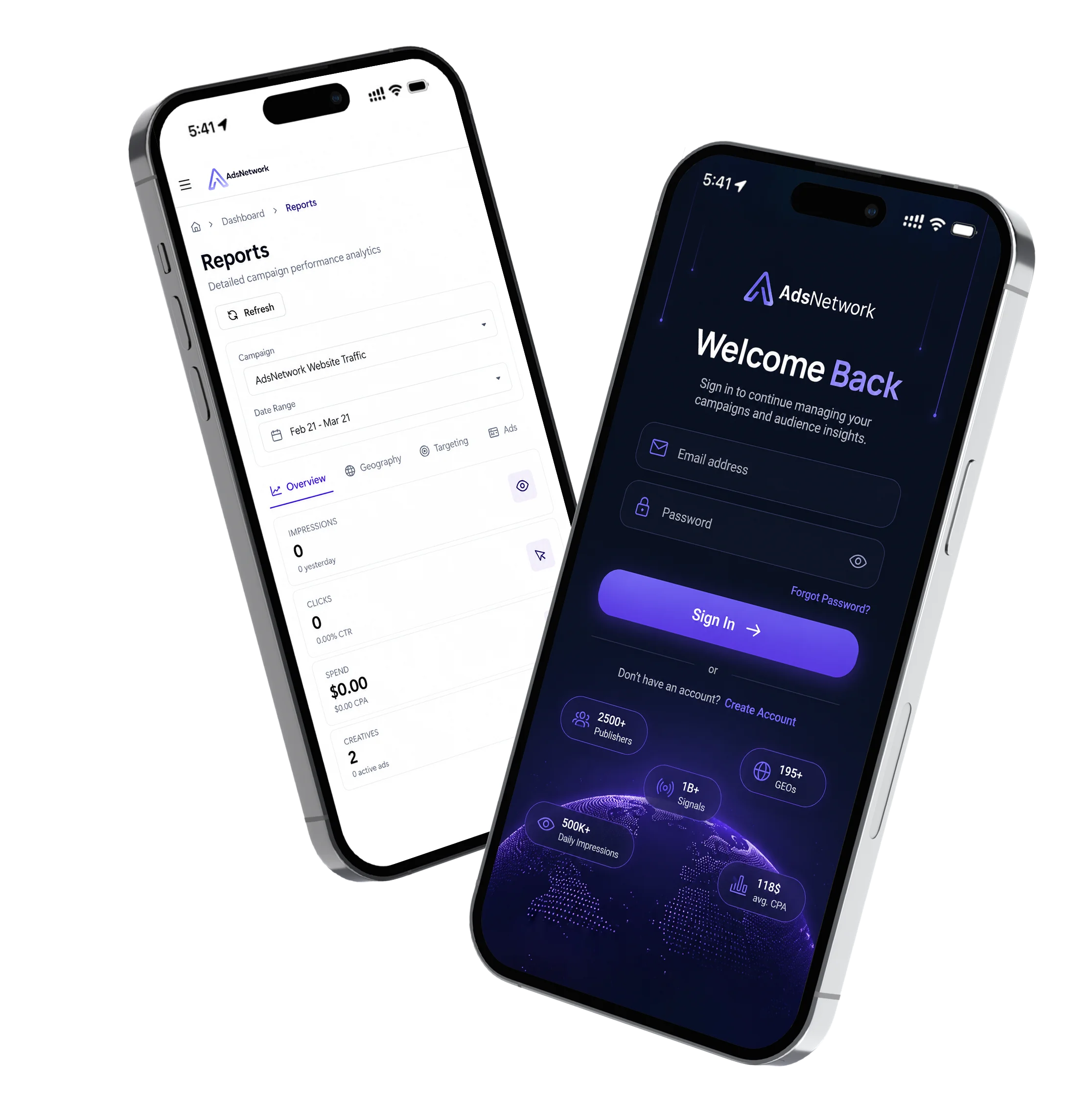
Stay connected to your live AdsNetwork campaigns with our mobile advertising app. Track impressions, clicks, conversions, campaign spend, and overall performance in real time—anytime, anywhere. Available for iOS and Android.