

Every time someone opens a webpage and sees an ad, something remarkable happens in the background. In under 200 milliseconds, multiple technology systems communicate, run an auction, and deliver a creative to that browser. The engine at the center of this process is the ad server. Understanding the role of ad servers in digital advertising is not optional for anyone running campaigns today. It determines where your ad appears and who sees it. It also controls how performance is measured and whether your budget reaches a real audience or disappears into invalid traffic.
What Is an Ad Server and Why It Matters
An ad server is a technology platform that manages, delivers, and tracks digital advertisements. It acts as the operational backbone of the entire digital advertising ecosystem. Publishers use ad servers to manage their available ad space. Advertisers use them to control their creatives, targeting parameters, and campaign budgets.
Without an ad server, running campaigns across multiple websites, devices, and formats would be an impossible manual task. Additionally, the ad server handles all of this automatically, making decisions at machine speed based on rules set by both buyers and sellers.
The scale of this market reflects its importance. According to Business Research Insights, the global ad server market was valued at $3.04 billion in 2025. It is expected to reach $6.02 billion by 2035, growing at a CAGR of 7.07%. Furthermore, FTC data cited in the same report shows that over 68% of digital publishers in 2024 had already adopted ad server technologies.
First-Party vs. Third-Party Ad Servers
There are two main types of ad servers. First-party ad servers are operated by publishers. They manage ad inventory, control which ads appear in which placements, and track impressions across their owned properties.
Third-party ad servers, however, are used by advertisers and agencies. These platforms give advertisers centralized control over their creatives across multiple publisher sites. They also provide independent measurement, helping advertisers verify delivery data that does not come from the publisher’s own system.
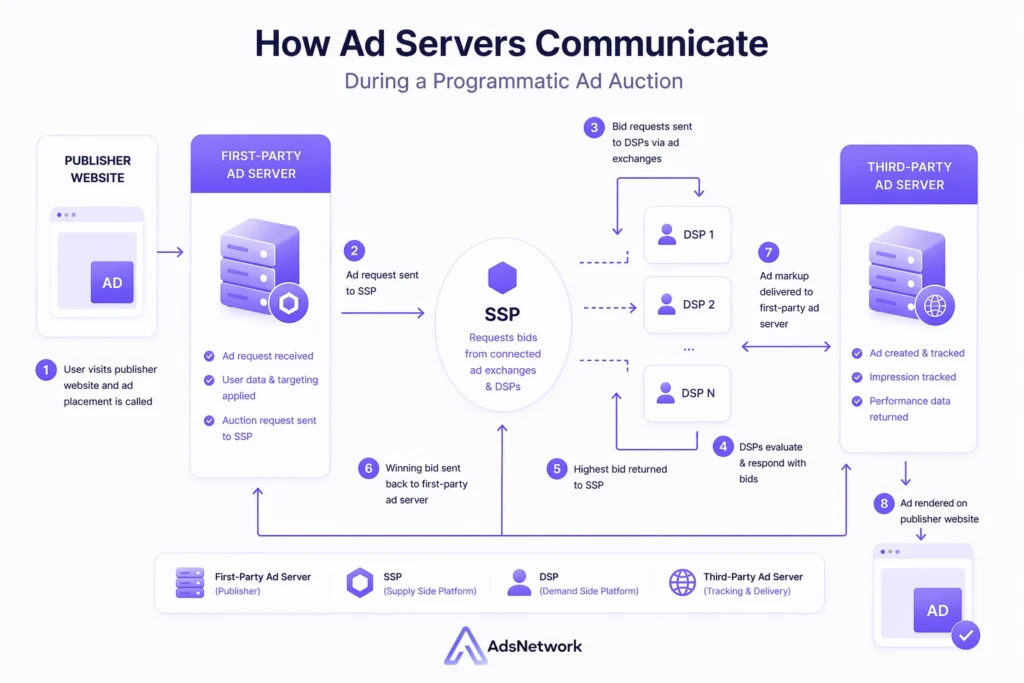
Both types work together in real time. When a user visits a page, the publisher’s ad server processes the request first. It then communicates with demand sources and DSPs to find the most relevant ad to serve.
How Ad Servers Work in the Programmatic Ecosystem
Programmatic advertising accounts for approximately 90% of all digital display ad transactions. Ad servers sit at the intersection of this entire system, connecting publishers, advertisers, SSPs, DSPs, and ad exchanges.
Here is the basic flow from page load to ad delivery:
- A user opens a webpage.
- The publisher’s ad server receives the request and evaluates available inventory.
- If programmatic demand is enabled, the request goes to an SSP, which runs an auction via an ad exchange.
- DSPs representing advertisers submit bids in real time, within milliseconds.
- The winning bid is returned to the publisher’s ad server.
- The ad server delivers the creative to the user’s browser.
- Impressions, clicks, and engagement data are recorded by both the publisher and advertiser ad servers.
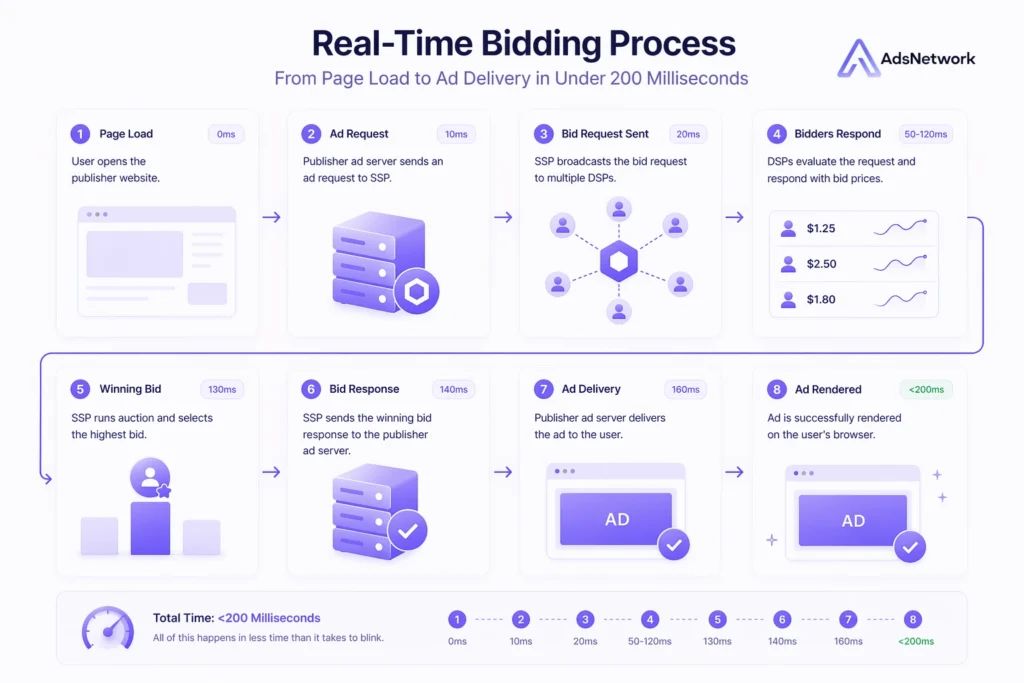
This entire process typically completes in under 200 milliseconds. None of it happens without a functioning ad server coordinating each step.
The Ad Auction Process in Milliseconds
The speed of ad serving is what makes modern digital advertising viable at scale. Specifically, header bidding allows publishers to request bids from multiple demand sources simultaneously before the ad server selects a winner. This approach increases competition for each impression and, consequently, improves publisher revenue.
Each auction decision is governed by parameters set in the ad server. These include budget caps, targeting rules, frequency limits, and creative specifications. Together, these constraints ensure the right ad reaches the right user, without overspending or repeating impressions to the same person.
Key Functions That Define the Role of Ad Servers in Digital Advertising
Beyond delivery, ad servers perform several functions that are critical for campaign success. Understanding these functions helps marketers make smarter decisions about which technology stack to use.
Targeting and audience segmentation. Specifically, ad servers apply targeting rules based on device type, browser, geographic location, time of day, and audience segment data. More advanced systems additionally integrate behavioral and contextual signals to improve relevance further.
Frequency capping. Without frequency controls, the same user would see the same ad dozens of times per day. Therefore, ad servers enforce limits, protecting user experience and preserving the advertiser’s budget for new impressions.
Creative management. Ad servers store and serve creatives in multiple formats, from display banners to video pre-rolls to native ads. They also run A/B tests across creative variants to identify which assets drive better performance.
Performance tracking and reporting. Every impression, click, and conversion is logged. Publishers and advertisers both access this data to optimize campaigns. Independent tracking from a third-party ad server also provides a verification layer that helps resolve discrepancies between buyer and seller data.
Targeting, Tracking, and Optimization
Effective ad server targeting has become more sophisticated over time. According to the Interactive Advertising Bureau, cloud-based ad server deployments increased by 43% between 2020 and 2024. Cloud infrastructure allows ad servers to scale rapidly across multiple devices and geographies without performance degradation.
For crypto and Web3 advertisers, this matters enormously. Campaigns targeting DeFi users, NFT holders, or wallet activity need a level of targeting granularity that generic display ad servers are not built to handle. In particular, a platform like AdsNetwork is designed specifically for this audience. It combines crypto-native publisher access with granular targeting that Web3 campaigns demand.

Ad Servers and the Problem of Ad Fraud
Ad fraud is one of the most damaging issues in digital advertising. According to Spider Labs’ 2025 Ad Fraud Report, global losses from digital ad fraud exceeded $37.7 billion in 2024. Spider Labs projects this figure will reach $41.4 billion in 2025. Additionally, the Association of National Advertisers has reported that only 43.9% of programmatic ad spend actually reaches real consumers, with the remainder consumed by intermediary fees and fraudulent activity.
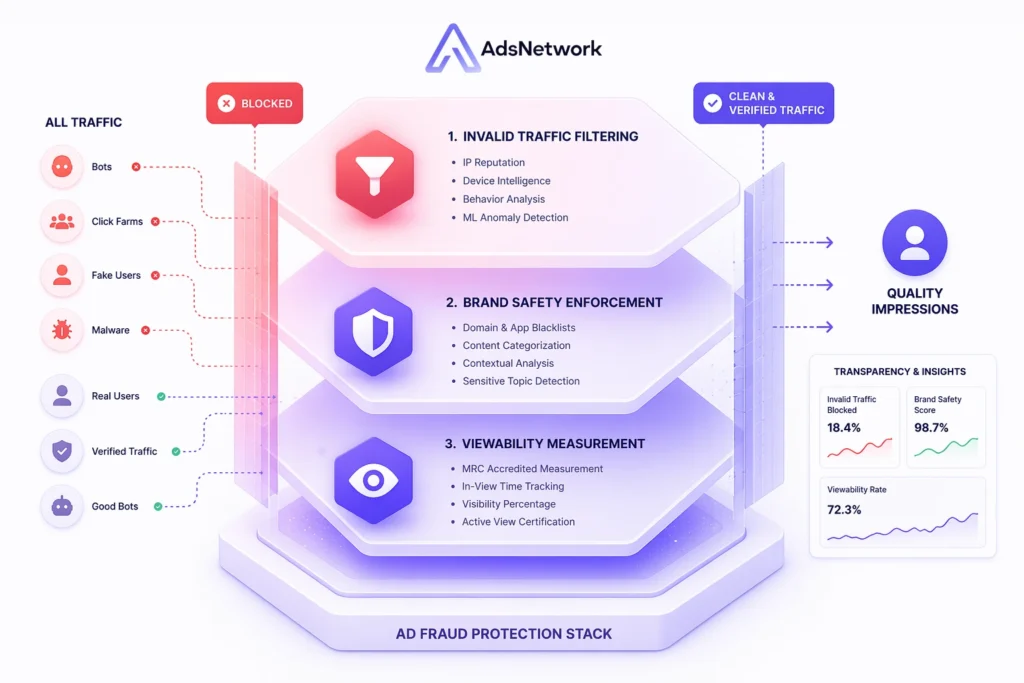
Ad servers play a direct role in combating this problem. Modern ad server platforms include built-in invalid traffic (IVT) detection, brand safety filters, and supply path verification tools. These features help both publishers and advertisers ensure that impressions are genuinely delivered to human audiences.
However, even the best ad server cannot eliminate fraud if the underlying inventory supply is not verified. Publisher quality matters as much as technology. Working with a network that manually vets its publishers, as AdsNetwork does, adds a layer of protection that automated systems alone cannot guarantee.
How Verification and Clean Data Protect Publishers
Publishers who use ad servers to enforce traffic quality controls benefit in multiple ways. First, they protect their CPM rates. Fraudulent or low-quality traffic depresses the value of legitimate impressions across the entire ecosystem.
Second, clean data leads to better advertiser trust. When a publisher can demonstrate real, verified engagement metrics, advertisers are willing to pay premium rates. This is particularly important in the crypto space, where performance expectations are high and communities are tightly knit.
Third, ad servers that integrate directly with third-party verification providers give both sides of a transaction real confidence. This transparency is something the Web3 advertising community has been demanding for years. You can explore how this model applies to crypto publisher networks in our earlier guide to building effective Web3 publisher strategies.
Ad Servers in Crypto and Web3 Advertising
The crypto advertising landscape has its own unique set of requirements. Mainstream ad servers built for e-commerce or consumer brands are not optimized for blockchain audiences. A crypto project promoting a token launch needs to reach users based on wallet behavior and on-chain activity. That is fundamentally different from targeting conventional demographic data.
Adoption is widespread, but suitability is a different question. According to FTC data cited by Business Research Insights, more than 68% of digital publishers in 2024 had adopted ad server technologies. However, adoption alone does not equal fit. The infrastructure needs to match the audience.
For Web3 publishers, ad server choice directly affects monetization. A publisher running a DeFi news site or blockchain explorer needs an ad server that understands crypto-native creatives. It also needs to connect to demand sources willing to pay competitive rates for blockchain audiences, without the policy restrictions that apply on mainstream networks.
Why Blockchain Projects Need Specialized Ad Server Infrastructure
Notably, blockchain projects face a challenge that most mainstream brands do not. Google and Meta restrict or outright ban advertising for tokens, exchanges, DeFi protocols, and NFT projects. Consequently, crypto advertisers cannot rely on mainstream ad server ecosystems to reach their target audiences effectively.
For this reason, purpose-built platforms fill this gap. They connect to crypto-native publishers, apply wallet-level targeting, and measure conversions that matter to Web3 teams. Specifically, these include wallet connections, on-chain transactions, and smart contract interactions.
Conclusion: Understanding the Role of Ad Servers in Digital Advertising
The role of ad servers in digital advertising goes far beyond simply serving a banner. Ad servers are the infrastructure that determines whether a campaign reaches real people, delivers accurate data, operates within budget, and drives results worth measuring.
For Web3 marketers, therefore, choosing the right ad server infrastructure is a strategic decision. Generic programmatic systems were not built for blockchain audiences. They lack the targeting signals, publisher relationships, and fraud controls that crypto campaigns require.
AdsNetwork is built to bridge this gap. As a crypto-native advertising platform, it gives Web3 teams the tools to reach verified, engaged blockchain audiences while maintaining the transparency and performance standards this market demands. Visit AdsNetwork to explore how a purpose-built ad platform can make a measurable difference for your next campaign.
Featured Posts

Oct 23, 2026
10 min read
What Is CPM in Advertising? Meaning, Formula and 2026 Rates
CPM is the cost an advertiser pays for 1,000 ad impressions, making it one of the most common…
Read Article
Sep 23, 2026
6 min read
What Is Advertising Technology (AdTech) and How Does It Work?
Advertising technology, commonly known as AdTech, refers to the software, platforms, tools, and systems used to plan, buy,…
Read Article
Sep 16, 2026
8 min read
Media Buying: A Complete Guide for Advertisers
Media buying is the process of purchasing advertising space to reach a target audience. It includes choosing where…
Read ArticleNeed Help?
Our team is ready to help you launch successful campaigns.
AI-Powered Mobile
Monitor Your Campaigns Anywhere
Stay connected to your live AdsNetwork campaigns with our mobile advertising app. Track impressions, clicks, conversions, campaign spend, and overall performance in real time—anytime, anywhere. Available for iOS and Android.