

Retargeting Ads Strategy That Converts
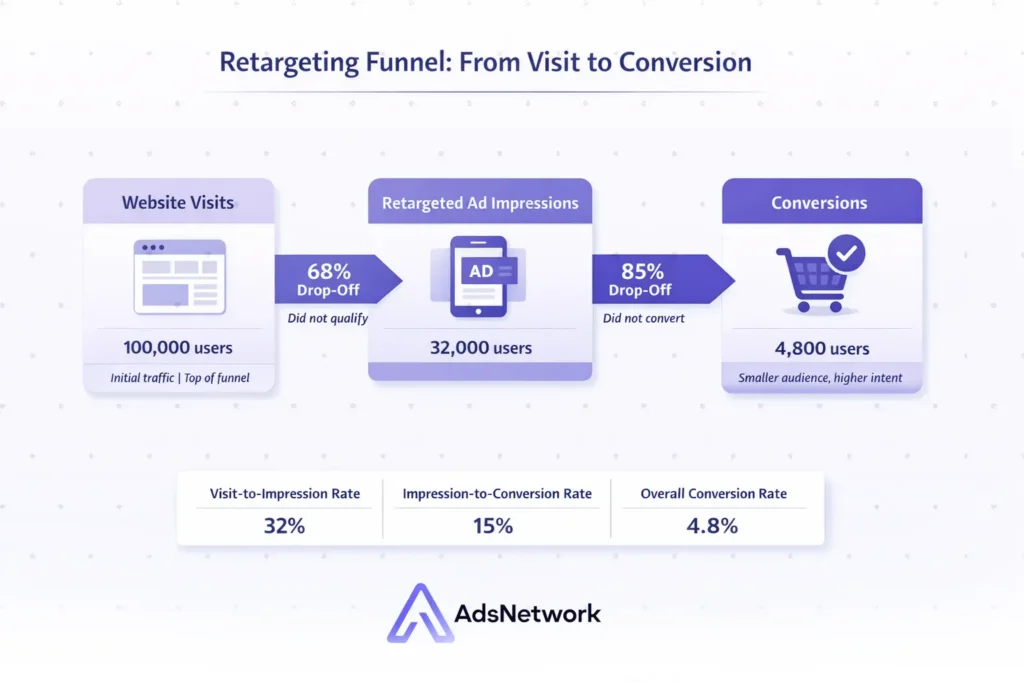
Somewhere between 96 and 98% of the people who visit your website leave without taking any action. They read a page, check a price, look at a product, and disappear. Standard digital advertising treats those people as lost. A strong retargeting ads strategy treats them as your warmest leads, because that is exactly what they are.
Retargeted users already know your brand. They have seen your product, read your copy, and made enough of a judgment to spend time on your site. They did not convert on the first visit because most people never do. The job of retargeting is to meet them again at the right moment, with the right message, and close the gap between interest and action.
This guide covers everything you need to build a retargeting ads strategy that converts: how to build the right audience segments, how to write creative that does not fatigue, how to manage frequency and timing, and what changes when you are running campaigns for a crypto or Web3 project.
Why a Retargeting Ads Strategy Outperforms Cold Advertising
The numbers behind retargeting are consistently stronger than almost any other digital advertising tactic, and the reason is simple: intent. A cold audience has not expressed any interest in your product. A retargeting audience has. That difference in intent shows up in every performance metric.
Retargeted ads achieve a click-through rate of around 0.7%, compared to 0.07% for standard display ads, making them ten times more effective at capturing attention. Conversion rates can increase by up to 150% when retargeting is added to a campaign, and 70% of consumers say they are more likely to complete a purchase after seeing a retargeted ad. Ninety-two percent of marketers report that retargeting outperforms other ad tactics in terms of ROI and engagement, according to data compiled by Amra and Elma.
Retargeting campaigns also cost less per conversion than cold campaigns. Average CPA for retargeting is 20 to 40% lower than non-retargeting campaigns, and the average ROAS sits around 4.2x, according to SQ Magazine’s 2026 retargeting performance data. For ecommerce specifically, retargeting ROAS averages 8:1, compared to far lower returns from cold prospecting.
These numbers hold because retargeting is not advertising to strangers. It is advertising to people who already raised their hand.
Build Your Audience Segments Before You Build Your Ads
The single biggest variable in retargeting performance is audience quality. Generic retargeting, showing the same ad to every past visitor regardless of what they did on your site, is the baseline. Segmented retargeting is where performance separates.
Segmented retargeting campaigns increase CTR by 76% and conversions by 147% compared to generic retargeting strategies. That gap reflects the difference between showing a brand reminder to a casual visitor and showing a targeted, behavior-specific message to someone who spent four minutes on your pricing page and did not convert.
Segment by On-Site Behavior
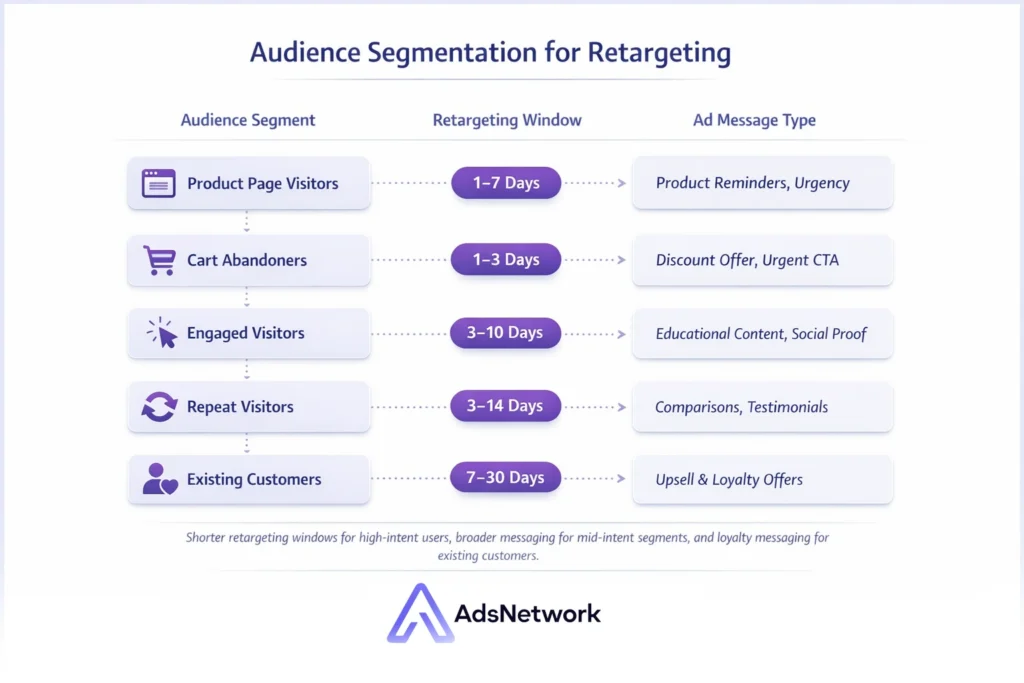
The most effective retargeting audiences are built around intent signals: what pages a user visited, how long they stayed, and what actions they started but did not complete. Here are the core behavioral segments worth building for most campaigns:
- Cart abandoners or incomplete conversions: These users were the closest to converting. They deserve the most direct follow-up, often with a specific incentive or objection-handling message. Facebook dynamic product ads recover 10 to 25% of abandoned carts.
- High-intent page visitors: Users who visited pricing, feature, or comparison pages showed serious consideration. They need proof points and clear calls to action, not general awareness content.
- Content engagers: Users who read blog posts or watched video content are earlier in the funnel. Retarget them with content that moves them one stage forward, not a conversion ask they are not ready for.
- Past converters: Existing customers should be excluded from acquisition campaigns and targeted separately with upsell, cross-sell, or retention messaging.
Separating these groups and writing specific messages for each is the foundation of a retargeting ads strategy that actually converts. It is also one of the fastest ways to increase ROAS without increasing total ad spend.
Set the Right Retargeting Window
How long you retarget someone after their initial visit has a direct impact on performance and cost efficiency. Most platforms default to 30-day or 90-day windows, but that does not mean they are right for your campaign.
Shorter retargeting windows of 7 to 14 days consistently outperform longer ones by around 30%, according to analysis from NewswireJet. Users are most receptive in the period immediately after their visit, when your product is still fresh in their mind. Showing ads to someone 75 days after a single page view wastes budget and generates minimal lift.
A practical framework: 3 to 7 days for high-intent visitors like cart abandoners, 14 days for general site visitors, and up to 30 days for content engagers who are earlier in the decision process. Beyond 30 days, evaluate whether those users are worth the CPM before extending.
Creative Strategy for Retargeting Ads That Convert
Retargeting creative fails in two ways. The first is showing the same generic brand message that cold audiences see, which ignores that the user already knows who you are. The second is bombarding the same user with the same creative for weeks until they actively tune it out. Both problems are fixable.
Match the Message to Where the User Is in the Funnel
Creative for cart abandoners should be direct: remind them what they left, address the most likely objection (price, shipping, trust), and make it easy to return. A specific incentive, a limited-time offer, or a social proof element works well here.
Creative for high-intent page visitors should focus on comparison and proof. Case studies, testimonials, feature breakdowns, and trust signals are appropriate. These users are evaluating you against alternatives.
Creative for early-funnel content engagers should move them one step forward, not straight to a conversion. Invite them to a deeper piece of content, a demo, or a community. Skipping the middle of the funnel wastes the goodwill built by the first touchpoint.
Dynamic retargeting ads, which automatically pull in the specific product or content a user viewed, deliver up to 2x higher CTR than generic retargeting creative, according to SQ Magazine performance data. Where your product or content catalog allows it, dynamic creative is the highest-return investment in your retargeting ads strategy.
Rotate Creative to Prevent Ad Fatigue
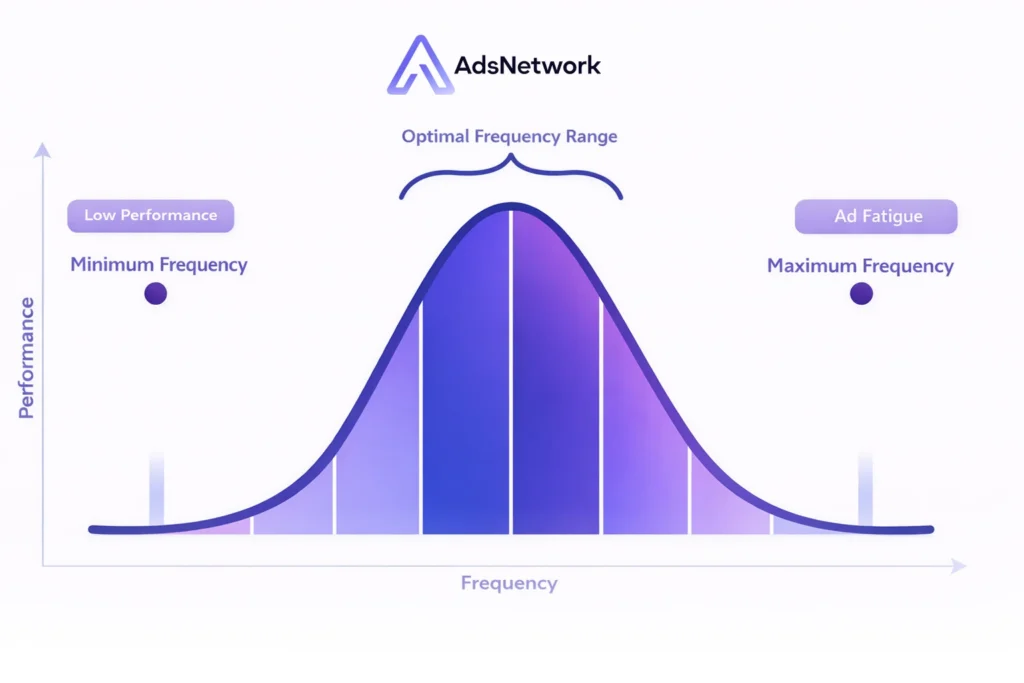
Ad fatigue is real and measurable. Overexposure to the same creative, typically exceeding 15 impressions per week, can increase ad fatigue by up to 40%, according to Marketing LTB analysis. When fatigue sets in, CTR drops, conversion rate drops, and you pay the same CPM for steadily declining results.
The fix is scheduled creative rotation. Refreshing retargeting creative every 10 to 14 days improves performance by 15 to 30% across most campaign types. In practice, this means having three to five creative variants ready at launch, rotating them on a schedule, and tracking engagement metrics as the signal for when a fresh set is needed.
For video retargeting, refreshing content more frequently works particularly well. UGC-style videos and testimonials generate 2.3 times higher CTR than polished brand content in retargeting placements, based on data cited by NewswireJet. Authenticity outperforms production quality in warm-audience contexts.
Control Frequency and Timing for Maximum Impact
Frequency is the number of times a single user sees your ad within a given period. Timing is when those impressions land. Both have a dramatic effect on whether your retargeting ads strategy converts or annoys.
Display retargeting ads shown within the first 24 hours after a site visit generate the highest CTR, often exceeding 1.2%, according to SQ Magazine data. That first day is the peak window. The user still has context for the visit, the decision is recent, and your message arrives while the consideration is active.
A practical frequency cap for most retargeting campaigns is 3 to 5 impressions per user per week. Below that level, you risk low awareness. Above it, you risk fatigue and a negative brand association. For high-value, high-intent audiences like cart abandoners, slightly higher frequency can be justified in the first 48 hours, then stepped down sharply after that.
Only 11% of shoppers dislike retargeted ads, and 30% actually react positively to them, according to data from TrueList. The perception problem with retargeting is almost entirely a frequency and relevance problem. Well-segmented, frequency-capped campaigns with relevant creative are not annoying. They are useful.
Run Multi-Channel Retargeting for Stronger Conversion Rates
Most users do not live on one platform. A person who visited your site might see your next ad on Google Display, then on Instagram, then while browsing a crypto news site. Multi-channel retargeting meets them wherever they go next, instead of hoping they return to the one channel you are running.
Multi-channel retargeting converts 24% better than single-channel campaigns, according to Marketing LTB statistics. Cross-platform retargeting also reduces CPAs by 21%, since the combined impression frequency is achieved more efficiently across platforms than by over-serving on a single one.
The key to multi-channel execution is consistent audience and message coordination. Build your retargeting audiences from first-party data, such as your email list, CRM data, or pixel audiences, and push those same audience definitions to multiple platforms. Then make sure the creative is adapted to each platform format without losing the core message.
Platform selection matters too. Facebook and Google account for over 80% of all retargeting ad spend globally, reflecting their dominance in reach and targeting infrastructure. For crypto and Web3 campaigns, supplement those platforms with crypto-native placements where audiences are already in a blockchain mindset.
Retargeting in the Cookieless Era
Third-party cookies, which powered retargeting audiences for over two decades, are gone from all major browsers. Safari and Firefox blocked them years ago. Chrome completed the deprecation in 2024. For any retargeting audience built on cross-site behavioral tracking, that infrastructure no longer exists.
The retargeting strategies that continue to perform rely on first-party data: information collected directly from users through your own platforms. Email lists, CRM records, on-site sign-ups, and loyalty program data all qualify. First-party retargeting audiences deliver up to 2x higher engagement rates compared to third-party cookie targeting, according to SQ Magazine’s retargeting data. The loss of cookies, while disruptive, has pushed teams toward audience data that was always higher quality.
Contextual targeting has also returned as a strong complement to behavioral retargeting. Research from DoubleVerify and IAS published in 2025 shows contextual ads performing within 5 to 8% of behavioral targeting on CTR, and within 10 to 12% on conversion quality, while outperforming behavioral on brand safety. For placements where first-party audience data is not available, contextual targeting is a reliable bridge in the modern digital advertising environment.
Retargeting Ads Strategy for Crypto and Web3 Campaigns
Web3 retargeting has historically been difficult for a specific reason: wallets are pseudonymous. There are no login forms. No email addresses attached to on-chain actions. A user visits a DeFi protocol, connects a wallet, browses a pool, and leaves. Standard retargeting infrastructure sees nothing useful in that session.
That gap is closing. Wallet-level retargeting, which connects on-chain activity to advertising audiences, is now available through Web3-native ad platforms. Rather than building retargeting pools from cookies, these platforms build them from wallet behavior: users who connected but did not swap, wallets that have a history of activity in your protocol’s category, or users who interacted with your contract but have not returned. As CoinDesk reported on Addressable’s retargeting service, wallet signals let projects target only the users who have already engaged with them, rather than paying for broad reach that never converts.
For Web3 teams, this changes what the retargeting ads strategy actually measures. The conversion event is not a purchase confirmation. It is a wallet transaction: a swap, a deposit, a stake, a governance vote. Retargeting campaigns should be evaluated on cost per wallet action, not just click-through rate or page view count. Audience segments built from on-chain behavior, such as wallets that bridged assets but never used your DEX, are more precise than any browser-based behavioral audience available in Web2.
Running wallet-based retargeting through a dedicated crypto ad network gives you access to placements and audience infrastructure that general ad platforms cannot provide. Crypto-native networks also deliver audiences that are already engaged with blockchain products, which narrows the distance between an ad impression and an on-chain action.
AdsNetwork is built for exactly this use case: connecting Web3 advertisers to crypto-native audiences with the targeting depth and reporting transparency needed to run retargeting campaigns that are measured in real wallet outcomes, not just dashboard impressions.
Build a Retargeting Ads Strategy That Converts, Not Just Reaches
The visitors who leave your site without converting are not gone. They are your warmest future customers. A retargeting ads strategy that segments by behavior, delivers message-matched creative, manages frequency carefully, and operates across multiple channels will bring a meaningful percentage of them back.
The most important shift is moving from retargeting as a reminder tactic to retargeting as a precision system. Know who you are reaching, know what they saw, know what stage they are at, and give them the exact message they need to take the next step. That precision is what separates campaigns with 150% conversion lifts from campaigns that just show the same banner to everyone who visited once.
For crypto and Web3 projects, add wallet-level signals to that system and the precision becomes sharper still. If you are ready to build retargeting campaigns on infrastructure designed for Web3 audiences, explore what is available at adsnetwork.io.
Frequently Asked Questions
How long should a retargeting window be?
The optimal retargeting window depends on where the user is in the funnel and how high their intent was. For cart abandoners and users who reached a conversion step, 3 to 7 days captures the highest-value window. Then for general site visitors who browsed product or feature pages, 14 days is a reasonable balance between reach and efficiency. For content engagers who are earlier in the consideration phase, up to 30 days can be justified. Shorter windows consistently outperform longer ones for high-intent audiences, with 7 to 14 day windows delivering roughly 30% better performance than 30-day windows across most campaign types.
How many times should you show a retargeting ad to the same user?
A frequency cap of 3 to 5 impressions per user per week is a practical starting point for most retargeting campaigns. Below that, awareness is limited. Above 15 weekly impressions, ad fatigue increases sharply and can raise fatigue rates by up to 40%. The right number also depends on creative variety: if you have multiple distinct creatives in rotation, you can support higher frequency without users feeling overexposed. Monitor CTR and conversion rate by frequency band in your platform reporting. When CTR begins declining at a specific frequency level, that is your cap.
Can you run a retargeting ads strategy without third-party cookies?
Yes, and in many cases the cookieless approach outperforms cookie-based retargeting. First-party data audiences, built from your email list, CRM records, on-site sign-up forms, and pixel events, are the foundation of modern retargeting. These audiences deliver up to 2x higher engagement rates than third-party cookie audiences because the data is cleaner and more relevant. For Web3 campaigns, wallet-based retargeting bypasses browser tracking entirely by connecting ad audiences to on-chain behavioral signals. Contextual targeting is also a strong complement: research from 2025 shows it performing within 5 to 8% of behavioral targeting on CTR, making it a reliable option when audience data is limited.
Ready to Get Started?
Launch your advertising campaign today and reach your target audience effectively.
Start Your CampaignAbout the Author
Ana Collins
Content specialist focused on digital advertising and marketing strategies. Passionate about helping businesses grow through data-driven campaigns.
Related Articles

How to Optimize Ad Campaigns for Maximum ROI
Most ad budgets do not disappear in one bad decision. They erode slowly, spread across campaigns that were never truly dialed in: audiences that are too broad, creative that went stale months ago, landing pages that convert at half the rate they should, and attribution models that hide where the real money is going. To […]
12 min read

How to Increase ROAS in Digital Advertising
Most campaigns do not fail because the product is wrong or the budget is too small. They fail because the return on ad spend never gets high enough to justify scaling. If you’re looking for ways to increase ROAS, it’s important to realise that low ROAS is not a budget problem. It is a signal […]
11 min read

Advertising Metrics Every Marketer Should Know
Most crypto projects launch ad campaigns with confidence. They set a budget, pick a network, hit publish, and then stare at a dashboard full of numbers they barely understand. The advertising metrics keep climbing. The results stay flat. If that sounds familiar, you are not alone. Knowing which advertising metrics actually matter, and how to […]
9 min read