

How to Optimize Ad Campaigns for Maximum ROI
Most ad budgets do not disappear in one bad decision. They erode slowly, spread across campaigns that were never truly dialed in: audiences that are too broad, creative that went stale months ago, landing pages that convert at half the rate they should, and attribution models that hide where the real money is going. To avoid this, it’s crucial to regularly optimize ad campaigns for best performance. By the time the quarterly report lands, the damage is done.
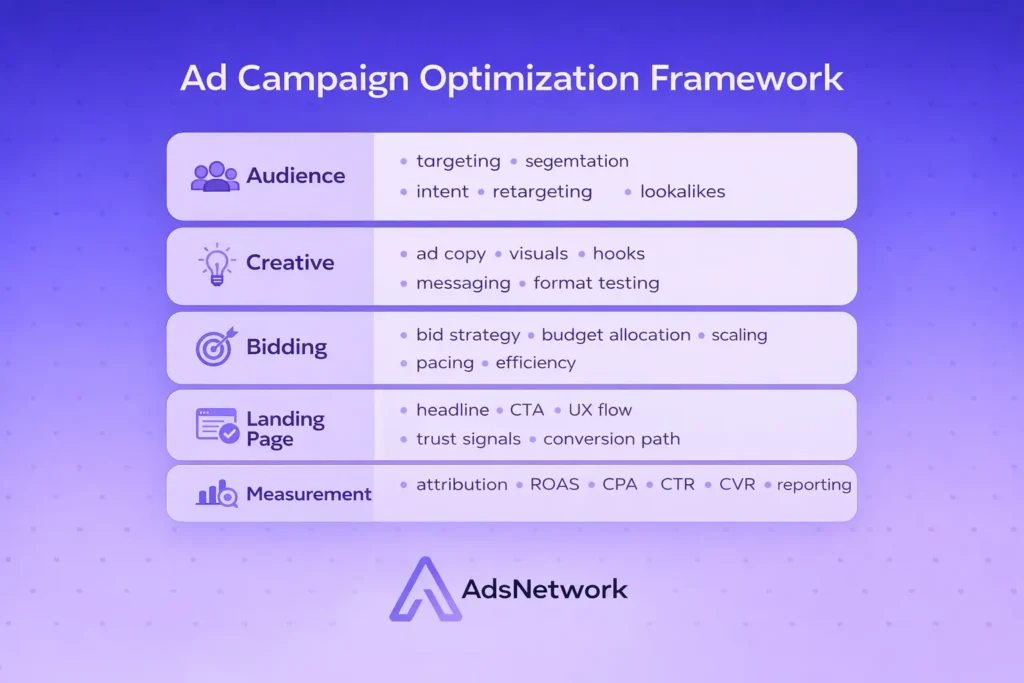
The good news is that ad campaign optimization is not complicated in principle. It is a system. Each lever connects to the next, and pulling the right ones in the right order compounds performance over time. This guide covers every major optimization lever available to digital advertisers in 2026, with specific notes on what changes when you are running crypto or Web3 campaigns.
Before applying any of the strategies below, make sure you are tracking the right advertising metrics. Optimization without measurement is guesswork.
Step One: Define What You Are Optimizing Toward
The most common reason campaigns underperform is that they are optimizing for the wrong thing. Clicks are not revenue. Impressions are not community. Optimizing for volume when you need profitability will grow your costs faster than your returns.
Before touching a single bid or ad group, answer two questions. First, what is your campaign objective: awareness, traffic, leads, or conversions? Second, what does a successful outcome look like in dollar terms?
Once you know your objective, calculate your maximum allowable cost per acquisition. If your product generates $200 in gross profit per sale, paying $80 per conversion leaves a healthy margin to reinvest. Paying $190 does not. That ceiling number, your target CPA, is the anchor for every optimization decision that follows.
For campaigns where conversion values vary, such as a token launch where some wallet connections lead to large purchases and others lead to nothing, switch from optimizing for CPA to optimizing for ROAS. Your platform bidding strategy should reflect whichever model maps more directly to your revenue structure. Our guide on how to increase ROAS covers this calculation in detail.
Allocate Budget Based on Performance, Not Habit
Many campaigns run on budgets that were set at launch and never revisited. Markets shift, audiences change, creative fatigues. Static budgets guarantee that money keeps flowing to placements and ad groups that no longer deserve it.
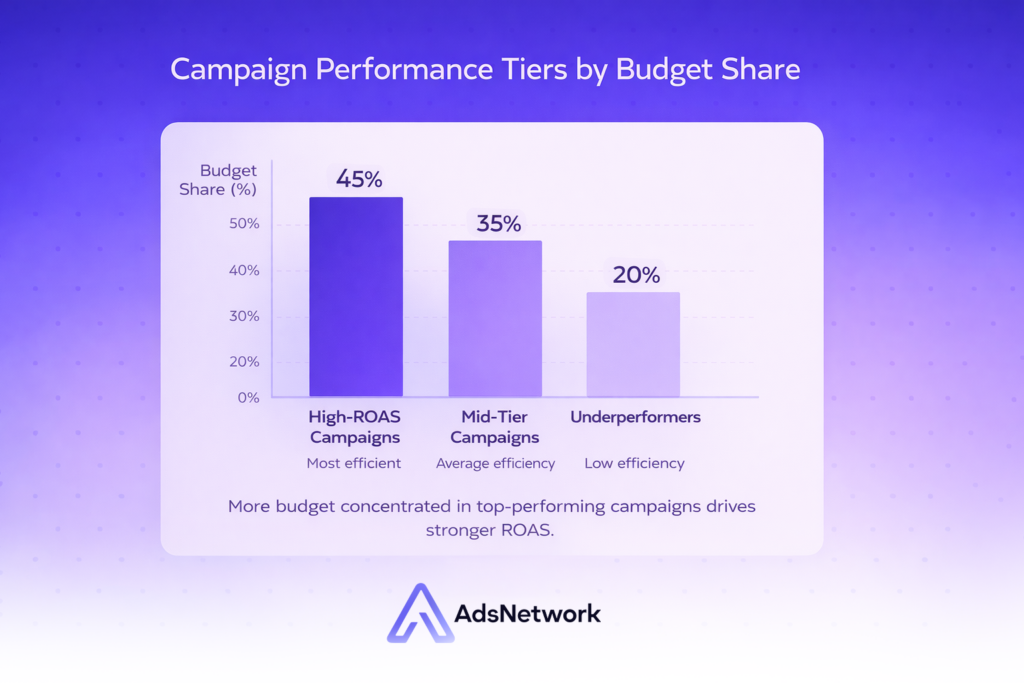
A practical budget allocation framework splits spend across three tiers based on performance data. Top-performing campaigns, those with CPA or ROAS comfortably inside your target range, receive the largest share and are scaled first. Middle-tier campaigns get steady budget to gather more conversion data before decisions are made. Bottom-tier campaigns, those consistently outside target metrics, get budget reduced or paused while you diagnose the issue.
For campaigns using AI bidding, reallocating budget across a portfolio rather than individual campaigns gives the algorithm more flexibility. Analysis from ALM Corp found that portfolio-level budget reallocation produced a typical performance lift of 19 to 27% in overall account ROAS, compared to managing each campaign with its own fixed daily budget.
A useful rule for shifting budget: campaigns with ROAS below 2.0 should be investigated before receiving more spend. Campaigns with ROAS above 3.5 and available conversion volume are candidates for scaling. Do not add budget to a campaign until you understand why it is performing well.
Choose and Configure the Right Bidding Strategy
Bidding strategy is one of the highest-leverage settings in any campaign. The wrong strategy can waste budget even if everything else is set up correctly. The right strategy, fed with clean conversion data, compounds performance over time as the algorithm learns from real signals.
Manual vs Automated Bidding
Manual bidding gives you control but requires constant attention. Automated smart bidding strategies, including Target CPA, Target ROAS, and Maximize Conversions, use machine learning to adjust bids in real time across thousands of signals: device type, time of day, audience behavior, and competitive pressure. In 2026, 62% of campaigns use machine learning bidding strategies for better targeting efficiency.
Use Target CPA when all conversions have similar value, such as a lead generation campaign where every sign-up is worth roughly the same. Use Target ROAS when conversion values vary, such as an exchange campaign where acquired users generate very different trading volumes.
Smart bidding requires conversion data to work. For Target ROAS, most platforms recommend at least 50 to 100 conversions per month before the algorithm can optimize reliably. Starting a new campaign with Target ROAS before you have that data volume typically results in erratic spending. Build conversion volume first with a Maximize Conversions strategy, then transition to Target ROAS once you have the data to back it up.
Quality Score and Its Effect on Cost
On Google Ads, Quality Score directly affects how much you pay per click. Higher Quality Score, driven by ad relevance, expected CTR, and landing page experience, can reduce cost per click by up to 50% according to WordStream benchmark analysis. Two advertisers bidding the same amount for the same keyword can pay very different CPCs based on Quality Score alone. Optimizing for relevance is not a vanity exercise. It is cost management.
Optimize Ad Creative Through Systematic Testing
Ad creative is the most visible part of your campaign and the most frequently ignored once it is live. Creative fatigue happens faster than most teams account for. An ad that performed well in week one may be actively dragging down performance by week six as the same audience sees it repeatedly.
Run A/B Tests Continuously
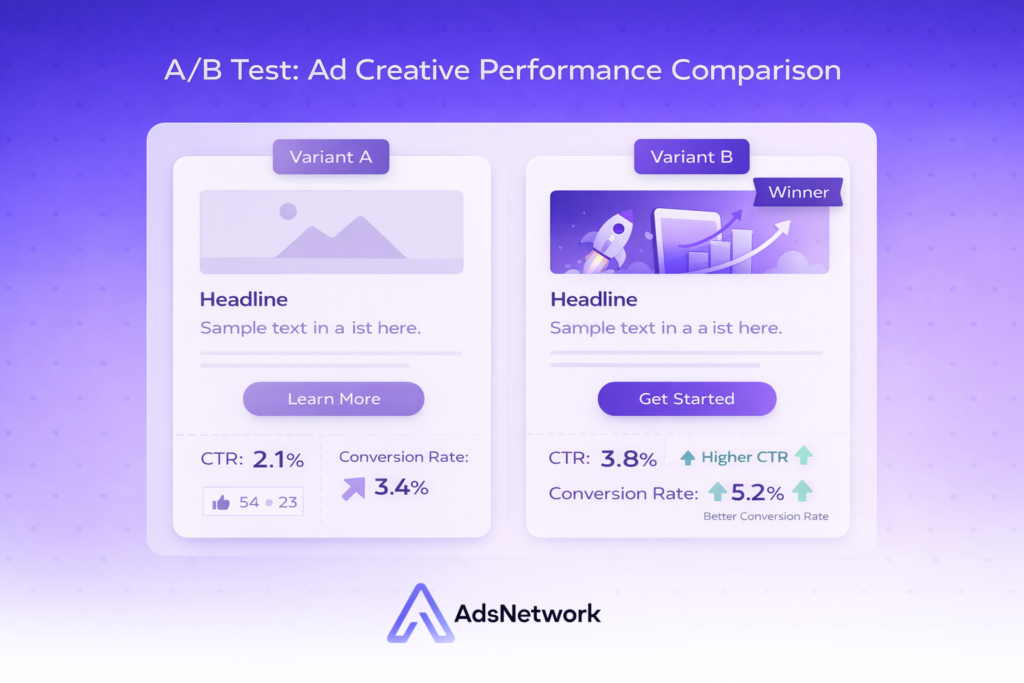
Only 17% of marketers actively A/B test their ad creative, according to landing page research from Genesys Growth, despite the fact that systematic testing produces an average 37% lift in conversion rates. That gap represents an enormous competitive advantage for teams willing to test consistently.
A disciplined testing process tests one variable at a time: headline, visual, offer, or call to action. Running multiple changes at once makes it impossible to know which variable drove the performance shift. Keep tests running for long enough to reach statistical significance before declaring a winner, and carry the winning element forward into the next test cycle.
Campaigns that evolve through regular testing drive 2.4 times higher ROI than static campaigns that run the same creative indefinitely, according to HubSpot 2025 marketing benchmarks. The compounding effect of small, consistent improvements is where most of the performance gap between average and top-performing campaigns comes from.
Match Creative to Channel and Funnel Stage
Creative that works on a cold prospecting campaign will not work on a retargeting campaign. Cold audiences need context: what you do, why it matters, and why they should care. Warm retargeting audiences already have that context. They need a specific reason to act now: a time-sensitive offer, a proof point, or a direct call to the next step.
Video consistently outperforms static images across most channels. Short-form video ads, particularly those under 30 seconds, convert three times better than longer formats according to multiple platform reports. For Web3 projects, authentic community-facing content tends to outperform polished brand advertising because the crypto audience values transparency above production quality.
Turn Landing Pages Into a Core Part of Campaign Optimization
A strong ad creative can only take a click so far. What happens on the other side of that click determines whether your campaign delivers ROI or just traffic. Landing page quality is one of the most undermanaged levers in digital advertising.
Page speed alone is a major conversion driver. Research from Genesys Growth found that each second of load time costs approximately 7% in conversions. For a business generating $100,000 monthly through landing pages, reducing load time from five seconds to two seconds could add $21,000 in monthly revenue from the same traffic volume.
Beyond speed, the most impactful landing page optimization tactic is message match: making sure the headline, offer, and visual on the landing page directly reflect what the ad promised. Mismatched messaging forces the user to re-evaluate their decision to click, and most of them will not stay to figure it out. Every point of friction between the ad and the conversion reduces the percentage of clicks that become customers.
Personalized calls to action convert 202% better than generic versions, according to data cited by Genesys Growth. Even simple personalization, showing different landing page content based on the traffic source or audience segment, produces measurable lift. For Web3 campaigns, personalizing landing pages by chain, wallet type, or campaign angle can materially improve conversion rates from paid traffic.
Fix Measurement Before You Optimize Anything Else
You cannot optimize ad campaigns accurately if your measurement system is broken or incomplete. Most advertisers are working with partial data and do not know it. They make scaling decisions based on last-click attribution that ignores most of the customer journey, or they count conversions that include a significant percentage of invalid traffic.
Start with conversion tracking. Every campaign should have conversion events defined that represent real business value, not just clicks or page views. Assign revenue values to conversions wherever possible. Without value data, smart bidding algorithms optimize for volume rather than profitability, which often means cheaper conversions that are worth less.
Implement UTM parameters consistently across every paid link. This connects your ad spend to your analytics platform and makes it possible to see which campaigns, ad groups, and creatives are actually driving downstream revenue. Gaps in UTM coverage create blind spots that make budget allocation decisions less reliable.
For crypto and Web3 campaigns, add on-chain attribution wherever your technology stack allows. A user who clicked an ad, connected a wallet, and completed a swap three days later represents a multi-touch journey. Standard browser-based attribution will likely credit only one touchpoint, or miss the conversion entirely. Layering on-chain signals onto your standard advertising metrics gives you a more accurate picture of true campaign ROI.
Optimize the Channel Mix for Your Audience
No single channel delivers maximum ROI for every campaign type. High-intent search campaigns typically outperform display for bottom-of-funnel conversions. Social and video outperform search for awareness and community growth. Retargeting outperforms cold prospecting for ROAS. The right optimization is not just within channels. It is about how budget is distributed across them.
For a full breakdown of which channels are growing fastest and where different audience types are most accessible, review your channel allocation against the current growth data for each platform.
For crypto and Web3 projects specifically, the channel optimization question starts with compliance. Google and Meta restrict most direct crypto promotions to pre-approved advertisers. This pushes the majority of Web3 advertising toward specialist that operate independently of those restrictions and reach audiences already active in the blockchain ecosystem.
Crypto-native ad networks also tend to deliver cleaner traffic for Web3 campaigns. Audiences are self-selected: they are on crypto news sites, DeFi dashboards, and blockchain-specific content platforms because they are actively engaged in the space. That context narrows the gap between a click and a conversion in ways that general audience targeting cannot replicate.
AdsNetwork is designed for exactly this channel segment. The platform connects crypto and Web3 advertisers with blockchain-native audiences across display and native formats, with the measurement tools needed to track campaign ROI beyond standard browser signals.
Optimize Ad Campaigns as a System, Not a Series of Fixes
The campaigns that deliver maximum ROI are not built on any single tactic. They are built on a connected system where clear goals feed the right bidding strategy, clean data feeds the algorithm, tested creative reaches the right audience, and strong landing pages convert the traffic that arrives. Pull one lever and you improve one metric. Build the system and you compound gains across all of them.
For crypto and Web3 advertisers, the same framework applies, with one additional layer: on-chain measurement. The teams that win in this space are the ones that connect their digital advertising campaigns to real wallet behavior, and optimize toward community metrics that actually reflect product health.
If you are ready to run better-optimized campaigns on infrastructure built for Web3 audiences, start at adsnetwork.io.
Frequently Asked Questions
How often should you optimize ad campaigns?
Campaign optimization should happen on a regular schedule, not just when performance drops. For active campaigns with significant daily spend, reviewing key metrics daily and making bid or budget adjustments weekly is a reasonable baseline. Creative should be reviewed every two to four weeks and refreshed when engagement metrics like CTR begin to decline. Attribution and conversion tracking should be audited monthly to catch data gaps before they affect budget decisions. Campaigns that evolve weekly drive 2.4 times higher ROI than static campaigns, so frequency of review directly impacts results.
What is the most impactful change you can make to optimize an ad campaign?
There is no single change that beats every other for every campaign. In practice, fixing broken or incomplete conversion tracking tends to produce the most widespread improvement because it unlocks better smart bidding performance, clearer attribution, and more reliable budget allocation decisions. After tracking is solid, the next highest-impact area for most campaigns is audience segmentation, separating warm retargeting audiences from cold prospecting audiences and tailoring creative and bids to each. Retargeting campaigns consistently deliver 71% higher ROAS than prospecting campaigns, making that audience split one of the clearest wins available in any campaign structure.
How do you optimize ad campaigns for crypto and Web3 projects specifically?
The best way to optimize ad campaigns is the same as any digital campaign: clear goals, accurate tracking, tested creative, and a tight feedback loop between data and decisions. The differences are in the measurement layer and the channel selection. For measurement, add on-chain attribution alongside standard browser tracking to understand how campaigns connect to actual wallet activity, not just clicks and sign-ups. For channels, use crypto-native ad networks rather than trying to scale on Google or Meta, where most crypto advertising is restricted. Define conversions as wallet-level events wherever possible, and track user retention after the initial conversion to confirm that acquired users are actually engaging with the product and not just claiming an airdrop.
Ready to Get Started?
Launch your advertising campaign today and reach your target audience effectively.
Start Your CampaignAbout the Author
Hana Mori
Content specialist focused on digital advertising and marketing strategies. Passionate about helping businesses grow through data-driven campaigns.
Related Articles
Retargeting Ads Strategy That Converts
Somewhere between 96 and 98% of the people who visit your website leave without taking any action. They read a page, check a price, look at a product, and disappear. Standard digital advertising treats those people as lost. A strong retargeting ads strategy treats them as your warmest leads, because that is exactly what they […]
13 min read
How to Increase ROAS in Digital Advertising
Most campaigns do not fail because the product is wrong or the budget is too small. They fail because the return on ad spend never gets high enough to justify scaling. If you’re looking for ways to increase ROAS, it’s important to realise that low ROAS is not a budget problem. It is a signal […]
11 min read

Advertising Metrics Every Marketer Should Know
Most crypto projects launch ad campaigns with confidence. They set a budget, pick a network, hit publish, and then stare at a dashboard full of numbers they barely understand. The advertising metrics keep climbing. The results stay flat. If that sounds familiar, you are not alone. Knowing which advertising metrics actually matter, and how to […]
9 min read