

How to Market a Crypto Project Successfully?
Why Most Crypto Projects Fail to Gain Traction
Your crypto project has a 95% chance of being forgotten within six months. Not because your tech is bad, but because your marketing is. For founders seeking advice on how to market a crypto project, over 18,000 tokens trade across 248+ exchanges, yet the majority fade into irrelevance within months of launch. The difference between the projects that gain traction and the ones that vanish almost always comes down to marketing.
But crypto marketing is not traditional marketing with a blockchain twist. It operates under a unique set of rules: skeptical audiences, fragmented regulations, platform restrictions, and a community culture that punishes inauthenticity. Understanding these dynamics is the first step toward building a crypto growth strategy that actually works.
This guide from AdsNetwork breaks down a proven framework for promoting a crypto project in 2025, backed by real data and examples from the projects that got it right.
Why Crypto Marketing Is Different
The crypto audience is not a general consumer base. Around 34% of crypto holders are aged 25–34, predominantly male, technically literate, and active across X, Discord, Telegram, and Reddit. They verify claims before investing, distrust polished brand campaigns, and reward projects that demonstrate substance over hype.
This audience operates in a regulatory minefield. Google and Meta enforce strict guidelines on crypto ads. The EU’s MiCA framework, the SEC’s evolving posture, and country-specific laws create compliance hurdles that can shut down campaigns overnight. Add to that a trust deficit driven by years of rug pulls and exit scams, and you understand why every message in blockchain marketing must earn its credibility.
Start with a Clear Value Proposition
Before spending a dollar on promotion, define what makes your project worth paying attention to. Your Unique Value Proposition (UVP) should answer three questions:
- What specific problem does your project solve?
- How does it solve it differently from existing alternatives?
- Why should someone trust your team to deliver?
If your team cannot articulate this in a single sentence, your audience won’t either. The UVP drives everything, from your landing page copy and social bios to pitch decks and AMA talking points. Nail this first.
Build Community Before You Build Hype
60% of Web3 marketers rank community building as their primary growth strategy.
In Web3 marketing, community is not a channel. It’s the foundation. Arbitrum and Blur both scaled through viral, participation-based campaigns with minimal paid spend. $DEGEN reached remarkable traction purely through community enthusiasm. The pattern is consistent: projects that build real communities outperform those that buy attention.
Each platform serves a different role in your crypto marketing stack:
- Discord: Structured long-form engagement including governance, technical discussion, and announcements.
- Telegram: Fast updates, real-time conversation, regional language groups.
- X (Twitter): The public square for narrative, discovery, and credibility building.
- Reddit: Deep-dive discussions, organic discovery, and research-driven credibility.
Consistency is non-negotiable. Projects that launch with energy and then go silent for two weeks lose trust fast. Stay visible: respond to questions, highlight community members, share development progress, and run regular engagement activities.
Token incentives accelerate this. Uniswap’s UNI airdrop remains the benchmark. A single well-timed distribution generated massive loyalty and turned recipients into long-term advocates. Airdrops, social farming, bounty programs, and learn-to-earn modules are now standard tools in every DeFi marketing playbook.
Influencer Marketing: Precision Over Volume
A well-placed endorsement from the right voice can drive thousands of users to your project. But crypto audiences have grown sharp at detecting paid promotions that lack substance.
The effective approach in 2025 separates two influencer tiers:
- KOLs (Key Opinion Leaders): Large reach for awareness campaigns and major announcements.
- KOCs (Key Opinion Consumers): Smaller, deeply engaged audiences whose endorsements feel authentic and drive higher conversion.
Prioritize alignment over follower count. An influencer entrenched in DeFi reaches a fundamentally different audience than one covering NFTs or GameFi. Long-term partnerships where the creator genuinely understands your product outperform transactional one-off posts every time. If an influencer is promoting five projects in the same week, move on.
Content Marketing and SEO: Compounding Growth
Paid campaigns spike attention. Content compounds it. A strong content strategy positions your project as an authority, captures organic search traffic, and provides the educational depth that converts visitors into users.
An effective crypto content mix includes:
- Educational articles explaining your technology, use cases, and real-world applications
- Thought leadership and industry analysis showcasing team expertise
- Step-by-step tutorials and product walkthroughs
- Transparent development updates and roadmap progress
- Video content: explainers, AMAs, market commentary, and behind-the-scenes footage
SEO is what makes this content work long-term. Target search queries your audience actually uses, such as “how to promote a crypto project,” “crypto marketing strategy,” and “best crypto ad networks.” Build backlinks from reputable crypto publications and publish on platforms like Medium and Mirror to leverage their domain authority. Research shows that educational tutorials outperform hype-driven content by 3x in engagement.
Market Making: The Strategy Nobody Talks About
Market making is rarely discussed as a marketing strategy, but it directly shapes how investors perceive your token.
Without dedicated liquidity, newly listed tokens suffer from wide bid-ask spreads, erratic price swings, and thin order books. This scares away traders regardless of your technology. One documented case study showed that after a market maker entered with dedicated liquidity support, a token’s price volatility dropped from 165% to 9%, and trading volume increased substantially.
What to evaluate in a market maker:
- Track record with similar token projects across multiple exchanges
- Transparent reporting on spreads, depth, and uptime metrics
- Customizable strategies for your token’s specific market conditions
- Ethical practices. Avoid any firm promising guaranteed results
Many top-tier exchanges require minimum liquidity thresholds before listing. Market making is not optional. It’s infrastructure.
Paid Crypto Advertising: Navigating the Restrictions
The paid advertising landscape for crypto has evolved significantly since the blanket bans of 2018. Today, several channels deliver real results for projects willing to work within compliance frameworks.
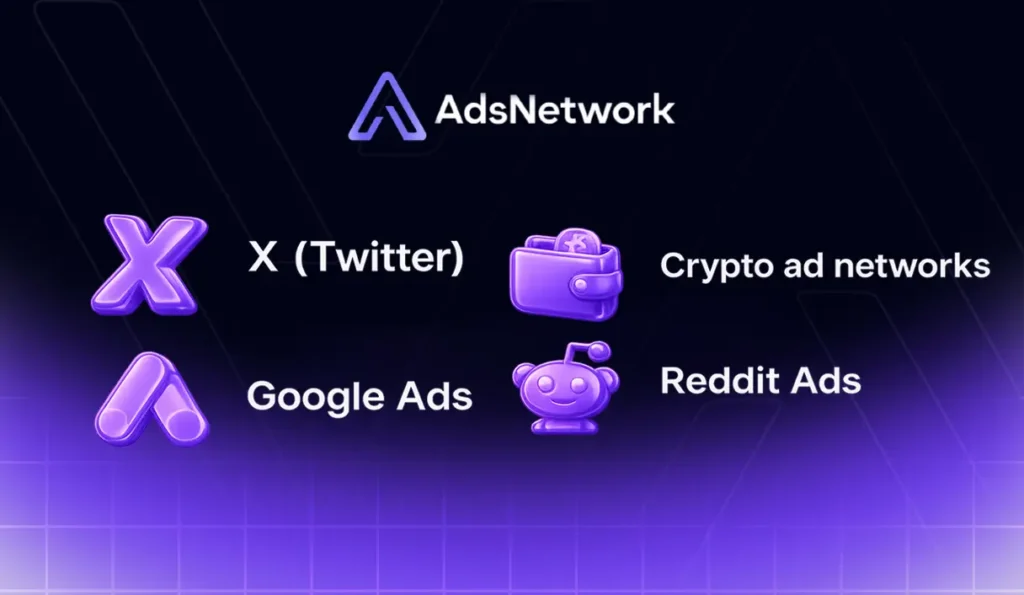
- X (Twitter): The most crypto-friendly major platform. Promoted tweets paired with influencer activity amplify reach effectively.
- Google Ads: Now available to certified crypto advertisers. Strong for capturing high-intent search traffic.
- Crypto ad networks: Platforms like AdsNetwork (adsnetwork.io) specialize in Web3 advertising with targeting capabilities mainstream platforms can’t match, including wallet-based segmentation, on-chain behavioral data, and blockchain activity analysis. Your ads reach users based on actual DeFi, NFT, or trading behavior.
- Reddit Ads: Subreddit-level targeting reaches technically engaged, research-driven crypto audiences.
Real results: a documented multi-channel crypto campaign improved Google Ads performance from 0.02x to 5.76x ROAS through systematic optimization, while crypto network advertising generated over 852,000 impressions among crypto-native audiences that mainstream platforms simply could not reach.
Precision targeting is everything. “Crypto enthusiasts” is not a targeting strategy. Segment by behavior: DeFi yield farmers, NFT collectors, day traders, institutional explorers. Each segment demands different messaging and creatives.
PR, Transparency, and Trust
Press coverage in outlets like CoinDesk, The Block, or Decrypt boosts legitimacy. But the real PR advantage comes from positioning your founders as thought leaders through op-eds, conference talks, and podcast appearances. Teams that offer timely, informed commentary on breaking developments naturally attract media attention.
Amplify earned media through paid promotion. A single press placement reaches the publication’s audience; promoting that coverage through a crypto ad network puts it in front of targeted Web3 audiences who missed it organically.
On the trust side, the bar keeps rising. Publish security audits, make smart contract code auditable, provide regular transparency reports, and never promise returns. The trend toward “marketing safe” is accelerating. Projects that operate above board earn disproportionate trust from both retail and institutional audiences.
Measuring What Matters
Without measurement, you’re guessing. Track these KPIs consistently:
- Community engagement rate: Active participation matters more than follower counts. A 5,000-member Discord with 40% daily activity beats 50,000 silent followers.
- Customer acquisition cost (CAC): What each new user, wallet connection, or investor costs to acquire.
- On-chain metrics: Wallet growth, transaction volume, and token holder distribution. This is the concrete evidence of real adoption.
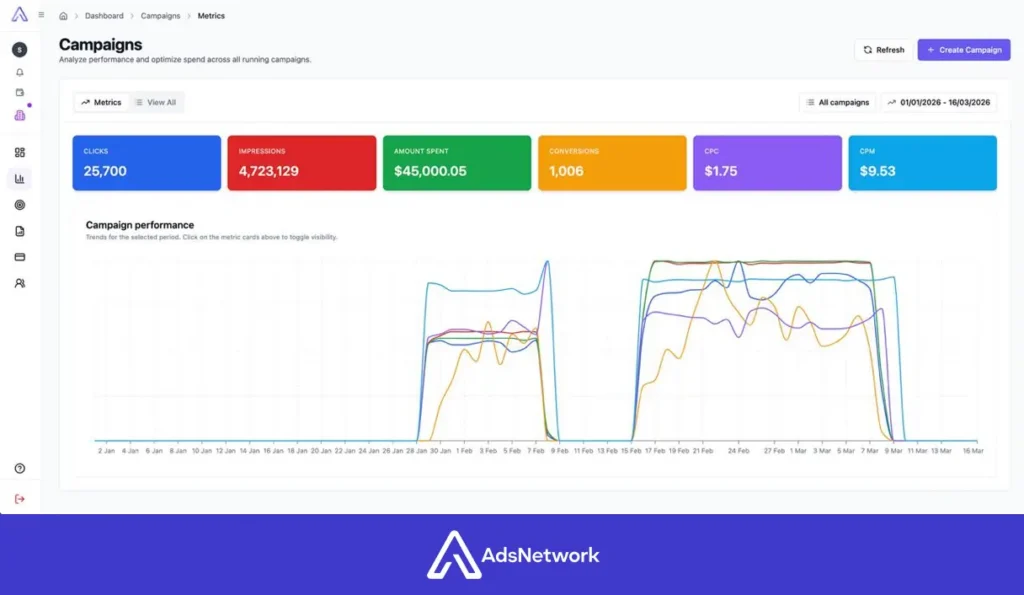
- Campaign ROAS: Track return on ad spend by platform, audience, and ad set. Reallocate budget toward what converts.
- Sentiment analysis: Monitor perception across X, Reddit, Discord, and Telegram in real time.
Build dashboards. Review weekly. Iterate fast. The teams that optimize based on data consistently outperform those running on intuition.
Frequently Asked Questions
How much does it cost to market a crypto project?
Budgets vary widely depending on project stage and goals. Early-stage projects can gain meaningful traction with $5,000–$15,000/month focused on community building, organic content, and targeted social campaigns. Projects pursuing exchange listings and broad visibility typically invest $30,000–$100,000+ monthly across paid ads, influencer partnerships, PR, and market making. The key is allocating budget where it delivers measurable returns, not spreading it thin across every channel.
What is the best platform to advertise a crypto project?
There is no single best platform. It depends on your audience and goals. X (Twitter) offers the most engaged crypto audience for organic and paid reach. Google Ads captures high-intent search traffic. Specialized crypto ad networks like AdsNetwork provide the deepest Web3-native targeting, reaching users based on wallet behavior and on-chain activity. Most successful projects combine two or three channels and optimize based on performance data.
How long does it take to see results from crypto marketing?
Community building and SEO are long-term plays that compound over 3–6 months. Paid advertising and influencer campaigns can generate immediate traffic within days, but converting that traffic into loyal users takes consistent follow-through. The most effective crypto growth strategies combine quick-win paid channels with long-term organic efforts, creating a flywheel where each channel reinforces the others over time.
Looking for smarter ways to reach Web3 audiences? AdsNetwork helps crypto projects connect with the right users through on-chain targeting and Web3-native advertising. Learn more at adsnetwork.io
Ready to Get Started?
Launch your advertising campaign today and reach your target audience effectively.
Start Your CampaignAbout the Author
Hana Mori
Content specialist focused on digital advertising and marketing strategies. Passionate about helping businesses grow through data-driven campaigns.
Related Articles
How to Build a Winning Advertising Funnel
Here is the problem with most paid advertising campaigns: they treat every user the same. A cold audience sees the same ad as someone who spent ten minutes on your pricing page. The campaign looks active. The dashboard shows impressions and clicks. But conversions stay flat, and nobody can explain why. The answer is almost […]
11 min read
Retargeting Ads Strategy That Converts
Somewhere between 96 and 98% of the people who visit your website leave without taking any action. They read a page, check a price, look at a product, and disappear. Standard digital advertising treats those people as lost. A strong retargeting ads strategy treats them as your warmest leads, because that is exactly what they […]
13 min read
How to Optimize Ad Campaigns for Maximum ROI
Most ad budgets do not disappear in one bad decision. They erode slowly, spread across campaigns that were never truly dialed in: audiences that are too broad, creative that went stale months ago, landing pages that convert at half the rate they should, and attribution models that hide where the real money is going. To […]
12 min read