

How to Increase ROAS in Digital Advertising
Most campaigns do not fail because the product is wrong or the budget is too small. They fail because the return on ad spend never gets high enough to justify scaling. If you’re looking for ways to increase ROAS, it’s important to realise that low ROAS is not a budget problem. It is a signal that something in the campaign system needs to change. Understanding where that signal is coming from is the first step to fixing it.
This guide covers the most effective tactics to increase ROAS across digital advertising channels, from tightening audience targeting and improving creative quality to fixing attribution gaps and protecting budgets from invalid traffic. Each strategy connects directly to a specific lever you can pull today. You will also find notes on how these tactics apply in crypto and Web3 campaigns, where standard benchmarks often need to be read differently.
If you are not yet tracking the right advertising metrics, start there before applying any of the strategies below.
Start With Your Breakeven ROAS
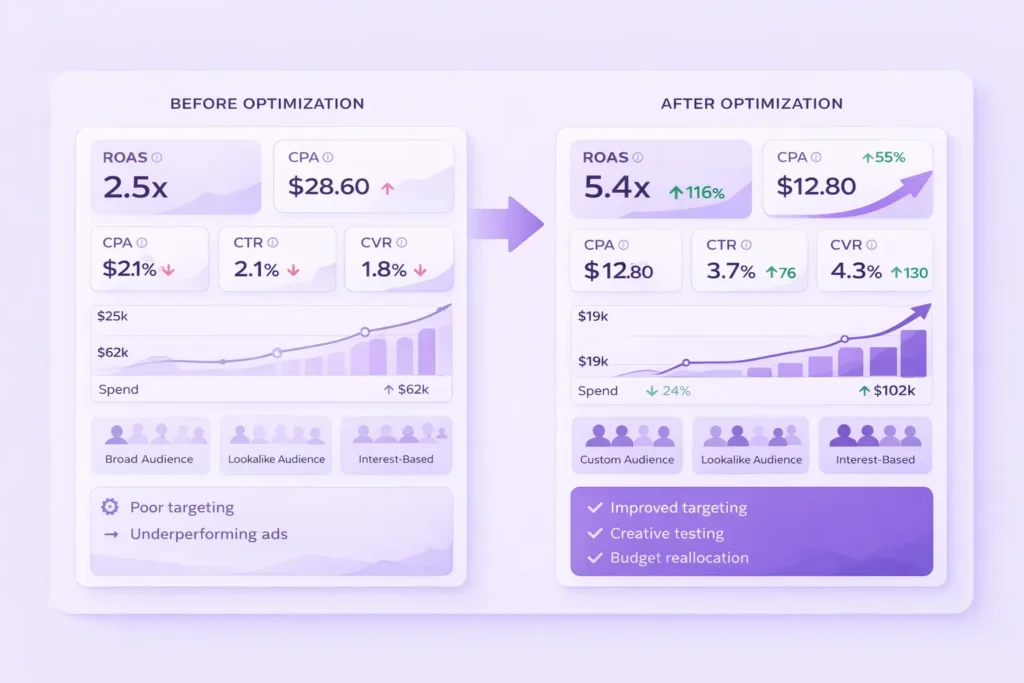
Before you can increase ROAS, you need to know what number actually matters for your business. That number is your breakeven ROAS: the minimum return you need just to cover costs and stay profitable.
The formula is straightforward: 1 divided by your profit margin equals your breakeven ROAS. A 25% margin means your breakeven is 4:1. A 50% margin puts it at 2:1. Anything below that number means you are losing money on every campaign dollar, even if the dashboard looks healthy.
Once you know your floor, you can set a realistic target. Most advertisers aim for a ROAS of 4:1 or higher. The median across Google Ads campaigns sits around 3.31x, while Meta (Facebook and Instagram) averages around 2.19x and TikTok averages 1.41x. These are midpoints across many verticals. Your target should reflect your specific margin structure, not the platform average.
For crypto and Web3 projects, standard ROAS benchmarks apply with one important caveat: if you are measuring conversions as wallet connections or sign-ups rather than direct revenue events, your ROAS calculation needs to incorporate customer lifetime value. A wallet connection that leads to a high-value on-chain transaction is worth far more than the initial conversion suggests.
Tighten Audience Targeting
Broad targeting is the most common cause of low ROAS. When your ads reach people who are unlikely to convert, you pay for impressions and clicks that will never generate revenue. Narrowing your audience improves conversion rate, lowers CPA, and lifts ROAS without requiring more budget.
Segment by Intent, Not Just Demographics
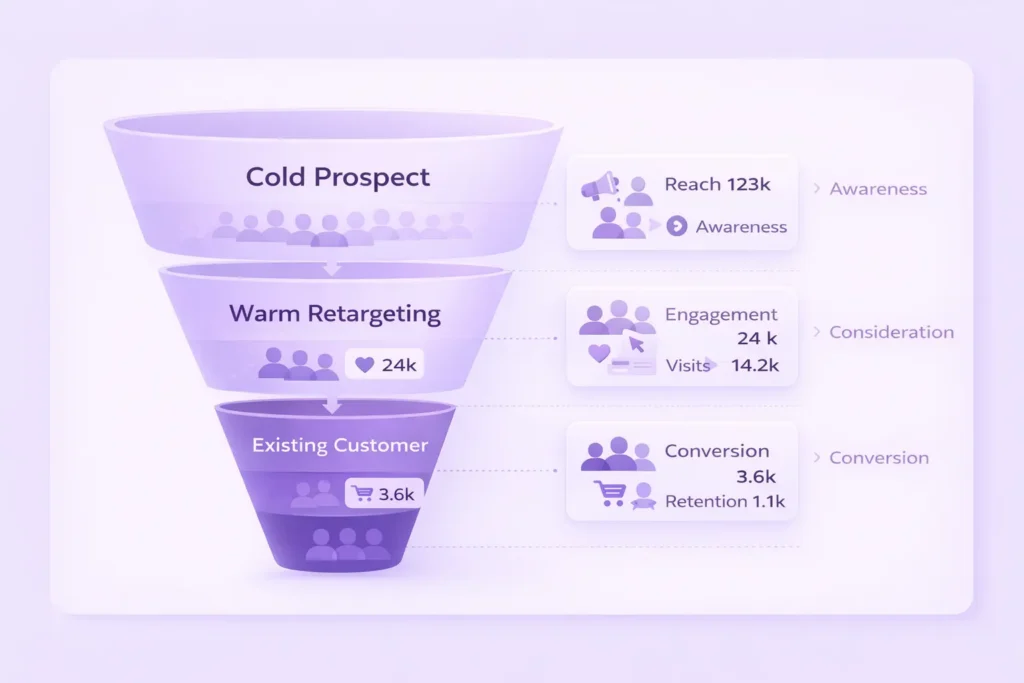
Demographic targeting (age, location, interests) gives you reach. Behavioral and intent-based targeting gives you buyers. The difference in performance is significant. According to Marketing Metrics data, the probability of selling to an existing customer is 60 to 70%, compared to just 5 to 20% for a new prospect. Segmenting your campaigns by funnel stage and tailoring messaging accordingly is one of the fastest ways to lift ROAS.
Campaigns using custom audiences built from first-party data consistently outperform broad targeting. First-party data audiences have been shown to deliver 23% lower CPCs than standard demographic targeting on Facebook alone, with lookalike audiences built from high-value customer segments delivering 19% better CPCs.
Use Negative Targeting Aggressively
Negative keyword lists and audience exclusions are just as important as what you target. Excluding irrelevant search terms, competitor-adjacent traffic, and low-intent queries removes wasted spend from the equation. For Web3 campaigns, this means excluding informational queries and audiences with no history of on-chain activity wherever possible.
Invest in Retargeting: The Single Highest-ROAS Tactic
No tactic consistently outperforms retargeting for increasing ROAS. The numbers are not close. Retargeting campaigns deliver 71% higher ROAS than prospecting campaigns, according to analysis of Facebook Ads performance data. Retargeted ads achieve click-through rates up to 10 times higher than standard display ads, according to industry benchmarks cited by Amra and Elma. The average ROAS for retargeting campaigns sits around 4.2x, compared to significantly lower returns from cold prospecting.
The reason is simple: retargeted users already know your brand. They have visited your site, engaged with your content, or abandoned a checkout flow. They need a nudge, not an introduction.
A well-structured retargeting strategy allocates roughly 15 to 30% of total ad budget to retargeting audiences, depending on funnel size. Research cited by NewswireJet found that a fashion retailer spending $2,500 of a $10,000 monthly budget on retargeting achieved a 5.1x ROAS from retargeted campaigns, compared to 3.6x from cold prospecting. The split was the difference between a profitable account and a marginal one.
For crypto campaigns run through Programmatic Advertising Explained for Beginners, retargeting wallet visitors and users who have previously connected but not completed a transaction is one of the most cost-efficient tactics available. On-chain signals give you retargeting precision that browser-based audiences alone cannot match.
Improve Creative Quality and Relevance
Even perfectly targeted campaigns will underperform with weak creative. Ad creative is the most visible factor in whether someone clicks, and the landing page they reach is the primary driver of whether that click converts. Both need continuous attention.
Test Creative Systematically
A/B testing ad creative is not optional at any meaningful budget level. Consistent creative testing has been shown to deliver 18 to 30% CTR improvements and 12 to 18% conversion rate lifts, according to analysis from ALM Corp. These are not edge-case improvements. They are the difference between a campaign that scales profitably and one that plateaus.
Video consistently outperforms static images. Facebook video ad campaigns show 31% better ROAS than image-only campaigns. Short-form video delivers engagement rates 2.5 times higher than long-form content. For Web3 projects, short explainer videos and community content tend to outperform polished brand ads, because authenticity is more trusted than production quality in this space.
Match the Landing Page to the Ad Promise
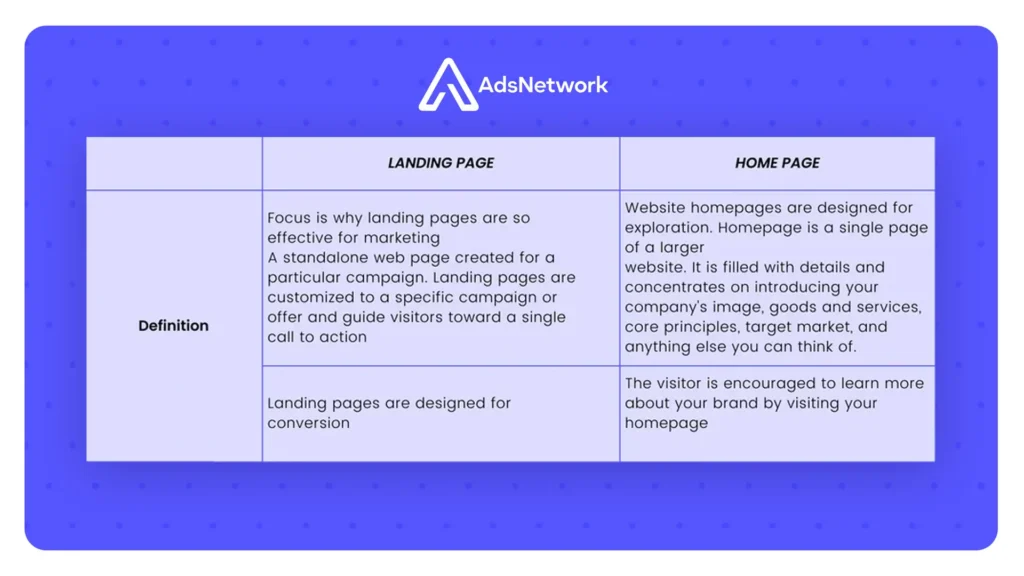
A strong click-through rate combined with a weak conversion rate points directly to landing page friction. The page a user lands on after clicking your ad must deliver exactly what the ad promised, immediately and without confusion. Slow load times, mismatched messaging, and unclear calls to action all drag down ROAS by converting fewer of the clicks you are already paying for.
Improving landing page experience lowers your cost per conversion without increasing ad spend. That means your ROAS goes up even if your traffic volume stays flat.
Fix Your Attribution Before You Optimize Anything Else
This is the step most teams skip, and it is the reason many optimization efforts fail to move the needle. If your attribution model is wrong, every decision you make based on campaign data is wrong too.
Last-click attribution, which credits the final ad touch before a conversion, is still the default on many platforms. It systematically undercredits the upper-funnel activities that drove awareness and mid-funnel engagement that kept the user in the consideration stage. Campaigns that look low-ROAS under last-click may be performing well when the full journey is visible.
Implement conversion tracking that assigns revenue values to conversion events, not just counts them. Use UTM parameters consistently across all paid links. For Web3 campaigns, layer on-chain data alongside browser-based attribution. A wallet that first clicked a banner ad, then saw a social post, then completed a swap four days later represents a multi-touch journey that last-click attribution will completely misread.
Clean attribution data also feeds better AI bidding. Platforms like Google and Meta use conversion data to optimize smart bidding strategies. When that data is contaminated or incomplete, the algorithm trains itself on bad signals, pushing budget toward placements that look good but do not convert.
Protect Budget From Invalid Traffic
Ad fraud is one of the most overlooked levers for improving ROAS, and one of the most impactful. If 20% of your traffic is invalid, then 20% of your budget is generating zero revenue. Removing that waste is the equivalent of a 20% budget increase with no additional spend.
The Lunio Global IVT Report 2026 found that $63 billion in ad spend was lost to invalid traffic in 2025 alone. A separate analysis of 105.7 billion impressions by Fraudlogix recorded an overall invalid traffic rate of 20.64%, meaning roughly one in five impressions showed characteristics of non-human activity.
The damage compounds through AI bidding. When invalid clicks flow into your conversion data, smart bidding systems learn to find more traffic that looks like those clicks. They optimize toward fraud without knowing it, steadily pushing budgets toward the lowest-quality placements in your campaign mix.
For digital advertising at any meaningful scale, third-party fraud verification and traffic quality auditing are not optional costs. They are budget protection.
Increase ROAS in Crypto and Web3 Campaigns
The strategies above apply across all digital advertising channels. In crypto and Web3 specifically, a few additional tactics make a material difference.
First, choose the right channel. Google and Meta restrict most crypto promotions to pre-approved advertisers. Running campaigns through a dedicated crypto ad network means you are reaching users who are already in the ecosystem, which improves conversion rate at every stage of the funnel.
Second, define your conversion event precisely. A wallet connection is a different quality signal than a newsletter sign-up. A completed swap or deposit is stronger still. The tighter your conversion definition, the more accurately your ROAS reflects true campaign value. Broad conversion tracking inflates ROAS numbers while hiding underperformance in the metrics that matter.
Third, track user retention after the initial conversion. A high ROAS on wallet connections that churn within a week is not a success. Layer post-conversion retention data into your ROAS calculation to see whether acquired users are actually engaging with your product. AdsNetwork provides reporting tools built for this kind of layered measurement, connecting campaign delivery to on-chain activity signals for a clearer view of what campaigns are generating.
Increase ROAS by Fixing the Fundamentals
There is no single tactic that doubles ROAS overnight. The campaigns that consistently increase ROAS are built on a set of fundamentals working together: precise targeting, strong retargeting, honest attribution, quality creative, and clean traffic. Fix one and you will see improvement. Fix all five and the gains compound.
For crypto and Web3 marketers, the same fundamentals apply, but the measurement layer goes deeper. Browser-based signals are the floor, not the ceiling. On-chain data is where the clearest picture of campaign performance lives.
If you are ready to run digital advertising campaigns on infrastructure designed for Web3 audiences, with the transparency and measurement tools needed to track ROAS accurately, visit adsnetwork.io.
Frequently Asked Questions
What is a good ROAS in digital advertising?
A good ROAS depends on your profit margin and business model, not a universal number. The general rule of thumb for most advertisers is 4:1, meaning $4 in revenue for every $1 spent on ads. The median across Google Ads campaigns sits around 3.31x, while Meta averages 2.19x. High-margin businesses can operate profitably at a lower ROAS. Low-margin businesses often need 5:1 or higher just to break even. Always calculate your breakeven ROAS first: divide 1 by your profit margin. That number is the floor, not the target.
Why is retargeting so effective at increasing ROAS?
Retargeted users already know your brand. They have engaged with your site, clicked an ad, or browsed a product. That familiarity dramatically reduces the friction between an ad impression and a conversion. Data consistently shows retargeting campaigns deliver 71% higher ROAS than prospecting campaigns, with average retargeting ROAS sitting around 4.2x. Website visitors who are retargeted are also approximately 70% more likely to convert than cold audiences, according to multiple industry sources. Retargeting uses the same ad budget more efficiently by focusing spend on users who have already shown intent.
How does ad fraud lower ROAS and what can you do about it?
Ad fraud lowers ROAS in two ways. First, it wastes budget directly: impressions and clicks generated by bots produce zero revenue, so every fraudulent interaction increases your total spend without increasing returns. Second, invalid traffic corrupts the data your AI bidding systems learn from, training them to optimize toward more fraud over time. The global invalid traffic rate across all channels was approximately 20.64% in 2025, according to Fraudlogix analysis of 105.7 billion impressions. To protect ROAS, use third-party fraud verification tools, choose ad networks with built-in traffic quality filtering, and audit placements regularly for unusual CTR or CPC patterns that may signal invalid traffic.
Ready to Get Started?
Launch your advertising campaign today and reach your target audience effectively.
Start Your CampaignAbout the Author
Miha Zupan
Content specialist focused on digital advertising and marketing strategies. Passionate about helping businesses grow through data-driven campaigns.
Related Articles
Retargeting Ads Strategy That Converts
Somewhere between 96 and 98% of the people who visit your website leave without taking any action. They read a page, check a price, look at a product, and disappear. Standard digital advertising treats those people as lost. A strong retargeting ads strategy treats them as your warmest leads, because that is exactly what they […]
13 min read
How to Optimize Ad Campaigns for Maximum ROI
Most ad budgets do not disappear in one bad decision. They erode slowly, spread across campaigns that were never truly dialed in: audiences that are too broad, creative that went stale months ago, landing pages that convert at half the rate they should, and attribution models that hide where the real money is going. To […]
12 min read

Advertising Metrics Every Marketer Should Know
Most crypto projects launch ad campaigns with confidence. They set a budget, pick a network, hit publish, and then stare at a dashboard full of numbers they barely understand. The advertising metrics keep climbing. The results stay flat. If that sounds familiar, you are not alone. Knowing which advertising metrics actually matter, and how to […]
9 min read