

How to Build a Winning Advertising Funnel
Here is the problem with most paid advertising campaigns: they treat every user the same. A cold audience sees the same ad as someone who spent ten minutes on your pricing page. The campaign looks active. The dashboard shows impressions and clicks. But conversions stay flat, and nobody can explain why.
The answer is almost always the same. There is no advertising funnel. The campaign has spend, creative, and targeting. What it is missing is structure. The right message, the right person, the right stage: that connection never gets made.
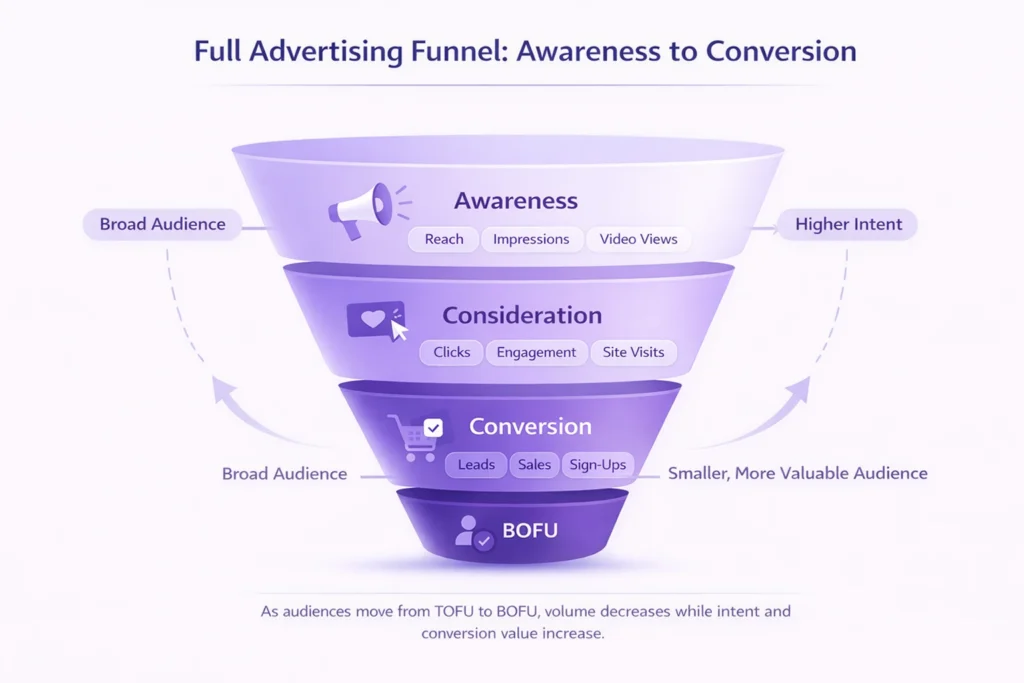
This guide walks through every stage of a winning advertising funnel. It covers TOFU awareness campaigns that build reach, MOFU nurturing that builds intent, and BOFU conversion tactics that close. It also covers what changes when you are running campaigns for a crypto or Web3 project.
Why Your Advertising Funnel Cannot Afford to Skip a Stage
Most advertising budgets are concentrated at one end of the funnel or the other. Early-stage brands pour everything into awareness because they need reach. Growth-stage brands pile budget into conversion campaigns because they need revenue. Both approaches leave the middle of the funnel empty, and that gap is where most leads are lost.
According to data compiled by Cropink, 79% of marketing leads never convert due to a lack of proper nurturing. Nearly eight out of ten people who enter your funnel drop out before acting. It is not because they were the wrong audience. It is because nobody stayed in contact through the consideration phase.
The cost of that gap is measurable. Companies with effective lead nurturing generate 50% more sales-ready leads at a 33% lower cost, according to the same research. And brands that apply a full-funnel strategy gain 45% higher ROI than competitors that focus on a single funnel stage. Building a complete advertising funnel is not a nice-to-have. It is where the ROI difference between average campaigns and high-performing ones actually comes from.
Despite this, 68% of businesses have not fully defined or documented their funnel strategy. Most advertisers are competing without a clear system. There is no structured approach to moving people from first impression to conversion.
Top of Funnel: Build Awareness With the Right Audiences
The top of the advertising funnel is where your brand meets people who do not know you yet. The goal here is not conversion. It is exposure, attention, and the beginning of familiarity. VWO research shows that 96% of website visitors are not ready to buy on their first visit. Trying to sell to cold traffic immediately is expensive and inefficient. TOFU campaigns do something more valuable: they fill the pipeline.
What Works at the Top of the Funnel
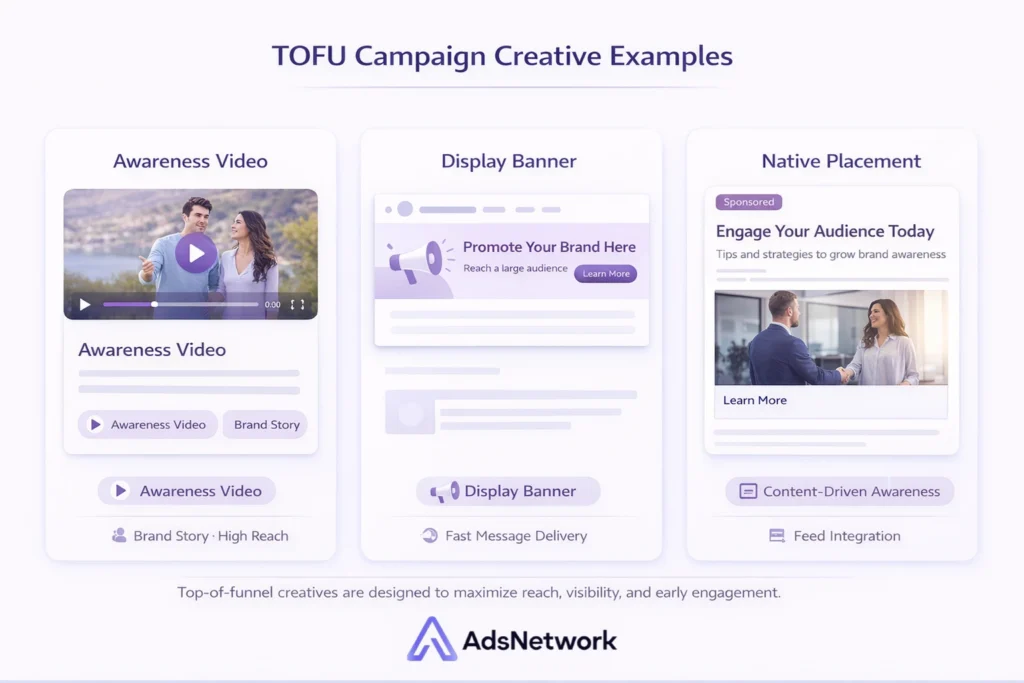
Top-of-funnel advertising is built around reach and relevance. The best formats are video, display, and native content that educates or provokes curiosity. None of them should ask for a commitment. The audience does not know your product yet. Your creative should speak to a problem or a category, not a feature list.
Broad programmatic placements, social video, and content discovery networks all serve TOFU well. They reach people in a passive browsing state. Targeting here should use demographic and interest signals. Intent signals are not relevant yet because intent has not been expressed.
TOFU budget should typically sit between 20 and 30% of total campaign spend, according to full-funnel allocation guidance from Factors.ai. Brands entering a new market may need to weight this higher. Established brands can run leaner at the top. Shift that budget to MOFU and BOFU, where intent is stronger.
The key TOFU metrics to watch are reach, frequency, CPM, and video completion rate. Do not judge TOFU campaigns by conversion rate. They are not built to convert. They are built to create the audience that MOFU and BOFU campaigns will later convert.
Middle of Funnel: Turn Interest Into Serious Consideration
The middle of the advertising funnel is the most neglected stage in most paid campaigns, and the most critical. This is where people who have heard of your brand decide whether it is worth learning more. A well-built MOFU stage is what separates campaigns that generate traffic from campaigns that generate qualified buyers.
A well-defined MOFU engagement strategy can increase response rates by 4 to 10 times compared to jumping straight to a hard conversion ask. That multiplier reflects the difference between talking to a cold lead and talking to a warm one.
MOFU Tactics That Build Intent
The formats that drive MOFU performance are more direct than TOFU content but not yet conversion-focused. Case studies, comparison content, product explainer videos, webinars, and email sequences all belong here. The goal is to give the prospect enough information and social proof to feel confident moving toward a decision.
Retargeting is the primary delivery mechanism at this stage. TOFU ad engagers, blog readers, and video viewers who watched at least 50% all belong in a MOFU retargeting pool. From there, they need content built for the consideration phase. Generic brand reminder ads are wasted here. Behavior-specific messages that acknowledge where the user is perform significantly better.
MOFU should receive the largest budget share of the three stages, typically 40 to 50% of total campaign spend. This reflects where the most decision-making happens. Underfunding the middle of the funnel while investing heavily in TOFU fills your pipeline with leads that never convert. They were never nurtured toward action.
Most buyers do not convert after a single interaction with a brand. Research shows that 63% of buyers need at least three touchpoints before making a decision. The MOFU stage is where those touchpoints are built. Relevant content, well-timed ads, and answered objections each move the prospect one step closer to a decision.
Bottom of Funnel: Close the Conversion With Precision
The bottom of the advertising funnel is where intent becomes action. The people who reach this stage already know your brand, understand your product, and are evaluating whether to commit. Your job at BOFU is not to introduce or educate. It is to remove the last remaining barrier between the prospect and the conversion event.
What Converts at the Bottom of the Funnel
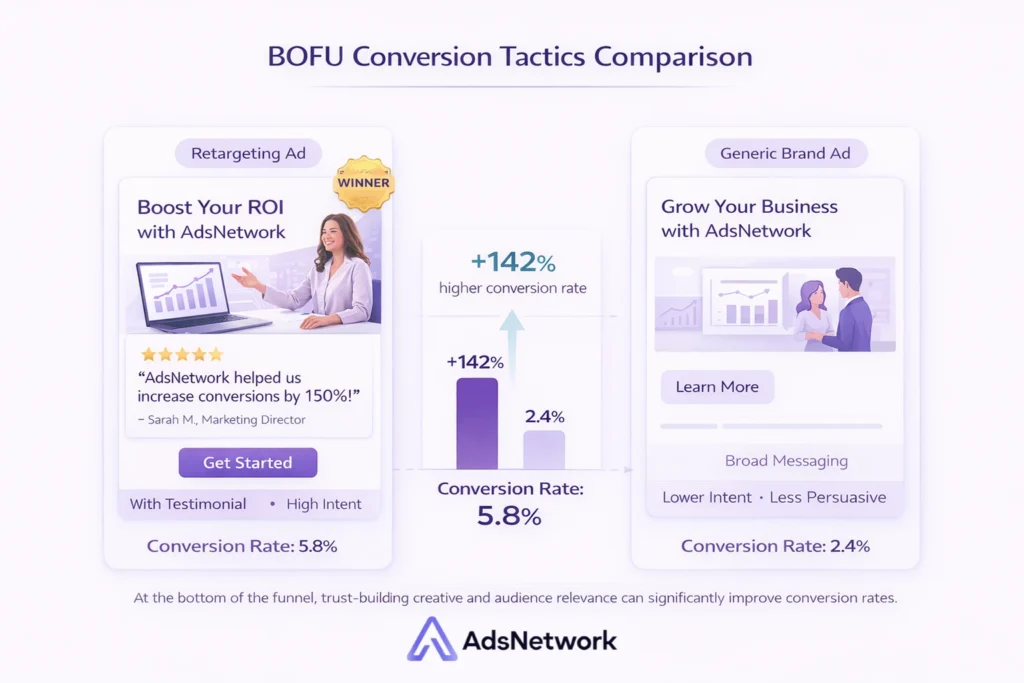
High-performing BOFU tactics are direct, specific, and frictionless. They include retargeting campaigns for high-intent users, limited-time offers that create urgency, and proof elements like testimonials. Landing pages optimized purely for the conversion action complete the picture.
Landing page performance matters enormously here. The average conversion rate is 2.35%. Top-performing pages hit 5.31% or higher, and the best reach 11.45%. That gap is not explained by traffic quality alone. It comes down to friction, message match, and whether the conversion feels low-risk.
Optimized landing pages can increase conversions by up to 300%, according to data cited by Cropink. For BOFU campaigns, landing page quality is not a secondary concern. It is the primary variable that determines whether your bottom-of-funnel spend returns revenue or waste.
Well-built Retargeting Ads are the delivery engine for BOFU. Pricing page visitors, abandoned checkouts, and repeat product viewers all belong in a BOFU retargeting audience. They need specific creative that speaks to their stage. Generic ads at this point throw away all the behavioral intelligence gathered across the funnel.
BOFU budget allocation sits at 20 to 30% of total spend. For brands with a strong TOFU and MOFU pipeline already built, this can be leaned into more aggressively. More qualified prospects arrive at the bottom, and CPAs are typically lower.
Measure the Funnel as a System, Not Stage by Stage
The most common mistake in advertising funnel management is evaluating each stage against isolated metrics. TOFU is judged by CPM. MOFU is judged by CTR. BOFU is judged by conversion rate. None of those numbers tells you whether the funnel as a whole is working.
A winning advertising funnel requires connected measurement. Track how users move from TOFU exposure to MOFU engagement. Track how many of those engaged users then show BOFU intent signals. When those handoffs are visible, you can identify where the funnel leaks and fix the right stage.
Strong CTR with weak conversion rate points to a landing page problem. High reach with low MOFU engagement means TOFU creative is not attracting the right audience. Heavy BOFU spend with low conversion rate means MOFU did not build enough intent. Each diagnosis needs a different fix. None of them is visible when you look at one stage at a time.
For a full breakdown of which Advertising Metrics to track at each funnel stage, review the metrics guide before setting up your reporting. The right measurement structure is what turns dashboard data into real optimization decisions.
Building an Advertising Funnel for Crypto and Web3 Projects
The three-stage funnel structure applies directly to Web3 campaigns. What changes is the conversion event at each stage and the channels available to reach audiences.
At the top of the funnel, crypto and Web3 projects compete for attention in a space saturated with noise. Projects that build genuine TOFU reach lead with education and community value. Price action and token launch hype do not work here. Content explaining a protocol mechanism or a real use case consistently outperforms generic awareness advertising.
At the middle of the funnel, consideration signals in Web3 differ from ecommerce or SaaS. Protocol documentation visits, tokenomics page views, and Discord joins are all strong MOFU signals. Retarget those users with content addressing trust, security, or product-specific questions. That maps directly to the objections crypto users have at the consideration stage.
At the bottom of the funnel, the Web3 conversion event is on-chain: a wallet connection, a transaction, a stake, or a deposit. These are higher-commitment actions than a standard ecommerce purchase. The BOFU stage for Web3 projects needs to work harder on proof. Security audits, team credentials, liquidity data, and community size all carry weight. Audiences want evidence before putting assets into a protocol.
Channel selection shapes the entire funnel for Web3 projects. Google and Meta restrict most direct crypto promotions. That means TOFU campaigns need platforms built specifically for this space. A specialist crypto ad network gives you access to the crypto-native publisher network where your audience is already active. AdsNetwork connects Web3 advertisers to blockchain-native audiences across every funnel stage, using display and native formats designed for crypto readers.
Build the Advertising Funnel That Earns the Conversion
Most campaigns do not fail at the bottom of the funnel. They fail in the gaps between stages. The TOFU traffic that was never nurtured. The MOFU prospects sent a conversion ask before they were ready. The BOFU landing pages that could not close what the ad creative opened. A winning advertising funnel eliminates those gaps by treating awareness, consideration, and conversion as one connected system.
The average funnel conversion rate across all industries is 2.35%. Top-performing funnels hit 5.31% and above. That difference is almost entirely explained by how well each stage prepares the audience for the next one. Build that connection deliberately, allocate budget proportionally, and measure the handoffs between stages. That is how a funnel goes from active to winning.
For crypto and Web3 projects ready to build campaigns for blockchain-native audiences at every funnel stage, visit adsnetwork.io.
Frequently Asked Questions
What is an advertising funnel and why does it matter?
An advertising funnel is a structured approach to moving potential customers from first awareness through consideration and toward conversion. It has three stages: TOFU for awareness, MOFU for consideration and nurturing, and BOFU for conversion. It matters because 79% of marketing leads never convert due to a lack of nurturing. Without a funnel, most TOFU audiences never reach conversion. There is no system to move them there. Brands that apply a full-funnel strategy consistently achieve 45% higher ROI than those focusing on a single stage.
How should I split my advertising budget across funnel stages?
A practical starting allocation: 20 to 30% for TOFU, 40 to 50% for MOFU, and 20 to 30% for BOFU. MOFU receives the largest share because that is where most decision-making happens. It is also where most campaigns underinvest. New brands may need to weight TOFU more heavily to build initial reach. Established brands can shift more toward MOFU and BOFU, where intent is stronger and CPAs are lower. Review these ratios quarterly based on where your funnel is leaking, not on a fixed formula.
How is a Web3 advertising funnel different from a standard digital funnel?
The three-stage structure is the same, but conversion events, trust signals, and available channels all differ. In Web3, TOFU content needs to lead with education, not product hype. Crypto audiences are skeptical by design and reward transparency. MOFU consideration involves specific objections: security, smart contract risk, team credibility, and tokenomics. Standard retargeting creative does not address these. BOFU conversion events are wallet-level actions like a first transaction or a stake. These require more trust than a typical ecommerce purchase. Channel selection is also constrained. Google and Meta restrict most direct crypto advertising. Crypto-native ad networks are essential infrastructure for reaching blockchain audiences at every funnel stage.
Ready to Get Started?
Launch your advertising campaign today and reach your target audience effectively.
Start Your CampaignAbout the Author
Hana Mori
Content specialist focused on digital advertising and marketing strategies. Passionate about helping businesses grow through data-driven campaigns.
Related Articles
Retargeting Ads Strategy That Converts
Somewhere between 96 and 98% of the people who visit your website leave without taking any action. They read a page, check a price, look at a product, and disappear. Standard digital advertising treats those people as lost. A strong retargeting ads strategy treats them as your warmest leads, because that is exactly what they […]
13 min read
How to Optimize Ad Campaigns for Maximum ROI
Most ad budgets do not disappear in one bad decision. They erode slowly, spread across campaigns that were never truly dialed in: audiences that are too broad, creative that went stale months ago, landing pages that convert at half the rate they should, and attribution models that hide where the real money is going. To […]
12 min read
How to Increase ROAS in Digital Advertising
Most campaigns do not fail because the product is wrong or the budget is too small. They fail because the return on ad spend never gets high enough to justify scaling. If you’re looking for ways to increase ROAS, it’s important to realise that low ROAS is not a budget problem. It is a signal […]
11 min read