

CPM vs CPC vs CPA: Which Model Is Best?
Every crypto ad campaign comes down to one fundamental question before anything else: how do you want to pay? The debate between CPM vs CPC vs CPA is not about which model is universally superior. It is about which model matches your campaign goal, your stage of growth, and your risk tolerance. Choose the wrong one and you can burn budget on impressions that never convert, clicks from bots, or conversions that cost more than the revenue they generate. Choose the right one and your spend becomes genuinely accountable.
This guide breaks down how each model works, what the real benchmark numbers look like in the crypto and Web3 space, and how to match the right pricing model to the right campaign objective.
What CPM, CPC, and CPA Actually Mean
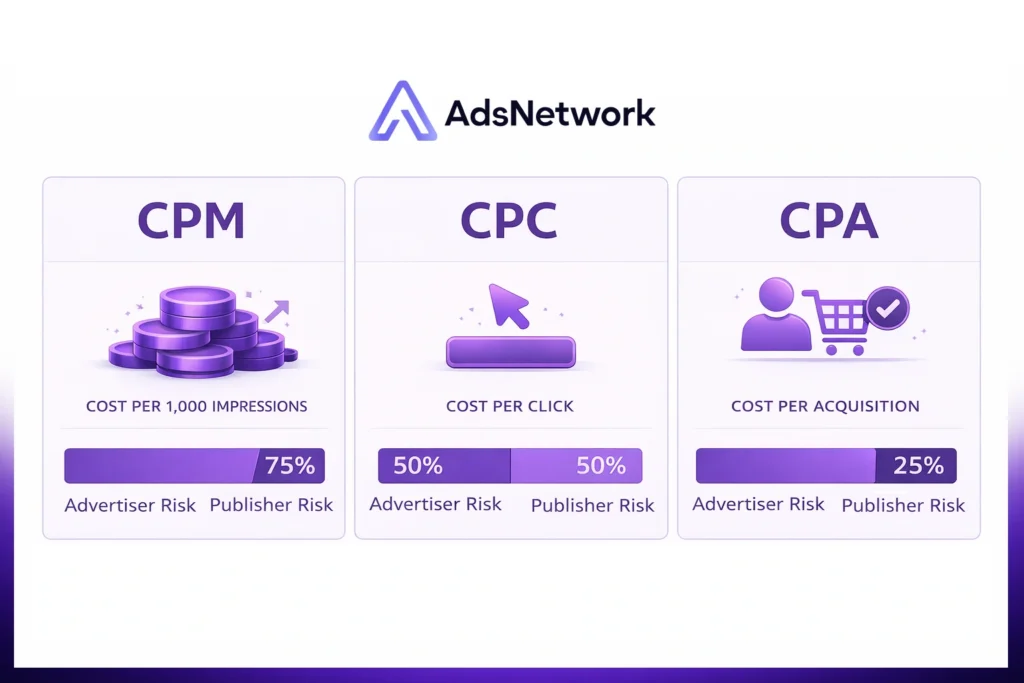
These three models describe how advertisers pay for digital ad inventory. They differ in what triggers a payment and who carries the risk when an ad does not perform.
CPM: Pay per 1,000 Impressions
CPM stands for cost per mille, or cost per thousand impressions. You pay a fixed rate every time your ad loads on a page, regardless of whether anyone clicks or engages. The formula is simple: CPM = (total spend / total impressions) x 1,000.
CPM gives you predictable reach. You know exactly how many eyeballs your budget will buy. That makes it the dominant model for brand awareness campaigns, token launches, and any situation where visibility is the primary goal. The risk sits entirely with the advertiser: if no one pays attention, you still pay.
CPC: Pay per Click
CPC stands for cost per click. You pay only when a user actively clicks on your ad and lands on your destination page. The formula: CPC = total spend / number of clicks.
CPC shifts some risk to the publisher. They only earn if their audience engages. For advertisers, every dollar directly reflects demonstrated interest rather than passive exposure. That makes CPC a strong fit for driving traffic to landing pages, exchange sign-up funnels, and wallet download pages. The limitation is that clicks do not guarantee conversions. There is often a significant gap between a user clicking an ad and completing an on-chain action.
CPA: Pay per Acquisition
CPA stands for cost per acquisition, or cost per action. You pay only when a user completes a specific predefined action: a registration, a first deposit, a token swap, or an app install. The formula: CPA = total spend / number of completed actions.
CPA is the most performance-oriented of the three models. Almost all the risk moves to the publisher or network, since they earn nothing until your campaign actually delivers results. That is why CPA inventory is scarce: publishers prefer predictable revenue. But for campaigns with a well-defined conversion funnel, CPA ties every dollar of spend directly to a measurable outcome.
| Model | Best For | Risk Holder | Fraud Exposure |
| CPM | Brand awareness, token launches | Advertiser | Highest (10.9% unprotected) |
| CPC | Mid-funnel traffic, sign-ups | Shared | Moderate (18% click fraud rate) |
| CPA | Conversions, deposits, installs | Publisher / Network | Lowest (9.75% of conversions) |
CPM vs CPC vs CPA: What the Benchmark Numbers Look Like in Crypto
Crypto advertising runs at different rates than mainstream digital advertising. Understanding the real numbers helps you set realistic budgets and spot when a network is overcharging.
CPM Benchmarks in Crypto
Crypto ad network CPMs span a wide range depending on the platform and placement quality. According to Coinzilla, the Google Display Network averages roughly $3.12 CPM, while premium crypto placements on networks like Coinzilla run between €3 and €10 CPM. For context, the Google Display Network averages around $3.12 CPM for mainstream inventory. Budget-tier crypto networks can start much lower, while premium placements on well-trafficked crypto publishers command a significant premium. The wide range makes network selection one of the most important CPM decisions you will make.
CPC Benchmarks in Crypto
Crypto CPC varies considerably by platform. Statista data compiled from Semrush shows cryptocurrency Google Ads in the US average around $0.79 CPC, well below the cross-industry Google Ads average of $5.26. On Facebook, the story is different: analysis of $3 billion in ad spend by Superads puts the global median CPC for Crypto & Blockchain campaigns at $2.51, roughly 124% above the global Facebook benchmark. On dedicated crypto ad networks, CPC bids start much lower but competitive placements can reach $2 and above.
CPA Benchmarks in Crypto
Crypto CPA data is harder to find publicly because most affiliate networks keep their rates private. The most frequently cited public figure is a crypto cost-per-lead range of $30 to $500 or more, varying significantly by offering type and lead quality, as documented by HotForexLead. For comparison, Amra & Elma report that the average CPA across all industries in PPC search is $59.18, with Financial Services averaging $81.93 on search. Crypto projects typically sit at the higher end of this range due to the complexity of the conversion action and the sophistication required from the user.
CPM vs CPC vs CPA: Matching the Model to Your Campaign Goal
Use CPM for Brand Awareness and Token Launches
CPM is the right model when your primary goal is visibility. Token launches, protocol rebrands, exchange announcements, and any campaign targeting a cold audience should almost always start with CPM. The goal at this stage is simple: get your project name and value proposition in front of as many relevant users as possible, as efficiently as possible.
A documented example of CPM at scale: Solidus Ai Tech ran a sustained CPM campaign through Coinzilla that generated more than 80 million impressions over the course of the campaign, with an average click-through rate of 0.37%. The project increased its monthly ad spend by 4,400% over the life of the campaign, a clear signal that the CPM model was delivering meaningful brand growth at an efficient cost per impression.
Use CPC for Mid-Funnel Traffic and Exchange Sign-Up Funnels
CPC works best once you have established some brand recognition and you want to drive qualified traffic to a specific destination. Sign-up pages, whitepaper downloads, wallet connection prompts, and ICO participation funnels are all natural CPC use cases. Each click represents demonstrated interest, which makes it easier to build retargeting audiences and measure engagement quality.
The key caveat is that CPC campaigns require strong landing pages. A high click volume means nothing if your destination page does not convert. CPC is the bridge between awareness and conversion, not a substitute for conversion rate optimization.
Use CPA for Conversion-Focused Campaigns with Clear Funnels
CPA is the right choice when you can clearly define and track a single conversion event. Crypto exchanges with standard registration and first-deposit funnels are the natural home for CPA. So are DeFi protocols where a wallet connection or first liquidity deposit is a trackable on-chain event.
Not every crypto network supports CPA. Major platforms like Coinzilla and Cointraffic operate primarily on CPM and CPC. Networks built for performance advertising, including those with on-chain tracking capabilities, tend to be better suited for CPA campaigns. Platforms like AdsNetwork that support multiple buying models give crypto teams the flexibility to run all three models from a single setup without juggling multiple vendor relationships.
The industry consensus, supported by multiple crypto marketing sources, is a sequential approach: CPM builds recognition, CPC drives qualified traffic, CPA converts. Running these three models in tandem as a full funnel rather than choosing one in isolation consistently outperforms single-model campaigns. For more on how this connects to the broader programmatic ecosystem, see our guide on Programmatic Advertising Explained for Beginners.
Ad Fraud Makes Model Choice a Risk Management Decision
Ad fraud is not a minor inconvenience in digital advertising. Juniper Research estimated $84 billion was lost to ad fraud globally in 2023, representing roughly 22% of all digital ad spend. The crypto vertical faces elevated exposure because higher CPMs and the pseudonymous nature of crypto transactions make it a more attractive target for fraudulent traffic operations.
Your pricing model determines how much fraud exposure you carry:
- CPM campaigns carry the highest fraud risk. Integral Ad Science reports a 10.9% fraud rate for non-optimized CPM campaigns, with unprotected campaigns experiencing fraud rates 15 times higher than protected ones. Bots generate fake impressions cheaply through pixel stuffing and automated page loads.
- CPC campaigns face moderate fraud risk. Pixalate found an 18% overall click fraud rate across open programmatic advertising based on analysis of 42 billion transactions. Desktop web is most affected at 26%, while mobile in-app sits at 10%.
- CPA campaigns have the lowest fraud exposure, but are not immune. Roughly 9.75% of conversions have been found to be invalid, with bots accounting for the majority of that figure. Fraudsters can complete lightweight conversion actions or steal attribution credit for organic conversions.
The practical implication: if you are running CPM campaigns without third-party verification tools, assume a meaningful portion of your impressions are going to non-human traffic. Choosing networks with built-in invalid traffic detection significantly reduces this exposure. For a broader look at how the crypto ad network landscape handles fraud, see our Best Advertising Networks for Crypto and Web3 Startups in 2026.
The Web3-Native Model Going Beyond CPM vs CPC vs CPA
A newer pricing model is gaining traction in Web3 advertising that does not fit neatly into the CPM, CPC, or CPA framework: Cost Per Wallet (CPW).
Introduced by Addressable, CPW measures the cost of acquiring a verified crypto wallet holder as a site visitor, rather than any visitor. Based on their analysis of 245 campaigns, wallet holders are 18 times more likely to sign up via wallet connect, 7 times more likely to complete a first transaction, and show a 7.4 times higher on-site engagement rate compared to non-wallet visitors.
CPW functions as a quality filter on top of the standard CPM model. Instead of paying for any impression or any click, you pay specifically for attention from users who are verifiably active in the crypto ecosystem. For DeFi protocols and Web3 projects where the entire user journey happens on-chain, CPW can dramatically reduce wasted spend compared to standard CPM or CPC campaigns targeting a broad digital audience.
This kind of on-chain audience targeting is part of what makes purpose-built crypto ad infrastructure meaningfully different from running display campaigns through a generic programmatic platform. When your target user is defined by their wallet activity rather than their demographics, the tooling needs to match.

Conclusion: CPM vs CPC vs CPA Comes Down to Stage, Goal, and Risk
The honest answer to which model wins the CPM vs CPC vs CPA debate is that the question itself is usually wrong. These three models are not competing choices. They are sequential tools that serve different stages of the same campaign funnel.
Use CPM to build recognition at the top of the funnel. CPC is ised to drive qualified traffic to the mid-funnel and use CPA to lock in measurable conversions at the bottom. Layer wallet-based targeting across all three stages and you filter out the fraud and the noise that would otherwise absorb a significant portion of your spend.
The bigger mistake is not picking the wrong model. It is treating model selection as a one-time decision rather than an evolving strategy. Start with CPM, measure, add CPC once you have an audience worth retargeting, and introduce CPA when your conversion funnel is tight enough to make the economics work.
Platforms like AdsNetwork support CPM, CPC, and CPA buying models alongside crypto-native targeting, making it straightforward to run a full-funnel strategy without splitting your campaign across multiple vendors. Visit adsnetwork.io to explore which pricing model fits your next campaign.
FAQ
Is CPM or CPC better for a new crypto project launching its token?
CPM is almost always the right starting point for a token launch. Your audience does not know your project yet, so you need maximum reach before click-through behavior is meaningful. Start with CPM to generate awareness across crypto-native publishers, then layer in CPC retargeting once you have a warm audience who has seen your brand at least once. Jumping straight to CPC or CPA with a cold audience typically produces poor performance because users have no context for your project.
How does ad fraud affect CPM campaigns differently than CPC campaigns?
CPM campaigns are the most vulnerable to fraud because bots can generate fake impressions at very low cost through automated page loading. Integral Ad Science data shows a 10.9% fraud rate for unprotected CPM campaigns. CPC campaigns face a different type of fraud: click fraud, where bots or competitor activity generates clicks that cost you money without any prospect of conversion. Pixalate found an 18% overall click fraud rate across open programmatic. CPA campaigns have the lowest fraud exposure by design, since completing a conversion action is harder to fake at scale. Using networks with built-in invalid traffic detection reduces exposure across all three models significantly.
What is Cost Per Wallet and should crypto projects use it instead of CPM or CPC?
Cost Per Wallet (CPW) is a Web3-native pricing model that measures the cost of acquiring a verified crypto wallet holder as a site visitor. Introduced by Addressable, it filters out non-crypto users and bots by qualifying every counted visitor against wallet ownership data. CPW is not a full replacement for CPM or CPC: it is best understood as a quality layer on top of the standard awareness model. For DeFi protocols, decentralized exchanges, and Web3 tools where the target user must be an active on-chain participant, CPW can substantially improve campaign efficiency by ensuring budget reaches only verified crypto-native users rather than a general digital audience.
Ready to Get Started?
Launch your advertising campaign today and reach your target audience effectively.
Start Your CampaignAbout the Author
Hana Mori
Content specialist focused on digital advertising and marketing strategies. Passionate about helping businesses grow through data-driven campaigns.
Related Articles

Retargeting Ads Strategy That Converts
Somewhere between 96 and 98% of the people who visit your website leave without taking any action. They read a page, check a price, look at a product, and disappear. Standard digital advertising treats those people as lost. A strong retargeting ads strategy treats them as your warmest leads, because that is exactly what they […]
13 min read

How to Optimize Ad Campaigns for Maximum ROI
Most ad budgets do not disappear in one bad decision. They erode slowly, spread across campaigns that were never truly dialed in: audiences that are too broad, creative that went stale months ago, landing pages that convert at half the rate they should, and attribution models that hide where the real money is going. To […]
12 min read

How to Increase ROAS in Digital Advertising
Most campaigns do not fail because the product is wrong or the budget is too small. They fail because the return on ad spend never gets high enough to justify scaling. If you’re looking for ways to increase ROAS, it’s important to realise that low ROAS is not a budget problem. It is a signal […]
11 min read