

Programmatic Advertising Explained for Beginners
Most digital ads today are bought and sold by machines, not people. That process is called programmatic advertising, and it has quietly become the backbone of online marketing. According to Statista, global programmatic ad spend reached an estimated $595 billion in 2024, and the market continues to expand rapidly. If you run a crypto project, a DeFi protocol, or a Web3 publisher and you are not using programmatic advertising yet, you are likely leaving reach and revenue on the table.
This guide breaks down how the whole system works, in plain language, with no jargon overload.
What Is Programmatic Advertising?
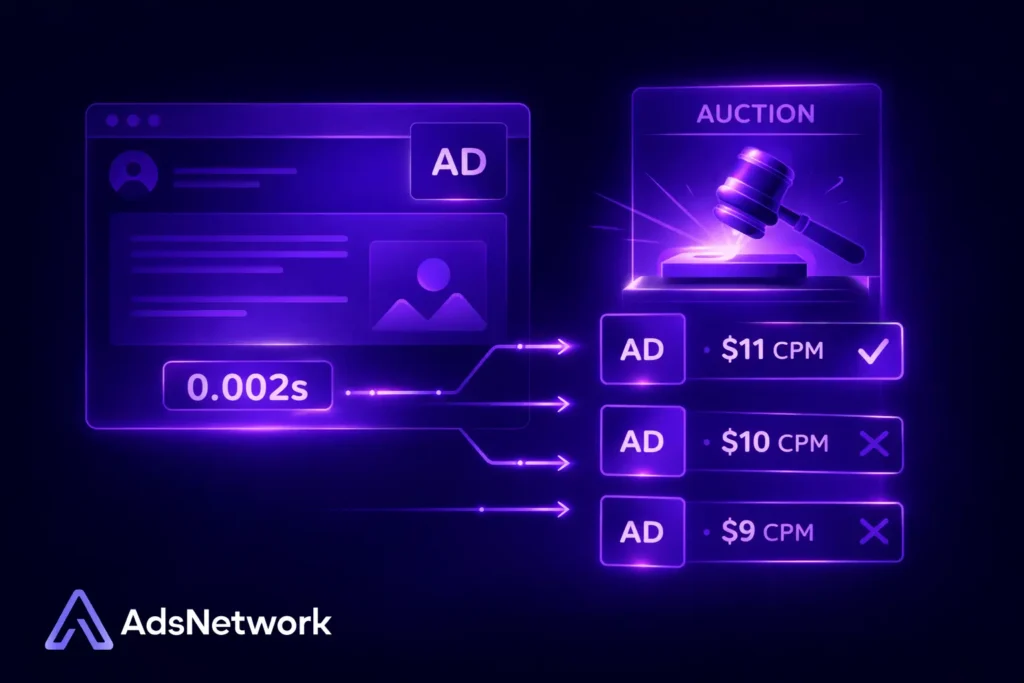
Programmatic advertising is the automated buying and selling of digital ad space. Instead of picking up the phone to negotiate a deal with a publisher, advertisers set targeting rules and budgets inside a platform. The software then finds the right audience, places the bid, and delivers the ad, all without human involvement in each transaction.
Before programmatic existed, buying ads meant lengthy back-and-forth with sales teams, fixed prices, and slow campaign launches. Programmatic changed that. Deals happen in milliseconds. Budgets go further. And campaigns can be adjusted in real time based on what the data shows.
Today, programmatic buying accounts for 88% of all digital ad impressions globally, according to Persistence Market Research. It has become the default mode for digital advertising, from mainstream brands to niche crypto communities.
The Core Components: DSPs, SSPs, and Ad Exchanges
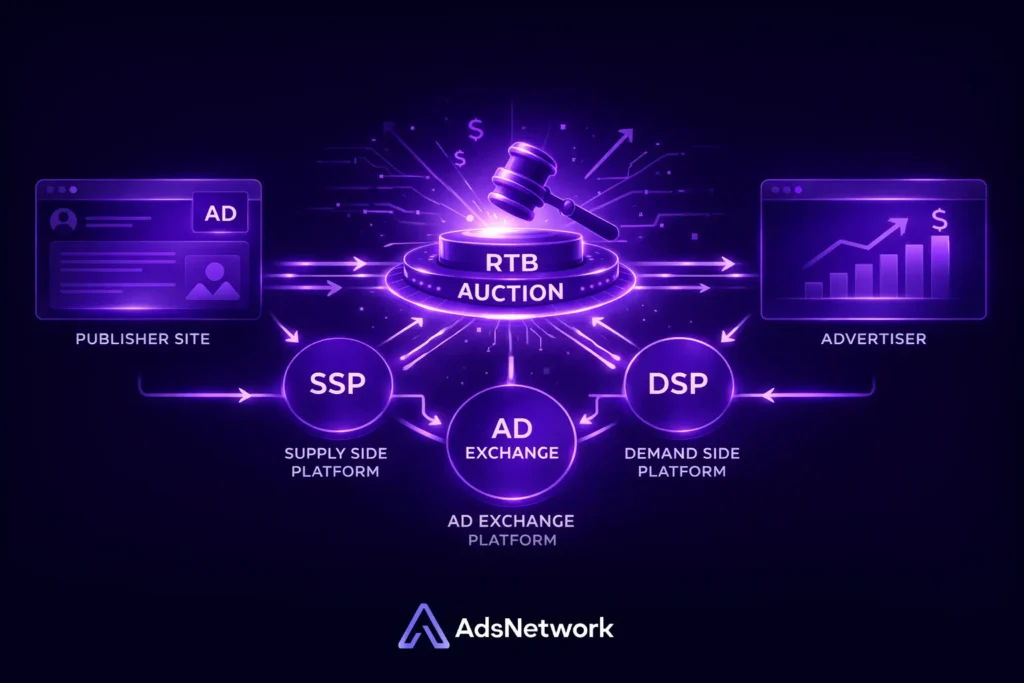
To understand how programmatic advertising works, you need to know the three main pieces of infrastructure that make it run.
Demand-Side Platforms (DSPs)
A DSP is the tool advertisers use. It lets you set targeting parameters, define your budget, and bid on ad impressions across thousands of sites and apps from one interface. The DSP connects to multiple ad exchanges and uses algorithms to decide which impressions are worth bidding on and how much to pay.
For Web3 projects, some DSPs go further. They support wallet-based targeting, allowing advertisers to reach users based on on-chain activity, like recent NFT purchases or DeFi protocol interactions.
Supply-Side Platforms (SSPs)
An SSP is the publisher’s counterpart. Publishers, think crypto news sites, Web3 communities, and blockchain-focused apps, connect their ad inventory to an SSP. The SSP then puts that inventory up for auction and helps maximize revenue by exposing it to as many potential buyers as possible.
Modern SSPs increasingly use header bidding instead of the older waterfall model. With header bidding, multiple buyers compete simultaneously for each impression rather than sequentially. That usually means higher revenue for publishers and better access to quality inventory for advertisers.
Ad Exchanges
The ad exchange is the marketplace where DSPs and SSPs meet. When a publisher’s SSP signals that an ad slot is available, the exchange runs an auction among competing DSPs in real time. The highest bidder wins and their ad appears on the page.
How Programmatic Advertising Works: The Real-Time Bidding Process
The most common way to buy programmatic inventory is through real-time bidding (RTB). Here is what happens the moment a user loads a webpage:
- The publisher’s SSP detects an available ad slot and sends a bid request to an ad exchange.
- The exchange forwards the request to connected DSPs, including data about the user and the placement.
- Each DSP evaluates the impression against its targeting rules and places a bid if there is a match.
- The exchange selects the winner, and the winning ad is served instantly to the user.
The entire process takes less than 100 milliseconds, completing before the page even finishes loading. RTB dominated programmatic in 2024 with a 42% market share across buying models, according to SNS Insider, underscoring how central auction-based buying has become.
Beyond open RTB, there are other buying models worth knowing:
- Private Marketplaces (PMPs): Invite-only auctions where select advertisers bid on premium, curated inventory. Good for brand-safe placements.
- Programmatic Guaranteed: A direct deal between advertiser and publisher, executed through programmatic pipes, with fixed pricing and guaranteed volume.
- Preferred Deals: Fixed-price, non-guaranteed access to a publisher’s inventory before it enters the open auction.
Why Programmatic Advertising Matters for Crypto and Web3 Projects
Crypto and Web3 marketing has a targeting problem. Your audience is global, technically sophisticated, and spread across thousands of forums, communities, and niche publications. Traditional media buying cannot reach them efficiently. Programmatic advertising can.
Here is why crypto teams are adopting programmatic at a fast rate:
Precision Targeting at Scale
Programmatic systems let you target users based on behavior, geography, device type, and context. For blockchain projects, advanced platforms add wallet-based signals, so you can reach users who have recently interacted with competing protocols or bought assets in your category. That level of precision is simply not available in traditional direct buys.
Real-Time Optimization
Campaign data flows in continuously. If one creative is underperforming, you can pause it and shift budget to better-performing variants without renegotiating a deal or waiting for a sales rep to respond. This matters a lot in crypto, where market conditions can shift within hours.
Broad Inventory Access
A well-configured DSP can serve ads across thousands of crypto sites, Web3 communities, fintech publishers, and mainstream sites, all from a single dashboard. You do not need separate relationships with each publisher. That dramatically reduces media ops overhead for lean crypto teams.
Transparent Reporting
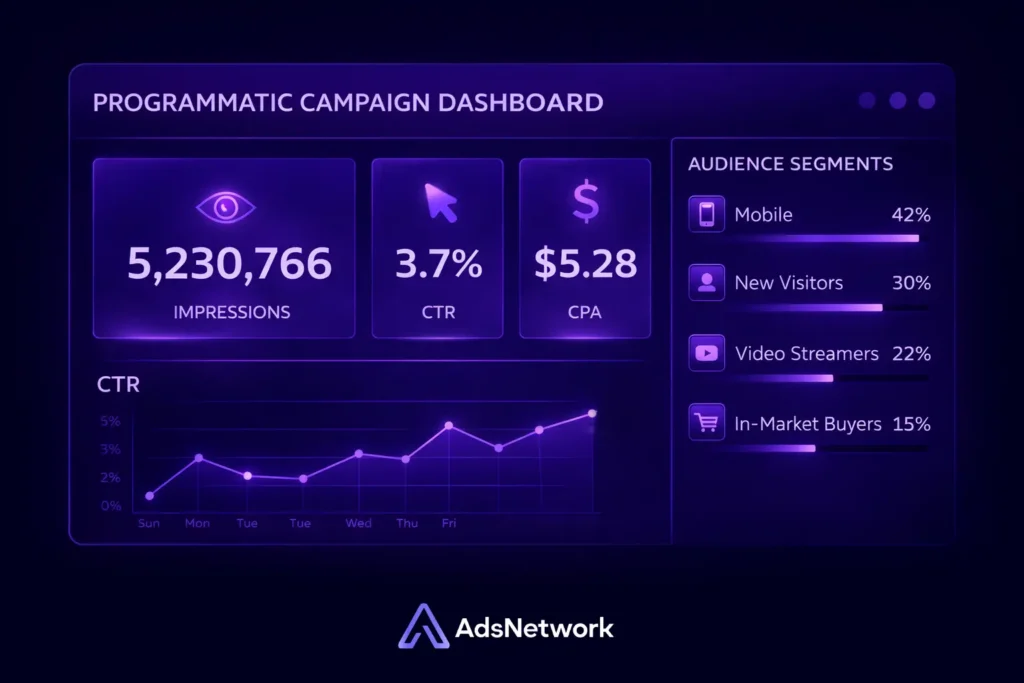
Programmatic platforms provide granular reports: impressions, clicks, conversion events, viewability rates, and more. For a sector where trust and transparency are core values, that accountability is a meaningful advantage over opaque, lump-sum ad buys.
A Real-World Example: How a DeFi Protocol Used Programmatic to Scale
Consider a mid-size DeFi lending protocol looking to grow its depositor base. The team had tried social media campaigns but found it difficult to reach high-intent users, those actively managing crypto portfolios rather than casual followers.
By switching to a crypto-focused programmatic setup, the team could target users who had recently visited staking platforms, interacted with competing protocols on-chain, or read yield farming content across publisher networks. Campaigns ran across premium crypto media inventory through private marketplace deals, ensuring brand-safe placements on trusted sites.
Because the DSP optimized bids in real time around cost-per-wallet-connect rather than cost-per-click, the team could track actual protocol engagement, not just traffic. That kind of outcome-focused optimization is only possible with programmatic infrastructure.
Platforms built for Web3 audiences, including AdsNetwork, give projects access to crypto-native inventory with built-in targeting for blockchain users. That means shorter setup times and audience data that is relevant from day one.
Common Programmatic Ad Formats
Programmatic advertising supports a wide range of formats. Choosing the right one depends on your campaign goal.
- Display banners: Standard image ads shown across publisher sites. Good for brand awareness and retargeting.
- Native ads: Ads that match the look and feel of the surrounding content. Higher engagement and lower friction for audiences unfamiliar with your project.
- Video ads: Pre-roll and mid-roll video placements. Strong for storytelling, token launch announcements, or protocol explainers.
- Mobile interstitials: Full-screen ads served in mobile apps. Mobile ads now account for over 63% of total programmatic impressions, per Persistence Market Research.
Programmatic Advertising and Data Privacy
Privacy regulation is reshaping how programmatic works. GDPR in Europe and CCPA in the United States have tightened rules on third-party data use. The industry is actively moving toward first-party data strategies and contextual targeting, where ads are matched to content rather than individual user profiles.
For Web3 advertisers, this shift actually creates an opportunity. On-chain data and wallet activity are owned by the user and disclosed voluntarily. Platforms that build targeting around these consent-native signals are ahead of the curve. Contextual placements on crypto-specific publishers also sidestep many privacy concerns entirely, since targeting is based on content relevance rather than personal tracking.
For publishers running crypto content, check out our guide on [INTERNAL LINK: Best CPM Ad Networks for Publishers in 2026] to see how programmatic inventory connects to monetization.
What to Look for When Choosing a Programmatic Platform
Not all DSPs are built for Web3. When evaluating platforms, prioritize these factors:
- Crypto and blockchain inventory access: Can the platform reach users on crypto news sites, DeFi dashboards, and Web3 communities?
- Audience targeting depth: Look for behavioral targeting, wallet-based segmentation, and contextual options.
- Transparency: Does the platform show you where ads ran, what they cost, and how they performed at the impression level?
- Fraud prevention: Automated systems can attract bot traffic. Choose platforms with built-in invalid traffic detection and third-party verification.
- Support for multiple buying models: Open RTB is a starting point, but access to PMPs and programmatic guaranteed gives you more control as campaigns mature.
If you are also evaluating paid social alongside programmatic, our [INTERNAL LINK: Best Advertising Networks for Crypto and Web3 Startups in 2026] covers the broader landscape.
Conclusion: Programmatic Advertising Is the Default for a Reason
Programmatic advertising is not a niche technical detail. It is the infrastructure behind most digital campaigns running today. For crypto and Web3 projects, it offers something especially valuable: the ability to reach highly specific, intent-driven audiences at scale, with full reporting and real-time control.
Whether you are launching a token, growing a DeFi protocol, or monetizing a Web3 publisher, understanding how programmatic advertising works puts you in a much stronger position. The mechanics are not complicated once you see the full picture. A user loads a page, a millisecond auction happens, and the most relevant ad wins. Everything else is optimization.
Ready to run your first programmatic campaign in the crypto space? Visit AdsNetwork at adsnetwork.io to explore crypto-native ad formats and get your Web3 project in front of the right audience.
FAQ: Programmatic Advertising for Beginners
What is the difference between programmatic advertising and traditional digital advertising?
Traditional digital advertising involves manual negotiations between advertisers and publishers, fixed pricing, and longer lead times to launch a campaign. Programmatic advertising automates the entire process. Targeting, bidding, and delivery are handled by software in real time, which means faster launches, more precise audience targeting, and campaign data that is available almost immediately.
Do I need a large budget to start with programmatic advertising?
No. Programmatic advertising works at many budget levels because you are bidding on individual impressions rather than buying fixed placements. Smaller budgets can still deliver results if targeting is tight and the creative is strong. Starting with a focused audience segment and a single ad format is often more effective than spreading a modest budget too thin across multiple channels at once.
Is programmatic advertising suitable for crypto and Web3 projects specifically?
Yes, and it is increasingly essential. Web3 audiences are fragmented across thousands of niche platforms, making broad traditional buys inefficient. Programmatic systems let crypto projects target users by behavior, content context, and in some cases on-chain signals. That precision is hard to replicate through any other paid media channel. Platforms built for the crypto ecosystem, like AdsNetwork, go further by providing inventory and targeting tools designed specifically for blockchain-native campaigns.
Ready to Get Started?
Launch your advertising campaign today and reach your target audience effectively.
Start Your CampaignAbout the Author
Hana Mori
Content specialist focused on digital advertising and marketing strategies. Passionate about helping businesses grow through data-driven campaigns.
Related Articles
Retargeting Ads Strategy That Converts
Somewhere between 96 and 98% of the people who visit your website leave without taking any action. They read a page, check a price, look at a product, and disappear. Standard digital advertising treats those people as lost. A strong retargeting ads strategy treats them as your warmest leads, because that is exactly what they […]
13 min read

How to Optimize Ad Campaigns for Maximum ROI
Most ad budgets do not disappear in one bad decision. They erode slowly, spread across campaigns that were never truly dialed in: audiences that are too broad, creative that went stale months ago, landing pages that convert at half the rate they should, and attribution models that hide where the real money is going. To […]
12 min read

How to Increase ROAS in Digital Advertising
Most campaigns do not fail because the product is wrong or the budget is too small. They fail because the return on ad spend never gets high enough to justify scaling. If you’re looking for ways to increase ROAS, it’s important to realise that low ROAS is not a budget problem. It is a signal […]
11 min read